Author: Anjana Devi

  • Your Threads Strategy Is Missing This One Thing (And Your Audit Will Prove It)

    Your Threads Strategy Is Missing This One Thing (And Your Audit Will Prove It)

    Here’s a quick question. When did you last post on Threads? If you had to think about it for more than three seconds, you already know something is off. Most SMB owners have the same Threads story. They signed up, posted a few times, noticed nothing much happened, and quietly moved on. The account exists. It just doesn’t do anything. The platform isn’t the problem. The strategy is.

    400M+
    Monthly active users by Aug 2025
    6.25%
    Median engagement rate, vs 3.6% on X
    127.8%
    YoY growth in daily active users through June 2025

    Threads crossed 400 million monthly active users by August 2025, up from 275 million just eight months earlier. Daily active users surpassed X on mobile for the first time in 2025. This is not a dying platform. This is a platform where most brands are simply showing up wrong. The thing they’re missing isn’t more content. It’s conversation.

    Threads Is Growing Fast – But Most Brands Are Treating It Like a Leftover

    When Threads launched in 2023, a lot of brands treated it as an Instagram overflow channel. Post the same content, same captions, same graphics. What happened, mostly, was nothing.

    Threads has its own tone, its own rhythm, and its own algorithm. Brands that mapped Instagram habits onto it found that polished graphics underperformed. Scheduled batches of promotional content got ignored. Follower counts crept upward without any meaningful engagement behind them.

    The platform rewards something that most social media workflows aren’t built to produce at all.

    Delphi, Bluekona AI mascot

    Most brands treat Threads like a party where they post a flyer on the door, stand in the corner checking their phone, and then wonder why nobody came over to talk. Showing up is not a strategy. Showing up and saying something is.

    The One Thing Most Threads Strategies Are Missing

    The missing piece isn’t a content calendar, a hashtag strategy, or better visuals. It’s replies. Specifically, replies per post – which the Threads algorithm weights more heavily than any other signal as of mid-2025, according to RecurPost and Metricool.

    The gap in plain terms – Most brands treat Threads like a broadcast channel. They post, move on, and check back in a week. The algorithm sees zero conversation activity and stops pushing the content beyond existing followers. The gap is not the quality of what you post. It’s what happens after.

    Why the Algorithm Weights Replies So Heavily

    By mid-2025, Meta shifted the For You feed toward a recommendation-driven model that surfaces content based on engagement signals, topic relevance, and conversation quality rather than follower count. This is significant for small brands. A brand with 500 followers can reach thousands of people if the conversation on their post is active enough.

    The flip side is equally true. A brand with 50,000 followers and a ghostly comment section will reach almost nobody outside their existing audience.

    What Brands Actually Get Wrong When They Show Up on Threads

    Beyond the reply issue, there’s a tone problem. Threads rewards candid, direct, slightly unpolished communication that feels like a person wrote it rather than a content team. Over-produced content and generic brand-voice copy underperform consistently.

    If you want to understand what hooks actually work in that first moment of attention, the same principle applies on Threads as anywhere else – read more in our breakdown of the first 3 seconds of a social media post.

    What doesn’t work

    Repurposed Instagram graphics, scheduled promotional captions, one-way announcements with no question or hook, link posts that push users off-platform.

    What works

    Direct opinions, industry observations, questions that invite pushback, behind-the-scenes text posts, replies to niche accounts with real audiences.

    Threads does not care how many times you posted this week. It cares how many conversations you started. There is a significant difference between those two things, and your reach will tell you exactly which one you have been doing.

    Delphi, Bluekona AI mascot

    What a Threads Audit Actually Reveals

    Most brands assume they know what they’re doing on Threads. The audit usually reveals something more honest, and occasionally more humbling. The gap between what you think your posting cadence looks like and what the data actually shows tends to be wide.

    If you’ve wondered whether an AI-powered audit is faster and more accurate than pulling the data yourself, we covered that comparison in depth in this breakdown of AI vs manual social media audits.

    Posting Cadence and Consistency Gaps

    The first thing an audit surfaces is your actual posting frequency versus what you remember posting. Most accounts think they post more often than they do. Significant gaps – sometimes weeks without activity – reset any momentum the algorithm had built. Consistency beats volume. Posting twice a week reliably outperforms ten posts in one week followed by three weeks of silence.

    Content Format Performance

    Threads supports text posts, photos, links, and videos. They don’t all perform equally. Most SMBs lean too heavily on link posts, which get the least traction because they ask users to leave the platform.

    Format Engagement Performance Reach Impact
    Photos Best performer 60% above text-only
    Text posts Solid Good when conversational
    Videos Variable Strong when short and native
    Link posts Lowest 37% below photos

    WebFX, 2025 Threads Marketing Benchmarks

    Reach vs Engagement Disconnect

    This is the finding that surprises people most. It’s possible to have a healthy engagement rate on Threads and still have flat or declining reach. Strong likes and reposts from existing followers keep your rate looking decent. But if nobody outside your circle is continuing conversations you started, the algorithm won’t push your content to new audiences. Reach growth on Threads requires outbound conversation activity, not just good content waiting to be noticed.

    Delphi, Bluekona AI mascot

    The audit does not lie. Your engagement rate looks fine because your existing followers are loyal. Your reach is flat because you have not talked to anyone new. Those are two very different problems, and only one of them shows up when you just check your notifications.

    What a Winning Threads Presence Looks Like for an SMB

    Tone and Voice – Personality Over Polish

    Threads users respond to content that sounds human. Shorter sentences, direct opinions, questions, observations, and the occasional take that invites pushback. You don’t need a design team or a videographer. You need a point of view and the willingness to express it. A local bakery posting “Sourdough starter that’s three years old hits different in winter. Anyone else notice this?” will outperform a branded promotional graphic every single time.

    The Reply Strategy That Expands Your Reach

    The most efficient thing you can do on Threads isn’t post more. It’s reply more. Reply to your own posts when people comment. Reply to posts from accounts in your niche. Start conversations in the replies of larger accounts whose audiences overlap with yours.

    The 15x reach multiplier – Companies that enable team members to engage with branded content on Threads see 10 to 15 times the organic reach of brand account posts alone, according to inBeat Agency’s 2026 research. Even solo founders who block 10 to 15 minutes daily for Threads replies – not posting, just responding – tend to see measurable reach growth within two to three weeks.

    Cross-Platform Leverage From Your Instagram and Facebook Presence

    If you already have an active Instagram or Facebook account, Threads has a structural advantage built in. Meta’s ecosystem makes cross-promotion between platforms easier than anywhere else. Your existing audience can follow you on Threads with minimal friction, and Meta’s infrastructure treats activity across all its platforms as connected signals.

    For SMBs that have spent years building a Facebook or Instagram following, Threads is one of the highest-leverage organic platforms available right now. The foundational work is already done. You can see how this connects to a broader cross-platform approach in our Facebook Business Page audit guide, which covers what cross-platform data reveals when you audit together rather than in silos.

    How to Use Your Audit Results to Fix It

    A complete Threads audit should surface five things. Your posting frequency and consistency over the past 90 days. Your content format breakdown and how each format performs for your specific account. Your average engagement rate versus platform benchmarks. Your reply rate when people engage with you. And how your reach has trended over time.

    From there, the fix is straightforward. Inconsistent posting? Set a minimum of two posts per week and hold it before adding more. Link posts dragging engagement down? Replace them with photos or plain-text observations. Reply rate near zero? Block fifteen minutes a day for engagement only – no posting, just responding.

    Once you know which content formats are working on Threads, the next step is to build those formats into a repurposing workflow so the same insight can work across your other platforms. Our guide on measuring the ROI of content repurposing walks through how to connect those dots, and our social search strategy and repurposing workflows post shows what that looks like in practice.

    Act before the window closes – Meta launched Threads ads globally in January 2026. When platforms move from growth to monetization, organic reach tightens in the months that follow. Brands with strong engagement signals baked in now will hold their reach better than those who wait. The window is still open. It won’t stay that way.

    BluekonaAI runs cross-platform audits across Threads, Instagram, Facebook, and YouTube, surfacing your actual cadence gaps, format performance, and reach trends in minutes.
  • Social Media A/B Testing Without a Budget: How to Run Organic Content Experiments That Actually Teach You Something

    Social Media A/B Testing Without a Budget: How to Run Organic Content Experiments That Actually Teach You Something

    Most teams assume A/B testing belongs in the paid ads world. And honestly, that assumption makes sense. Paid gives you a clean split. Two versions, two audience groups, one clear winner. Organic social does not work that way. You cannot divide your audience. You cannot post two versions at the same time and measure them side by side.

    So most content teams skip experiments entirely and go with gut feel instead.

    That is where growth stalls.

    You do not need a paid budget to run meaningful content experiments. You need a system. And right now, most of your competitors are running without one. They post, check the numbers, feel okay or a little disappointed, and move on. No written hypothesis. No experiment log. Nothing changes next time because of what happened last time.

    This guide walks you through a practical framework for running organic social media A/B tests that give you real, repeatable lessons. Not hunches. Actual insights that compound into a content advantage over time.

    Why Most Organic Teams Never Actually Learn

    The irony of social media is that you are already swimming in data. Every platform gives you reach, impressions, saves, shares, watch time, and click-through rate. You are not short on numbers.

    What most teams are short on is a structure for turning those numbers into conclusions.

    When you post a video, check the views, notice it did well, and try to “do more of that” next week without understanding what specifically worked, you are not learning. You are hoping the same unknowable combination of factors lines up again on its own.

    Real learning needs a before-and-after comparison where only one thing changed. Without that, every result is ambiguous. Your Reel got 80% more reach this week. Was it the hook? The format? The audio? The fact that you posted on a Wednesday instead of Monday? The algorithm having a generous day?

    You will never know. And that is the whole problem. Check out our article on the problem with social media metrics to understand why this blind spot costs most teams more than they realise.

    The One Rule That Makes or Breaks Every Experiment

    Change exactly one thing at a time.

    That is the whole rule. Everything else in your testing process builds on this single idea.

    If you change your hook, your format, your posting time, and your caption length all in the same post, and that post performs well, you have a data point but no lesson. You cannot untangle what drove the result. You are right back to guessing.

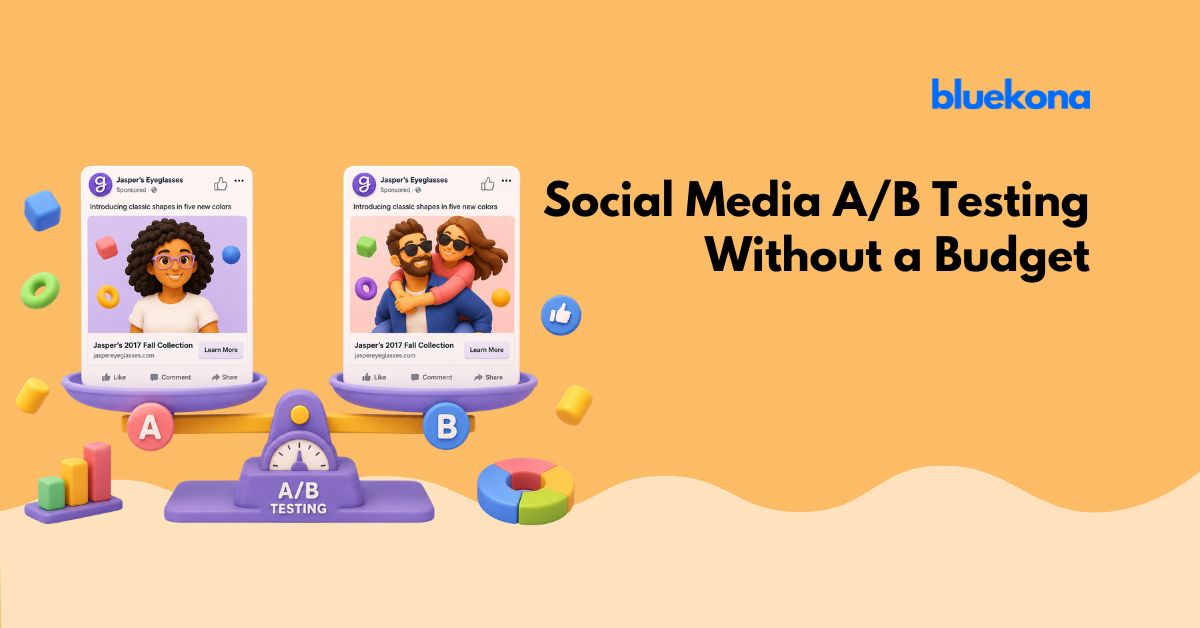
    The discipline of organic A/B testing is picking one variable, keeping everything else the same, and comparing the results over a consistent time window. It feels slow. It is the only method that actually tells you what is working and why.

    Delphi, Bluekona AI mascot

    Changing your hook, your format, your caption length and your posting time in the same test is not an experiment. That is just chaos with a content calendar.

    What to Test First (and What to Leave for Later)

    Not all variables are worth your time equally. Some have a massive impact on whether your content gets seen at all. Others are marginal adjustments. Here is where to focus first, and what to come back to once you have the big stuff dialled in.

    Start Here

    Hook or Opening Line

    The first sentence of your caption, the first frame of your video, or the headline on a static post. This is the highest-leverage variable across almost every platform. A weak hook kills reach before the algorithm has a chance to push the content anywhere.

    Start Here

    Content Format

    Carousel versus single image versus Reel versus text post. Format sends a major signal to platform algorithms and shapes how your audience consumes and shares content. Test the same topic in different formats to isolate what the format itself is contributing to your results.

    Next

    Call to Action Wording

    The specific words and placement of your CTA drive comments, saves, and shares, which all feed the algorithm. Small wording changes produce surprisingly large differences. Test “Save this for later” against “Which tip was most useful to you?” and you will likely see a real gap.

    Next

    Posting Time and Day

    When your audience is online and in what mindset matters more than most people think. Test the same content type at different times to find your actual peak windows, not the generic “best times to post” guides that have nothing to do with your specific audience.

    Later

    Caption Length

    Short and punchy versus long-form and contextual. Platform and audience both shape which performs better. The only way to know what your specific audience prefers is to test it directly on your own account, not by following generic platform advice.

    Later

    Thumbnail or Cover Image

    On YouTube and TikTok especially, the cover frame or thumbnail determines whether anyone clicks or watches in the first place. If video is your primary format, move this variable higher on your testing list. It is one of the most direct levers for improving click-through rate.

    How to Run the Experiment Step by Step

    Here is the process that separates teams who accumulate real content knowledge from teams who are still guessing after two years of posting.

    • 1
      Write a hypothesis before you post anything. Do not reverse-engineer a story after the results come in. Write it down first. Something like “I believe a question-based hook will generate more comments than a statement hook on our LinkedIn posts about analytics, because it prompts the reader to give a direct response.” This forces clarity and makes your results actually interpretable.
    • 2
      Create two versions of the post and change only one variable. Write Version A and Version B. Keep the topic, format, visual style, posting time, and hashtags identical. The only thing that changes is your test variable. If you are testing hooks, the rest of the caption must stay exactly the same in both versions.
    • 3
      Post them in the same week on different days. Post Version A on Tuesday, then Version B on the following Tuesday. Same time of day, same platform, same week of the month. You cannot post both simultaneously on organic, so this staggered approach is your best approximation of a controlled comparison.
    • 4
      Measure the right metric for the variable you are testing. Match your measurement to your test. Testing a CTA? Measure comments and saves. Testing a hook? Measure early reach and the percentage of people who watched past the first three seconds. Testing format? Look at shares and profile visits. Using one vanity metric for everything will give you misleading conclusions.
    • 5
      Log the result as a win, a loss, or inconclusive. Keep a simple experiment log. Record what you tested, the hypothesis, the result for each version, and your conclusion. A basic spreadsheet works. The log is the real asset here. It is what turns a collection of individual tests into compounding institutional knowledge about your audience.
    • 6
      Run the same test at least three times before drawing conclusions. One test is a data point. Three tests are a pattern. If question-based hooks outperform statement hooks in three out of three tests, you have a finding worth acting on. If results split two to one, keep testing. Do not build strategy on a single result.

    Which Metrics to Track on Each Platform

    One of the most common testing mistakes is measuring the wrong thing. A post can have high reach and zero engagement. Another can have low reach and very high saves. Which one won? It depends entirely on what you were testing for.

    Match your measurement to your variable every single time. Here is a quick breakdown of which metrics signal real performance on each platform, as opposed to the vanity numbers that look good but tell you nothing useful.

    On Instagram, saves and shares carry the most algorithmic weight. Reach from people who do not follow you yet is a signal that the algorithm is actively pushing your content beyond your existing base. Likes are the weakest indicator by far and should be the last thing you optimise for.

    On LinkedIn, comments and reposts are what drive reach. Impressions from outside your network tell you the content is breaking through into new audiences. Reactions matter far less than the volume and quality of comments you generate. See our breakdown of LinkedIn content strategy for more context on what the algorithm rewards.

    On TikTok, watch time percentage and rewatch rate are the metrics that matter most. A high view count with low average watch time means people are clicking away fast. That is a negative signal regardless of how impressive the raw number looks in your dashboard.

    On YouTube, click-through rate on your thumbnail and title combined with average view duration explains most of your algorithmic performance. High CTR with low view duration is a signal your title over-promised what the video actually delivered.

    On Facebook, shares and link clicks matter most for organic reach. Track your organic reach per post as a percentage of your total follower count. If that ratio is shrinking month over month, your content is losing relevance with the algorithm. Our guide on Facebook metrics that actually matter in 2026 goes deeper on this.

    On Threads, replies and quote posts are the strongest signals. Reshares tell you people found the content worth amplifying to their own networks. Like counts on Threads are almost meaningless as a performance indicator and should be ignored when evaluating your tests. And if you want to understand how dwell time quietly shapes your reach, that applies across all of these platforms too.

    Likes are the participation trophy of social media. Nice to receive. They will not tell you a single useful thing about whether your content is actually working.

    Delphi, Bluekona AI mascot

    Building a Quarterly Learning Loop

    Individual tests are useful. A system of tests over time is a growth engine.

    The difference is compounding. Each experiment builds on the last. After a quarter of structured testing, you stop asking “what should we post this week?” and start asking “based on what we already know works, what should we test next?” That shift changes how your whole content operation runs.

    Here is a simple quarterly loop that works for SMBs and agencies of any size.

    In Month 1, run four to six hook experiments on your two most active platforms. By the end of the month you should know with real confidence which hook styles drive the most early engagement for your specific audience, not for someone else’s audience in a different niche.

    In Month 2, run four to six format experiments, applying your winning hook style from Month 1. You are now stacking knowledge. You have already optimised the opening line. Now you are testing what structure and format perform best on top of that foundation. See our piece on why manual audits waste your time for how automation can accelerate this part of the process.

    In Month 3, test CTA wording and posting time. By this point your content is already stronger from two rounds of experiments. The smaller optimisations compound on a better base and produce a bigger result than they would have at the start.

    At the end of the quarter, review your experiment log and write a short summary of what you found. This becomes your actual content strategy for the next quarter. Not a mood board. Not a trend report. An evidence-based plan built entirely on what you know works for your audience.

    Mistakes That Make Your Tests Useless

    Testing too many variables at once. Already mentioned, worth repeating one more time. One variable per test. Every single time. No exceptions.

    Pulling results too early. Organic content needs time to distribute and find its audience. Do not compare a two-day-old post to a seven-day-old post. Set a consistent measurement window of five to seven days and apply it to every experiment you run, every time.

    Treating outliers as strategy. A post that goes semi-viral will skew your data. Note it in your log, celebrate it, and then set it aside when drawing conclusions. Do not rebuild your entire content approach around one anomaly that you may never be able to replicate.

    Missing the external context. A post that underperforms during a major news cycle or platform outage is not failing because of your content. Log what was happening alongside your results. That context becomes important when you review your data later and need to explain why a particular test week looks different from the rest.

    Comparing across different audience sizes. If your account grew significantly between Version A and Version B, you are not running a fair comparison. You are measuring two different audience pools. Flag large growth jumps in your experiment log and treat those results with appropriate caution.

    The Compounding Advantage

    Most of your competitors are not doing this.

    They are posting based on what worked for someone else, in a different niche, with a different audience, six months ago. They are copying trending formats without checking whether those formats actually convert for their specific followers. And when something underperforms, they shrug and move on without a single lesson to show for it.

    When you have six months of structured organic experiments behind you, you have something no competitor can copy. Tested, validated knowledge about what works for your audience, on your platforms, in your category. Because every experiment builds on the last, the knowledge gap between you and teams that are still guessing keeps getting wider every single week.

    The brands that win on organic social over the long term are not always the ones with the biggest teams or the most creative instincts. They are the ones who learn faster. Structured A/B testing on organic content is exactly how you build that learning advantage, without spending a cent on ads. If you want to see how this applies to a specific brand playbook, our breakdown of scaling social media strategy with AI is a good place to go next.

    Delphi, Bluekona AI mascot

    Your competitors are still posting on vibes. You are posting on evidence. That is not a small edge. That is the whole game.

    Bluekona AI gives you cross-platform analytics, automated content audits, and actionable insights across every platform in one place, so your experiment log practically writes itself.

  • Social Commerce: How to Turn Followers into Buyers Without Paid Ads

    Social Commerce: How to Turn Followers into Buyers Without Paid Ads

    Social commerce is now a $2.6 trillion global market. And a big chunk of that money is moving through organic content, not paid ads.

    That might surprise you. We have spent years being told that if you want to sell on social media, you need to pay to play. Boost posts. Run retargeting campaigns. Spend money to make money.

    But something shifted. People started trusting ads less and trusting people more. Real customers showing off real products in their real lives started converting better than any polished campaign. And the platforms themselves built tools that let buyers complete a purchase without ever leaving the app.

    In 2026, the most effective social commerce strategies do not always come with an ad invoice attached. This guide walks you through exactly how to build one.

    What Social Commerce Actually Means?

    Social commerce is not just a “Shop Now” button on a post.

    It has grown into a full buying experience that lives inside social platforms. We are talking about product tags in Reels, live shopping streams on Instagram and YouTube, DM-based checkout conversations, shoppable Stories, pinned posts with direct purchase links, and community spaces where people ask for product recommendations and get them within minutes.

    In 2026, the line between scrolling and shopping is nearly invisible. Consumers are not jumping out of Instagram to visit your website. They are discovering, researching, and buying without ever leaving the app. Instagram’s native search function now processes an estimated 1.2 billion product-related queries every single month. People are using social platforms the way they used to use Google Shopping.

    This is a massive opportunity for brands willing to show up consistently and build real trust before asking for the sale.

    Delphi, Bluekona AI mascot

    The ocean does not advertise itself and yet everything comes to it. Be the ocean. Or at least, be the brand that acts like one.

    The Organic Path from Follower to Buyer

    Think of organic social commerce as a three-stage journey.

    Stage 1 is Awareness. This is where someone discovers you for the first time. Short-form video is king here. A Reel, a YouTube Short, a TikTok that catches someone mid-scroll and makes them stop. They do not know you yet. They are just curious.

    Stage 2 is Consideration. Now they are checking you out. They visit your profile, scroll your feed, watch a few more videos, maybe read some comments. This is where carousels, how-to posts, tutorials, and customer stories do the heavy lifting. You are answering the question “can I trust this brand?”

    Stage 3 is Conversion. This is where a DM, a pinned post, a testimonial video, or a live shopping session tips them over the edge. They are ready to buy. Your job is to make it easy.

    Most brands invest everything in Stage 1 and forget Stages 2 and 3 even exist. That is where followers pile up and sales do not.

    Platform by Platform — Where to Focus Your Organic Effort

    Not every platform works the same way for social commerce. Different platforms attract different buyers, support different content formats, and convert at different points in the purchase journey.

    Platform Best For Top Organic Format Native Commerce Feature Conversion Stage
    Instagram Discovery + impulse buying Reels, Carousels, Stories Instagram Shop, product tags, link stickers Awareness + Conversion
    TikTok Viral discovery, Gen Z audience Short-form video, live streams TikTok Shop, live shopping, product showcase Awareness + Conversion
    YouTube Deep trust, high-value purchases Long-form reviews, tutorials, Shorts Shopping shelf, product links in description Consideration + Conversion
    Facebook Community-led selling, 35+ audience Groups, live video, Marketplace listings Facebook Shop, Marketplace, group buy features Consideration + Conversion
    Threads Conversational selling, brand voice Text posts, authentic commentary No native commerce yet — bio link driven Awareness (Early)

    The short version: Instagram and TikTok are your best bets for discovery and impulse buying. YouTube builds the deep trust that leads to considered purchases. Facebook still converts well for community-driven sales and slightly older audiences. Threads is early but worth testing for direct, conversational selling that feels genuinely unfiltered.

    The Content Types That Actually Drive Purchase Intent

    Not all content is created equal when it comes to selling. Here are the formats that consistently move people from “interested” to “I want this.”

    User-generated content is the single most powerful purchase driver on social right now. A real customer showing your product in their actual life beats any polished brand video. 74% of shoppers convert from UGC in 2026. Repost it, highlight it, celebrate it. Make your customers feel like stars and they will keep making content for you.

    Tutorials and how-to content work because they answer the question “but will it actually work for me?” When someone watches a video of your product solving their exact problem, the sale is basically already made.

    Before and after posts are simple and effective. Show the transformation. Let the result do the talking. This format works especially well in beauty, fitness, home, and food.

    Founder-led content builds trust faster than almost anything else. When the person behind the brand shows up authentically, people feel like they know you. And people buy from people they feel they know.

    Live shopping streams are growing fast across every platform. They combine entertainment, urgency, and direct purchase in one place. Brands that do live shopping well are seeing conversion rates that paid ads can only dream about.

    Testimonials in video format hit differently than a star rating. Put a real person on camera talking about why they love what you make and watch what happens.

    Why Most Brands Lose Buyers Before the Sale

    You can have great content and still miss the sale. Here are the most common places brands lose buyers mid-funnel.

    No clear next step. You made someone interested and then gave them nothing to do with that interest. Every post designed to convert needs one clear, simple action. Not five options. One.

    A confusing bio link setup. Your bio link is prime real estate. If someone has to click three times to find the product they just saw in your Reel, you have lost them. One fast, frictionless link to exactly what you are showing is what works.

    Inconsistent posting. Trust is built through repetition. If someone discovers you on Monday and your last post was six weeks ago, they move on. Consistency signals you are an active, real business worth buying from.

    Ignoring DMs. A huge amount of social commerce happens through direct messages. Someone asks “do you ship to Canada?” and gets no reply for three days. Sale gone. Treat your DMs like a live checkout counter.

    Skipping the follow-up. Someone saved your post. Someone clicked your bio link but did not buy. Someone DM’d you and then went quiet. A gentle follow-up through Stories, a reply, or a DM check-in often closes the sale that almost happened.

    How to Use Analytics to Find Content That Is Already Driving Sales

    Here is something most brands overlook completely. You probably already have content that is generating real purchase intent right now. You just cannot see it because you are looking at likes and impressions instead of the signals that actually matter.

    The metrics that tell you a post is close to driving a sale are profile visits after a post goes live, bio link clicks, DM volume following specific content, saves and shares rather than just likes, and story link taps.

    When a post causes a spike in profile visits and bio link clicks in the same 24-hour window, that is a buying signal. That person wanted to know more. They were considering a purchase.

    When you can see which content formats, topics, and posting times generate these signals consistently, you stop guessing and start scaling what works. Brands that optimized their Instagram content based on these signals reported a 47% increase in organic product page visits compared to brands that did not.

    This kind of clarity is exactly what a proper social media audit surfaces. Not vanity metrics. The real content behaviors that connect to actual sales.

    Delphi, Bluekona AI mascot

    Likes are applause. Link clicks are people reaching for their wallets. Know the difference. Track the difference. Act on the difference.

    Real Brands Getting Organic Social Commerce Right

    Glossier built a $1.8 billion brand almost entirely on community and user-generated content. Their Instagram still looks more like a fan account than a corporate brand page, and that is entirely the point. Real people, real skin, real results. Their #maskforce campaign invited actual customers to share photos wearing their products, turning every buyer into a brand ambassador. Followers trusted Glossier because Glossier always looked and felt like one of them.

    Rhode Skin (Hailey Bieber’s brand) grew through organic content during its early phase. Minimal editing, founder-led videos, authentic storytelling. The product sold itself because the content made people feel like they were in on something real. Rhode went from launch to billion-dollar valuation with a strategy rooted in genuine community building rather than paid promotion.

    Gymshark is a masterclass in community-first selling. They did not start by selling workout gear. They started by selling a sense of belonging to people who took fitness seriously. Their organic content created a movement, and that movement converted buyers at a scale most brands only achieve through heavy ad spend.

    The common thread across all three? Trust came before the transaction. Their followers felt like fans before they became customers. And fans convert at a completely different rate than cold ad traffic.

    Where Bluekona Fits Into Your Social Commerce Strategy

    Running a full content audit across multiple platforms is genuinely painful if you are doing it manually. You are switching between dashboards, downloading data, and trying to connect dots that live in five different places. Most brands either skip the audit entirely or do it once a year when it is already too late to act on what they find.

    Bluekona pulls all of that together in minutes. You connect your accounts, and you immediately get a clear picture of which content is driving real engagement, which formats your specific audience responds to, and which posts are generating the signals that lead to purchases.

    For social commerce specifically, this means you can find your best-performing content fast, understand what is making people take action, spot the gaps in your funnel before they cost you more sales, and build a content strategy based on your actual data rather than assumptions.

    You do not need to post more. You need to post smarter. Bluekona shows you what smarter looks like for your audience.

    Delphi, Bluekona AI mascot

    I navigate the entire ocean by reading the currents. You have got the data. Use it. Stop swimming in circles.

    Start Turning Followers into Buyers This Week

    Organic social commerce is not a secret hack or a shortcut. It is what happens when you show up consistently with content that builds trust, answers real questions, and makes buying feel like a natural next step rather than a hard sell.

    You do not need a big ad budget to make it work. You need clarity on what your audience actually responds to, a content rhythm that moves people through the funnel, and the right tools to tell you what is working and what is not.

    Run a free Bluekona audit to see which of your posts are already driving purchase intent and what is holding the rest back. Your buyers are already following you. Let us help you bring them the rest of the way.

  • Stop Spying, Start Learning: A Better Way to Use Meta Ad Library

    Stop Spying, Start Learning: A Better Way to Use Meta Ad Library

    Here’s what usually happens. A marketer opens Meta Ad Library, searches a competitor, finds an ad that looks polished, screenshots it, and tries to rebuild it with their own logo. Then they wonder why the results don’t match.

    The problem isn’t the tool. The problem is the approach. Competitor research was never supposed to be a shortcut to creative work. It’s meant to help you understand the market, not replace thinking about your audience.

    The goal of looking at competitor ads isn’t replication. It’s understanding. And those are very different things.

    Copying a competitor’s ad is like wearing someone else’s outfit to a first date. Sure, it might look good on them. But it’s not you, and your audience can tell.

    Delphi, Bluekona AI mascot

    What Is the Meta Ad Library

    Meta Ad Library is a free, publicly accessible database of ads running across Facebook, Instagram, Messenger, and Threads. No account needed. You can search any brand name or keyword and immediately see what ads are currently live.

    It was originally built for ad transparency, but it has quietly become one of the most useful market research tools available to anyone running paid or organic social media. You can view ad creatives, read the copy, see how long an ad has been running, and in some cases check regional targeting details.

    What you cannot see is performance data. No click-through rates. No conversion numbers. No engagement metrics. Just the ad itself, which means interpretation is entirely on you.

    What Competitor Ads Actually Reveal

    When you stop looking for ads to copy and start looking for patterns to learn from, the Meta Ad Library becomes genuinely useful. Here’s what’s actually in there if you look at it the right way.

    01
    Market Positioning
    How brands in your space describe themselves and what they want to be known for. The words they keep using tell you a lot about how the category talks about itself.
    02
    Customer Pain Points
    The problems brands keep returning to, because those are the ones their customers care about most. Repetition across multiple brands signals a real, shared frustration.
    03
    Common Offers
    What incentives dominate the category, from free trials to percentage discounts to lead magnets. Seeing the same offer everywhere tells you what the market expects.
    04
    Content Trends
    Whether the market is leaning into UGC, founder video, carousels, or static image ads right now. Format trends move fast and competitor research catches them early.
    05
    Seasonal Priorities
    What brands push at different times of year and where the gaps in the calendar tend to appear. Knowing the rhythm helps you plan ahead instead of reacting.
    💡
    Keep in mind
    Patterns beat individual ads every time
    None of this tells you what will work for your audience. But it tells you what the market conversation looks like right now, which is valuable context before you make any creative decisions.

    A Practical Meta Ad Library Research Process

    If you want to use the tool well, slow down and be systematic about it. A few searches and screenshots won’t teach you much. Pattern recognition takes a little more time.

    1. Search your direct competitors

    Look at what’s actively running, what themes appear more than once, and whether their messaging feels consistent or scattered.

    2. Search by industry keywords

    Try terms like “fitness coaching” or “accounting software” instead of just brand names. This shows you broader market trends beyond your direct competition.

    3. Look for patterns, not individual ads

    Ask yourself which problems appear repeatedly, which offers everyone is pushing, what emotional angles come up most often, and what formats are everywhere right now.

    One ad is a creative choice. Ten ads with the same hook are market data. That’s what you’re actually looking for.

    Delphi, Bluekona AI mascot

    What To Analyze Beyond the Ad Itself

    Most marketers only look at the creative. But there’s more information available if you’re willing to dig one layer deeper.

    Ad longevity matters a lot. If a brand has been running the same ad for six months, that’s usually a signal it’s performing well. Profitable ads don’t get turned off. So when you see something that’s been live for a long time, that’s not laziness, that’s a strong indicator of a proven message.

    Creative format tells you something too. Is the market full of polished product videos? Founder-led talking head clips? UGC-style testimonials? The format that dominates often reflects what the audience in that category is most comfortable with, which is useful to know before you decide what to make.

    Don’t forget to check the landing page. A lot of the real insight comes after the click. What’s the headline promising? What’s the CTA asking for? Is there a clear offer or just a brand story? The full funnel picture is often more revealing than the ad creative alone.

    If you see a brand running five or six variations of the same ad with slightly different headlines or visuals, that tells you they’re actively testing. Which means they haven’t figured it out yet either.

    The Limitation Most Marketers Ignore

    Here’s what Meta Ad Library actually shows you, and what it doesn’t.

    Shows What Meta Ad Library tells you
    What competitors are publishing
    How long an ad has been running
    Creative formats in use
    Copy and messaging angles
    Does not show What it leaves out
    Audience preferences
    Engagement quality
    Brand perception
    Community response
    What actually converts

    This creates a dangerous assumption that a lot of marketers fall into without realizing it. If a competitor is running an ad, it must be working. Not necessarily. They might be testing something new. They might be burning budget on a campaign that isn’t converting. You have no way to know.

    You can see what they’re saying. You can’t see if anyone’s actually listening. That’s a pretty important gap.

    Delphi, Bluekona AI mascot

    Why Competitor Research Alone Creates Bad Strategy

    When everyone in a category is watching everyone else and copying what looks successful, something predictable happens. Everything starts to look the same. The same hooks. The same offers. The same creative formats. The same emotional triggers.

    This is how markets get saturated with generic content that nobody actually connects with. Everyone is optimizing toward the average, which means nobody is standing out.

    If your entire strategy is built on watching what competitors are doing, you will always be one step behind and you will never say anything that feels original to your audience. You end up competing on execution in a space where everyone is executing the same playbook.

    Competitor research shows you what the market is already saying. It doesn’t tell you what your audience actually wants to hear. That requires a different kind of intelligence altogether.

    Competitor Intelligence vs Audience Intelligence

    These two things solve different problems, and understanding that distinction is what separates brands that are just keeping up with the market from brands that are actually building something.

    Competitor Intelligence answers
    What is the market saying right now
    Which offers are common in the category
    What creative formats are popular
    Where the obvious gaps in positioning are
    Audience Intelligence answers
    What your specific audience actually cares about
    Which content drives real engagement
    What topics consistently build trust
    What sparks conversation and builds community

    Both are valuable. The problem is when brands treat the first as a substitute for the second. Knowing what the market is saying is only useful if you also know what your audience is listening for.

    Where Bluekona Fits Into This

    Meta Ad Library tells you what’s happening in the market. Bluekona tells you what’s happening with your audience. And that second part is where most of the real decisions actually get made.

    Bluekona helps you understand which topics your audience engages with, what content consistently performs across your channels, and which themes are building genuine interest over time rather than just getting seen once and forgotten.

    When you’re looking at engagement patterns, you start to see things that competitor research can never show you. What drives people to comment. What gets shared. What kind of content makes someone stop scrolling long enough to actually read something. What builds a community rather than just an audience.

    This is also where you can validate ideas before spending real budget on them. Competitor research might surface an idea worth exploring. Bluekona helps you figure out whether that idea actually resonates with your people before you invest in building it out.

    The Best Competitive Research Workflow

    The most effective approach isn’t choosing one over the other. It’s being clear about what each one is actually for and using them together as a full picture rather than treating either as the whole answer.

    Step 1
    Use Meta Ad Library to understand
    Market trends
    How competitors are positioning themselves
    What offers are common in your category
    Which creative formats are dominating right now
    Step 2
    Use Bluekona to understand
    Your audience’s actual interests
    Which content themes perform best for you specifically
    Engagement patterns that show what builds real community
    Whether ideas from market research will land with your people

    Together they give you something that neither can offer on its own: a clear picture of what the market is doing and a clear picture of whether any of it applies to you. That combination is where smarter marketing decisions come from.

    The brands that win aren’t the ones with the best eye for copying. They’re the ones who learn from the market and build around their audience. Market intelligence tells you where the opportunities are. Audience intelligence tells you which ones are actually worth pursuing.

    Frequently Asked Questions

    Is the Meta Ad Library free to use?

    Yes. Anyone can access it without creating a Meta account. Just go to the library, search a brand name or keyword, and the active ads will show up.

    Can I see competitor Facebook and Instagram ads?

    Yes. The Meta Ad Library shows active ads from any brand running campaigns across Facebook, Instagram, Messenger, and Threads.

    Does Meta Ad Library show ad performance?

    No. It does not provide engagement data, click-through rates, or conversion information. You can see the ad creative and how long it has been running, but not how it is actually performing.

    Should I copy competitor ads?

    No. Use competitor ads to understand market trends and patterns. Copying creative directly puts you in a reactive position and tells you nothing about whether it will work for your specific audience.

    How does Bluekona complement Meta Ad Library research?

    Meta Ad Library gives you market intelligence, showing you what competitors are publishing and what patterns exist across the category. Bluekona gives you audience intelligence, showing you what your specific community engages with, what content performs, and which ideas are worth pursuing before you put budget behind them.

    Don’t stop at competitor research

    Understanding what the market is doing is a starting point, not a strategy. Find out what your audience actually cares about and build from there.

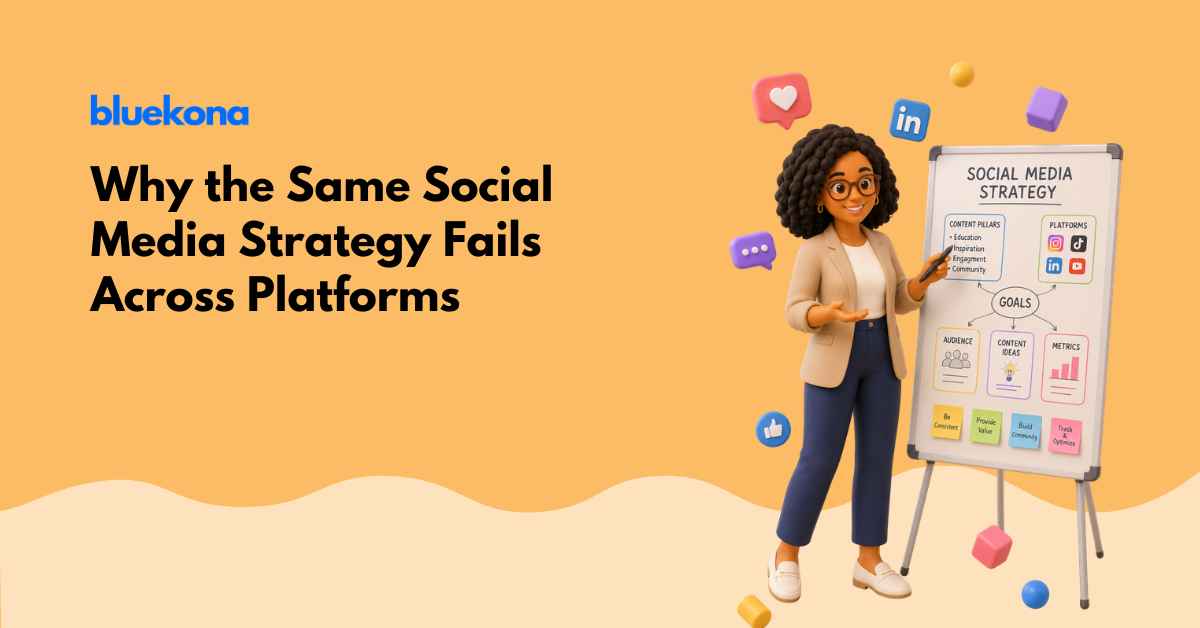
  • Why the Same Social Media Strategy Fails Across Platforms

    Why the Same Social Media Strategy Fails Across Platforms

    Most brands do not actually have a content problem. What they have is a mismatch problem. The same post goes out on LinkedIn, Instagram, TikTok, Facebook and YouTube, all on the same day, all looking the same. Then everyone sits around wondering why one platform brings results and the rest bring silence.

    Here is the simple truth. Different people use different platforms for different reasons. A teenager scrolling TikTok on a Tuesday night is not in the same headspace as a manager researching software on YouTube during lunch. A founder checking LinkedIn before a meeting is not doing the same thing as a parent chatting in a Facebook group about weekend plans.

    This guide walks through how audience, platform, content and business goals fit together, and how Bluekona helps you figure out what is actually working instead of guessing.

    The Biggest Social Media Mistake Brands Still Make

    A lot of companies treat social media like a broadcast tower. One piece of content goes up, then it gets copied and pasted across five platforms with zero changes. Same caption, same image, same tone, everywhere.

    The problem is that social platforms are not the same kind of place. They are not five doors leading into the same room. Each one is its own little world, with its own rules, its own pace and its own kind of audience attention. When you post the exact same thing everywhere, you are speaking the same language to people who are not listening for the same things.

    Think about how differently you behave on different apps. On LinkedIn you might be reading something useful before a meeting. On Instagram you might be looking for something nice to look at while waiting in line. On TikTok you might just want to laugh for thirty seconds. None of these moods match up, so why would one piece of content work for all of them?

    Different Platforms, Different Mindsets

    People do not just use platforms, they use them with a purpose in mind, even if that purpose is something small like killing five minutes. Once you understand what mindset someone is in when they open an app, it becomes much easier to know what kind of content will actually land.

    LinkedIn

    On LinkedIn, people are usually thinking about their work, their career or their industry. They are reading with a slightly more serious hat on. This is the place for thought leadership, industry insights, case studies and the occasional opinion that goes against the usual advice. People here want to learn something or feel sharper after reading.

    Instagram

    Instagram is more about feeling than thinking. People come here for inspiration, for lifestyle, for a sense of who they want to be. Reels, visual storytelling, behind the scenes glimpses and creator collaborations all do well here because they tap into identity and aspiration rather than logic.

    TikTok

    TikTok is built for discovery and entertainment. People are not searching for anything specific, they are just scrolling and letting the app surprise them. Short videos, trends, things that feel real and unpolished, and quick product demos all fit this fast moving environment.

    Facebook

    Facebook still has a strong sense of community and family around it. A lot of activity happens in groups, in local discussions and around small businesses. Customer stories and community conversations do well here because people are looking for connection, not just content.

    YouTube

    YouTube is where people go when they actually want to solve something. They are researching, learning or trying to decide between two options. Tutorials, comparisons, reviews and deep dives work well because the audience has already arrived with a question in mind.

    Understanding Generational Behavior

    On top of platform behavior, there is also the question of who you are talking to in terms of age and life stage. Different generations were raised on different internet habits, and that shapes what feels natural to them.

    Gen Z

    Gen Z grew up with social media as their default search engine. Around 46 percent of them say they prefer social platforms over traditional search when looking things up, and about 77 percent use TikTok to discover new products. Many of them spend more than four hours a day on social apps.

    What they respond to is authenticity, community, fast answers and entertainment. Brands that want their attention need to lean into short form video, work with creators, use content made by real users, and build things that feel interactive rather than one way.

    Millennials

    Millennials are big users of social media too, with around 86 percent active on these platforms and an average of 8.4 accounts per person. About 56 percent say they buy things based on influencer recommendations, and 65 percent trust suggestions that come from friends.

    This group wants practical value. They want to trust the brand, they want convenience, and they want to feel like the people behind the brand know what they are talking about. Educational content, honest testimonials, real case studies and influencer partnerships all work well here.

    Gen X and Boomers

    These audiences value trust, familiarity, simplicity and reliability above almost everything else. They are not chasing trends, they are looking for something steady. Community focused content, regular engagement on Facebook, longer educational videos and genuine customer success stories tend to do well with this group.

    The Apollo.io Playbook

    For sales reps and founders, Apollo focuses on LinkedIn, TikTok and YouTube Shorts, with content built around growth hacks, tutorials and practical workflows people can use right away. For VPs of sales and other executives, the focus shifts to LinkedIn, review sites and more enterprise focused channels, with messaging centered on return on investment, consolidating tools and overall business outcomes.

    The product is the same. What changes is who is being spoken to, where they are being reached, and what kind of message actually matters to them.

    Why Posting Frequency Is Not the Real Problem

    A question that comes up again and again is how often a brand should be posting. Should it be daily, three times a week, once a day per platform?

    The honest answer is that frequency is the wrong starting point. The better question is what should be posted, where it should go, and who it is actually for. Posting seven times a week to an audience that does not care will almost always do worse than posting three times a week to people who are genuinely interested.

    Frequency still matters, but only after relevance, audience fit and content quality are in place. Without those, more posting just means more noise.

    Building an Audience-Platform Matrix

    One simple way to bring all of this together is to build a kind of matrix or map that connects audience to platform to content to goal. It does not need to be complicated, but it does need to be honest.

    Start by asking who your audience actually is. Are they Gen Z, Millennials, Gen X, professionals, everyday consumers, or decision makers inside companies?

    Next, ask where these people actually spend their time. Not where you assume they spend time, but where they really are based on what you can see in your own data.

    Then look at what kind of content they consume in those spaces. Are they watching videos, scrolling carousels, reading thought leadership posts, following tutorials, or hanging out in community groups?

    Finally, be clear about what action you actually want. Is this about awareness, engagement, getting leads, driving sales, or keeping existing customers around longer? Each of these goals might point you toward a different mix of platform and content.

    Why Most Brands Struggle

    Most brands are not failing because they are lazy. They are failing because they are working off assumptions instead of evidence.

    You hear things like, we should be on TikTok because everyone is talking about it, or LinkedIn is hot right now so let us double down there, or let us just post every single day and see what happens. None of these statements actually answer the real questions. Is our audience even there? Are they engaging when we show up? What kind of content is actually working for us right now?

    Without answers to those questions, a strategy is really just a guess dressed up as a plan.

    How Bluekona Helps

    This is exactly where Bluekona comes in, by turning those guesses into something you can actually see and act on.

    On the audience side, Bluekona helps you understand who is engaging with your content, what kind of content resonates with them, and how different audience segments are responding over time.

    On the platform side, it shows you where your engagement is actually strongest, how each platform is performing compared to the others, and how content effectiveness differs from one channel to the next.

    On the content side, it helps identify which content pillars are winning, what your audience seems to genuinely prefer, and what patterns keep showing up in the way people engage.

    Put together, this means that instead of guessing where to post, how often to post, or what to create next, you get a clearer, data backed direction to work from.

    “I am not here to tell you social media is hard. I am here to tell you that guessing is hard. The data was just sitting there the whole time.” – Delphi

    The Future of Social Media Strategy

    The brands that win going forward will be the ones that stop thinking platform first and start thinking audience first. Instead of asking which app to chase next, they will ask who they are actually trying to reach, what those people care about, where they spend their time, and how they like to take in information.

    Once those questions are answered honestly, the platform strategy almost builds itself. The platforms are just the rooms. The real work is understanding the people inside them, and that is the shift that separates brands that get noticed from brands that get scrolled past.

    Frequently Asked Questions

    Does every business need to be on every social media platform?
    No. It makes more sense to focus on the platforms where your target audience is actually active and engaged, rather than trying to be everywhere at once.

    How do I know which platform is best for my audience?
    Look at audience demographics, content preferences and engagement patterns instead of just following whatever platform is trending at the moment.

    Is posting more often always better?
    Not really. Consistent, good quality content aimed at the right audience usually does better than high volume posting aimed at nobody in particular.

    Should B2B and B2C brands use different social media strategies?
    Yes. While some basic principles overlap, audience behavior, content formats and buying journeys tend to look quite different between the two.

    How can Bluekona improve audience targeting?
    Bluekona helps identify audience segments, content performance patterns and platform specific opportunities using real engagement and behavioral data, so decisions are based on what is actually happening rather than assumptions.

  • How to Create Reels People Actually Share

    How to Create Reels People Actually Share

    Most creators chase views. The ones who actually grow understand something different. The real question is not whether people will watch your Reel. It is whether someone will think of a specific friend while watching it.

    Some Reels get thousands of views and then disappear. Others keep showing up in group chats, DMs, and Slack channels for weeks. The difference is not production quality. It is not the trending audio. It is not even the caption.

    It is whether the person watching it immediately thought of someone else.

    The Hidden Distribution Channel Most Creators Ignore

    Most engagement on Instagram stays on Instagram. Likes stack up on your post. Comments sit below the video. Even saves live inside the app, visible only to you in your analytics.

    But when someone forwards your Reel, something different happens. That piece of content moves from the feed into a person’s DM with someone they actually know. It travels from your account into a private conversation between two real people.

    The algorithm can push content to more screens. But only people can push content into relationships.

    👍 Likes Stay on the platform. Only you see the count.
    💬 Comments Stay on the platform. Public but passive.
    ✈️ Forwards Move between people. Person to person distribution.

    And most creators never even think about designing for forwards. They are optimizing for the algorithm while ignoring the far more powerful distribution channel sitting right there.

    The Five Types of Reels That Get Shared

    There are patterns to what people forward. Once you see them, you start noticing them everywhere. Here are the five types of Reels that consistently travel through DMs.

    Relatability Reels

    “The freelancer checking their bank account every hour after sending an invoice.”

    Person-Type Reels

    “Every marketing team has this one person.”

    Useful Shortcut Reels

    “Three hooks that consistently increase watch time.”

    Contrarian Reels

    “Posting more is not always the answer.”

    Conversation Reels

    “Most brands are posting way too much content.”

    Relatability Reels work because they describe a feeling so accurately that the person watching thinks, “I need to send this to the four other people who understand this.” Person-Type Reels work because they make someone instantly picture someone they know.

    Useful Shortcut Reels travel when they answer something a friend has been asking about. Contrarian Reels spark the forward because sharing a hot take is a way of starting a conversation. Conversation Reels are practically designed to be debated in DMs.

    Why Broad Content Rarely Gets Shared

    Generic content creates a weak emotional response. When a Reel is aimed at everyone, it connects with no one deeply enough to make them pick up their phone and send it to a person they actually know.

    Look at the difference between these two ideas for a Reel:

    Too broad

    “How to grow on Instagram.”

    Shareable

    “The creator spending five hours editing every Reel and wondering why growth still feels impossible.”

    The first one is information. The second one is recognition. Recognition is what gets forwarded.

    Specificity is not about narrowing your audience. It is about creating a strong enough signal that the right people feel seen. And when people feel deeply seen, they want to share that feeling with someone else.

    A broad Reel gets a like. A specific Reel gets sent to a friend with three crying laughing emojis and a “this is literally us.”

    A Better Question to Ask Before Posting

    Most creators run through the same checklist before posting. Is this valuable? Is it educational? Does it fit the brand? Is the caption good? Is the thumbnail working?

    All of those questions are fine. But there is one question that cuts through all of them and tells you almost immediately whether your Reel has share potential.

    The one question to ask before every post

    Can someone instantly think of one specific person they would send this to?

    If the answer is yes, your Reel has something working in its favour that no algorithm can replicate. It has a reason to travel.

    If the answer is no, it does not mean the content is bad. It might still get views. But it probably will not go anywhere on its own. It will sit on the feed, collect some passive engagement, and stop there.

    Content that cannot answer the “who would send this” question is usually too broad, too safe, too general, or too focused on what the creator wants to say rather than what the audience needs to feel.

    Stop Measuring Only Visibility

    The best Reels do not feel like content. They feel like something someone needed to say, and you happened to say it first.

    Before you post your next Reel, imagine it landing in someone’s DM inbox. Picture the person receiving it. Picture what the sender typed above it when they forwarded it.

    If you can see that moment clearly, your Reel has a real chance of going somewhere. If you cannot, it might be worth asking what needs to change to get there.

    Forwards are not a metric you can buy or boost. They are a sign that your content made someone feel something strong enough to share it with another human being. That is rarer than most creators think, and far more valuable than most platforms let on.

    See how Bluekona AI helps creators build content that people actually forward — not just scroll past.

  • What Is The New Currency of Social Media?

    What Is The New Currency of Social Media?

    Something has shifted. You have probably felt it, even if you could not name it. A creator with 18,000 followers drops a video and the comment section explodes. A brand with two million followers posts something and it lands with a quiet thud. Crickets.

    People scroll faster than ever. Watch time is shrinking. Audiences consume content in bursts, fragments, and stolen moments. And yet, somehow, they are leaving more comments, saving more posts, sharing more things, and sliding into more DMs than ever before.

    This is not a contradiction. This is the new reality of social media.

    The platforms that are winning right now are not rewarding the people who get seen the most. They are rewarding the people who get responded to the most. The game has changed, and most brands are still playing by the old rules.

    Social media used to reward visibility. Now it rewards participation. And those are very different things.

    Why Follower Count Is Losing Its Meaning

    There was a time when follower count meant everything. It made sense. Feeds were chronological, so if you had a big audience, your posts reached them directly. You owned your audience the way a newspaper owned its subscribers. More followers meant more reach, full stop.

    That world is gone.

    Today, algorithms decide what gets seen. Not subscriber lists. Not follower counts. Algorithms look at engagement signals: how quickly people respond, how deep the conversations go, how often the same people keep coming back. A creator with 20,000 genuinely active followers can outperform one with two million passive ones because their content triggers real behavior.

    Follower count now tells you one thing: how many people once clicked a button. It does not tell you how many people trust the creator, remember their content, buy what they recommend, or care enough to come back. It is a headcount, not a relationship measure.

    20K Active followers can beat 2M passive ones in reach
    3x Engagement weight algorithms give comments over views
    80% Of buying decisions happen after social interaction, not just viewing

    The brands that have figured this out are not chasing follower counts anymore. They are chasing conversations. And there is a big, important difference between the two.

    Comments Are Becoming Their Own Culture

    Spend five minutes in a popular TikTok comment section and you will understand. The comments are not just reactions to the video. They are their own show. People are riffing off each other, building inside jokes, starting debates, doing bits. The original content becomes the stage and the comment section becomes the actual performance.

    This is not a quirk. This is a fundamental shift in how people use social platforms.

    On LinkedIn, a single provocative post can trigger a thread that runs for days. People who never watched the original video jump in because the debate is where the action is. On Instagram, meme replies and callback jokes in the comments get more engagement than the post itself. On YouTube, entire communities form inside the threads of certain channels, with regulars who know each other, reference past conversations, and build a shared culture that lives in the replies.

    Why do people love comments so much? Because they offer something that passive content never can: a way to be seen. When you drop a funny comment and people like it, you get a small but real moment of belonging. You signaled your humor, your worldview, your membership in the culture. That is deeply human. And it is now a core feature of how social media works.

    Comments are not just reactions anymore. They are entertainment layers, mini communities, algorithmic fuel, and increasingly, they are the reason people show up at all.

    Why View Time Is Falling but Engagement Is Rising

    Here is the part that confuses a lot of marketers. If people are scrolling faster and watching less, how is engagement going up? Should not the two move together?

    Not anymore.

    Modern users do not consume content the way they used to. They do not sit down and watch a 10-minute video from start to finish. They see a clip, catch the gist, jump to the comments, watch 40 seconds, get pulled into a thread, share a screenshot to a friend, come back three hours later to check replies. Their attention is fragmented, but their participation is real and it is active.

    Attention is not disappearing.
    It is fragmenting.

    What this means practically is that average view duration is a weaker signal than it used to be. Someone who watches 12 seconds of your video, laughs, and sends it to four people is more valuable than someone who watches the whole thing and scrolls past. The first person participated. The second one consumed.

    Platforms have figured this out. The algorithm is no longer just looking at watch time. It is looking at what happens around the content. Did people react? Did they comment? Did they save it? Did they come back? Did the same people engage twice? These signals carry more weight than raw view counts, and they are reshaping what it means to have good content.

    Social Media Is Becoming Participation Media

    Let us name what is actually happening here. Social media is not really social media anymore in the old sense. It is not a broadcasting platform where creators publish and audiences watch. It is a participation platform where the content is just the opening move in a much bigger conversation.

    Old Social Media
    • Broadcasting content outward
    • Creator-centric model
    • Passive audiences watching
    • Follower count = power
    • Views are the win
    • One-way communication
    New Social Media
    • Conversations and participation
    • Community-centric model
    • Active audiences responding
    • Engagement depth = power
    • Recurring interaction is the win
    • Two-way and multi-way dialogue

    The features that platforms are building tell the whole story. Stitches, duets, reaction videos, collaborative posts, comment-pinning, reply threads, DM links from posts: all of these are participation tools, not broadcasting tools. They are built to pull the audience into the content, not just in front of it.

    The brands winning on social right now treat every post as an invitation. An invitation to respond, to share an opinion, to join a joke, to start something. Not a billboard. An opening line.

    The Rise of Engineered Engagement

    Here is where things get interesting, and a little bit clever. Creators and marketers have started to realize that participation can be designed. You do not have to wait and hope people comment. You can build systems that make it almost inevitable.

    You have probably seen this everywhere by now. “Comment GUIDE below and I’ll DM you the full resource.” “Type TEMPLATE and I’ll send it straight to your inbox.” “Reply PART 2 if you want me to continue this.” These are not accidents. They are engineered participation loops, and they work.

    A comment today is often more valuable than a passive view. It signals intent, emotional response, participation, and algorithmic relevance, all at once.

    Tools like ManyChat have made this systematic. Someone comments a keyword, an automated DM fires, a funnel begins. The comment triggers distribution. The comment triggers lead generation. The comment triggers a conversation that might end in a sale. One action, multiple outcomes.

    This is not manipulation. It is smart design. It meets people where they already are, in the comment section, doing what they already want to do, and it turns that behavior into something useful. For the creator and for the audience.

    The Problem With Modern Engagement Loops

    But here is the honest part. Not everything about engineered engagement is good.

    When every creator is doing “comment PART 2,” the comment section starts to feel like a vending machine. Transactional. Hollow. People comment the keyword because they want the thing, not because they actually care. The conversation looks real on the surface, but there is no genuine exchange happening underneath.

    Fake urgency has become a plague. “Last 24 hours to get this.” “Only 3 spots left.” “You need to see this before it’s gone.” When everyone uses the same tricks, the tricks stop working. And worse, they start to erode trust.

    The brands that are going to win long-term are not the most automated. They are the ones that combine scalable systems with genuine interaction. They use the tools to handle volume, but they show up personally when it matters. They respond to comments like humans, not robots. They build systems that serve real relationships, not systems that simulate them.

    Automation is a multiplier. But you have to start with something worth multiplying.

    What Brands Are Still Measuring Wrong

    Most brand social media reports still look the same. Impressions this month. Follower growth. Reach. Views. Maybe engagement rate as a percentage.

    These numbers feel safe because they are easy to explain. “We reached 400,000 people this month.” Great. But did any of them care? Did any of them come back? Did a single one of them feel like they were part of something?

    The old metrics were built for broadcasting. Count how many people you reached. The new metrics need to be built for participation. Measure how many people responded, returned, and brought their friends.

    Reach without participation has limited value. You can pay for reach. You can buy impressions. What you cannot buy is a community of people who genuinely give a damn about what you do.

    The New Metrics That Actually Matter

    So what should you be measuring instead? Here are the signals that tell you whether your social presence is actually building something.

    💬 Comment depth Conversation quality
    🔁 Repeat commenters Returning voices
    🔖 Save behavior Intentional interest
    💌 DM conversions Relationship signals
    📈 Engagement velocity How fast response grows
    🎯 Sentiment quality What people feel

    Repeat commenters tell you that someone is coming back because they want to be part of what you are building, not just because an algorithm served your post. Save behavior tells you that someone valued your content enough to want it again later. DM conversions tell you that a public interaction turned into a private relationship, which is where trust really lives.

    Engagement velocity tells you whether your content is sparking something that compounds. A post that gets 50 comments in an hour and then builds to 300 over three days is a very different beast from a post that gets 300 comments once and goes silent. The first one has momentum. The second one is just a spike.

    These are participation signals. And they are the most honest picture of whether your social presence is actually working.

    Where Bluekona Fits Into All of This

    This is exactly the problem Bluekona was built to solve. Not just what gets seen, but what actually creates participation and builds community momentum over time.

    Detects meaningful engagement patterns

    Identifies what sparks real discussion, what creates recurring interaction, and what your audience emotionally responds to.

    Tracks participation beyond vanity metrics

    Measures comment behavior, engagement depth, audience return patterns, and participation consistency over time.

    Finds your compounding content

    Shows which themes build communities, which formats sustain interaction, and what creates recall instead of a one-time spike.

    Answers the questions that matter

    Not just “how many views did this get?” but did people care, did they participate, did conversations continue, did the community strengthen?

    Why Viral Reach Is Becoming Less Valuable

    Here is a slightly uncomfortable truth that the industry does not talk about enough. Going viral is not what it used to be. Ten years ago, viral meant something. It meant your content broke through, that millions of people chose to share it, that you had captured something real about a cultural moment.

    Today, viral can mean an algorithm pushed your content to a cold audience who scrolled past it in 2 seconds, boosted by a spike of passive eyeballs that evaporated the next morning and left nothing behind. No new followers. No conversation. No community. No recall.

    Visibility without participation is increasingly hollow. You can have a post that reaches 5 million people and builds less lasting value than one that reaches 50,000 people who feel genuinely connected to what you do.

    The brands that understand this are shifting their goal. Not just: reach as many people as possible. But: reach the right people, and give them a reason to respond, return, and recruit others. That is a compounding strategy. That is how communities actually form.

    What This Means for You Right Now

    If you take one thing from all of this, let it be this: the social media game has moved. The old scorecard is broken. Follower counts, raw views, and passive impressions are not the full story anymore, and optimizing for them alone is increasingly a path to spinning your wheels without going anywhere.

    The new game is participation. It is about creating content that people feel compelled to respond to. It is about building systems that turn responses into relationships. It is about measuring the things that actually compound over time, repeat visitors, deep conversations, saves, DMs, community momentum.

    This does not mean you stop caring about reach. Reach still matters. But reach is the starting point, not the finish line. What you do with that reach, how you turn passive eyeballs into active participants, that is where the real value is built.

    The brands that figure this out now will have an enormous head start. Because right now, most of their competitors are still chasing the old numbers. And while they are busy counting followers, the smart brands are building communities that will still be showing up three years from now.

    Stop measuring only visibility

    Understand what actually drives participation. Build communities, not vanity metrics. Measure what compounds.

  • Community-Led Growth Is Replacing Traditional Social Media Funnels

    Community-Led Growth Is Replacing Traditional Social Media Funnels

    Think about the last ad you stopped scrolling for. Now think about the last time a friend recommended something and you actually bought it. The difference between those two moments is the entire story of why social media marketing is changing.

    For years, brands followed the same playbook. Post content on a schedule. Run campaigns around product launches. Buy reach when organic numbers drop. Track impressions and follower counts at the end of each month. Repeat forever.

    That model is running out of steam. Organic reach keeps falling. Paid acquisition costs keep rising. And the audience that brands worked so hard to build has learned to tune out promotional content faster than anyone expected.

    People now trust communities, creators, and peers far more than they trust brand messaging. That is not a trend. That is a fundamental shift in how humans make decisions online. And most brands have not caught up to it yet.

    Community Is No Longer a Layer. It Is the System.

    When people hear the word “community” in a marketing context, they usually picture Discord servers, comment sections, or a branded hashtag that gets used twice and forgotten. That is not what we are talking about.

    Real community-led growth is a repeatable mechanism. It is the system through which your audience grows itself. Not because you pushed them to, but because they found something worth being part of.

    The difference shows up in specific behaviors. Challenges where people create their own versions of your content. UGC systems where customers become your most effective storytellers. Community prompts that spark conversations. Rituals around product drops. Creator collaborations that feel authentic because they actually are.

    What Modern Community-Led Growth Actually Looks Like

    Here is where it gets practical. Community-led growth shows up in four distinct ways, and the best brands are running all of them at once.

    Content Participation Loops

    Your customers are not just consuming your content. In a participation-first model, they are remixing it, reacting to trends alongside you, creating testimonials, and sharing their own experiences. The audience becomes the distribution channel. This is how a simple challenge format can reach ten times more people than a paid promotion of the same idea.

    Community-Driven Discovery

    Most people discover new brands not through ads but through shared posts, conversations, and social proof from people they already trust. The brands building community are investing in that discovery path, not just the paid one. They are making themselves easy to find through their people, not just their budgets.

    Belonging-Based Retention

    People stay with brands when they feel included, seen, and like they are part of something bigger than a transaction. That emotional connection changes the retention equation entirely. It stops being about discount codes and loyalty points and starts being about identity. When someone feels like they belong, they are not just a repeat customer. They are a quiet ambassador.

    Event-Driven Momentum

    Product drops. Creator activations. Community launches. Coordinated participation moments that people actually look forward to. Some of the biggest brands have figured out that demand is increasingly orchestrated socially. The event is the marketing. The community shows up because they want to be part of the moment, not because they were targeted.

    What Solopreneurs Can Learn from Gymshark’s Go-to-Market Playbook

    Why Most Brands Fail at Community

    Knowing about community-led growth and actually building it are two very different things. Most brands that try to make the shift end up doing the same things they always did, just with a community label on top.

    They chase engagement through posting more often. They confuse high follower counts with actual community health. They run a challenge, get a small spike, declare success, and move on to the next campaign.

    The real failure is in design. Most teams never ask the question that actually matters. What triggers someone in our audience to participate? Not just like something. Not just watch it. But actually do something because of it.

    The Real Problem: Teams Do Not Know What Actually Compounds

    Here is the uncomfortable truth about most social media teams right now. They are tracking the wrong things.

    Likes tell you what people approved of in the moment. Participation patterns tell you what people keep coming back to. Follower growth tells you about the top of a funnel. Recurring contribution tells you about the health of a community. These lead to completely different decisions.

    Where Bluekona Fits Into All of This

    This is the problem Bluekona was built to solve. Most teams are not missing effort. They are missing clarity. They are putting genuine work into their social presence and still not seeing compound growth because they cannot see the patterns that would tell them what is actually working.

    The future of social growth is not audience accumulation. It is participation design.

    The Shift From Campaigns to Systems

    Legacy brands launch campaigns. Modern brands design ecosystems. A campaign has a start date, an end date, and a budget. It creates a spike in attention and then it is over. The next campaign has to start from scratch and do the same work all over again.

    What High-Performing Teams Are Doing Differently

    The teams seeing real community-led growth share a handful of habits that separate them from everyone still running the old playbook.

    They are designing systems before they design content. They start by asking what they want people to do, feel, and share, and then they build the content to support that. The content serves the system, not the other way around.

    They are measuring participation, not just performance. They track how many people came back, what triggered repeat behavior, and which community signals are strengthening over time. They do not celebrate a viral post if it did not bring people deeper into the community.

    They are building identity-driven communities. Gymshark is not just selling gym wear. It is giving people a community of people committed to training. Glossier is not just selling skincare. It is building a space for people who see beauty differently. The product is the ticket to the community, not the other way around.

    How to Build a Community-Led Growth System

    If you are ready to stop running campaigns and start building systems, here is where to begin.

    1. Design participation triggers

    Figure out what makes your audience want to do something, not just watch something. What prompt or challenge will get them to create, share, or respond?

    2. Create repeatable content loops

    Build formats that can run again and again with your audience generating new versions each time. The format stays the same. The community fills it in.

    3. Reward visibility and contribution

    Spotlight the people who participate. Feature their content. The fastest way to get more people to show up is to show that showing up means something.

    4. Build identity around the community

    Give your community a name, values, a shared language. Make it feel like a place, not a marketing channel. Identity drives the most durable participation.

    5. Track compounding engagement signals

    Measure what is building over time. Repeat contributors. Recurring threads. Community-driven amplification. These signals tell you if your system is actually working.

    Stop building campaigns people scroll past.

    Start building systems people participate in. Design growth that compounds. Bluekona shows you exactly where your community is already trying to grow, and how to help it.

  • LinkedIn Is Becoming a Search Engine. Most Brands Still Treat It Like a Feed

    LinkedIn Is Becoming a Search Engine. Most Brands Still Treat It Like a Feed

    There’s a quiet shift happening on LinkedIn that most marketing teams haven’t caught on to yet.

    LinkedIn has been slowly changing what it rewards. It now pushes long-form posts, original thinking, structured content, and real expertise. The platform is nudging people away from quick engagement plays and toward content that actually teaches something.

    This is not a random design decision. LinkedIn is building toward becoming a place where people search for knowledge, not just scroll through updates.

    And that changes everything about how you should be showing up there.

    The problem with chasing likes

    Most companies use LinkedIn like a broadcasting channel. Post the blog recap. Share the team photo. Drop a motivational quote on Monday morning. Watch the likes come in. Move on.

    That approach feels productive, but it builds nothing over time.

    A post that gets 500 likes today will be completely invisible by Thursday. The engagement was real, but it left no trace. Nobody finds it a month later. It does not help someone discover your brand when they search for a topic you cover.

    Searchable content works differently. A well-written article or a post that actually explains something useful can keep pulling in new readers for months. People find it through search. AI tools surface it when someone asks a related question. It keeps working long after you stopped thinking about it.

    That is the difference between content that performs and content that compounds.

    LinkedIn content is now an SEO asset

    Here is something most brands have not fully accepted yet: your LinkedIn posts are being indexed by Google.

    LinkedIn articles especially. When someone searches for a topic, LinkedIn content shows up in results. And as AI-powered search tools get better at pulling in expert opinions and structured knowledge, the brands that have built a consistent body of work on LinkedIn will have a real advantage.

    Think about what people actually search for on LinkedIn. They search for founders by name. They look up companies before a sales call. They search for opinions on a specific topic. They look for people who seem to know a lot about a problem they are trying to solve.

    If your content does not show up in those searches, you are invisible at exactly the moment someone is looking for you.

    What actually works in this new environment

    Not all LinkedIn content is created equal when it comes to discoverability. Here is what tends to perform well over time.

    Original perspective. Repeating what everyone else is saying does nothing for your authority. When you share a genuine point of view, especially one that challenges a common assumption, people remember it.

    Clear structure. Posts that are easy to skim and read on a phone tend to reach more people. Short paragraphs, clear breaks, a strong opening line.

    Language people actually search for. Write the way someone would type a question into a search bar. What would they ask? Answer that.

    Real depth. Insight beats inspiration every time. One well-explained idea will do more for your reputation than ten motivational posts.

    Content that stays useful. A post explaining how to think about a specific business problem will still be relevant a year from now. A post about a trending news story will not.

    What most brands are still doing wrong

    The habits that used to work on LinkedIn are now working against you if you are trying to build long-term discoverability.

    Engagement bait gets likes but no recall. When someone sees your brand name three months later, they will not remember what you said.

    Reposting your blog does not build authority. It just moves existing content to a different channel without adding anything.

    Chasing trends that have nothing to do with your expertise makes you look like you are just filling a content calendar.

    Generic corporate tone makes every post forgettable. People do not connect with a brand voice that sounds like it was written by a committee.

    The bigger shift in how you need to think about content

    The brands that are winning on LinkedIn right now are not posting more. They are posting with a clear point of view, consistently, on a specific set of topics.

    Over time, they become the brand you think of when a certain topic comes up. That kind of recall is worth far more than any single viral post.

    But most companies do not have a system for figuring out which topics are building that recognition, which posts people keep coming back to, or which ideas deserve to be expanded into something bigger. They post, check the engagement numbers, and move on.

    That is where most of the value gets left on the table.

    What this means for your LinkedIn strategy

    Stop thinking about LinkedIn as a place to distribute content. Start thinking about it as a place to build a searchable body of knowledge about your area of expertise.

    That means publishing content with some depth to it. It means writing in a way that answers real questions. It means staying consistent on a few topics long enough that people start to associate your brand with those ideas.

    It also means paying attention to what is actually working, not just what is getting likes. Which posts bring in new followers weeks after they were published? Which topics keep coming up in comments? Which content seems to spark real conversations rather than just passive scrolling?

    The brands that figure that out will have a significant advantage as LinkedIn continues to shift from a social feed into something closer to a professional knowledge engine.

    The ones still chasing likes will keep wondering why their content never seems to build any momentum.

  • The Complete Social Media Playbook for Small Businesses That Actually Drives Growth

    The Complete Social Media Playbook for Small Businesses That Actually Drives Growth

    Most small businesses are not failing at social media because they are lazy or not trying hard enough. They are failing because they are doing it without a system.

    They post when they feel like it, engage when they remember, and scroll through analytics without really knowing what any of it means. Sound familiar? Good. That means this is for you.

    1. Build a Strong Online Presence Before You Post Anything

    Before you post a single thing, make sure your profile actually makes sense to a stranger. Your bio should answer three questions in under five seconds: who are you, who do you help, and what do you do. If someone has to think about it, you have already lost them.

    Get your visuals sorted too. That means a clear profile photo, a consistent color scheme, and fonts that match your brand. This does not have to be fancy. It just has to be consistent. Inconsistency is the number one reason people do not take small business accounts seriously.

    Your brand voice matters just as much as your visuals. Are you fun and casual? Professional and clean? Figure that out before you start talking to people, because switching halfway through confuses everyone, including your own team.

    If your bio takes longer to read than my attention span… we have a problem.

    Delphi the Dolphin

    2. Engage With Your Audience Like a Human Being

    Posting and disappearing is one of the most common mistakes small businesses make. Social media is not a billboard. It is a two-way street. When someone comments on your post, reply. When someone sends a DM, actually respond to it. When someone tags you, acknowledge them.

    Go beyond just reacting to your own content too. Show up in the comments of related accounts. Answer questions in your niche. Share other people’s content when it is genuinely useful for your audience. Being visible in places where your customers hang out is underrated.

    The businesses that win at social are the ones that treat every comment and every DM like a mini conversation with a real customer. Because that is exactly what it is.

    Leaving comments on read is the social media equivalent of walking away mid-conversation. Don’t be that business.

    Delphi the Dolphin

    3. Use Influencer Marketing, But Pick the Right People

    When most people hear “influencer marketing,” they picture big celebrities with millions of followers and even bigger price tags. But for small businesses, that is not the play. Micro-influencers — people with audiences of a few thousand to maybe fifty thousand — are often a much better fit.

    Here is why. A micro-influencer in your niche has a tight, engaged community. Their followers actually trust their recommendations. Compare that to a massive influencer with millions of followers who may never interact with a single post. Reach without relevance is just noise.

    Look at the quality of their audience, not just the size. Check if their followers are real, if their engagement rate is decent, and most importantly, if their content matches what your business stands for. One good micro-influencer partnership can do more than a dozen random sponsored posts from a big name.

    A million followers who scroll past you versus five thousand who actually listen? I’ll take the five thousand every single time. Size isn’t everything. I’m talking about pods. Obviously.

    Delphi the Dolphin

    4. Let Your Customers Do the Talking With User-Generated Content

    User-generated content, or UGC, is when your customers post about you on their own. A photo of your product, a review on their story, a tag in a post about their experience with your business. This kind of content is gold, and it is free.

    Why does it work so well? Because people trust other people. A customer saying your coffee is the best they’ve had in years means a lot more than you saying it yourself. That is just human nature, and smart businesses use it.

    Start by actively encouraging your customers to share. Ask them after a purchase. Make it easy by creating a branded hashtag. Repost the best ones on your own feed with a shoutout. When people see that other real customers love your business, new ones are far more likely to give you a shot.

    Real tip: A simple “tag us and we’ll feature you” prompt can dramatically increase the amount of UGC you receive. Make it part of every purchase follow-up or packaging insert.

    5. Set Goals That Actually Mean Something

    Here is a question most small businesses cannot answer: what is every single post trying to do? If the answer is “just get likes” or “just stay active,” that is not a strategy. That is a habit with no direction.

    Every piece of content you put out should serve one of four goals. It is either building awareness and helping new people discover you, growing engagement and deepening the relationship with your existing audience, generating leads and pulling people into your funnel, or directly driving sales.

    When you know what you are trying to do, you can actually tell if it is working. A post designed to get shares has different metrics than a post designed to get sales. Mixing them up means you are always guessing whether anything is actually moving the needle.

    Posting without a goal is like swimming without a destination. Sure, you’re moving. But where exactly are you going? Not somewhere good, I’ll tell you that much.

    Delphi the Dolphin

    6. Build a Content System You Can Actually Stick To

    Creativity is great. But creativity alone does not build a consistent social presence. A content system does. That means having clear content pillars — maybe three or four broad themes your brand talks about regularly — and repeatable formats that you can produce without reinventing the wheel every single time.

    Content pillars could be things like customer stories, behind-the-scenes content, product education, and industry tips. With four pillars, you always know what to post. You just rotate through them.

    Pair that with a simple posting schedule and you have something most small businesses do not: a reliable, repeatable content process. You do not need to post every day. You need to post consistently. Two or three times a week, every week, beats posting ten times one week and going silent for three weeks.

    7. Make Decisions Based on Data, Not Gut Feel

    Most small businesses look at their analytics and feel vaguely anxious. The numbers are right there, but it is not clear what they mean or what to actually do about them. That is the real problem with data for SMBs. It is not the lack of it. It is the lack of clarity around what to do with it.

    Start small. Look at your top five performing posts from the last month. What do they have in common? Was it the format, the topic, the day you posted, the caption style? That pattern tells you what to do more of. Now look at your five worst performers. What do those have in common? That tells you what to stop doing.

    Track engagement patterns over time, not just individual post performance. Look for which content drives actual conversation versus just silent likes. And if you are running any kind of link-based content, watch your click-through rate, not just reach. Reach tells you who saw it. Clicks tell you who cared.

    The question to ask after every post is not “how many likes did it get?” The real question is “did this move people closer to becoming customers?

    Delphi the Dolphin

    8. Manage Your Reputation Before Someone Else Does It for You

    Your brand’s reputation is not built in your polished campaigns. It is built in the comments section. It is built in how you respond to a frustrated customer. It is built in how fast you acknowledge a mistake. And it is absolutely shaped by whether you choose to engage with feedback or hide from it.

    Set up alerts or regularly check for mentions of your business name across platforms. Respond to negative comments quickly and calmly. You do not have to agree with every complaint, but you do have to acknowledge it. Ignoring it is far worse than engaging with it, because silence looks like guilt.

    The businesses that handle criticism well in public often come out looking better than ones who never get criticized at all. It shows you are real, you care, and you are not afraid of accountability. That builds more trust than any perfectly crafted post ever could.

    One bad comment left ignored screams louder than ten good ones. I have incredible echolocation. I hear everything. So do your customers.

    Delphi the Dolphin

    Why Doing All of This Still Is Not Enough on Its Own

    Here is the honest truth. Most SMBs that follow these eight steps still feel like they are spinning their wheels. They are posting. They are engaging. They are even experimenting with content. But they are not learning fast enough from what they are doing.

    The problem is not effort. The problem is fragmentation. Their social activity lives in one place. Their website traffic lives somewhere else. Their sales data is in yet another tool. And nobody is connecting the dots between what happens on social media and what actually happens to the business.

    So they keep guessing. They keep doing more of everything and hoping something sticks. That is expensive. Not just in money, but in time and energy that small business owners cannot afford to waste.

    This Is Exactly Where Bluekona Comes In

    Bluekona is built for exactly this moment. It is not another analytics dashboard. It is the decision layer that SMBs have been missing. It connects your social activity to your real business outcomes so you can finally see what is actually working and what is just filling up your content calendar.

    It identifies which content is genuinely driving engagement and sales, not just likes. It spots the audience segments that are actually converting, not just scrolling. It shows you the patterns worth repeating and the ones worth dropping. And it does all of this without making you wade through spreadsheets or sit through data reviews you do not have time for.

    The goal is simple. SMBs do not need more tools. They need more clarity. Bluekona gives you that clarity so you can stop experimenting blindly and start scaling what is already working.