Tag: content marketing

  • Social Media Management vs Marketing: Why Most Brands Get It Wrong (And How to Fix It)

    Social Media Management vs Marketing: Why Most Brands Get It Wrong (And How to Fix It)

    Most brands think that showing up on social media every day is enough. Post something in the morning, reply to a few comments, maybe throw in a reel, and call it a day.

    But here is the thing. Posting consistently is not the same as growing consistently.

    There is a big difference between managing your social media and actually marketing through it. Most brands either do not know the difference or treat them as the same thing. And that one mistake is quietly killing their growth.

    Let us break it all down.

    social media management and marketing difference

    The Confusion That Is Costing You Growth

    Here is what most brands believe: if we stay active on social media, the results will follow.

    So they post every day. They stay consistent. They reply to comments. They keep the page looking alive.

    But months go by and nothing much changes. No real bump in sales. No new customers coming in through social. Just a page that looks busy but is not really doing anything.

    The problem is not effort. The problem is strategy disconnect.

    Social media management and social media marketing are two very different things. They have different goals. They need different thinking. But most brands blur the line between them and end up doing neither well.

    Once you understand how they are different and why they need to work together, everything starts to make more sense.

    What Social Media Management Actually Is (And What It Is Really For)

    Social media management is about showing up. Every day, consistently, in a way that feels familiar to your audience.

    It includes things like posting content on a regular schedule, replying to comments and messages, keeping your brand voice consistent across every post, and watching what people are saying about you online.

    Now here is how most people think about management. They think it is just “the posting part.” Like a chore you tick off a list.

    But that is the wrong way to look at it.

    Management is actually building something invisible but very powerful. It is building familiarity. When someone sees your content three days in a row, then again next week, then the week after, something starts to happen in their brain. They start to recognise you. They start to trust you. They think, “these people are around. They seem real. I know them a little.”

    That kind of trust does not happen from one viral post. It happens from showing up, over and over, in a way that feels human and consistent.

    So management is not just posting. It is planting seeds of trust every single day.

    What Social Media Marketing Actually Is (And Why It Feels Harder)

    If management is about building trust, marketing is about turning that trust into action.

    Social media marketing is the growth side of things. It includes running paid ads, partnering with influencers, building funnels that move people from seeing your content to actually buying something, and tracking what is working in terms of real numbers like clicks, conversions, and revenue.

    Marketing feels harder because it is more direct. You are not just trying to stay visible. You are trying to get someone to do something. Click this. Buy this. Sign up for this. That requires more strategy, more testing, and more understanding of your audience.

    But here is the reframe. Marketing is not just promotion. It is not just running ads and hoping people bite. Done right, it is turning attention into revenue in a way that is predictable and repeatable.

    The key word there is attention. You need attention before marketing can work. And that is exactly what management builds.

    The Real Problem: They Do Not Talk to Each Other

    This is the part most brands miss entirely.

    Management and marketing usually live in completely separate worlds inside a company. The person managing content is focused on posting schedules and engagement rates. The person running campaigns is focused on ad spend and conversions. They rarely sit in the same room and compare notes.

    So what happens?

    Management and marketing disconnected

    Your team keeps generating content. Some posts do really well. People love them. The comments are great. Lots of shares. But nobody takes that information and asks, “what made this work? Can we put money behind this and reach ten times more people?”

    On the other side, the sales team runs campaigns. They pick creative based on what they think will work. But they are not looking at what has already proven itself in organic content. So they are guessing, spending money, and sometimes getting lucky.

    There is no feedback loop. Content does not inform campaigns. Campaigns do not shape content.

    The result is that effort keeps going up but impact stays the same. You are doing more and more but the needle is barely moving.

    This is the real problem. Not a lack of content. Not a lack of budget. A lack of connection between the two.

    Why Doing Only One of Them Will Always Fall Short

    A lot of brands pick a lane. Either they go heavy on management or they go heavy on marketing. And both paths hit a wall eventually.

    If you only focus on management, you feel busy and active. Your page looks great. Engagement is decent. But at the end of the month when someone asks what social media actually brought in for the business, the answer is not satisfying. You are visible but you are not growing.

    If you only focus on marketing, you can get attention fast. Ads can put you in front of thousands of people overnight. But if those people land on your page and there is nothing there to trust, they leave. A thin content presence with no real history, no community, no voice makes even the best ad feel hollow. People do not buy from strangers, and a page with no soul feels like a stranger.

    Here is the idea to hold onto.

    Trust without reach does not scale.

    Reach without trust does not convert.

    You need both. And you need them working together, not running in parallel and never crossing paths.

    How High Performing Brands Actually Win

    The brands that are genuinely winning on social media are not posting the most. They are not spending the most on ads either.

    What they are doing is learning the fastest.

    They treat their organic content like a testing ground. Every post is an experiment. Which hook got people to stop scrolling? Which format got the most saves? Which topic made people tag their friends? They are watching all of this closely.

    Then they take what works and they scale it. They put money behind the posts that already proved themselves. They build campaigns around the themes and messages that organic content showed actually resonate.

    It is a simple loop but most brands are not running it.

    loop 4 step management and marketing

    Post something. See what connects. Learn from it. Scale the winners.

    Content leads to insight. Insight leads to campaigns. Campaigns lead to growth. And then that growth tells you what to do next.

    The Missing Layer That Most Teams Overlook

    Here is where things get interesting.

    Most social media teams are tracking metrics. They know their reach numbers. They know how many likes a post got. They watch follower counts go up and down.

    But there is a difference between tracking metrics and actually understanding what is happening.

    Knowing that a post got a lot of likes is not the same as knowing why it got likes. And knowing why something worked is what lets you repeat it and scale it.

    Most teams are collecting data but not creating insight. They are looking at numbers but not seeing patterns. They do not know which type of content consistently builds trust over time. They do not know which topics tend to lead to actual conversions down the line. They are flying a bit blind.

    Metrics without meaning is just noise.

    data insight patterns

    The missing layer is insight. Someone or something that takes all that data from your daily content and your campaigns and finds the patterns that actually matter for your business goals.

    Without that layer, management and marketing stay disconnected. With it, they start working as one system.

    Where Bluekona Fits Into All of This

    This is not about adding another tool to your stack.

    Bluekona sits in that missing space between management and marketing. It connects your daily content activity to your actual growth outcomes.

    With Bluekona, you can see which content patterns are consistently driving engagement and building trust. You can understand what kind of posts tend to lead to conversions, not just likes. You can take that knowledge into your campaigns so you are not guessing, you are doubling down on what already works.

    It is not a scheduling tool. It is not just an analytics dashboard. It is the system that takes what you post every day and turns it into something your whole strategy can learn from.

    If you have ever felt like your content team and your growth team are working in different directions, Bluekona is what brings them back to the same page.

    social media marketing and management stats

    A Simple Framework to Align Both

    You do not need to overhaul everything. Here is a simple way to start connecting management and marketing.

    Start by using your organic content as a testing ground. Try different types of posts. Mix up your hooks. Experiment with formats like carousels, short videos, text posts, and stories. At this stage you are not trying to go viral. You are trying to learn what resonates with your specific audience.

    Then pay attention to the patterns. What content keeps getting saved? What makes people comment something real, not just a fire emoji? What gets shared? What makes people come back to your page? These signals are telling you something important.

    Finally, use those signals to guide your marketing. When you run paid campaigns, lead with the ideas and formats that already proved themselves. When you retarget people who engaged with your content, you are reaching people who already have a little bit of trust built up. That makes conversion so much easier.

    Test with management. Learn from the data. Scale with marketing. That loop is what high performing brands are running all the time.

    The Future of Social Media Strategy

    The brands that will win in the next few years will not win because they posted the most or spent the most.

    They will win because they learned the fastest and built systems that connect everything.

    The social media landscape is noisier than ever. Getting attention is harder. Keeping it is harder. Converting it is harder. But the brands that treat every post as a data point, every campaign as a learning opportunity, and every insight as fuel for what comes next will keep pulling ahead.

    It is not about doing more. It is about doing things that are connected to each other and pointed in the same direction.

    Bringing It All Together

    Social media management keeps you visible. It builds the familiarity and trust that makes people feel comfortable with your brand.

    Social media marketing drives growth. It takes that trust and turns it into real business results.

    But neither one works fully on its own. Management without marketing keeps you stuck in maintenance mode. Marketing without management keeps you reaching people who do not trust you yet.

    The real advantage is in connecting them. Letting what you learn from daily content shape your campaigns. Letting your campaign results influence your content. Building a system where every part of your social media effort is talking to the other parts.

    connecting what you have

    Most brands are not doing this. Most brands are treating content and growth as separate problems. And that gap is exactly where they are losing.

    Stop treating them as two different jobs. Start building the system that connects them.

    Run a Bluekona audit and see what your content is really telling you about what drives your growth.

  • Why Social Media Search Decides Whether You Win the Sale

    Why Social Media Search Decides Whether You Win the Sale

    Think about the last time you heard about a new product or service. What did you do next? You probably looked it up. Not just on Google, but somewhere you trust. Maybe you searched on Instagram. Maybe you typed the brand name into YouTube or scrolled through Reddit for honest opinions. This is what buyers do now, and it has become a completely normal part of how people make decisions.

    People search for brands on social platforms to answer a few simple questions in their head:

    • Is this company actually real and legit?
    • Do they know what they are talking about?
    • What are other people saying about them?
    • Are they active right now, or did they stop posting two years ago?

    These are not complicated questions. But if someone cannot find good answers quickly, they move on. They do not email you to ask. They just leave.

    Here is how this search behavior plays out across platforms. On TikTok, someone searches for a tool review and watches three videos before deciding to try something. On LinkedIn, a potential client looks up the founder by name to see if they post anything useful. On YouTube, a buyer searches for product demos to see how something actually works before buying. On Reddit, people search the brand name to find honest conversations where no one is trying to sell them anything.

    Discovery has moved inside social platforms. People start their research there, form opinions there, and often make their decision there too. If your brand is not present in these places in a meaningful way, you are already behind before the conversation even starts.

    The Real Risk Is Brand Invisibility

    Most brands worry about negative reviews or bad press. And yes, that is a real problem. But here is the bigger issue that almost no one talks about: for most brands, nothing shows up at all.

    When someone searches for you and finds silence, their brain fills in the gap with doubt. They start wondering if you are new, if you are trustworthy, or if anyone else has even heard of you. That doubt is quiet but it is powerful, and it kills sales faster than a negative review ever could.

    Here are some signs that a brand has an invisibility problem:

    • No one is talking about them in any online communities
    • No creators or regular people have mentioned them anywhere
    • There is no educational content that shows up when you search their topic
    • Nothing signals that they are an authority in their field
    • Social search results come back mostly empty or completely irrelevant

    If this sounds familiar, it does not mean your product is bad. It just means you have not built a visible presence yet. And in today’s world, that gap costs you real money. People who could have become customers are quietly deciding to go with someone else who showed up when they searched.

    Social Media Is Now a Search Engine

    We have been trained to think of search as something that happens on Google. You type something in, you get a list of links, you click one. That is still happening, but it is no longer the whole picture.

    Each major social platform now functions as its own discovery engine, and people use them in specific ways:

    • Instagram surfaces creators and brands by topics and hashtags. Someone searching for skincare tips or marketing tools will find accounts and posts, not just ads.
    • TikTok has become one of the most powerful product discovery tools on the internet. Young buyers in particular go there first when they want to see something in action before spending money.
    • YouTube is the second largest search engine in the world. If your product or expertise is not showing up there in some form, you are missing out on a massive channel where people actively look for guidance.
    • LinkedIn is where professionals go to check credibility. When someone is about to hire you, partner with you, or buy from you, they search your name and your company. What comes up matters a lot.
    • Reddit is where people go when they want real talk. It is full of unfiltered conversations, and if your brand comes up there in a good way, it carries a lot of weight. If it does not come up at all, that is a missed opportunity.

    Search behavior is shifting from Google-first to platform-first, especially for younger buyers. The brands that understand this are building presence across all of these channels. The ones that do not are leaving their reputation to chance.

    Run a 20-Minute Social Search Audit

    You do not need a big tool or a fancy agency to figure out where you stand right now. You can run a basic social search audit in about twenty minutes. Here is how to do it.

    Step 1: Search your brand name across platforms

    Open LinkedIn, TikTok, Instagram, YouTube, Reddit, and X one by one. Type your brand name into the search bar. Look at what comes up. Are there posts, videos, or discussions? Or is it mostly quiet?

    Step 2: Search variations of your name

    People do not always search for your exact brand name. Try these combinations too:

    • Your brand name plus the word reviews
    • Your brand name plus pricing
    • Your brand name plus alternatives
    • Your founder name alone

    These are the searches people run when they are comparing options or doing their final check before buying.

    Step 3: Look at what actually shows up

    As you go through the results, pay attention to what types of content appear. You are looking for discussions, videos, posts, complaints, and testimonials. Note where you show up strong, where you show up weakly, and where you do not show up at all.

    Step 4: Check the comments on your own content

    Sometimes the most useful signals are not in search results but in the comments section of what you have already posted. What are people asking? What are they reacting to? Are there unanswered questions sitting there?

    Step 5: Look for mentions in forums and creator content

    Search your brand name on Reddit and check if any creators have mentioned you in their videos or posts. These outside mentions are often more trusted than anything you say about yourself.

    Once you have gone through all of this, write down what you found. This is your starting point, your baseline. From here, you can see exactly what needs to improve.

    What Healthy Social Search Looks Like

    When a brand has strong social visibility, it feels different to the people searching for them. Things just click. Trust builds fast. Here is what that looks like in practice.

    Strong brands tend to show up in a few specific ways. Multiple creators mention them without being paid to do so. The founder or team is posting useful, interesting content regularly. There is educational content that teaches people something, which signals real expertise. When you look at the comments under their posts, there are real conversations happening, not just a row of fire emojis. And you see them popping up across more than one platform, which creates a sense of being everywhere in a good way.

    This is what we can call a digital reputation layer. It is not one single post or one great review. It is a combination of signals that builds up over time and gives people the confidence they need to take the next step with you. When this layer is strong, buyers feel like they already know you a little before they ever reach out. That makes everything easier.

    When this layer is thin or missing, the opposite happens. People feel like they are taking a risk. And most people do not want to take risks when there are other options available.

    How to Fix Weak Social Search Presence

    If your audit showed you that your visibility is low, do not panic. This is fixable. But it takes a clear plan, not just posting more randomly and hoping something sticks.

    Publish content that shows your expertise

    Think about the questions your buyers ask before they reach out to you. Answer those questions in posts, short videos, and threads. Educational content does two things at once. It helps people who find it, and it shows up in search results when others look for the same thing. This kind of content works long after you publish it.

    Get others to mention you

    The most trusted content about your brand is content you did not create. Work with creators in your space for honest reviews. Get on podcasts where your audience hangs out. Write guest pieces for places they already read. When other people talk about you, it carries more weight than anything you say about yourself.

    Show social proof in real ways

    Do not just say your product is good. Show it. Share real customer stories, actual outcomes people have had, and testimonials that feel specific rather than generic. Buyers are smart and they can tell the difference between a real story and a polished marketing sentence.

    Get into real conversations

    Reply to your comments. Start discussions around topics your audience cares about. Join threads in your industry, even when the conversation is not about you. Being present and engaged signals that real people are behind your brand, which matters a lot in a world full of automated, soulless accounts.

    Build a recognizable narrative

    Before you do any of this, get clear on three things. What problem do you solve? What category does your brand belong to? What do you believe about your industry that others might not? When you know these things, your content starts to feel consistent and connected. People begin to recognize you. That recognition is what makes your name mean something when someone searches for it.

    How to Control the Narrative

    Narrative control does not mean spinning things or hiding the truth. It means being intentional about what you put out into the world so that when someone searches for you, they find the version of your brand that you have built on purpose.

    You control the narrative by doing a few things consistently. You create content that is authoritative and searchable. You repeat the key themes of your brand across platforms so people start to associate those ideas with you. You show up in conversations in a way that reflects how you want to be seen.

    Here is the thing about narrative: if you do nothing, the narrative still forms. It just forms without you. Other people fill in the gaps, usually with whatever comes to mind first. That might be a misunderstanding, an old review, or simply nothing at all. None of those are good for business.

    When you take an active role in shaping what shows up when people search you, you are not being manipulative. You are just being present. You are making sure that the real story of your brand, what you do, who you help, and how you think, is actually findable.

    Why Most Brands Fail at This

    Most brands know they should be doing this. Very few actually do it well. And the reasons are pretty consistent.

    They post randomly without a real strategy, which means their content does not build up into anything coherent. They do not track mentions, so they have no idea if people are talking about them or what they are saying. They do not think about how social platforms work as search tools, so they never optimize for discoverability. And they measure the wrong things, looking at likes and follower counts instead of whether they are actually showing up when people search for what they offer.

    The underlying issue is that most brands focus on content production and forget about discoverability. Posting something is not the same as being findable. You can have a full content calendar and still be completely invisible to buyers because the content is not connected to how people search or what they care about.

    Fixing this does not require a bigger budget. It requires a clearer strategy and better tracking so you can see what is working and what is not.

    How Bluekona Can Help

    Building a strong social presence is one part of the challenge. Knowing whether it is actually working is another. This is where Bluekona comes in.

    Bluekona is built to help brands track and understand their social search visibility over time. Instead of guessing whether your content is making a difference, you get a clear picture of how your brand reputation footprint is evolving.

    Here is what Bluekona helps you do:

    • Track social search signals so you know how discoverable your brand actually is across platforms
    • Analyze where brand conversations are happening and what people are saying
    • Spot content patterns that are driving real discoverability, not just engagement
    • Understand which posts and topics are building real recognition over time

    Most brands are flying blind when it comes to this kind of visibility. They post, they hope, and they check their follower count. Bluekona gives you a clear view of how your social reputation is being built, where the gaps are, and what to do about them.

    This is not about vanity metrics. It is about understanding whether the work you are putting in is actually making you easier to find and harder to ignore.

    Key Takeaways

    • Buyers search for brands on social media before they make a decision. If you are not showing up, you are not in the running.
    • Social platforms are now search engines. LinkedIn, TikTok, YouTube, Instagram, and Reddit are all places where discovery happens every day.
    • Brand invisibility is a bigger problem than bad reviews. Silence creates doubt, and doubt kills conversions.
    • Narrative control requires intentional content and real conversations, not just random posting.
    • Tracking your social discoverability is the only way to know if what you are doing is actually working.
  • What Solopreneurs Can Learn from Gymshark’s Go-to-Market Playbook

    What Solopreneurs Can Learn from Gymshark’s Go-to-Market Playbook

    Most brands try to buy attention. Gymshark built a $1.45B empire by earning it.

    Founded in 2012 in a garage by teenager Ben Francis, Gymshark didn’t win by outspending Nike or Adidas. They won by out-creating them—turning influencers into athletes, community into currency, and content into the engine of compounding growth. Paid ads? They used them, sure—but only as fuel for what was already catching fire.

    While competitors were burning through ad budgets, Gymshark was building content people actually searched for, shared, and showed up for. That’s the difference between hype and a flywheel.

    In this breakdown, we’ll dissect how Gymshark went from garage startup to global powerhouse in just over a decade—and, more importantly, how you can steal their playbook and start applying it today.

    Garage to Global — The Fast Growth Timeline

    In 2012, Ben Francis wasn’t a founder with investors or a roadmap—he was a teenager stitching gym clothes in his parents’ garage. Fast forward to 2025: Gymshark is valued at $1.45 billion.

    The real turning point? The 2013 BodyPower Expo. While legacy brands rolled out sterile booths and glossy displays, Gymshark rolled in with creators like Lex Griffin, Steve Cook, and Nikki Blackketter—athletes who were already embedded in the fitness culture. They weren’t paid mouthpieces; they were real people with real followings who wore Gymshark because it felt authentic.

    The effect was explosive. Not a 48-hour viral blip, but the kind of organic buzz that turns heads, builds waitlists, and cements a brand inside a community.

    And Gymshark didn’t let it fade. They turned that moment into a system: fast-cycle product launches built on community feedback, limited drops that created genuine scarcity, and a marketing engine that always started with the people living the lifestyle—not a boardroom strategy deck.

    The solopreneur steal: Your breakthrough won’t come from a clever ad hack. It’ll come from embedding yourself in the community you serve—and letting them pull your brand forward.

    The Content Flywheel — How Gymshark Built a Machine That Compounds

    Most brands are still debating whether to chase TikTok trends or double down on Instagram. Gymshark skipped the debate and built something more powerful: a content ecosystem that feeds itself. Every piece of content fueled the next, creating a flywheel of compounding growth.

    Creator-Led Marketing (Before It Was Cool)

    Those early partnerships with Lex Griffin, Steve Cook, and Nikki Blackketter weren’t just influencer shoutouts. Gymshark called them “athletes,” but really, they were ambassadors living the lifestyle and bringing their audiences with them. By 2023, the network had grown to 125+ creators, driving more than 30% of Gymshark’s social-driven revenue.

    The solopreneur steal: Don’t rent billboards disguised as influencers. Build long-term partnerships with creators whose audiences trust them. Authenticity scales better than follower counts.

    Content Systems That Compound

    Here’s where Gymshark played chess while everyone else played algorithm roulette. Instead of random posting, they built repeatable systems across every major channel:

    • Instagram (7.7M+ followers): Athlete-driven content, customer transformations, and workouts worth saving—not just polished product shots.
    • TikTok (4.3M+ followers): They didn’t just hop on trends, they created them. The “66 Days: Change Your Life” challenge alone drove 200M+ views.
    • YouTube (long-form depth): Series like Gymshark Lifts gave the brand authority and loyalty beyond 15-second clips.
    • Blog (Gymshark Central): Ranking for 356K keywords and pulling in 1.5M organic visits monthly (Ahrefs, 2025). An SEO gold mine powering the entire funnel.

    The brilliance? Every piece of content did double (or triple) duty. A single YouTube video became Instagram clips, TikTok challenges, and blog material. One photoshoot stocked months of social posts. Creator collabs amplified across all platforms.

    That’s the flywheel. Not random hype, but a system where content compounds instead of fades.

    Paid Ads Were an Amplifier, Not Foundation

    Here’s where most marketers misread the Gymshark story. They assume it was all organic magic—that a billion-dollar brand grew without ever touching paid ads. Wrong. Gymshark did use ads—they just didn’t rely on them as the foundation.

    While competitors were burning cash on generic product pushes, Gymshark used paid media as an amplifier. The playbook was simple: test content organically, then scale only what proved it could stand on its own.

    Take their “66 Days: Change Your Life” challenge. It racked up 200M+ views organically before Gymshark spent a dime. Only then did they push paid media behind it—pouring gasoline on a fire that was already roaring.

    And when they did spend, it wasn’t on sterile “buy now” ads. It was creator-led videos, user-generated transformations, and challenges people were already sharing. Paid ads extended reach; authenticity did the heavy lifting.

    The solopreneur steal: Don’t use ads to test whether your content is good. Use them to scale what’s already proven to resonate. If your content can’t get traction without paid spend, no budget in the world will save it. But nail the organic first, and ads become the multiplier every scrappy brand dreams of.

    The Moat: Community as Growth Engine

    Here’s what separated Gymshark from every other brand trying to copy their success: they didn’t just build an audience—they built a community.

    audience vs community difference

    Offline Experiences That Created Online Legends

    While “digital-first” brands obsessed over dashboards, Gymshark was doubling down on the real world. The Gymshark Lifting Club wasn’t just a gym—it was a pilgrimage site. Pop-ups weren’t sales activations—they were gatherings of the tribe. And when they took over Venice Beach, the 70M+ impressions weren’t the point—the cultural signal was.

    The solopreneur steal: Even if you run a digital business, find ways to meet your community offline. A coffee chat, a local meetup, or an annual event can forge loyalty no algorithm can touch.

    Owned Channels: Where Belonging Happens

    Gymshark also built moats on platforms they controlled. Their app, blog, and Discord-style communities weren’t just content distribution—they were connection engines. Members shared transformations, tracked workouts, swapped advice, and held each other accountable.

    That’s the difference between customers and evangelists. Customers buy your products. Evangelists defend your brand, recruit new members, and stick with you when competitors come knocking.

    The solopreneur steal: Stop chasing “followers.” Start facilitating connections. Your job isn’t just to push content—it’s to create spaces where your people can find each other. Products can be copied. Communities can’t.

    What Solopreneurs and Marketers Can Learn

    Gymshark didn’t stumble into a $1.45B valuation. They built a system—and you can too, even without a billion-dollar budget. Here’s the playbook worth stealing:

    1. Invest in Content Systems That Compound
      Forget chasing the next viral TikTok. Gymshark’s blog pulls 1.5M monthly organic visits and their YouTube series keep attracting new fans because they built assets that pay dividends long after publishing.
      Your move: Start building your own media engine—SEO, blogs, YouTube. Boring? Maybe. Effective? Absolutely.
    2. Build Creator Relationships, Not Transactions
      Gymshark didn’t rent influencers. They partnered with people who lived the lifestyle. By 2023, those authentic voices drove 30%+ of social-driven revenue.
      Your move: Don’t buy followers. Find aligned creators—even small ones—who actually believe in what you’re building.
    3. Treat Paid Media Like Gasoline, Not the Engine
      Most solopreneurs burn money trying to force mediocre content to work. Gymshark only spent when they knew content resonated—turning sparks into bonfires.
      Your move: Prove it works organically first. Then, use paid to amplify—not compensate.
    4. Close the Feedback Loop
      Gymshark didn’t guess what content or creators worked. They measured, refined, and doubled down.
      Your move: Use tools like BlueKonaAI to track performance across channels, spot what drives real engagement, and kill what doesn’t. Guessing is for amateurs—feedback loops are your competitive edge.

    The bottom line: Gymshark’s secret wasn’t ads, luck, or hype. It was systems—content, community, creators—that compound. The only question is whether you’re ready to stop winging it and start building your own flywheel.

  • 50+ AI Marketing Tools—and Why Most Teams Only Need One

    50+ AI Marketing Tools—and Why Most Teams Only Need One

    Did you know that a whopping 92% of marketers now consider themselves advanced users of AI?

    And it gets better, 80% of them believe these tools are exceeding their ROI expectations, while 94% have seen an increase in revenue. We’ve officially transitioned from asking, “Will this work?” to “What should we keep?”

    But here’s where things start to get tricky.

    Somewhere between ChatGPT for content creation, Jasper for nailing brand voice, Synthesia for video production, Sprout Social for scheduling, and Albert.ai for ads—the initial promise of efficiency has become buried under a mountain of overlapping solutions.

    Interestingly, 82% of teams feel they’re ahead of the AI game. Yet, many now describe themselves as “somewhat advanced,” which suggests that while confidence is high, clarity is lacking. The tools are effective, but the strategies behind them? Not so much.

    With over 100 tools for content, email, analytics, and social media, marketers aren’t struggling to adopt AI anymore—they’re overwhelmed by choices. Decision fatigue has taken the place of ROI skepticism as the biggest hurdle to AI-driven growth.

    This isn’t just another hype article. It’s a candid examination of what’s excessive, what’s truly valuable, and why streamlining your tools might be the smartest AI strategy your team can adopt—before your entire stack collapses under its own weight.

    The AI Landscape Is Overwhelming (Here’s Why)

    Remember the days when picking a marketing tool was as simple as choosing between Mailchimp and Constant Contact?

    Now, it feels like you’re trying to manage 8 to 12 different AI platforms for everything from content creation to analytics, ads, and scheduling—most of which end up overlapping in ways that just add to the confusion.

    AI was meant to make your life easier, but instead, it seems to have complicated things even more.

    Let’s take a look at the current situation

    Content Creation & Copywriting

    1. ChatGPT (OpenAI): Generates long and short-form content with creative brainstorming, multilingual support, and reasoning tools powered by GPT‑4. Ideal for drafting articles, emails, and chat scripts fast.
    2. Jasper: Tailors copy to your brand voice using templates and workflows — great for scalable content production.
    3. Writesonic: Offers 80+ templates and GPT-4 integration for blog, ad, and SEO content with multilingual support.
    4. Rytr: Affordable tool for short social media posts and emails with built-in plagiarism checks.
    5. Copy.ai: Delivers email and ad copy with predictive performance scoring and team collaboration features.
    6. Anyword: Generates copy with real-time performance predictions while keeping your brand voice consistent.
    7. Scalenut: Supports long-form content with topic clusters and keyword planning to improve SEO relevance.
    8. HyperWrite: Context-aware autocomplete and email reply suggestions, ideal for improving writing speed.
    9. Koala Writer: Automatically drafts SEO-optimized blog posts in multiple languages.
    10. MarketMuse: Uses topic modeling to identify content gaps and build authority.
    11. Frase: Creates SERP-aligned content outlines and briefs using answer scoring and NLP.
    12. Clearscope: Grades term relevance to boost on-page SEO performance.
    13. SurferSEO: Offers keyword clustering and NLP suggestions for SERP-focused content optimization.
    14. Outranking: Automates SERP-gap analysis, outlines, and internal link recommendations.
    15. NeuralText: Combines keyword research with AI-generated drafts and competitor SERP comparisons.
    16. Alli AI: Performs CMS-integrated bulk on-page SEO optimization.
    17. RankIQ: Builds outlines for low-competition niches with high-CTR title suggestions.
    18. Semrush ContentShake AI: Delivers 12× faster brief creation based on trend data and auto-posting integration.
    19. Ahrefs + AI: Suggests SERP-gap questions and keyword ideas aligned with backlink data.
    20. RankMath AI: Offers in-editor title and meta generation using GPT for WordPress users.
    21. WordLift: Adds schema markup and builds knowledge graphs to enhance semantic SEO.
    22. ZipTie: Tracks brand mentions and alerts with AI-generated SERP overview reports.

    Video & Audio Production

    1. Synthesia: Creates video avatars and presentations in 140+ languages without filming.
    2. Descript: Provides video editing with AI-generated transcripts, voice overdubs, and filler-word removal.
    3. Runway: Enables real-time object removal and VFX with generative video support.
    4. Google Veo: Converts text into B-roll videos at a lower price point.
    5. OpusClip: Automatically extracts short clips and resizes them for social platforms using hook detection.
    6. ElevenLabs: Generates natural and multilingual AI voices with emotional tonality for dubbing.

    Image & Creative Assets

    1. Canva Magic Media: Text-to-image generation and editing using templates and brand kits.
    2. Leonardo.AI: High-speed AI image generation with 3D texture support for creatives.
    3. Scenario: Helps generate game and ad assets trained on specific visual styles.
    4. AdCreative.ai: Builds ad visuals, banners, and videos with scoring and competitive insights.
    5. HubSpot Campaign Assistant: Auto-generates ad copy and visuals with direct sync to Marketing Hub.
    6. Imagine.art: Free HD text-to-art and video generation with real-time upscaling.

    Social Media Management & Listening

    1. Sprout Social: Includes AI Assist for captions, posting timing, sentiment analysis, and listening.
    2. Hootsuite + OwlyGPT: Offers caption generation and real-time trend discovery via AI.
    3. Buffer AI Assistant: Simplifies content planning with auto captions and optimal send times.
    4. FeedHive: Recycles top-performing content using AI and conditions content reposting rules.
    5. Agorapulse: Features a content writing assistant and unified inbox with fraud detection filters.
    6. SocialPilot: Enables bulk scheduling and AI tagging for up to 500 posts.
    7. Loomly: Suggests post ideas based on trends, with approval workflows.
    8. Hookle: Serves as a mobile AI assistant offering daily suggestions and smart scheduling.
    9. Zoho Social: Powers governance-ready scheduling with SmartQ AI and analytics.
    10. Sprinklr Social: Delivers enterprise-level AI capabilities, multi-channel support, and brand safety tools.

    Advertising & Campaign Optimization

    1. Albert.ai: Self-optimizes across ad channels with budget reallocation and keyword tuning.
    2. Smartly.io: Automates creative, predictive bidding, and cross-channel ad buying at scale.
    3. Moloco Ads: Enables ML-driven programmatic advertising using first-party data.
    4. Enhencer AI Ads: Targets Shopify stores with creative asset and audience modeling for strong ROAS.
    5. Evolv AI: Optimizes web experiences via multivariate testing in real time.
    6. HubSpot AI Ads: Manages creative generation and performance tracking within the CRM.

    Email Marketing & Outreach

    1. Seventh Sense: Predicts best time and day to improve email deliverability for each contact.
    2. Encharge: Enables AI journey building with GPT‑powered sequencing and segment prediction.
    3. ActiveCampaign: Offers predictive sending and lead scoring within its CRM.
    4. Brevo (Sendinblue): Generates email subject lines and merges marketing + transactional messages.
    5. Lavender: Analyzes tone and length in real-time to coach email improvements.
    6. Flowrite: Drafts context-aware emails directly in Gmail and Outlook.
    7. GetResponse AI: Combines funnel building with conversion-optimized copy templates.
    8. Mailchimp Intuit Assist: Enhances subject lines and predictive segmentation with embedded analytics.
    9. Ortto AI: Predicts open rates and auto-segments audiences using natural language filters.

    Conversion Rate Optimization (CRO)

    1. Unbounce Smart Traffic: Routes traffic to winning variants, often boosting conversions ~30%.
    2. Evolv AI: Enables continuous UX optimization through machine learning multivariate testing.
    3. Ortto AI Decision Shapes: Uses AI to predict lead quality and branch customer journeys automatically.
    4. AgencyAnalytics CRO Suite: Offers industry benchmarks with AI-assisted copy and design testing.
    5. HubSpot AI CRO Toolkit: Provides personalized CTAs and predictive form optimization.
    6. Invesp AI CRO Labs: Detects funnel anomalies and alerts to reduce churn using pattern analysis.

    Customer Segmentation & Journey Mapping

    1. Optimove: Automates micro-segmentation with predictive churn and LTV scoring.
    2. Insider Predictive Suite: Orchestrates cross-channel journeys with real-time upselling triggers.
    3. Delve AI: Builds automated personas and maps journeys using competitor behavioral data.
    4. AWS Marketplace AI Segmentation: Offers many ML models for first-party data segmentation.
    5. Upwork AI Segmentation Toolkit: Combines consulting with custom segmentation models for SMBs.
    6. MyMap.AI: Converts raw data into visual, chat-based journey maps automatically.
    7. UXPressia ChatGPT Prompts: Generates interview scripts and journey documentation via AI prompts.

    Marketing Automation & Predictive Analytics

    1. Zapier Canvas + Agents: Orchestrates AI workflows across multiple tools — no code needed.
    2. Ortto AI: Provides predictive revenue analytics and natural-language data queries.
    3. Sitecore AI: Personalizes content with web, email, and commerce data integration.
    4. Salesforce Einstein GPT: Embeds predictive lead and opportunity scoring natively in CRM.
    5. IBM Watsonx Predictive: Offers large-scale customer forecasting with real-time model training.
    6. LeewayHertz Predictive Suite: Delivers industry-specific forecasting models tailored to business needs.

    Influencer & Partnership Marketing

    1. Sprout Influencer Marketing (Tagger): Scores influencers based on fit and campaign ROI.
    2. CreatorIQ: Matches creators via AI image-recognition and audience data while filtering fraud.
    3. Heepsy: Filters for authentic influencers and estimates costs across TikTok, IG, and YouTube.
    4. Favikon: Ranks influencers and provides CRM-like oversight on 10M+ creators.
    5. InfluencerMarketing.ai (IMAI): Predicts influencer prices and automates briefing at scale.
    6. Lionize: Manages influencer matchmaking, contracts, and payouts end-to-end with AI support.

    Voice, Chat & Customer Support

    1. Drift AI Chat: Automates conversational sales and meeting bookings around the clock.
    2. Intercom Fin AI: Generates support replies based on company docs for faster resolutions.
    3. Zendesk AI Bots: Provides ticket triage and suggested macro responses to reduce agent load.
    4. Amazon Connect Wisdom: Offers real-time script and knowledge assistance during agent calls.
    CategoryPopular ToolsThe Overlap Problem
    Content CreationChatGPT, Jasper, Writesonic, Copy.ai, AnywordAll write copy. Most do emails and blogs. Few offer real differentiation.
    SEO Content ToolsSurferSEO, Frase, Clearscope, MarketMuse, OutrankingSERP analysis + keyword + writing = indistinguishable stacks. But Perplexity and ChatGPT could do the research.
    Video & AudioSynthesia, Descript, Runway, OpusClip, ElevenLabsAll offer video creation/editing. Teams typically need 1 atmost 2, not 5
    Image CreationCanva Magic Media, Leonardo.AI, AdCreative.ai, Imagine.artTemplates and text-to-image tools converge into the same outputs
    Social MediaSprout Social, Buffer AI, Hootsuite, FeedHive, AgorapulseScheduling + AI captions = duplicate functionality in different UIs
    AdvertisingAlbert.ai, Smartly.io, Moloco, HubSpot AI Ads, EnhencerPredictive bidding + creative automation, all solving the same ROAS problem
    Email & OutreachLavender, Flowrite, Mailchimp Intuit Assist, Encharge, ActiveCampaignSend-time optimization and copy tuning are baseline features now
    CRO & TestingUnbounce, Evolv AI, Ortto, HubSpot CRO ToolkitA/B testing overlaps—insights don’t sync across platforms
    Customer AnalyticsOptimove, Insider, Delve AI, MyMap.AI, AWS AI MarketplaceAll do journey mapping and churn prediction. Data lives in silos
    Automation & ForecastingZapier Canvas, Salesforce Einstein GPT, IBM Watsonx, Ortto AIEveryone promises “end-to-end automation”… none delivers it cleanly
    Influencer MarketingCreatorIQ, Heepsy, Sprout Tagger, Lionize, IMAISearch, vetting, and pricing all duplicated in separate dashboards
    Voice & Chat SupportIntercom Fin, Drift AI Chat, Zendesk AI, Amazon ConnectBots don’t share memory—repetition kills UX and team efficiency

    The Uncomfortable Math

    • Average tools per team: 8–12
    • Average spend: $200–$2,000/month
    • Time wasted switching tools: 2–3 hours daily
    • Functionality actually used: ~30%

    What That Looks Like Day to Day

    Monday: Juggle between Jasper, Sprout Social, and Canva just to get a single blog post and promo ready.

    Tuesday: Realize ChatGPT could handle about 70% of what Jasper does. Start questioning why you’re paying for both.

    Wednesday: Spend 45 minutes hunting down your influencer data, only to end up exporting it to a spreadsheet anyway.

    Thursday: Manually approve “automated” posts across four different platforms. Here we go again.

    Friday: Ask yourself: Are we really using AI—or is it using us? This isn’t about having bad tools.

    It’s about unchecked chaos. Every tool claims to be the ultimate solution. So, you end up buying ten. The outcome? More tools, less clarity.

    The smartest teams aren’t just scaling AI. They’re streamlining it. The bloat isn’t just a theory—it’s a reality.

    The Honest Case for Consolidation

    Let’s be honest, consolidation isn’t without its flaws. It’s a strategic trade-off, but if you’re truly focused on speed, clarity, and control, it’s a trade worth making.

    You’re not stuck picking between “one platform to rule them all” or juggling eight different specialized tools. Instead, you’re opting for a smarter foundation — a single strategic core that can manage 80% of your marketing operations with just 20% of the overhead.

    And, what is it that you gain?

    1. Speed That Actually Matters

    When content creation, scheduling, and performance analytics are all housed in one place, you can finally stop the endless tool-switching. No more wasting 2–3 hours a day just trying to get the context you need.

    2. Clarity in Decision-Making

    Unified dashboards aren’t just a nice-to-have. They reveal important patterns. The connection between Tuesday’s blog, Wednesday’s social post, and Friday’s email spike becomes crystal clear when everything is integrated into one system.

    3. Lower Cost of Ownership

    Many AI stacks can drain your budget: think $200–$8K a month in subscriptions, plus those sneaky hidden costs like integration, troubleshooting, and duplicated features. Consolidation can slash your spending by 40–60%—and you won’t have to sacrifice performance.

    4. Reduced Training Overhead

    Mastering one platform deeply is far more effective than fumbling with eight tools. New hires get up to speed faster, teams can work more efficiently.

    But, you might loose

    1. Loss of Depth in Specialized Areas

    There’s a reason we have specialist tools. Whether it’s Jasper’s brand voice training, Synthesia’s avatars, or Clearscope’s scoring, these tools outshine generalists when it comes to their specific niches. If you’re really pushing the envelope in a particular field, you might still find yourself needing these resources.

    2. Less Flexibility in Unique Situations

    Need enterprise-level influencer fraud detection? How about complex multivariate testing or multilingual avatar-led videos? For those tricky last 20%, you’ll definitely want to rely on top-notch tools.

    3. Roadmap Reliance

    When you decide to consolidate, you’re putting your faith in the idea that your platform will grow alongside you.

    If the tool you pick doesn’t focus on what your team needs in the next quarter, you could be left waiting, or forced to add something on temporarily.

    The bluekona Approach: 80/20 Done Right

    bluekona isn’t about replacing everything you already have. Instead, it acts as a smart consolidation layer, giving your team a single, dependable hub for content, scheduling, analytics and some light automation.

    Now, what about that remaining 20%? That’s where you bring in specialists, but only when they can clearly show a return on investment. Think of them as temporary boosts rather than permanent additions.

    You don’t need a dozen tools cluttering your workflow. What you really need is one all encompasing tool that cover most bases, plus one or two specialists to step in when it really matters.

    Consolidation doesn’t mean you have to settle. It’s all about prioritizing what truly counts.

    Because the real question isn’t “Which tool does this best?”.
    It’s “Which tools actually make a difference?”

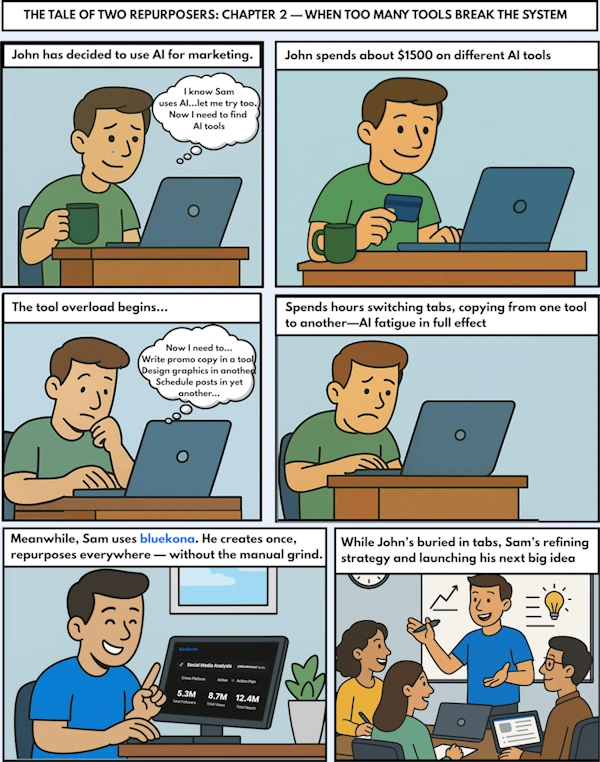
    The Tale of Two Repurposers - Chapter 2 - When Too Many Tools Break the System

    What bluekona Covers..And What It Doesn’t?

    In a world where every platform claims to be your all-in-one marketing solution, bluekona takes a different approach, it prioritizes focused excellence over unnecessary features.

    Instead of trying to replace your CRM, email platform, ad manager, or project tracker, it doesn’t aim to do it all. Its mission is to excel in the 80% of your marketing workflow that truly fuels growth.

    Functionbluekona Handles?What You GetWhat You Will Not
    Content Creation✅ YesAI-powered writing, brand voice control, multi-format outputComplex video scripts, technical docs, advanced design assets
    Content Strategy✅ YesCustom growth plans, audience analysis, competitor insightsDeep industry research, academic-level thought leadership
    Content Distribution✅ YesOne-click publishing, cross-channel formattingCommunity management, Automatic engagements
    Performance Analytics✅ YesUnified dashboards, ROI insights, content growth trackingMulti-touch attribution, ad ROI modeling
    Social Media Scheduling✅ YesBuilt-in scheduler, format optimization
    Email Marketing❌ Noemail automation, segmentation, deliverability tuning
    Paid Advertising❌ NoCampaign setup, bidding strategies, A/B testing
    Video Production❌ NoScript suggestions and outlinesAvatar creation, motion graphics, high-end editing
    Influencer Marketing❌ NoContent re-use insightsFraud filtering
    Technical SEO❌ NoSchema markup, link building, SERP performance tracking

    Here’s what that looks like

    Old Way:

    • Write in Jasper
    • Edit in Grammarly
    • Design in Canva
    • Schedule in Buffer
    • Check metrics in Sprout
    • Combine data from four platforms
    • Repeat daily with a different mix

    bluekona Way:

    • Connect your channels just once
    • Create AI-driven content that fits your brand perfectly
    • Repurpose it everywhere with a single click
    • Review your performance all in one dashboard
    • Iterate, improve, and scale—without the hassle of too many tools

    Why “Not Everything” Is the Point

    1. Efficiency > Complexity

    bluekona hones in on the systems that truly matter, content creation, strategy, distribution, and performance. That’s where your time is spent—and where the inefficiencies often hide.

    2. Depth > Breadth

    You don’t need a toolbox full of 47 tools. What you need is a solid platform designed to deliver results every day, with the flexibility to bring in specialists when the situation calls for it.

    The Strategic Play: Core + Optional Power-Ups

    Need top-notch video production? Use Synthesia.
    Launching a major influencer campaign? Add CreatorIQ.
    Diving deep into SEO? Plug in Clearscope.

    But let those tools be situational—not foundational.

    bluekona serves as your command center for growth—not just another tech stack. It offers you the simplicity to execute and the power to scale—without getting lost in a sea of tools.

    Who This Is For—And Who It’s Not

    bluekona isn’t for everyone. It’s designed for marketers who are ready to leave the chaos behind and scale their efforts more intelligently.

    This Is For:

    1. Growing Teams Overwhelmed by Tool Chaos
      You’ve piled on tool after tool, tackling small issues while creating bigger headaches. Now, your team spends more time juggling logins than actually creating content. bluekona offers a single platform to plan, publish, and measure. No need to juggle five different tools to get the job done.
    2. Agencies Wasting Billable Hours on Manual Tasks
      Client work should be smooth and efficient, but instead, you find yourself hopping between dashboards, copying insights into slides, and manually reformatting posts. bluekona cuts out the middleman, allowing you to work efficiently without having to patch together eight different tools.
    3. Solo Marketers on the Brink of Tech Burnout
      You’re wearing all the hats, like, writing, designing, scheduling, reporting—and your “tool stack” is starting to cost more than your rent. You need a content engine that’s ready to go right out of the box, not a patchwork system that requires a Zapier expert to operate.

    This Isn’t For:

    1. Enterprise Ops with Highly Customized Needs
      If you’re managing multi-market, compliance-heavy, attribution-focused campaigns, you’ll still need specialized, integrated platforms—and probably a development team to keep everything running smoothly.
    2. Teams Already Committed to Complex Workflows
      If your setup is already intricately connected with custom APIs and tailored dashboards—and it’s working well—switching to a new system might cause more headaches than it’s worth.
    3. Brands Pushing the Envelope on Creative Innovation
      If staying ahead means diving into AI-generated 3D content, dynamic video avatars, or interactive experiences, you’ll need cutting-edge creative tools that go beyond what bluekona offers.

    The Bottom Line

    The AI boom addressed the wrong problem.

    It flooded marketers with more tools, more options, and more “solutions”. But it didn’t tackle the real issues, like, fragmentation, decision fatigue, workflow overload, and tool sprawl.

    The top-performing teams aren’t cranking up their AI usage, they’re actually dialing it back, but in a smart way. They’re focusing on what truly makes a difference and cutting out the noise.

    So, here’s the real question: Are you in control of your tech stack, or is it running the show?

    Start your audit. Discover what bluekona can replace. Identify what’s fueling your growth—and what’s just eating away at your budge

  • How Canva Built an Unbreakable Content Moat?

    How Canva Built an Unbreakable Content Moat?

    When someone searches for “how to make a resume,” Canva doesn’t just rank, it leads.

    Their blog post explains the process. The embedded YouTube video demonstrates it. Their templates allow users to start right away. By the time someone finishes reading, they are already using Canva’s o build their resume and are halfway to becoming paying customers.

    That’s not just content. That’s a smart strategy.

    While most SaaS companies spread their efforts thin—blogs in one place, templates in another, tutorials lost on YouTube, Canva created an interconnected, education-focused system. Each type of content works together to attract visitors, teach results, and encourage product usage.

    The outcome? A strong content barrier that competitors cannot surpass. They would need to rebuild the entire system.

    In this blog, we’ll reverse-engineer how Canva created this stronghold. From their SEO blog structure to their YouTube-blog combinations that succeed in search engines.

    We will also discuss how to create a similar barrier in your niche, even if you’re starting from scratch.

    Let’s break it down.They tapped into a fundamental truth

    The Education-First Strategy

    Most design tools focus on their features, but Canva took a different approach by emphasizing outcomes.

    They tapped into a fundamental truth. The issue with design isn’t about the tools itself, it’s about the knowledge gap.

    You don’t search, “designing tool with great gradient controls.” Instead, you search, “I want to create a resume that looks good”. This understanding influenced their entire content strategy.

    Rather than starting with what their product can do, Canva built a system that teaches you exactly what you want to achieve and then helps you get there, all within the Canva platform.

    When it comes to SaaS onboarding, most focus on just the interface. But Canva? They’re all about the outcomes.

    They realized that most people avoid design not because they can’t do it, but because they don’t believe they can. Every tutorial, every blog post, and every Design School guide aims to reduce fear, simplify the process, and show users, “you can do this.”

    Quotes like “It’s easier than you think to design a flyer from scratch” build confidence, and it works.

    It converts unsure visitors into enthusiastic first-time creators

    The Educational Architecture

    Canva’s system operates on three levels:

    1. Foundation: Design principles, color theory, typography, general literacy
    2. Application: Specific tasks, resumes, flyers, logos
    3. Advanced: Industry use cases, real estate flyers, school newsletters, business decks

    Each layer connects to the next. Each one develops skills and creates reliance on the product.

    This is why Canva doesn’t need to sell hard. Their system guides users into the product. Templates are directly integrated into tutorials. Calls to action don’t interrupt the content. Infact, they are part of the content.

    It’s learn, try, succeed, all within a closed loop.

    Why It Works?

    This strategy solves three problems at once

    • Discovery: Educational content ranks for long-tail, high-intent queries like “how to make a poster” or “resume layout for students.”
    • Conversion: By the end of the tutorial, users aren’t just informed. They’re already halfway done with their design.
    • Retention: Success builds confidence. Confidence drives return usage. Each completed project increases the odds of the next.

    This is how Canva built a growth engine by making “learn” and “use” the same step.

    While most brands see education as an afterthought, Canva turned it into their competitive advantage.

    Canva’s SEO Flywheel

    Canva doesn’t see SEO as just a way to get traffic. They see it as an ecosystem, where each page, template, and tutorial supports the others.

    At the core of this approach is a self-sustaining flywheel.

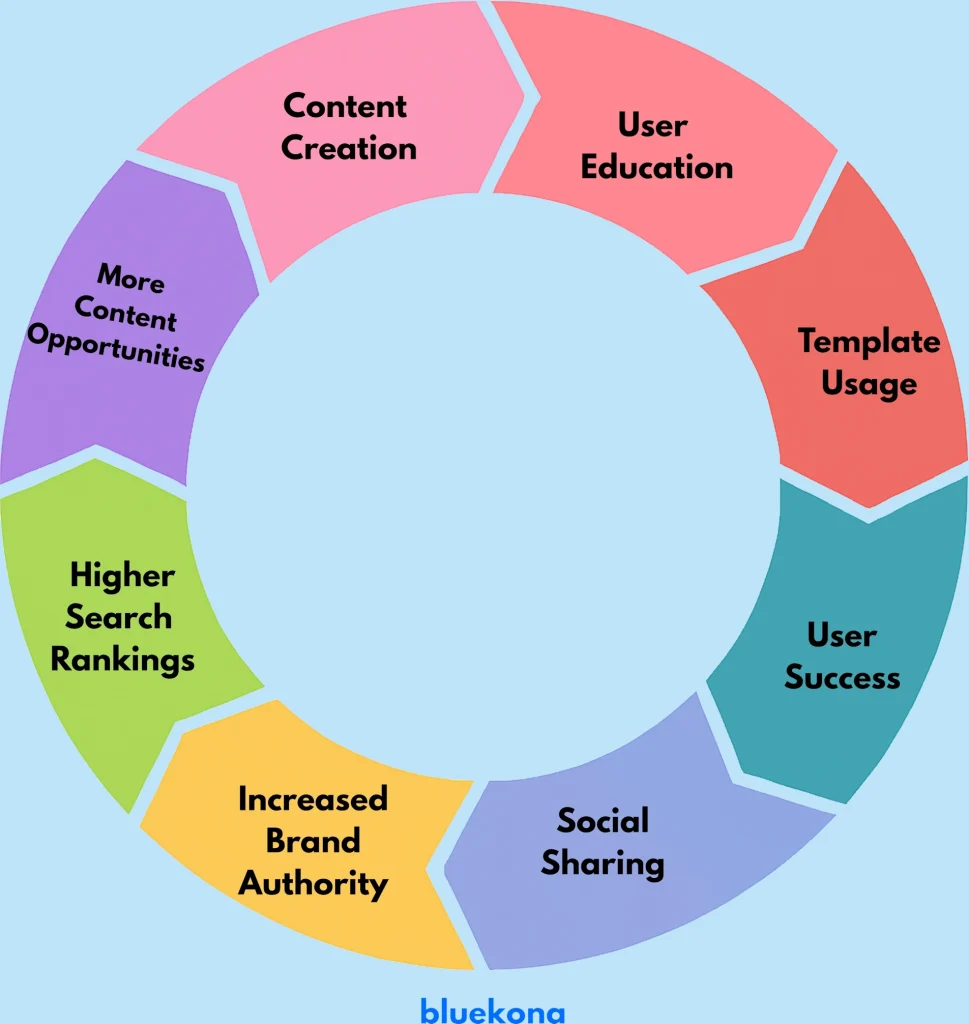
    Educational content drives template usage. Template success generates user data. Data fuels smarter content creation. Everything is indexed, linked together, and optimized for intent.

    canva content flywheel - how it works

    The outcome? It was not just about search rankings. It’s about achieving lasting organic strength and creating an SEO advantage that competitors can’t easily replicate.

    1. Targeting Genuine Design Intent, Not Just Popular Keywords

    While most SaaS tools compete for broad terms like “best design software,” Canva explored the complete range of real user needs

    • Tactical outcomes like “How to make a resume,” “How to design a flyer.”
    • Contextual use cases such as “Wedding invitation design,” “Restaurant menu templates.”
    • Skill development content like, “Typography basics,” “Color theory for beginners.”
    • Industry verticals, for instance “Real estate flyer design,” “School newsletter templates.”

    This detailed targeting reaches users at every stage of their design journey, from total beginners to niche professionals. It connects them directly to Canva’s template ecosystem.

    Each keyword cluster serves as a high-conversion gateway into the product.

    2. Internal Linking

    This is where Canva really stands out from the crowd.

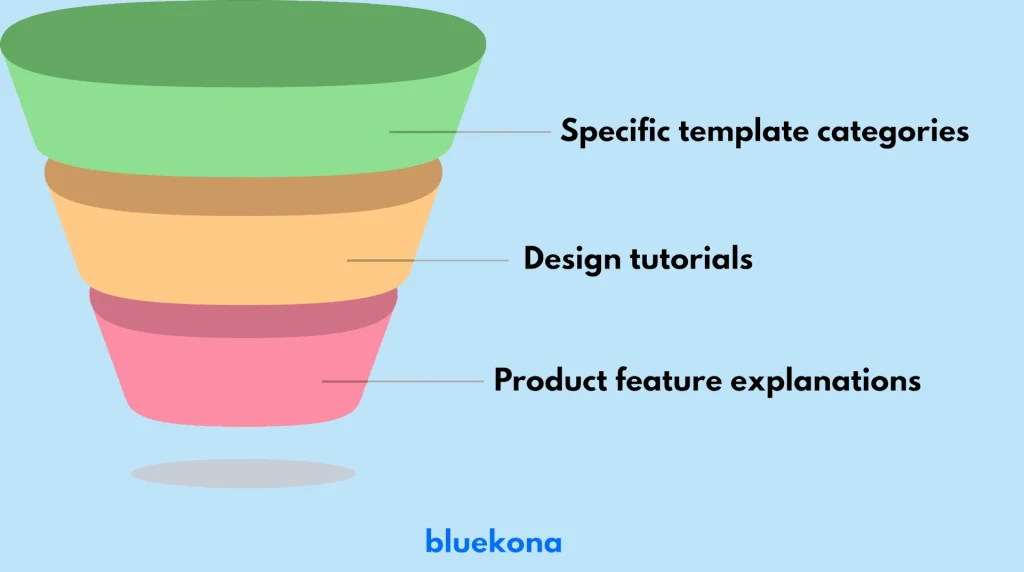
    Their internal linking is not random. It’s a carefully crafted funnel that takes you to the bottom even before you realize it

    • Specific template categories
    • Design tutorials
    • Product feature explanations

    Let’s see how this works in practice. The page how to make a resume for your first job, links to entry-level resume templates with the CTA “Choose a free template to get started”. At the end of this page, you see other follow-up guides like “How to write a cover letter”

    This internal structure boosts:

    • SEO performance (through distributed link equity and crawlability)
    • Engagement metrics (lower bounce rates and higher time on site)
    • Conversions (fewer obstacles between intent and action)

    It’s all about shaping the user journey as an SEO strategy. And it really scales.

    3. Content Clustering for Authority and Conversion

    Canva builds topical clusters instead of standalone articles. Their resume hub includes

    • Resume writing fundamentals
    • Layout tips and formatting guides
    • Industry-specific resume advice
    • Cover letter writing tutorials
    • LinkedIn profile optimization

    Each piece supports the others and links across the cluster. And the benefits are clear:

    • Google recognizes the thorough coverage of topics, leading to better rankings
    • Users can easily explore related subjects, resulting in longer session times
    • More opportunities for calls to action and template placements, boosting conversions

    It’s a perfect blend of SEO, user experience, and funnel strategy.

    Why Competitors Can’t Copy This?

    Sure, anyone can whip up a blog post on “how to make a resume.” But let’s be real,it’s almost impossible to create a flywheel as effective as Canva’s.

    To pull that off, you’d need:

    • In-depth keyword research and a solid understanding of user intent
    • Content operations that can scale while maintaining editorial precision
    • A product that allows for the immediate application of what users learn
    • A smart internal linking and taxonomy strategy
    • A long-term dedication to teaching first and selling second resource library

    Most people won’t go the extra mile. But Canva already has.

    How bluekona Helps You Build a Content Moat Like Canva, Without the Manual Labour

    Canva built its content moat over years of hard work involving writers, SEOs, video editors, template designers, and endless revisions.

    With bluekona, you can achieve the same level of success, minus the massive team.

    It automates the key elements of Canva’s strategy such as, repurposing content, distributing it across different formats, internal linking, and tracking performance.

    What took Canva years to develop, you can establish in just a few months.

    Transform One Asset into a Multi-Format Ecosystem

    Your top-performing content is already doing its job. bluekona helps it shine everywhere.

    From a single long-form article, you can effortlessly create 10s of content.

    Understand What to Scale and What to Let Go

    Stop playing the guessing game. bluekona’s AI-driven content performance engine shows you:

    • Which content formats lead to the most trial starts, demo requests, or purchases
    • Which topics generate links, shares, and deeper engagement across platforms
    • What content paths actually guide users from learning to converting

    You’ll have a clear roadmap of where to invest your efforts. And most importantly, you’ll know what to cut.

    Build Topical Authority on Autopilot

    bluekona groups your content around themes, similar to Canva’s resume system, and fills in the gaps.

    It identifies internal linking opportunities to share SEO value. It creates hub-and-spoke content calendars to increase domain authority. It suggests long-tail keywords based on actual user behavior and ranking potential.

    What once took SEO strategists weeks to plan, bluekona accomplishes automatically.

    You provide the expertise, and bluekona transforms it into a content system that educates, scales, and compounds

    Want to build a content moat like Canva?

    Start with a free bluekona Content Performance Audit.

    Identify your highest-performing educational assets.
    See where your ecosystem is strongest and where it’s lacking.
    Get a customized roadmap to scale what’s working and improve what’s not.

    Find your best educational content. Turn it into your growth engine.

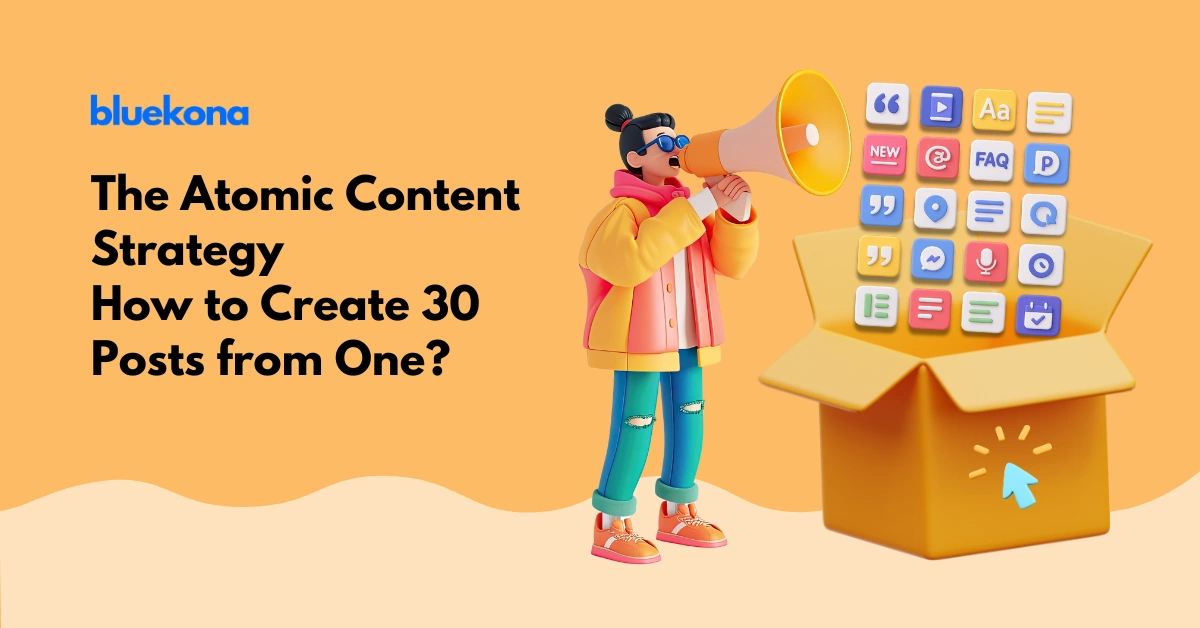
  • How to Use the Atomic Content Strategy to Create 30 Posts from One Asset?

    How to Use the Atomic Content Strategy to Create 30 Posts from One Asset?

    Here’s the brutal truth about content marketing, posting more doesn’t mean creating more.

    While your team is busy trying to fill up seven content calendars, brands like Duolingo and HubSpot are taking a smarter approach. Instead of churning out 30 separate pieces, they focus on crafting one strong idea and breaking it down into over 30 effective, platform-specific posts.

    This isn’t just lazy recycling or half-hearted repurposing. We’re talking about Atomic Content — a strategic, no-nonsense method that treats every blog post, video, or webinar like precious material: rich, high-value content that can be split into numerous impactful microcontent pieces.

    Take a 10-minute video, for instance. That can easily transform into 30 posts across Instagram, LinkedIn, TikTok, Threads, and YouTube Shorts. Or consider a single blog post; it can generate quote cards, carousels, threads, audiograms, FAQs, and snippets for newsletters. Same insights, but with a much wider reach and zero creative fatigue.

    Trying to do this manually? That’s tough. But with BlueKona AI? It’s as easy as a single click.

    Let’s dive into how the Atomic Content Strategy works and see how BlueKona automates everything from breaking down your content to publishing it, so you can post more without feeling overwhelmed.

    What Is Atomic Content?

    Atomic Content is breaking down a single core idea, like a blog post, podcast, webinar, or video, into smaller pieces that fit different platforms.

    This approach helps you reach more people without doing extra work.

    Think of it this way, instead of making 30 different posts from 30 brainstorming sessions, you create one valuable asset and deconstruct it into 30+ smaller pieces. Each one optimized for where it will be published — Instagram, LinkedIn, TikTok, Threads, Pinterest, and more.

    The Media Company Mindset Shift

    Here’s where many content teams go wrong. They act like bloggers who can distribute. They post once, move on, and repeat.

    Smart brands operate like media companies. When CNN covers a story, it doesn’t stop with just one piece. They turn it into a morning segment, a social clip, a newsletter, a panel discussion, and a podcast episode.

    Same story. Multiple formats. Maximum reach.

    Your content deserves that kind of attention. That blog post you spent 10 hours crafting? It’s not “done.” It’s a valuable source waiting to be tapped.

    Why Atomic Content Works?

    The psychology is straightforward. Repetition = Reach Frequency = Familiarity.

    Most people need to see your message 7 to 12 times before they take action. If you only post once, you’re relying on perfect timing. But if you post thoughtfully, you increase your chances.

    With Atomic Content, you can reach your audience across various platforms and formats.

    Miss them with Monday’s LinkedIn carousel? No problem—Wednesday’s Instagram quote card can pick up the slack. And Friday’s Twitter thread might just be the nudge that drives the click.

    Same message. Different formats. Various moments of receptivity.
    That’s not spam. That’s strategic frequency.

    The Manual Pain (Why Most Don’t Do It)?

    If Atomic Content is so effective, why isn’t everyone jumping on board?

    Well, the manual execution can be a real headache. Repurposing content sounds like a great idea, until you find yourself deep in the process.

    1. The Time Trap

    Let’s take a closer look at what it actually takes to break down a single piece of content by hand

    • Creating the original asset (like a blog, video, or webinar): 3–8 hours
    • Researching platform specifics (format rules, trends): 4.5 hours Adapting the content (copy, hooks, angles): 7.5 hours
    • Creating visuals (graphics, overlays): 2.5 hours
    • Writing captions (tailored for each platform): 2.5 hours
    • Scheduling and optimizing: 2 hours
    • Total: 22+ hours for just one content asset.

    Most teams can barely get their main content out the door, let alone spend another full day breaking it down into smaller pieces.

    2. The Format Nightmare

    Every platform has its own quirks. Instagram demands 1080×1080 squares, 9:16 Reels, and those attention-grabbing hooks in the first 3 seconds. Don’t forget about stories.

    LinkedIn likes carousels, but they have to be professional yet engaging. Text posts? They need to be insightful and shareable.

    TikTok requires vertical, fast-paced edits with captions and trending audio.

    Twitter/X versus Threads? Same message, but the tone and structure need to be completely different.

    YouTube Shorts calls for native edits, catchy captions, and a vertical format.

    Your designer is juggling 47 different aspect ratios. Your editor is buried under clips they’ll never revisit. Your copywriter is rephrasing the same idea a dozen times.

    3. The Creative Burnout Cycle

    Here’s how manual repurposing typically unfolds

    Week 1: “Let’s transform this blog into 20 pieces of content!”

    Week 2: The designer spends 6 hours on quote cards, while the editor is working late.

    Week 3: The copywriter is exhausted, and the editor is falling behind on everything else.

    Week 4: “Forget it, let’s just post the blog and move on.”

    The team gets stuck in a cycle of production purgatory, resizing, reformatting, and rewriting when they should be focusing on what they do.

    The Blueprint. How to Go From 1 to 30?

    Enough theory, here’s how Atomic Content works in practice. One core idea. Thirty native posts. A month of content from a single asset.

    Let’s walk through it using a real example, say your core post is, “The 5 Psychology Triggers That Double Email Open Rates.” This is a 12-minute YouTube video full of useful insights, examples, and results.

    Original Content Asset

    • Format: 12-minute YouTube video (or a long blog post, webinar, or podcast)
    • Time investment: about 8 hours for research, scripting, filming, and editing
    • Initial reach: One post, one platform, one chance

    The Atomic Breakdown. 30 Pieces

    3 Quote Cards (Instagram/LinkedIn)

    • “Fear of missing out drives 34% more opens than curiosity.”
    • “Questions in subject lines increase opens by 23%.”
    • “Numbers outperform words: ‘5 tips’ beats ‘several tips’ every time.”

    3 Video Snippets (Reels/Shorts/TikTok)

    • 60-second breakdown of the curiosity gap
    • 30-second subject line makeover
    • 45-second rapid-fire on all 5 triggers

    1 Carousel (LinkedIn/Instagram)

    • 8-slide format, one trigger per slide with examples

    3 Pinterest Pins

    • Infographic, step-by-step
    • Checklist

    2 FAQ Snippets (SEO-rich blog sidebars or schema)

    • “What psychology triggers increase email open rates?”
    • “How do you write subject lines that get clicked?”

    2 LinkedIn Text Posts

    • “I analyzed 10,000 subject lines. Here’s what actually works…”
    • “Your open rates are low. Here’s why (and how to fix them)…”

    1 Twitter/X Thread (republished on Threads)

    • 8-tweet breakdown of each trigger

    1 Newsletter Blurb

    • 150-word teaser with a CTA for the full video

    1 Reddit or Quora Answer

    • Direct reply to “What makes people open marketing emails?”

    3 Audiograms

    • 30 to 60 seconds of soundbites with waveform visuals for LinkedIn/X

    Reposts + Remixes ( 1 Republish)

    • 1 Republished Version – Fresh angle: “Why Your Subject Lines Are Killing Your Sales.”

    5 Scheduled Reposts (spread out across platforms)

    • Week 2: Instagram quote repost
    • Week 3: LinkedIn carousel replay
    • Month 2: TikTok snippet with trending audio
    • Month 3: Threads thread repost
    • Month 6: Full video repost with a “Did you miss this?” hook

    3 Platform Variants

    • Different thumbnails, headlines, or CTAs

    The Math That Changes Everything

    Old model: 1 video = 1 post

    Atomic model: 1 video = 30 posts across 7 platforms over 6 months

    Same core idea. 30 times the visibility. Zero burnout.

    Output, Visibility, and Performance

    When you implement Atomic Content systematically, it doesn’t just increase output. It changes your whole content operation. This is how leading brands boost their presence without increasing their team size.

    Higher Frequency Without Burnout

    Before Atomic Content: –

    • 3 to 4 posts per week across all platforms
    • Team scrambling for fresh ideas
    • 50-plus hour weeks to maintain consistency
    • Constant panic about having nothing to post

    After Atomic Content: –

    • 15 to 20 posts per week with the same team
    • 6 months of content planned from 5 to 6 core ideas
    • Creators focus on strategy instead of formatting
    • Content calendar stays full without the rush

    A two-person agency team increased their output from 12 to over 60 posts per month. They did this by creating 5 deep assets each month and breaking them down into smaller pieces.

    Content isn’t just about frequency. It’s also about being consistently present. You show up everywhere your audience is.

    Virality equals the right idea, the right platform, and the right timing. With traditional content, you get one chance. With Atomic Content, you get over 30 chances for the same core insight to succeed.

    Authority grows faster through repeated angles and conversion rates increase due to familiar content.

    Moreover, creation becomes easier as you dive deeper rather than wider

    Bottom line: Atomic Content turns your best ideas into engines for growth, not one-off posts lost to the algorithm.

    Ready to Multiply Your Content?

    Run your Atomic Content Audit. Drop in your last blog post and instantly see how many platform-native pieces it could become.

    BlueKona turns one idea into a month of content, automatically.
    No extra hours. No burnout. Just scale.

  • How to Measure ROI of Content Repurposing?

    How to Measure ROI of Content Repurposing?

    Most brands repurpose content. But almost none can prove if it’s worth it.

    Sure, you can track likes, clicks, or views. But when one podcast becomes a LinkedIn post, a YouTube short, an email snippet, and a blog quote — which one actually delivered value?

    Without a clear view of repurposed content ROI, brands overcommit to content that flops and underuse what performs.

    This is where AI changes everything.

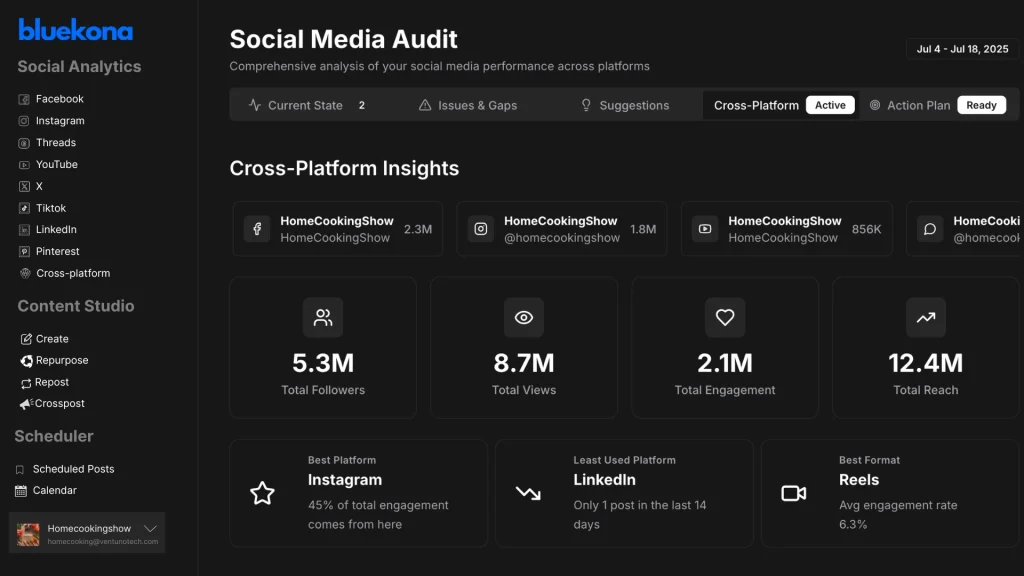
    Bluekona’s Social Media Audit connects the dots across channels, formats, and timelines, revealing how each repurposed asset contributes to real business outcomes. Engagement. Traffic. Leads. ROI.

    Let’s break down why measuring repurposing ROI is so hard — and how Bluekona makes it automatic.

    The Real ROI Problem in Repurposing

    Repurposing content sounds efficient in theory — but in practice, it’s often where marketing data goes to die.

    • Manual tracking is painfully slow and riddled with errors. Spreadsheets break. UTM tags get skipped. Team members forget what went where.
    • Platforms don’t talk to each other. YouTube tracks views. LinkedIn counts impressions. Instagram cares about reach. There’s no unified picture of performance.
    • Performance gets fragmented. One idea spawns multiple assets. But how do you compare the original YouTube video to its Instagram Reel or LinkedIn quote card? You can’t — not without painful stitching.

    The result? Teams double down on content that looks good in isolation but delivers little ROI.

    Meanwhile, high-performing repurposed assets go unnoticed or get used once and forgotten.

    The biggest problem isn’t creating more content — it’s not knowing which content is actually worth creating again.

    What ROI of Repurposing Should Include

    Most content teams track surface-level metrics — likes, views, maybe CTR. But repurposing ROI goes deeper. To make smart decisions about what to keep creating (and what to stop), you need to measure impact holistically.

    Measuring ROI isn’t just about likes. It’s about efficiency and impact — across every repurposed asset.

    If you're only measuring likes, you're not tracking ROI - you're tracking applause

    1. Platform-by-Platform Engagement

    How did each version of your content perform — not just in aggregate, but per channel?

    A LinkedIn snippet may drive comments, while the same clip on Instagram gets ignored. You need to know what works where, not just that something worked.

    2. Time Saved vs. Reach Gained

    Repurposing is supposed to be efficient — but is it?

    ROI should weigh how much time and effort was saved versus how much additional reach or engagement was actually earned. Did the five social edits justify the edit hours?

    3. Attribution to Leads, Traffic, or Growth

    Which repurposed pieces are pulling their weight in real business terms?

    ROI means tracking back to outcomes — clicks, form fills, subscribers, pipeline. Not every post will convert, but patterns reveal which formats move people forward.

    4. Frequency of Reuse vs. Effectiveness

    How many times did an asset get reused — and how did performance hold up? Some formats degrade after the first post.

    Others get stronger with iteration. ROI measurement should help you identify when to repurpose again, reformat, or retire.

    With this level of visibility, you’re not just tracking content but you’re also optimizing your entire repurposing strategy for efficiency and impact.

    What It Takes to Measure ROI of Repurposed Content

    To get real visibility into repurposed content performance, teams need more than scattered analytics. The process should be automated, connected, and insight-driven. Here’s what an effective solution looks like

    Bluekona gives you full visibility into how your repurposed content performs.

    Each feature is designed to solve a specific pain point and help you make smarter, faster decisions about what to reuse, reformat, or retire.

    1. Cross-Platform Content Mapping

    Manually connecting performance across channels is messy and time-consuming.

    Bluekona automatically links every version of a content piece, whether it’s original posts, repurposed formats, or cross-posts, so you can measure their performance together or separately, all in one place.

    2. AI-Powered Content Grouping

    The AI clusters similar content types, like quote cards or short-form reels, and then ties them to actual results.

    It maps each group to key metrics like engagement, lead generation, and click-through rates.

    3. Timeline-Based ROI Views

    Tracking repurposed content over time is nearly impossible without a system.

    Bluekona gives you a timeline view that shows how a single idea performs across platforms and over weeks or months. This makes you see momentum, fatigue, or missed opportunities.

    4. Cross-Platform Attribution and Scoring

    Performance isn’t just about views. To measure impact, content should be evaluated on what it actually drives — clicks, form fills, new followers.

    Ideally, each asset should carry an engagement score that factors in all of its appearances, even across different platforms.

    5. Smart Recommendations Engine

    Deciding what to repurpose again shouldn’t be a guessing game.

    Bluekona analyzes performance patterns and gives clear guidance on whether to republish, reformat, or retire each asset based on data.

    This lets your team focus time and budget on what’s proven to work.

    See Bluekona in Action

    A well-executed repurposing strategy isn’t just about content output. It’s about visibility into what’s working, where, and why.

    Dashboards like this one provide a centralized view of cross-platform performance so you can stop guessing and start optimizing.

    bluekona - dashboard of client homecooking

    Here is what to look for in the dashboard

    1. Unified Performance Across Platforms

    The dashboard pulls in metrics from each social channel — including views, engagement, and reach.

    This allows you to compare performance side by side. No more toggling between apps or exporting CSVs.

    2. Total Impact at a Glance

    Core metrics like Total Followers, Views, Engagement, and Reach are displayed across all platforms. This makes it easy to measure the full return on marketing efforts, even when it’s scattered into different channels.

    3. Format-Specific Wins

    In this example, Reels are identified as the best-performing format with a 6.3% average engagement rate.

    Knowing which format consistently drives ROI helps you decide where to focus future repurposing efforts.

    4. Platform Gaps and Opportunities

    While Instagram drives nearly half of the total engagement, LinkedIn has seen almost no recent activity.

    This type of insight helps justify reallocating team time — or testing underused platforms with proven content.

    Insight in action: Repost high-performing Instagram content to LinkedIn to fill engagement gaps.

    This kind of visual breakdown gives your team the clarity to stop guessing, start tracking, and make every repurposed asset count.

    What to Do With This Data

    It’s not enough to know how your content performed — you need to act on it. ROI insights like these turn your repurposing efforts into a high-efficiency growth strategy.

    Cut the Waste

    If certain formats consistently underperform, stop investing time in them.

    Low-engagement Stories, static posts with no clicks, or platforms with zero traction — this is where effort gets lost. Let the data make those calls for you.

    Double Down on What Works

    Use ROI insights to identify high-performing formats and platforms, then scale them.

    If Instagram Reels drive the most engagement, views, or leads, make that your core repurposing focus. Invest more in what’s proven to deliver results.

    Prove the Value of Your Content Team

    Go beyond vanity metrics. Use hard data to measure impact of your team’s work — how much reach, engagement, and lead potential each repurposed asset is generating.

    You’re not just making content — you’re building a system that multiplies returns.

    This is the kind of insight that turns content strategy from a creative function into a measurable, defendable business asset.

    Ready to See What’s Actually Working?

    Book a free social media ROI audit and get a clear view of how your repurposed content is performing across every platform.

    Stop guessing. Start measuring what matters.

    Let BlueKona show you how every piece of content pays off — or doesn’t.

  • From Prompt to Profit: The Full AI-Powered Content Lifecycle

    From Prompt to Profit: The Full AI-Powered Content Lifecycle

    Most marketing teams still run content operations like it’s 2015. They are struggling with separate tools, isolated teams, and painfully slow approvals.

    You write one blog post, maybe share it on LinkedIn, and then it disappears. Meanwhile, competitors are flooding every platform, daily.

    It’s slow. It’s disconnected. And it’s built for a world that no longer exists.

    According to the Content Marketing Institute, 70% of marketers say they repurpose content — but fewer than 15% do it systematically. That gap is where growth either compounds, or collapses.

    Delphi quote - working for workflow

    Content today moves at the speed of platforms, not planners. One asset isn’t enough. You need it repurposed into 10 formats, distributed across 5 channels, optimized for multiple audiences — and tracked in real time.

    Enter the AI-powered content lifecycle.

    We’re not talking about generic AI writing assistants. We’re talking about a full-stack marketing engine that takes you from initial prompt to platform-ready content to performance analytics — without duct-taping together half a dozen tools.

    In this guide, I’ll break down each stage of the modern AI-powered content lifecycle — ideation, creation, distribution, repurposing, and performance tracking — and show you exactly how BluekonaAI powers the entire flow from end to end.

    If you’re serious about scaling organic growth without bloating your headcount, this is the workflow your team needs.

    What is the AI Content Lifecycle?

    Traditional content processes are linear and disconnected. You brainstorm, produce, publish, measure and then repeat, often from scratch.

    Delphi quote

    The AI content lifecycle flips that on its head. It treats content creation as a continuous, connected system, where each stage fuels the next, and data constantly feeds back into strategy.

    At a high level, the AI content lifecycle has five key stages:

    1. It starts with ideation, where AI taps into real search data, trend signals, and past content performance to surface strategic ideas that actually align with what your audience wants — eliminating the guesswork.
    2. Next comes creation, with AI drafting high-quality, platform-ready assets that serve multiple purposes: long-form blogs, video scripts, social posts, all consistent with your brand’s tone. Instead of jumping between disconnected drafts, you get cohesive content from the first prompt.
    3. After that is distribution, where AI automates publishing across channels in one smooth step. Whether you’re updating your CMS, scheduling emails, or posting to social platforms, the process is centralized and fast, eliminating countless manual copy-paste routines.
    4. Then comes repurposing, the stage where true efficiency compounds. Instead of letting a single blog post gather dust, AI transforms it into multiple new formats: LinkedIn carousels, TikTok scripts, newsletter sequences — each one adapted in tone, length, and structure for its unique audience. No more reinventing the wheel with every piece.
    5. Finally, there’s performance tracking. Forget disconnected dashboards and clunky spreadsheets; AI pulls engagement, conversion, and reach metrics together in real time. That means you know exactly what’s working and can feed those insights right back into your next round of ideation — making the entire system smarter with every cycle.

    Together, these five stages form a truly continuous, intelligent loop — one that helps your team publish faster, reach further, and optimize smarter, without bloating headcount or burning out your best people.

    This system isn’t just a time-saver. It unlocks compounding growth. Instead of starting from scratch every week, your best-performing content becomes a flywheel — reshaped, reamplified, and continually optimized with no extra friction.

    Platforms move fast. So should your team. The AI content lifecycle is how brands stay visible, consistent, and relevant, without bloating headcount or burning out creatives.

    Stage 1: Ideation — Smarter Starts with AI

    Most content workflows still kick off the same painful way: someone asks, “What should we write this week?” and a random brainstorm happens.

    Delphi - Stop throwing spaghetti at the wall. Start serving what your audience is actually hungry for.

    A few half-baked ideas surface, you pick one, and start typing hoping it sticks. That’s not strategy. That’s guesswork.

    BluekonaAI turns that guesswork into a systematic, data-powered idea engine. Instead of relying on hunches, it uses trend-aware intelligence from social signals, and even your past best-performing content to surface ideas with proven audience demand.

    That means you get to high-opportunity topics before your competitors do with none of the chaos.

    Beyond simply suggesting titles, the platform helps you build out your content with your team in the loop.

    That means your content creators don’t waste time rewriting objectives, angles, or keyword lists, they get a clear, intelligent first draft that’s almost ready to go, reducing the lag between strategy and execution.

    In short, ideation with BluekonaAI means faster, smarter, and more focused planning — setting your entire content lifecycle up for success before a single word is written.

    Stage 2: Creation — From Prompt to Platform-Ready

    Once you’ve nailed down the right ideas, the next hurdle is actually producing high-quality, on-brand content. And doing it fast enough to stay relevant.

    Traditionally, that meant briefing a writer, waiting days for a draft, reviewing it, rewriting it, adapting it for different formats, and hoping it held up across multiple channels.

    Multiply that by 10 or 20 assets a month, and you’ve got a bottleneck that can choke any growth plan.

    Delphi - Why 10 drafts - boss 1 prompt

    Enter Bluekona’s Content Studio. Need a blog post? You get a fully structured long-form article, with optimized subheads, relevant internal links, and strategic keyword integration already built in.

    Want a LinkedIn thought piece from that same topic? It rewrites it in a sharper, persona-driven tone, with a hook, a body, and a CTA specifically designed for feed engagement.

    How about a YouTube script? Done. Scene markers, intro/outro lines, on-camera voice and flow — all aligned with your brand guidelines.

    This is what sets BluekonaAI apart from cookie-cutter AI tools: it doesn’t just churn out filler. It creates intent-matched content.

    Each asset is aware of the format, the distribution channel, and the outcome it’s supposed to achieve.

    Even better, BluekonaAI remembers your past content. It can reuse top-performing CTAs, maintain consistent messaging, and avoid repeating ideas that fell flat before.

    No more blank docs, no more headline rewrites, no more endless tweaks to fit one post across five channels.

    This is full-stack, multi-intent content creation, optimized for both output and outcomes. From a single brief, you can launch a blog post, a video script, a carousel, a Twitter thread, and an email sequence, all aligned and ready to publish.

    That’s how you scale quality, velocity, and consistency without adding headcount.

    Stage 3: Distribution — Publish Everywhere, Instantly

    You’ve got strategic ideas and platform-ready content — but if it sits in a Google Doc or gets buried in a project folder, it’s worthless.

    Distribution is what actually puts your work in front of people, and most teams still struggle here.

    Jumping between social schedulers, manually posting, and praying everything goes live at the right time.

    BluekonaAI removes that friction by connecting content creation directly to distribution. The moment an asset is approved, it’s ready to schedule— no copy-pasting, no endless uploading, no channel-by-channel checklists.

    It’s the “one-click publish” mindset: instead of wasting time coordinating posts across platforms, you can reinvest that effort into refining your strategy. By cutting out the manual steps, you ensure your content goes live—on time, in the right format, and built to perform.

    Stage 4: Repurposing — Multiply Every Idea

    Most brands treat repurposing as an afterthought, if they do it at all. They’ll copy a paragraph from a blog, squeeze it into a social post, and call it a day. The problem? That approach is random, time-consuming, and rarely consistent in tone or structure.

    In today’s multi-platform environment, you can’t afford for a great piece of content to die after a single post. Audiences engage differently on each platform, and you need your best ideas to follow them — adapted to every format, in every channel.

    BluekonaAI makes this effortless. Instead of manually rewriting or reformatting, it transforms your primary content asset into a full suite of secondary assets, automatically tuned for context, tone, and platform style.

    Delphi quote - Data should not play hide and seek

    For example, that in-depth blog post can become:

    • a LinkedIn carousel with short, scroll-stopping slides
    • a short-form video script tailored for TikTok or Reels
    • an engaging Twitter thread built for conversation
    • a bite-sized email nurture sequence
    • a podcast snippet summary for Spotify

    And it doesn’t just swap words around. BluekonaAI’s repurposing engine is format-aware — understanding the unique style and narrative flow of each channel. It can condense a story for a TikTok script with hooks and cliffhangers, expand it for a podcast transcript, or rewrite it for a more conversational newsletter style.

    Even better, it preserves your brand voice and messaging across every asset. That means no more awkward rewrites or hiring yet another freelancer to fix tone inconsistencies. The platform reuses your brand’s proven calls-to-action, style guidelines, and key phrases, keeping everything recognizable and consistent.

    This is how you get true scale. Instead of asking your team to “do more with less,” you multiply what’s already working. High-performing content is reamplified, resurfaced, and retargeted to different audiences without starting from scratch.

    The result? Your content pipeline goes further, lasts longer, and reaches more people — without the painful delays and coordination hassles that kill momentum.

    If the modern attention span is measured in seconds, you need to meet audiences wherever they scroll. BluekonaAI makes that possible, turning one idea into many, across every platform, on-brand and on-time.

    Stage 5: Performance Tracking — Close the Loop

    You can’t improve what you don’t measure. Yet most teams still struggle, either relying on lagging useless metrics like traffic or likes, or drowning in a maze of spreadsheets and inconsistent attribution models. It’s messy, slow, and often too late to act.

    Delphi Quote - chasing data

    BluekonaAI changes that by making performance data instantly visible, centralized, and actionable — without hiring a full-time analyst. The moment content goes live, Bluekona begins tracking its impact across every connected channel:

    • clicks, views, and conversions for blog posts
    • engagement rates and reach for social posts
    • open and click-through rates for email campaigns
    • watch time and retention for video

    Even better, Bluekona ties these metrics directly back to the original idea and content format, so you can see exactly what’s moving the needle — and what’s falling flat. No more guessing which assets to scale up or which channels to prioritize.

    And it goes beyond reporting. Bluekona builds feedback loops right into the workflow:

    Underperforming content? It suggests a retargeting or repackaging strategy.

    Top-performing content? It flags it for repurposing and wider syndication.

    Channels that underdeliver? It recommends shifting focus, not just throwing more content at the wall.

    This isn’t just analytics — it’s true content intelligence, designed to make your marketing lifecycle continuously smarter. You move faster, optimize better, and reinvest effort where it matters most.

    With Bluekona, your team doesn’t just ship more content. You ship smarter content, tuned by real-world data.

    No spreadsheets. No guesswork. Just clear visibility, faster decisions, and sustainable growth.

    Why BluekonaAI Wins: The Power of a Unified Engine

    Most content teams stitch together a chaotic patchwork of tools — one for writing, another for scheduling, something else for analytics, plus countless spreadsheets to bridge the gaps. That approach costs time, drains budgets, and often fails to deliver the consistent results growth teams need.

    BluekonaAI is different. It replaces the messy “tool stack” with a single, unified engine that covers every phase of the content lifecycle: from strategy and creation to distribution, repurposing, and performance tracking.

    Delphi - Fire tools

    No more multiple logins, conflicting data, or tasks falling through the cracks. With one seamless platform, your team can focus on what actually matters: getting valuable content to market, faster and more efficiently.

    That means fewer approvals, fewer rewrites, and dramatically lower costs — without sacrificing quality or control. In other words, the same creative horsepower, minus the friction.

    If you’re serious about scaling your organic growth, BluekonaAI is the upgrade your workflow has been waiting for.

    Wrap Up

    Winning with content used to be about who could write better or publish more. Now it’s about who can operate smarter.

    The AI-powered content lifecycle isn’t just a productivity hack—it’s how modern marketing teams scale organic growth without bloating headcount or burning out creatives. When ideation, creation, distribution, repurposing, and performance tracking all run through one system, content becomes a growth engine—not a bottleneck.

    BluekonaAI gives you that engine.

    Whether you’re a lean team trying to punch above your weight or an established brand tired of disconnected tools, Bluekona replaces chaos with clarity—and manual work with momentum.

  • Content Velocity vs. Content Quality: How to Balance Both in the AI Era

    Content Velocity vs. Content Quality: How to Balance Both in the AI Era

    Content is flooding every single channel right now. Feeds are jam-packed. Search results are more competitive than ever. And your audience? They’re tired of shallow, repetitive posts that sound like they were written by a robot in 30 seconds.

    AI has made pumping out content ridiculously easy. But pumping out good content? That’s where most teams fall flat.

    Brands either publish a ton of mediocre stuff no one remembers, or they sink weeks into polishing a single article, only to miss opportunities to grow.

    But the truth in today’s market is that you can’t afford to pick sides. You need both quality and velocity — because that’s what modern distribution and learning loops demand.

    Delphi - Worthy Content

    If you want to build authority, rank higher, and stay top of mind, you have to create systems that let you move fast and deliver value.

    In this article, I’ll break down exactly how to build a content workflow that scales without sacrificing quality, using smart AI tools and a proven structure.

    Ready? Let’s dive in.

    Velocity vs. Quality

    Before you can fix the problem, you need to name it.

    Velocity is all about speed and scale. It’s how fast — and how consistently — you can get content out the door. Think consistency, publishing frequency, and your ability to show up in multiple channels week after week. The faster you move, the more opportunities you have to connect with your audience and test what works.

    Quality, on the other hand, is about depth and impact. That means relevance to your audience, originality that stands out, well-researched insights, a polished finish, and a voice that actually resonates. Quality is what makes someone read, remember, and trust your brand.

    Here’s the trap: most teams think they have to choose. They either crank out a mountain of low-value posts that nobody cares about, or they obsess over one perfect article for weeks and lose all momentum.

    That old trade-off just doesn’t cut it anymore — and in a minute, I’ll show you why.

    Delphi Speed vs Quality

    Why the Old Tradeoff Doesn’t Work Anymore?

    When ranking #1 on Google could lock in steady traffic for a year content teams had to pick a lane, either publish fast and risk low-quality output, or spend weeks in every piece and fall behind in distribution.

    That tradeoff is now obsolete and infact dangerous.

    Delphi quotes on AI - Human in the loop

    Today, AI has smashed the barriers to content production. Anyone can spin up a 1,500-word blog post or a week of social posts in minutes. Feeds are overflowing with shallow, mass-produced content. Audiences can sense it instantly. Algorithms can detect it even faster. And platforms are responding.

    • Google’s Helpful Content updates are actively devaluing AI-written pages that lack originality and real insight.
    • LinkedIn’s feed algorithm has shifted to prioritize meaningful conversations over cheap engagement hacks.
    • YouTube and TikTok still reward volume — but only if you hold attention and drive watch time.

    In other words, flooding channels with low-effort, high-velocity content is a one-way ticket to irrelevance. It not only fails but signals to algorithms that you’re not worth showing at all.

    On the flip side, slow, handcrafted content creation is a luxury most teams can’t afford. If it takes 3 weeks to publish one blog post, you’re not just falling behind you also become invisible in the AI flood. The market moves faster than your editorial calendar.

    The only way to scale today is to build a system that delivers both. And that’s exactly what efficient AI workflows like Bluekona Content Studio can do for you.

    The 3-Layer Content Stack Framework

    To publish fast without sacrificing quality, you need structure and not just more hours.

    The 3-Layer Content Stack is a simple but scalable model for content creation that ensures:

    1. Your best ideas don’t die in a Google Doc,
    2. Every asset pulls double or triple duty, and
    3. Your publishing cadence stays consistent without burning out your team (or yourself).

    Here’s how it works

    Layer 1: Core Content (Depth)

    This is your high-value, original thinking—the long-form assets that anchor your expertise.

    This can be

    • A blog post that solves a specific pain point
    • A podcast episode
    • A live webinar or founder AMA

    You don’t need to publish these daily. But you do need to create them with intent—clear angles, search demand, and a POV that cuts through.

    AI’s role here:

    • Assist with research, structure, and draft generation
    • Suggest related subtopics to increase coverage depth
    • Accelerate editing with grammar, clarity, and tone alignment

    Layer 2: Repurposed Assets (Reach)

    This is where you take that hero content and remix it into format-native posts for each platform.

    From one blog of the first layer, you can spin out

    • A 7-slide LinkedIn carousel
    • A short-form quote reel (Instagram/Youtube Shorts/TikTok)
    • An email with the top 3 insights
    • A Twitter/X thread distilling the main argument
    • A one-pager for sales enablement

    AI’s role here:

    • Automatically extract key quotes, stats, and CTAs
    • Rewrite sections to match platform tone (e.g. LinkedIn vs Instagram)
    • Create multiple angles (e.g. “hot take,” “how-to,” “summary”) for A/B testing

    Layer 3: Micro Content (Momentum)

    These are your daily snippets that keep you visible and engaged.

    From Your content in level two, pick

    • 1-sentence takeaways
    • Audiograms from podcast clips
    • Reaction tweets to trends (tied back to your content)

    AI’s role here:

    • Surface snackable moments from longer content
    • Write first-draft hooks, headlines, and CTAs
    • Schedule and distribute on a cadence that fits your audience

    Why This Framework Works

    This model shifts your mindset from “create more” to “extract more value from what you’ve already created.”

    It gives your content strategy density. Every core idea generates 5–15 assets, each tailored for different formats and attention spans.

    It also feeds the algorithmic loop. In other words, more assets = more data = faster iteration = better results.

    And with the right AI engine behind it (hint: BluekonaAI), this becomes an automated system and not your full-time job.

    FAQ

    What is content velocity in SEO and marketing?

    Content velocity is how fast and how consistently you can publish. In SEO, higher velocity helps you target more keywords, stay fresh in Google’s eyes, and build authority. But remember: velocity only works if quality stays high.

    Why does content quality matter in the age of AI?

    Because AI made it ridiculously easy to crank out generic, soulless content, which audiences and algorithms ignore. Platforms like Google and LinkedIn actively bury low-value spam. Only content that’s insightful, clear, and genuinely helpful gets traction now.

    How can AI help improve both speed and quality in content creation?

    AI is a brilliant sidekick for research, outlines, drafts, and repurposing — as long as you keep the human brain in charge. Let AI handle the heavy lifting, but don’t outsource your strategic thinking. The best results come from using AI to accelerate, not to autopilot.

    How often should I publish content to balance quality and speed?

    Forget a magic number. Instead think of its layers. Publish a valuable, in-depth piece weekly or biweekly, then repurpose it into daily or near-daily micro content. Experiment and watch what actually drives reach and engagement.

    Can repurposed content still rank in search or perform on social?

    Absolutely. If you adapt it properly it can perform. Repurposing is not copying and pasting. It’s transforming a core idea into a format and style that fits the platform and meets audience expectations. Native, audience-first reuse is the key to making it work.

    Don’t Pick One, Build the System

    The teams winning today aren’t choosing between quality or speed. They’re refusing the question entirely.

    Instead of debating tradeoffs, they’re building systems that are repeatable. AI-assisted workflows make high-quality output inevitable and fast.

    They publish more. They learn faster. They improve with every iteration.

    This isn’t about grinding harder or chasing trends. It’s about structuring your content operation so that every idea has velocity, and every asset has impact.

  • Why Your Repurposed Content Isn’t Working — And How AI Fixes That

    Why Your Repurposed Content Isn’t Working — And How AI Fixes That

    “Create once, repurpose forever.” It sounds brilliant in theory. But in practice? Most content repurposing is just copy, paste, repost, pray.

    Let’s be honest. That’s not strategy. That’s desperation masked as productivity.

    The real problem isn’t that you’re repurposing content. It’s that you’re doing it manually, inefficiently, and without any learning loop.

    Here’s the kicker: AI can take the same core content and actually make it work across platforms. Let’s break down why your current repurposing workflow is wasting your time, and how AI transforms it into a scalable system.

    What Does “Content Repurposing” Actually Mean?

    Real content repurposing isn’t a blind copy‑and‑paste marathon. It’s a three‑step process:

    1. Reformat – Change the structure to fit the new channel. Turn a 1,500‑word blog post into a 10‑tweet Twitter thread or a 30‑second reel script.
    2. Reframe – Shift the angle or tone so it resonates with that audience. A B2B LinkedIn carousel might lean on data and case studies but the same core idea on Instagram could lean into storytelling or behind‑the‑scenes visuals.
    3. Redistribute – Publish with the right timing, metadata, and hooks. A YouTube Short needs a punchy title and thumbnail whereas an email snippet needs a compelling subject line and preview text.

    But What Most Marketers Are Doing Is

    Open your blog post, hit CTRL+C, switch to LinkedIn, hit CTRL+V—maybe swap a word or two—and hit Publish. Rinse and repeat for every channel.

    That’s not repurposing. That’s syndication with zero strategy.

    True repurposing = reformat + reframe + redistribute.

    Why Traditional Repurposing Fails (Hard Truths)

    Manual vs AI Repupose Content Comic

    1. No Learning Loop

    Without tracking what performs, you’re flying blind. You churn out variations, cross your fingers, then rinse and repeat. An AI-driven process, by contrast, learns which formats hit and doubles down—turning every post into a smarter, compounding investment.

    2. No Channel Context

    Treating every social channel the same is like speaking French in Spain. A Twitter thread thrives on rhythm and punchy hooks. An Instagram caption lives on crisp visuals and a killer one-liner. A YouTube description? It’s a search-optimized pitch. Same core idea—different languages.

    3. Repetition Kills Engagement

    Seeing the identical message on every platform is like hearing the same song on repeat. Audiences tune out. If your followers catch you copy-pasting blog paragraphs into their feeds, they’ll scroll past in seconds.

    4. Time Sink with Minimal ROI

    Manually slicing and dicing content for each channel eats up six-plus hours a week. That’s not something that can be scaled up.

    How AI Fixes Content Repurposing (and Makes It Compound)

    1. Learning from What Works

    Every click, comment, and share feeds back into the system. AI tracks which formats, styles, and tones hit the mark and refines future outputs accordingly. Over time, your repurposing engine becomes a self-learning flywheel—compounding results with every cycle.

    2. Channel-Specific Adaptation

    AI doesn’t just chop down your blog paragraph, it recrafts it as a tweet hook, a slide headline, or a meme caption, depending on the platform. No more awkward one-size-fits-all posts.

    3. Infinite Angles

    Want fresh spins on the same core idea? AI can flip your blog into a punchy listicle, or a visual quote series—in minutes, not hours. It’s not just about pumping out more content it’s also about creating smarter variations that resonate.

    4. Built-In Distribution

    Modern AI tools handle publishing natively, (i.e) queuing up posts, optimizing send times, and pushing to each channel in one streamlined flow. It’s your automated traffic cop, keeping every piece of content on schedule.

    What to Look For in a Good AI Repurposing Tool?

    1. Context-Aware Content Transformation

    The tool should read your source material and intelligently reshape it for each channe, rather than you fumbling with mismatched pieces.

    2. One-Click Distribution Across Platforms

    You shouldn’t need separate apps for LinkedIn, Twitter, Instagram, and email. Look for native publishing so you hit “Go” once, and your content lands everywhere on schedule.

    3. Performance Feedback Loop

    Every post is a data point. Your repurposing engine should feed engagement metrics back into its AI brain, so it learns what works and doubles down on high-ROI formats.

    4. Zero Frankenstein Stack

    If you’re juggling Chat GPT, Buffer, Zapier, and three other tools just to publish a single thread, you’re wasting time. The right AI repurposing platform bundles creation, scheduling, and analytics under one roof—no duct tape needed.

    Spoiler: bluekona was built to do exactly this.

    Wrap Up

    You don’t need more blog posts. You need to squeeze 10× value from the ones you’ve already written.

    Manual repurposing is a dead end. AI is the fast lane.

    With BlueKona, your content becomes a growth asset and not a one-off experiment.

    Give it a spin for free and watch your best ideas work harder.