Tag: repurposing

  • How to Future-Proof Your Content With Social Search Repurposing

    How to Future-Proof Your Content With Social Search Repurposing

    Virality is luck. Distribution is insurance.

    Every post you drop into the feed void has a 24-hour lifespan—maybe less. Engagement spikes, then dies. By tomorrow? It’s digital graveyard material.

    Here’s the shift most brands are missing: by 2025, TikTok, YouTube, and Instagram aren’t “social” anymore—they’re search-first platforms. Gen Z already treats TikTok as their #1 discovery engine, and 36% of consumers now trust brand info from social search more than Google.

    That means if your content only lives in feeds, it’s invisible to the fastest-growing search behavior.

    Also, only ~20% of content actually gets repurposed across platforms—leaving 80% of discoverability on the table.

    This workbook isn’t about squeezing out more posts. It’s about future-proofing them by designing assets that survive algorithm shifts, stay searchable, and keep working long after the hype fades.

    Future-Proof Audit

    Most audits obsess over vanity metrics—likes, shares, quick spikes. None of that matters if your content can’t survive without the algorithm’s life support.

    This audit is about shelf life. If your work dies in 24 hours, you don’t own attention—you’re just renting it.

    The Survival Test: Three Brutal Questions

    1. Which of your posts still bring traffic 3+ months later?
    Pull up analytics for content 90+ days old. What’s still driving views or clicks? If the answer is “almost nothing,” you’re designing for decay, not discovery. Evergreen content compounds. Feed-only content vanishes.

    2. If TikTok killed the For You Page tomorrow, would your content still rank in search?
    Search your own profile with keywords your audience would use. Can you find your videos? If not, you’re building on rented land. Search rankings are the only real estate you control.

    3. How many of your video titles would someone actually type into a search bar?
    “POV: This changed everything” won’t survive. “How to fix a leaky faucet in 5 minutes” will. Trend titles get attention today but search titles work forever.

    Your Results: Where You Actually Stand

    • Feed Addict: If<10% survives past 30 days. Dependent on algorithm roulette.
    • Hybrid Creator: If ~30% has search potential, but no system.
    • Search Savvy: If 60%+ discoverable months later. You get search but miss feed momentum.
    • Platform Master: If content thrives in both feed + search. Rare.

    Most brands think they’re Hybrid. But the audit shows they’re Feed Addicts.

    Wake-up call: If your content dies within weeks, you’re not broken—you’re just outdated. The good news? Every new piece can be engineered for survival.

    Think your content can survive the algorithm apocalypse? Let’s test it.

    The Search Survival Matrix

    Not all platforms are created equal. Some bury your content by breakfast. Others let it resurface months or even years later.

    Creators lose because they treat every platform the same. They spend 80% of their energy on feeds that consume content instantly, and almost none on search platforms that compound.

    Feed-First Platforms – The 24-Hour Gamble

    Threads, X (Twitter), Instagram Stories, Facebook Feed, LinkedIn Feed

    • Visibility peaks within hours, then collapses.
    • Discovery is algorithm roulette, not search.
    • Old posts are practically unfindable.

    Think about it: when was the last time you scrolled back 90 days on someone’s Twitter feed? Exactly.

    Search-First Platforms – The Compound Interest Play

    TikTok (search tab), YouTube, Pinterest, Reddit, LinkedIn Articles

    • Visibility grows with time and optimization.
    • Discovery happens through search queries + related content.
    • Old posts keep pulling traffic long after publish.

    Your “how to negotiate salary” TikTok from last year can still rank today. That YouTube tutorial? Still feeding leads while you sleep.

    Feed-first posts are like the groceries you buy to eat right away. Whereas, search-first are like planting fruit trees, where you put in the effort once and enjoy the harvest for years to come.

    Workbook Exercise: Rebalance Your Portfolio
    1. Pick a home base. Choose one search-first hub (YouTube, TikTok, or Pinterest) and design everything else as distribution spokes.
    2. Audit last 30 days. List your posts. Tag each as Feed-first or Search-first.
    3. Calculate your ratio. If >70% of your time is on feed-first, you’re burning effort for short-term hits.
    4. Shift your mix. Aim for 30% feed-first (quick engagement) and 70% search-first (long-term discovery).

    Evergreen Repurposing Framework

    Most brands treat repurposing like leftovers: cut one piece of content into smaller scraps, toss them across platforms, and call it “strategy.” That’s not future-proofing—it’s efficiency theater.

    Real repurposing means engineering content to live two lives at once: the immediate burst of feed attention and the long-term compound effect of search discoverability.

    Think of every idea as having two timelines:

    • Feed Bait – short, sharp, designed to spark momentum.
    • Search Hooks – durable, optimized to keep working months or years later.

    When both timelines run together, you get the compound effect: short-term buzz feeding into long-term growth.

    The Dual-Timeline Strategy

    Feed Bait is the spark. It thrives in feeds where immediacy rules. These posts:

    • Peak within hours, sometimes minutes.
    • Live on trends, curiosity, and FOMO.
    • Are designed to be shared and consumed quickly.

    Search Hooks are the fuel. They’re built for search engines—on TikTok, YouTube, Pinterest, and Reddit—where discoverability compounds. These pieces:

    • Can keep generating traffic for months or years.
    • Are optimized to answer questions and solve problems.
    • Get surfaced whenever someone actively looks for the solution you’ve already created.

    On their own, each timeline has a weakness. Feed Bait dies fast. Search Hooks take time to gain traction. Together, they solve each other’s problems. Feed Bait drives immediate attention into your Search Hooks, which then capture that interest and sustain it long after feeds move on.

    The Framework in Action: Feature Launch

    Original idea: “We just launched a new feature.”

    Most brands stop here—they make one announcement post and call it content marketing. Future-proof brands split the idea into both timelines.

    Feed Bait:

    • A TikTok clip showing the team celebrating the launch. Hooked with: “POV: Your startup finally ships the feature everyone asked for.” CTA pushes viewers to the full tutorial.
    • An Instagram Story sequence showing the “before/after” pain point the feature solves. CTA: “See the full walkthrough on YouTube.”

    Both create buzz, but within 24 hours they’re gone.

    Search Hooks:

    • A YouTube tutorial: “How to [specific outcome] with [Feature Name] – Complete Tutorial 2025.” Optimized for “how to” search queries.
    • A Pinterest infographic: “5 Steps to [Desired Outcome].” A format designed to be saved and referenced.
    • A Reddit snippet: answering “What’s the best way to [solve this problem]?” in a relevant subreddit.

    These assets don’t disappear. They’re discoverable for months or years, pulling in fresh traffic every time someone searches.

    More Use Cases

    • Common Mistakes: A Twitter thread listing the top 3 mistakes (Feed Bait) links into a YouTube breakdown of why those mistakes matter and how to fix them (Search Hook).
    • Unusual Tools: A TikTok showing an unexpected tool hack (Feed Bait) drives to a detailed review and comparison on YouTube or Reddit (Search Hooks).

    In each case, the short-term post sparks curiosity, while the long-term post captures intent.

    Building the Bridge

    The bridge is where most brands fail. They create Feed Bait and Search Hooks but never connect them. Without the bridge, the timelines don’t reinforce each other.

    Your feed posts should always point directly to your searchable assets:

    • “Full tutorial in my bio.”
    • “I break this down step-by-step in my latest YouTube.”
    • “Save this infographic—link in comments for the deep dive.”

    The bridge turns short-term attention into long-term traffic.

    The Compound Effect

    • Month 1: Feed Bait spikes awareness.
    • Month 3: Search Hooks begin surfacing in queries.
    • Month 6: Search traffic surpasses the original feed burst.
    • Month 12: Search content continues to drive business with zero new effort.

    This isn’t about creating more. It’s about creating smarter—where every content idea gets two lives, not one.

    Algorithm-Proof Checklist

    Algorithms shift daily. What ranks today might vanish tomorrow. But here’s the truth, the platforms don’t reward hacks—they reward content that looks and sounds like what people are already searching for.

    Think of this checklist as your final pre-publish filter. Run every piece of content through it before you hit upload. If you can’t check the boxes, your content isn’t algorithm-proof—it’s algorithm-dependent.

    1. Is your keyword spoken in the video, not just written in the caption?

    Captions are metadata. Spoken words are signals. Platforms like TikTok and YouTube transcribe audio automatically. If your keyword is only buried in text, you’re invisible to search indexing. Say the keyword out loud. Make sure the algorithm—and your audience—hear it.

    Example: Instead of captioning “How to fix a leaky faucet,” start your video by literally saying: “Here’s how to fix a leaky faucet in under 5 minutes.”

    2. Is your hook framed as a question people actually search?

    Hooks drive clicks. But the wrong kind of hook dies fast. Curiosity baits (“You won’t believe this…”) fade in feeds. Search-friendly hooks (“How do you…?” / “What’s the best way to…?”) live forever.

    Example:
    ❌ “POV: When your faucet won’t stop dripping.”
    ✅ “How do you fix a faucet that won’t stop dripping?”

    The second example maps directly to search queries. The first one gets a laugh and disappears.

    3. Did you cross-link to longer-form, searchable content?

    Feed posts spark attention, but if they end in dead-ends, the momentum dies. Always bridge short-form into your search assets: tutorials, blogs, AMAs, YouTube explainers.

    Example: A TikTok trend clip about your new feature should point directly to your YouTube tutorial. The trend creates buzz. The tutorial captures intent. Without the bridge, you’re just tossing sparks into the wind.

    Workbook Drill: Audit Your Last 5 Posts
    1. Did you say the keyword out loud?
    2. Was the hook framed as a searchable question?
    3. Did you point viewers to a longer searchable asset?
    If you answered “no” to 2 or more, your content is built on algorithm roulette, not discoverability.

    Stop gambling on algorithms. With bluekona, you can build content systems engineered to last—discoverable today, tomorrow, and years from now.
  • How to Design Your Social Search Strategy with Repurposing Workflows

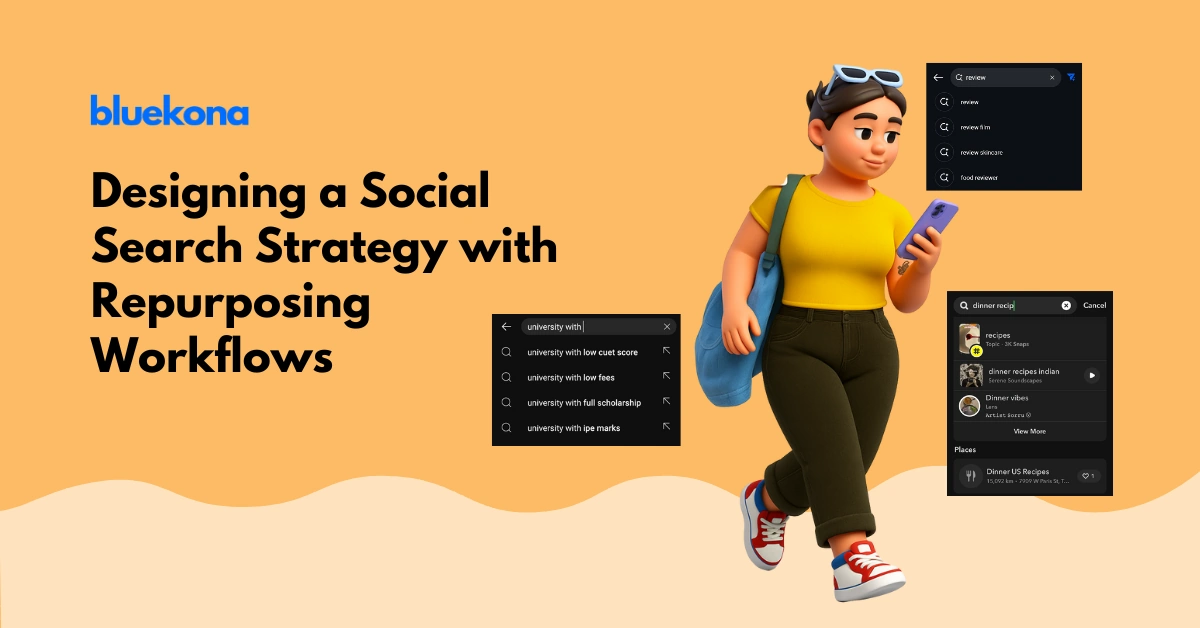
    How to Design Your Social Search Strategy with Repurposing Workflows

    Here’s a reality check: Google is no longer the starting point for product discovery.

    An entire generation has shifted their search behavior to TikTok, YouTube, and Instagram. They’re not typing “best running shoes” into Google—they’re scrolling TikTok reviews, watching YouTube unboxings, and swiping through Instagram carousels. For Gen Z, social platforms are the search engines.

    But most brands are still stuck in “post and pray” mode. They publish once, hope for engagement, and move on. The result? Content that vanishes into the feed instead of compounding into visibility.

    The brands that win social search know content isn’t disposable—it’s recyclable. They build repurposing workflows that transform a single asset into multiple searchable entry points across every platform like TikTok explainers, YouTube Shorts, Instagram carousels, LinkedIn posts, even Pinterest how-tos.

    This isn’t about chasing viral luck. It’s about engineering discovery—turning every blog, video, or podcast into an ecosystem of searchable content that works 24/7.

    The question is: will your brand keep treating posts like throwaways, or start building workflows that make you impossible to miss?

    Why Social Search > Traditional SEO in 2025

    The numbers don’t lie: traditional search is losing the discovery battle.

    • 90% of consumers now rely on social to track trends and discover products. This isn’t passive scrolling—it’s intentional, search-driven behavior that’s replacing the old Google funnel.
    • TikTok has dethroned Google as Gen Z’s go-to search engine. Instead of reading SEO blog posts, they’re watching 60-second creator reviews, searching hashtags, and scanning comments for unfiltered feedback. TikTok delivers authenticity at scale—something Google can’t replicate.
    • YouTube isn’t just for entertainment—it’s a 2.5B-user search engine. From “how to fix a leaky faucet” to “best budget smartphone 2025,” users treat it as the visual version of Google. With 3B+ monthly searches, it’s the second-largest search engine in the world.
    • Instagram is now a full-blown product discovery hub. With 61% of users researching purchases on-platform, discovery flows seamlessly into shopping via Stories, Reels, carousels, and tags.

    The shift is clear. SEO gives you answers, but social search gives you experiences. And for modern consumers, experiences win every time.

    The Problem with One-and-Done Posting

    Here’s the brutal truth: most brands are stuck in a “post once and vanish” cycle. They spend weeks creating a single piece of content, publish it, maybe cross-post once or twice—and then move on. Within 48 hours, that content is buried in the algorithm’s graveyard, never to be seen again. It’s the marketing equivalent of designing a billboard and hiding it in your basement.

    Over 80% of brand content is never repurposed. That means teams are treating every post as disposable while sitting on goldmines of insights, tutorials, and stories that could be multiplied into dozens of searchable touchpoints. In an attention economy, that’s not just wasteful—it’s strategically devastating.

    Without systematic distribution, even your best content is invisible in social search. TikTok, YouTube, Instagram—they reward consistency and omnipresence. Users don’t just want one perfect video or post; they look for brands that keep showing up with answers.

    The math is simple: create 100 posts, you get 100 chances to be discovered. Create 50 and repurpose each into 10 formats across platforms—you now have 500 chances. Guess which brand wins in social search?

    The leaders aren’t creating more content. They’re creating smarter workflows that turn every idea into an ecosystem of discovery.

    Social Search Optimization Through Repurposing

    The secret to winning social search isn’t pumping out endless new content—it’s multiplying the discoverability of what you already have. Every piece of content is a seed that can grow into a searchable forest—if you repurpose it strategically.

    Take a single blog post on healthy smoothie recipes. Instead of posting once and moving on, you can break it down into:

    • TikTok explainers answering “What’s the best smoothie for energy?”
    • YouTube Shorts showing quick recipe demos
    • Instagram carousels with ingredient breakdowns
    • FAQ snippets tackling questions like “Are smoothies good for weight loss?”

    Each one becomes its own searchable doorway into your brand.

    The key is phrasing content the way people actually search:

    • “Best smoothie recipes for weight loss”
    • “How to make a high-protein smoothie”
    • “Green smoothie vs fruit smoothie benefits”

    This isn’t just algorithm-friendly—it mirrors human behavior.

    Look at Prime drinks. They’ve turned user-generated content into a discovery engine. Instead of just reposting reviews, they remix them into search funnels: “Best Prime flavors,” “Prime vs [competitor] taste test,” “Why people choose Prime.” Each piece targets a different search intent while amplifying authentic customer voices.

    The result? They’re not betting on one viral hit. They’ve built a search ecosystem where every query has a Prime-related entry point. That’s the real power of repurposing.

    Platform-by-Platform Breakdown

    Each platform has its own search DNA, and winning brands repurpose content to match how users actually discover.

    TikTok

    TikTok is built for immediate, search-driven answers. Lead with searchable hooks like:

    • “POV: you need the best skincare routine”
    • “If you’re wondering how to meal prep…”

    Repurpose content into “best of” lists, quick explainers, and trending Q&As. TikTok’s search function prioritizes videos that answer queries directly, so packaging multiple tips into digestible clips multiplies discoverability.

    YouTube

    Think of YouTube as a dual search engine. Long-form tutorials capture high-intent queries, while Shorts act as snackable discovery tools. Smart brands pin their most searchable Shorts—like “Top 5 budget cameras 2025”—so they serve as permanent entry points that funnel viewers into deeper tutorials.

    Instagram

    Here, it’s about balance. Carousels = evergreen discovery. Each slide can hit different keywords while the whole post stays searchable long-term.

    Reels = immediate attention. They ride trending audio and hashtags to surface in Explore.

    LinkedIn

    LinkedIn rewards authority-driven repurposing. Turn insights into trend analyses, “lessons learned,” or frameworks broken down in carousel posts. This positions you as the expert people find when they search for professional growth and industry knowledge.

    Pinterest & Reddit

    These are the evergreen discovery engines. Pinterest thrives on “how-to” content, tutorials, and visual inspiration that users save with purchase intent.

    Reddit is the validation hub—repurpose content into comparison posts, authentic reviews, and community-friendly breakdowns that answer niche queries.

    The takeaway: Don’t just repurpose content. Reformat it to match each platform’s search psychology—that’s how you create a net that captures discovery everywhere.

    The Workflow That Wins

    Most brands overcomplicate content creation. The ones dominating social search run systematic workflows that multiply every asset into a network of discovery.

    1. Start with a high-value core asset. A blog, video tutorial, webinar, or case study—the “mother ship” packed with insights and answers people actually search for.
    2. Repurpose into 10+ formats. Not random reposts, but strategic multiplications. From one asset you can create:
      • TikTok quick tips
      • Instagram carousel breakdowns
      • YouTube Shorts
      • LinkedIn thought leadership posts
      • Pinterest visual guides
      • Reddit/FAQ-style explainers
        Each format mirrors different search behaviors while staying rooted in the same core message.
    3. Distribute with precision. Don’t scatter posts everywhere—map formats to platforms where they win. TikTok for snackable tips, Instagram for visual storytelling, LinkedIn for authority, Pinterest for evergreen how-tos.
    4. Measure and double down. Track what surfaces in search, drives saves, or fuels engagement. Then reinvest in those winning formats and scale harder.

    The result is a content multiplication effect: one strategic asset becomes dozens of searchable entry points across every platform. Instead of chasing endless new content, you’re building a system where your ideas keep resurfacing—making your brand not just visible, but unavoidable.

    The Automation Advantage

    Here’s the reality: everything we’ve outlined—repurposing, platform-specific optimization, systematic distribution, and measurement—takes serious time and coordination. Most teams can’t sustain it manually. That’s exactly why Bluekona exists.

    Bluekona automates the repurposing workflow that powers social search dominance. What used to take weeks of manual slicing, formatting, and scheduling now happens in minutes.

    The workflow becomes simple:

    • Create once → optimize everywhere.
    • Upload a blog, video, or podcast → Bluekona transforms it into TikTok hooks, Instagram carousels, YouTube Shorts, LinkedIn posts, and Pinterest-ready guides.
    • Every format is search-optimized with phrasing that matches how people actually look for solutions.

    The result? Every core asset turns into a comprehensive search funnel, multiplying your chances of discovery across every platform that matters. Instead of hoping one post hits, you’re systematically everywhere your audience is searching.

    The social search revolution isn’t coming—it’s here. The only question is whether you’ll try to keep up manually… or win with Bluekona’s automation.

  • How Duolingo Dominates Social Media Through Intelligent Content Reuse

    How Duolingo Dominates Social Media Through Intelligent Content Reuse

    If you’ve scrolled TikTok or Instagram lately, chances are you’ve met Duo, the green owl.

    Duolingo is everywhere. Reels, tweets, memes, YouTube Shorts — all spun from the same simple ideas, but adapted so cleverly they feel brand new every time.

    It’s tempting to chalk this up to luck. Viral mascots. Funny scripts. But that’s missing the point.

    Duolingo built a repeatable content system that reuses and repurposes content at scale, without losing authenticity. It’s a machine, not magic.

    Today, I’ll break down exactly how this system works, why it’s so effective, and how you can clone it for your own brand — even if you’re working solo and can’t afford a social media team.

    Step Inside Duolingo’s Content Machine

    Let’s pull back the curtain.

    One consistent mascot. One consistent brand tone. Yet they show up on ten different platforms with near-daily content.

    How?

    They’ve mastered low-fi content on purpose. This means quick videos, memes, screenshots, and trends with minimal production — but maximum relatability.

    They don’t reinvent the wheel daily. They repackage ideas instead of creating from scratch.

    That’s the real Duolingo social media strategy — reuse in a way that doesn’t feel reused.

    One Idea to Ten Outputs

    Here’s how their machine works in practice:

    • TikTok? Meme it with the owl dancing.
    • Twitter? Shrink it to a one-liner.
    • Instagram? Break it into a carousel with swipeable slides.
    • YouTube Shorts? Add a voiceover to the same footage.
    • Blog? Expand the concept with examples, then embed all the above.

    Most people come up with an idea and post it once. Duolingo runs it across 5–10 outputs, milking every drop of engagement.

    Duolingo repurposing

    Why This Works

    Let’s break down why Duolingo’s approach absolutely crushes it.

    Familiarity = Trust

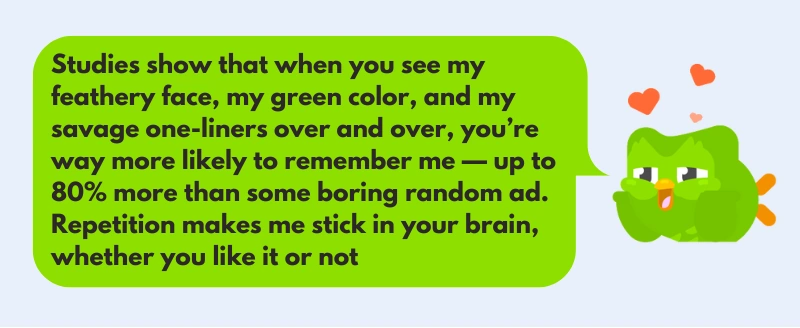
    When you see Duo’s chaotic, funny personality appear again and again — even in slightly remixed jokes — you start to trust it. Humans crave patterns. Psychologically, repetition makes a brand feel reliable and memorable.

    Think of it like a catchphrase on a sitcom. If Joey from Friends had said “How you doin’?” only once, no one would remember it. Because he repeated it, it became iconic. Duolingo does the same with its social voice.

    Duolingo Familiarity

    Platform Algorithms Love Volume

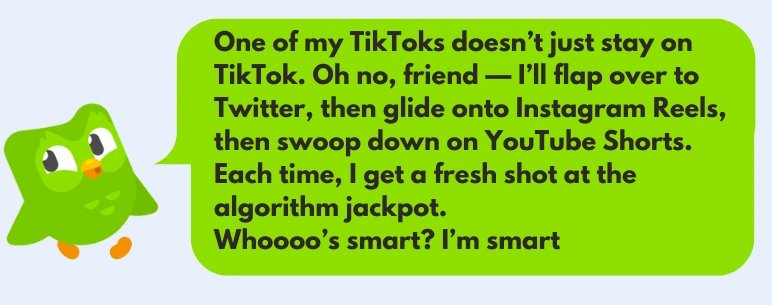
    If you post once, even a brilliant piece of content can get buried. Algorithms on TikTok, Instagram, YouTube, and Twitter reward volume + consistency, not just originality.

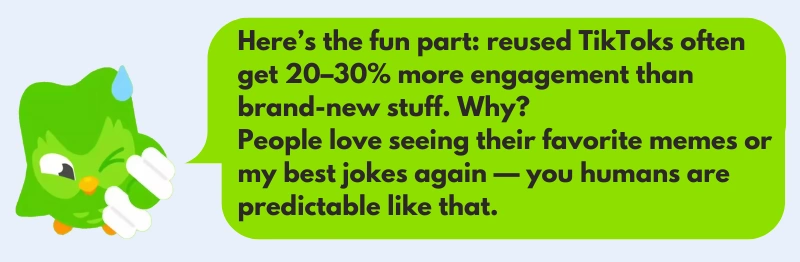
    Duolingo doesn’t create new ideas daily. They redistribute the same ideas in new formats, which triggers multiple algorithm boosts throughout the week.

    That means one concept can get surfaced to multiple audiences — on different days, on different platforms — rather than burning out in a single post.

    Duolingo Volume

    Speed > Perfection

    In a feed-driven world, perfection is a trap.

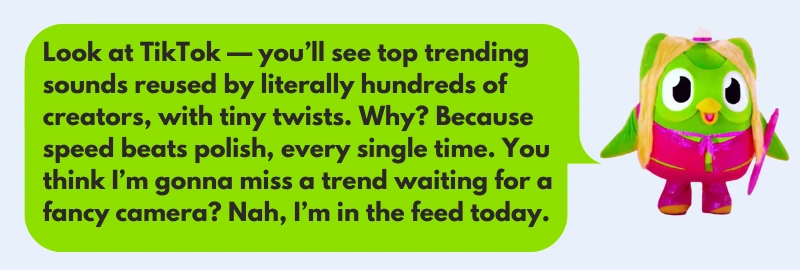
    If you spend weeks polishing, you’ll miss the trend window entirely. Duolingo ships content fast, then refines only if it sticks. That lets them ride cultural moments before they fade, with raw, authentic, relatable production.

    Think of their iPhone-shot videos filmed in a corner of the office. That “lo-fi” look is the point — it blends perfectly with the native feed, and avoids the overproduced, stale brand vibe people ignore.

    Duolingo Speed over Perfection

    Team Efficiency

    Here’s the secret to Duolingo’s insane output: they aren’t making more ideas, they’re multiplying them.

    If you build a system to slice, dice, and remix one idea into 5–10 platform-optimized posts, your team avoids burnout while publishing way more.

    That means:

    • Fewer approvals
    • Faster turnaround
    • More consistent brand voice

    And consistency builds familiarity, which brings us full circle to trust — the ultimate brand advantage.

    Duolingo Efficiency

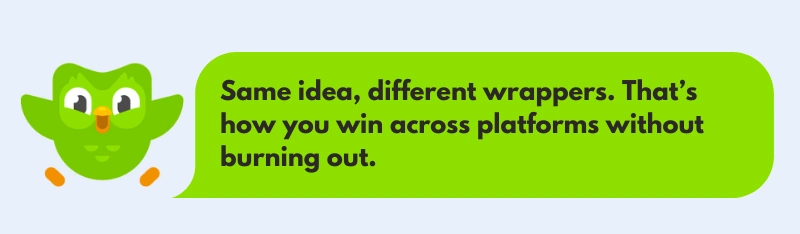
    Bottom line? Duolingo’s reuse machine works because

    • Audiences trust repetition
    • Algorithms reward frequency
    • Lo-fi speed beats polish
    • Your team (or you solo) can stay consistent without burning out

    It’s not luck. It’s a system — and it’s 100% stealable.

    Why Manual Repurposing Fails?

    Let’s get brutally honest, most people try to repurpose manually, and then quit. Here’s why that approach fails — almost every single time.

    Too Many Tools, Too Many Steps

    You’re writing scripts in Google Docs, then jumping over to Canva for graphics, then chopping video in Premiere, then adding captions by hand in yet another tool. It’s a productivity nightmare. Every switch costs you time, attention, and money — and slows your entire workflow to a crawl.

    Rewrites Feel Like Starting Over

    Ask any creator: taking a 1,000-word blog post and rewriting it for Twitter can feel like starting from scratch. Your brain freezes because it has to shift style, tone, and structure. It’s exhausting, and most people procrastinate rather than power through.

    Scaling Dies at the Second Platform

    Sure, you might repurpose manually for Instagram and TikTok. But what happens when you add Twitter? Or YouTube Shorts? Your system crumbles. Manually adapting every post to multiple platforms is simply too heavy to sustain at scale. Burnout is guaranteed.

    Creative Fatigue Sets In

    The final nail in the coffin: you feel like you’re repeating yourself over and over, even though your audience hasn’t even seen most of it yet. That disconnect kills your motivation. Creators burn out because they’re mentally exhausted trying to repackage the same message, worrying it’s stale, when in reality their followers still need to hear it.

    The right system, powered by AI or a structured repurposing framework, takes away all this friction. That’s how you achieve Duolingo-level consistency — without burning through your sanity or your budget.

    Clone the System: Do It Like Duolingo — Without a Team

    Alright, let’s get tactical. You know Duolingo’s secret, reuse with ruthless efficiency.

    Now let’s build your own version — even if you don’t have a team, a video editor, or a mascot suit.

    Here’s how to do it, step by step.

    1. Start with a Core Asset

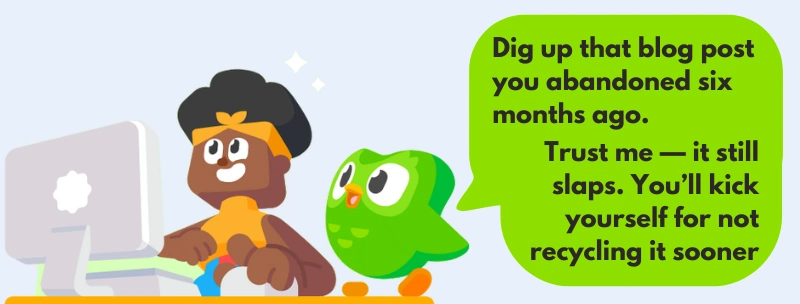
    Pick one piece of content. That’s it. It could be a blog post, a podcast episode, a YouTube video, or even an old newsletter you wrote months ago. You do not need to start from scratch — in fact, your old content is a goldmine just waiting to be reused.

    2. Drop It into Bluekona AI

    Take that asset and paste it straight into Bluekona. Then, pick the formats you want like a tweet thread, linkedIn post, instagram carousel, tiktok script, email subject lines

    No more blank page syndrome. No more struggling to rewrite the same idea 10 different ways.

    3. Instantly Get Platform-Optimized Outputs

    Bluekona doesn’t just regurgitate plain text — it actually reshapes your message to fit each platform’s native style, tone, length, and best-practice CTAs. That means less tinkering for you, and more shipping content that actually fits where it’s going.

    4. Polish & Post

    Now you’re working with drafts that are already 80% finished, instead of facing a cold, empty doc. Your only job is to add any final personal touches and hit publish.

    duolingo Advice

    Wrap-Up

    Let’s make this crystal clear. Duolingo isn’t magical. They aren’t riding on lucky viral moments. They’re methodical, consistent, and ruthlessly efficient at squeezing every ounce of value out of their ideas.

    You don’t need a green owl costume to pull this off. You just need a system — a repeatable machine that helps you reuse, repackage, and remix what you’ve already created.

    And remember, reusing isn’t cheating. It’s the smartest move you can make. You’ve already put in the hard work once. Why let it fade after a single post?

    Your best ideas deserve more life, more reach, and more engagement — without burning you out.

    Don’t create more. Repurpose better.

    Start with Bluekona AI.

  • Why Your Repurposed Content Isn’t Working — And How AI Fixes That

    Why Your Repurposed Content Isn’t Working — And How AI Fixes That

    “Create once, repurpose forever.” It sounds brilliant in theory. But in practice? Most content repurposing is just copy, paste, repost, pray.

    Let’s be honest. That’s not strategy. That’s desperation masked as productivity.

    The real problem isn’t that you’re repurposing content. It’s that you’re doing it manually, inefficiently, and without any learning loop.

    Here’s the kicker: AI can take the same core content and actually make it work across platforms. Let’s break down why your current repurposing workflow is wasting your time, and how AI transforms it into a scalable system.

    What Does “Content Repurposing” Actually Mean?

    Real content repurposing isn’t a blind copy‑and‑paste marathon. It’s a three‑step process:

    1. Reformat – Change the structure to fit the new channel. Turn a 1,500‑word blog post into a 10‑tweet Twitter thread or a 30‑second reel script.
    2. Reframe – Shift the angle or tone so it resonates with that audience. A B2B LinkedIn carousel might lean on data and case studies but the same core idea on Instagram could lean into storytelling or behind‑the‑scenes visuals.
    3. Redistribute – Publish with the right timing, metadata, and hooks. A YouTube Short needs a punchy title and thumbnail whereas an email snippet needs a compelling subject line and preview text.

    But What Most Marketers Are Doing Is

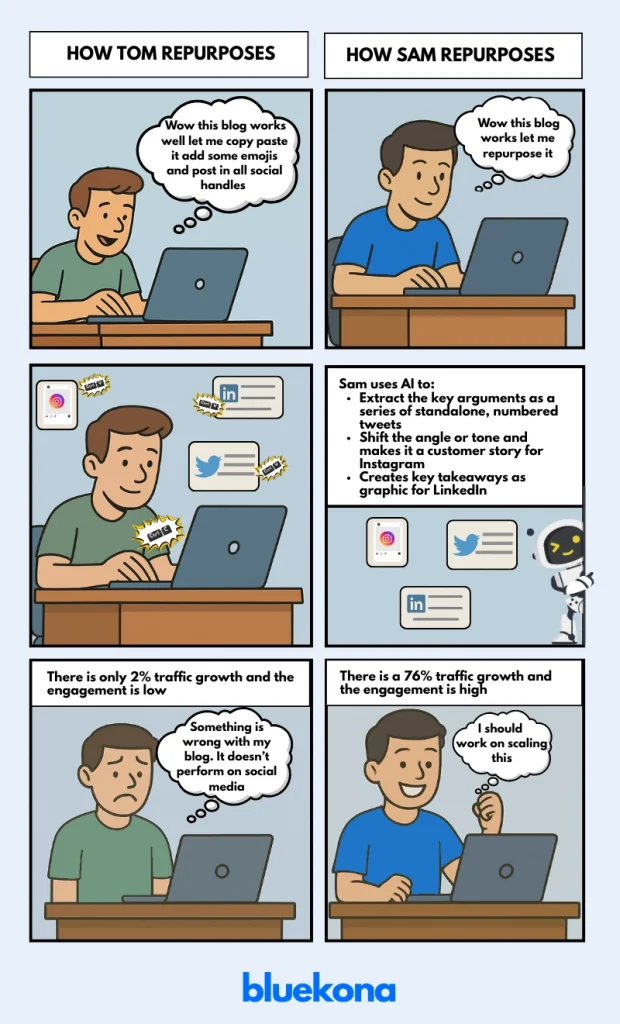
    Open your blog post, hit CTRL+C, switch to LinkedIn, hit CTRL+V—maybe swap a word or two—and hit Publish. Rinse and repeat for every channel.

    That’s not repurposing. That’s syndication with zero strategy.

    True repurposing = reformat + reframe + redistribute.

    Why Traditional Repurposing Fails (Hard Truths)

    Manual vs AI Repupose Content Comic

    1. No Learning Loop

    Without tracking what performs, you’re flying blind. You churn out variations, cross your fingers, then rinse and repeat. An AI-driven process, by contrast, learns which formats hit and doubles down—turning every post into a smarter, compounding investment.

    2. No Channel Context

    Treating every social channel the same is like speaking French in Spain. A Twitter thread thrives on rhythm and punchy hooks. An Instagram caption lives on crisp visuals and a killer one-liner. A YouTube description? It’s a search-optimized pitch. Same core idea—different languages.

    3. Repetition Kills Engagement

    Seeing the identical message on every platform is like hearing the same song on repeat. Audiences tune out. If your followers catch you copy-pasting blog paragraphs into their feeds, they’ll scroll past in seconds.

    4. Time Sink with Minimal ROI

    Manually slicing and dicing content for each channel eats up six-plus hours a week. That’s not something that can be scaled up.

    How AI Fixes Content Repurposing (and Makes It Compound)

    1. Learning from What Works

    Every click, comment, and share feeds back into the system. AI tracks which formats, styles, and tones hit the mark and refines future outputs accordingly. Over time, your repurposing engine becomes a self-learning flywheel—compounding results with every cycle.

    2. Channel-Specific Adaptation

    AI doesn’t just chop down your blog paragraph, it recrafts it as a tweet hook, a slide headline, or a meme caption, depending on the platform. No more awkward one-size-fits-all posts.

    3. Infinite Angles

    Want fresh spins on the same core idea? AI can flip your blog into a punchy listicle, or a visual quote series—in minutes, not hours. It’s not just about pumping out more content it’s also about creating smarter variations that resonate.

    4. Built-In Distribution

    Modern AI tools handle publishing natively, (i.e) queuing up posts, optimizing send times, and pushing to each channel in one streamlined flow. It’s your automated traffic cop, keeping every piece of content on schedule.

    What to Look For in a Good AI Repurposing Tool?

    1. Context-Aware Content Transformation

    The tool should read your source material and intelligently reshape it for each channe, rather than you fumbling with mismatched pieces.

    2. One-Click Distribution Across Platforms

    You shouldn’t need separate apps for LinkedIn, Twitter, Instagram, and email. Look for native publishing so you hit “Go” once, and your content lands everywhere on schedule.

    3. Performance Feedback Loop

    Every post is a data point. Your repurposing engine should feed engagement metrics back into its AI brain, so it learns what works and doubles down on high-ROI formats.

    4. Zero Frankenstein Stack

    If you’re juggling Chat GPT, Buffer, Zapier, and three other tools just to publish a single thread, you’re wasting time. The right AI repurposing platform bundles creation, scheduling, and analytics under one roof—no duct tape needed.

    Spoiler: bluekona was built to do exactly this.

    Wrap Up

    You don’t need more blog posts. You need to squeeze 10× value from the ones you’ve already written.

    Manual repurposing is a dead end. AI is the fast lane.

    With BlueKona, your content becomes a growth asset and not a one-off experiment.

    Give it a spin for free and watch your best ideas work harder.