Category: Marketing

  • AI Content Disclosure, Does Labeling AI-Assisted Posts Build Trust or Kill Reach?

    AI Content Disclosure, Does Labeling AI-Assisted Posts Build Trust or Kill Reach?

    Somewhere in your feed right now sits a caption that reads a little too polished and a little too fast to have been typed by hand. You scroll past without deciding whether a human or a tool wrote it, mostly because you cannot tell, and the brand that posted it never said either way.

    That uncertainty is the normal state of social media in 2026. AI tools have moved past the experimental phase inside marketing teams and into daily habit. 87% of marketers now use AI for social media, and 89.7% of social media professionals reach for an AI tool several times a week, according to Sociality.io’s 2026 AI in Social Media Marketing report. The tools are no longer a novelty. They are the default first draft.

    What has not settled is what brands owe their audience once that draft goes live. Do you say a caption started as a prompt. Do you mention a product image was generated instead of shot. The platforms are now answering that question whether marketing teams like it or not, and the consumer data on what happens next is messier than most teams expect.

    91% of consumers expect brands to disclose AI use in marketing, yet only 20% of brands always do Fractl, 2026 AI Search Consumer Trust Study
    31% say visible AI-generated content makes them trust a brand less, versus 7% who trust it more Fractl, 2026
    50% of Gen Z have unfollowed, muted, or blocked an account they believed was posting AI content Sprout Social, Q1 2026 Pulse survey

    Why This Question Won’t Go Away in 2026

    Every content calendar built this year runs into the same quiet decision point. A tool helped write this caption, clean up this photo, or generate this video clip. Saying so used to feel optional, almost like admitting you used a spellchecker. It no longer works that way.

    Platforms have started making the choice for brands, and audiences have opinions that do not sit still long enough to build a simple rule around. A founder posting three times a week does not have the bandwidth to run a research study before every post. What they need is a clear read on what the data actually says, and a workable policy they can apply without overthinking each caption. That is what the rest of this piece is built to give you.

    The tension worth naming early is this. Consumers say, loudly and consistently, that they want transparency. Then, in the same surveys and in controlled studies, they respond to visible AI labels by trusting the content less and engaging with it less. Holding both of those facts at once is uncomfortable, but it is also the actual situation SMB marketers are operating inside right now.

    Delphi, Bluekona AI mascot

    People say they want the truth about your content, then they get grumpy the second they actually see it. Welcome to marketing in 2026.

    What the Platforms Now Require

    Brands debating whether disclosure is worth the trust hit are increasingly finding the decision made for them. Each major platform has landed on a different enforcement model, and the differences matter for how much control a small team actually has.

    TikTok’s Automated Detection

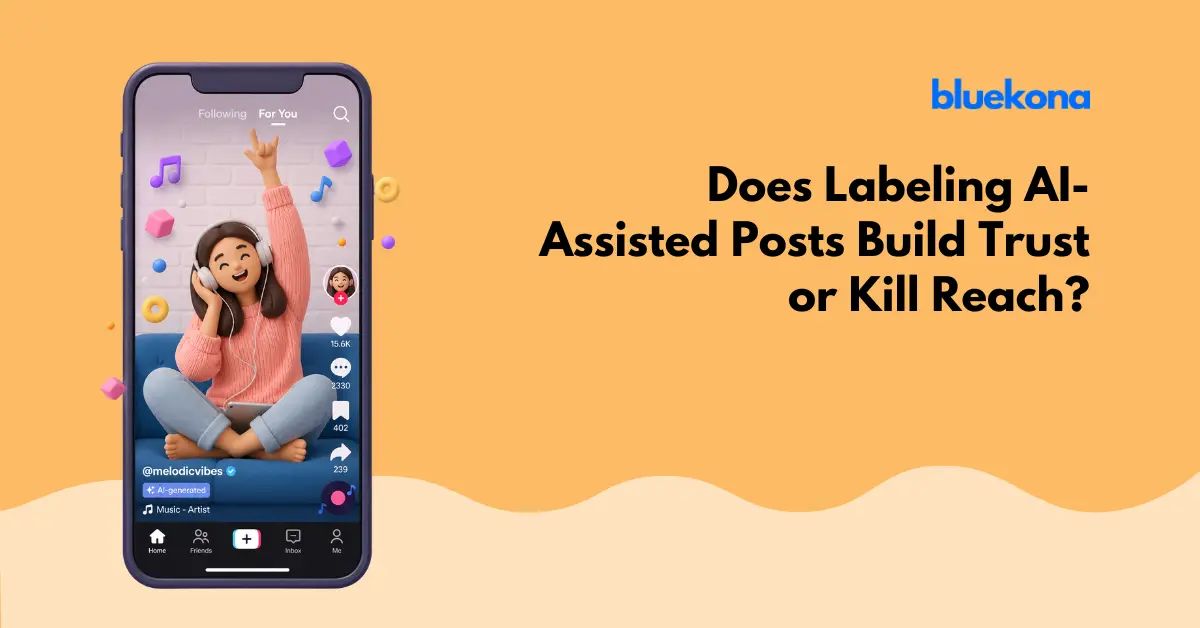
    TikTok now requires visible labels on AI-generated visuals and audio that depict realistic people or scenes. The platform reads C2PA Content Credentials to catch synthetic media automatically, even when a creator skips the disclosure step entirely. After three unlabeled AI videos, TikTok cuts account reach by roughly 60% for 30 days and pauses Creator Fund earnings during that window.

    Meta’s In-Post Tag

    Meta unified its AI content rules across Instagram and Facebook in February 2026. Disclosure now has to appear as a tag above the post itself, separate from the caption, similar in placement to a paid partnership label. Burying an AI disclosure in the ninth line of a caption no longer satisfies the requirement.

    YouTube’s Manual Flagging

    YouTube still relies on creators to flag AI-generated content themselves, with penalties building for repeated failure to disclose. It is the least automated of the three systems, which puts more responsibility, and more room for judgment calls, on the creator.

    PlatformDisclosure methodDetectionPenalty for skipping it
    TikTokVisible label on synthetic visuals or audioAutomatedReach cut ~60% for 30 days after 3 violations
    MetaIn-post tag above the contentManualContent restrictions, tag added if missed
    YouTubeCreator-flagged disclosureManualEscalating penalties for repeat non-disclosure

    The Trust Data Is a Contradiction

    What Consumers Say They Want

    Ask people directly and the answer is close to unanimous. 91% of consumers expect brands to disclose when AI played a role in their marketing, according to Fractl’s 2026 AI Search Consumer Trust Study. Yet only 20% of organizations always disclose, and 33% never do. That gap between what audiences expect and what brands actually deliver is the real starting point for any disclosure policy.

    What Happens When They See the Label

    Here is where it gets uncomfortable. The same Fractl research found that only 7% of consumers say visible AI-generated content makes them trust a brand more, while 31% say it makes them trust the brand less. Wanting transparency in principle and rewarding it in practice turn out to be two different behaviors.

    The Real Question Isn’t Whether to Disclose

    Platforms have already removed “quietly hide it” as a viable long-term option. The actual decision left for SMBs is what to disclose, how specifically, and how that disclosure is worded, since those choices are what separate a trust-building label from a trust-damaging one.

    TikTok reading your content’s digital fingerprints means hiding AI use isn’t a strategy anymore. It’s just a risk you’re choosing to take.

    Delphi, Bluekona AI mascot

    Why Labels Sometimes Kill Reach (and Sometimes Don’t)

    Recent academic work on AI content labeling adds useful nuance to the blunt trust numbers above. Studies published through 2026 found that labeling content as AI-generated or AI-assisted reduced both emotional and behavioral engagement compared to unlabeled human-created content, especially for posts built around an emotional hook. Once someone knows a post came from a tool, they respond to it differently, often less warmly.

    But at least one study found a more encouraging pattern sitting underneath that headline result. Disclosure had a positive moderating effect on the relationship between content inauthenticity and engagement, meaning that when the underlying creative was strong, labeling it as AI-assisted protected engagement rather than tanking it. The label itself is not automatically the problem. A weak, obviously synthetic post that also gets labeled tends to underperform twice over. A strong, well-made post that gets labeled tends to hold up.

    This is the piece most SMBs miss when they read a scary headline about AI labels killing reach. The label is not erasing good content. It is removing the cover that let mediocre content coast on ambiguity. If you have been relying on your audience not noticing the difference, that grace period is closing. If you are using AI tools well, inside a real content lifecycle rather than as a shortcut around effort, disclosure is far less risky than it looks on paper.

    The Gen Z Problem

    The demographic split in this data deserves its own section because it changes the calculus depending on who your audience actually is. Half of Gen Z say they have unfollowed, muted, or blocked an account because they believed its content was AI-generated. That is not a mild preference. That is an active rejection behavior, and it is concentrated in exactly the age group most SMBs are trying hardest to reach on Instagram, TikTok, and Threads.

    Older audiences, by contrast, tend to respond more to whether the content is useful and well made than to whether a tool touched it along the way. A brand serving a 45-plus audience on Facebook is working with a very different risk profile than a brand chasing 19-year-olds on TikTok. Your disclosure policy should account for that split rather than applying one blanket rule across every platform you post on.

    A Disclosure Framework for SMBs (What to Label, What Not To)

    The distinction that actually matters is not “did AI touch this content” in some abstract sense. Nearly every post touches AI somewhere now, whether that is a grammar check, a scheduling tool, or a caption idea. The distinction that matters is between AI-assisted work, where a human wrote the real substance and used a tool to speed up production, and AI-generated work, where the tool produced the core content itself, especially realistic images, video, or audio of people.

    Skip the disclosure

    Using AI to brainstorm caption ideas you then rewrote yourself. Using AI to resize or color-correct a photo you actually shot. Using AI for grammar and spell checking.

    Disclose clearly

    A fully AI-generated image or video, especially one depicting a realistic person. AI-written copy that ran with no meaningful human edit. A synthetic voiceover standing in for a real person.

    That split lines up with what most consumers actually seem to object to. The trust data is not punishing brands for using a grammar checker. It is punishing brands for letting a fully synthetic image or video pass as authentic without saying so. Framing your policy around this distinction, rather than trying to disclose every single tool touchpoint, keeps you honest without turning every caption into a legal disclaimer.

    How to Disclose Without Undercutting Your Own Content

    Wording matters more than most brands assume. A flat, generic label like “AI-generated content” reads as a compliance stamp and does little to build trust on its own. A specific, human sentence does more work. Something like “we used AI to help draft this caption, then edited it ourselves” tells your audience exactly what happened and signals that a person was still involved and cared about the result.

    1. Be specific about what the tool did.

      “AI-assisted” tells your audience nothing on its own. “AI helped generate the visuals, our team wrote the copy” tells them everything they need.

    2. Put the disclosure where the platform expects it.

      Follow Meta’s in-post tag placement or TikTok’s on-screen label rather than burying a mention deep in the caption, since audiences and moderation systems both read prominent placement as more honest.

    3. Pair disclosure with your strongest creative, not your weakest.

      Since the research shows labels protect engagement when the underlying content is strong, do not save disclosure practice for your lowest-effort posts.

    4. Test the wording itself. 

      Treat disclosure language like any other content variable. Run one version against another the same way you would test a hook, following the same one-variable-at-a-time approach covered in our piece on organic content experiments without a budget.

    Delphi, Bluekona AI mascot

    Disclosure isn’t a confession booth. It’s a chance to remind people a real person is still steering the ship, and that’s worth saying out loud.

    Turning Transparency Into a Trust Advantage

    Most of the brands your audience follows are still treating disclosure as a liability to minimize rather than a habit to build. That gap is an opening. A brand that discloses clearly, pairs that disclosure with genuinely strong creative, and keeps a real human voice active in the process is doing something the majority of accounts in any given feed are still avoiding.

    This only works as a long-term habit if you are also watching how your audience actually responds, not just guessing. That is where a real human brand approach and consistent auditing work together. You cannot fix a disclosure policy you are not measuring, and most small teams have no clean way to see whether a labeled post is landing differently than an unlabeled one across YouTube, Instagram, Facebook, and Threads at once.

    Brands that treat AI as one tool inside a broader strategy, rather than the whole strategy, tend to scale with AI without losing the trust that got them followers in the first place. Disclosure is not the enemy of growth. Sloppy, unexamined use of AI is. Get the distinction right, and transparency becomes one more reason your audience sticks around instead of one more reason they scroll past.
  • How Often Should SMBs Actually Post? What 2026 Data Says

    How Often Should SMBs Actually Post? What 2026 Data Says

    Every SMB marketing team has stared at a blank content calendar and asked the same question. How many times a week do we actually need to post? Ask ten agencies and you get ten different numbers. Ask an algorithm update and the number changes again next quarter. The good news is that fresh 2026 data gives a much clearer answer than most advice columns offer, and it has almost nothing to do with hitting a magic number.

    This article breaks down what the newest research says about posting frequency on Instagram, Facebook, and YouTube. It also explains why the “right” number is different for every account, and how to stop guessing and start using your own engagement data instead.

    Why “Post Every Day” Became the Default Advice

    The daily posting rule got popular for an honest reason. Early social algorithms rewarded raw activity, and agencies with big teams that posted constantly grew fast. Smaller teams copied that playbook without asking whether it fit their resources or their audience.

    Most SMB teams don’t have an agency’s headcount. A founder running marketing solo, or a two-person team splitting content across four platforms, doesn’t have the bandwidth to post daily on Instagram, Facebook, and YouTube at once. Following advice built for a fifteen-person social team usually leads to burnout, rushed content, and a feed full of filler posts nobody engages with.

    Delphi, Bluekona AI mascot

    Posting five times a day just to look busy is like a fish swimming in circles. Looks like effort, goes nowhere.

    What the 2026 Data Actually Shows

    Buffer’s 2026 State of Social Media Engagement report analyzed more than 52 million posts across ten platforms, collected between 2024 and 2025. It is one of the largest posting frequency studies available, and its findings are more useful than any single “post X times a week” rule.

    450%
    More engagement per post for accounts posting in 20 or more of 26 weeks
    Buffer, State of Social Media Engagement 2026
    66%
    More subscribers for YouTube channels posting 12 or more times a month
    VidIQ, 2026 channel analysis
    42%
    More engagement on Threads for accounts that reply to comments
    Buffer, State of Social Media Engagement 2026

    Consistency Beats Volume

    The single biggest factor in the Buffer study was not posting frequency. It was consistency over time. Accounts that posted in at least 20 of the 26 weeks measured saw roughly 450 percent more engagement per post than accounts that posted in four weeks or fewer. Accounts that posted somewhere in between, five to nineteen weeks, still saw about 340 percent more engagement than sporadic posters.

    That gap is bigger than the difference between any two specific posting frequencies. A brand that posts three times a week, every single week, will likely outperform a brand that posts daily for two weeks and then disappears for a month. This is exactly the pattern Bluekona’s own research on content velocity versus content quality points to as well.

    Showing up three times a week, every week, beats showing up daily until you get tired and vanish for a month. Consistency is the actual flex.

    Delphi, Bluekona AI mascot

    Platform by Platform Benchmarks

    Once consistency is locked in, platform benchmarks are a useful starting point for how much to post. Here is what recent research points to for the platforms Bluekona covers.

    PlatformRecommended FrequencyWhat the Data ShowsImpact
    Instagram3 to 5 feed posts weekly, plus 2 to 4 ReelsIn-feed posts perform best around 3 to 5 times weekly, while Reels need higher frequency to sustain reachHigh Impact
    Facebook1 to 2 posts per dayA HubSpot study of over 13,500 Facebook users found this frequency performs bestModerate
    YouTube Shorts3 to 5 Shorts weeklyChannels posting 12 or more times monthly gain 66 percent more subscribersHigh Impact

    Where the Returns Start Shrinking

    Buffer’s data also shows a real ceiling. Moving from one post a week to two to five posts a week produces a strong lift in views per post. Posting six to ten times a week adds more gains, but each additional post adds less than the one before it. Beyond that point, reach per individual post tends to decline even as total account activity climbs.

    In plain terms, more posts grow an account’s total reach, but each post reaches a shrinking slice of the audience. That tradeoff works fine for teams with the capacity to sustain it. It becomes a losing trade the moment it means every post gets less thought than the last one, a pattern covered in more depth in the problem with social media metrics.

    Quick Takeaway

    More posts grow total reach. Fewer, stronger posts grow reach per post. Pick the tradeoff that fits your team’s actual capacity, not the one that sounds most impressive in a meeting.

    Why the Right Number Is Different for Every Account

    Platform benchmarks are averages pulled from millions of accounts across every industry imaginable. Your account is not average. A dental practice’s audience checks Instagram differently than a beverage brand’s audience does. A B2B founder’s LinkedIn habits look nothing like a consumer brand’s Facebook habits.

    The benchmarks in this article are a reasonable starting point if you have no other information. But the moment you have a few weeks of your own posting history, your own numbers should carry more weight than any industry study, including this one.

    Works Well

    Posting Based on Your Own Data

    You track which formats and days actually drive engagement, then adjust your plan to match your audience.

    Falls Short

    Posting Based on a Generic Rule

    You copy a frequency number from a blog post or competitor and apply it regardless of your own audience behavior.

    How to Find Your Own Optimal Cadence

    Figuring this out manually means exporting data from several analytics dashboards, lining it up in a spreadsheet, and hoping a pattern appears before the quarter ends. Most SMB teams don’t have the hours for that, so they default to a generic number and hope for the best. This is the exact gap explored in tracking content performance across platforms without a spreadsheet or analyst.

    A cross-platform audit handles that comparison automatically. Instead of guessing whether Tuesday or Thursday works better for Instagram Reels, or whether a Facebook page is quietly overposting, you get a direct read on which days, formats, and frequencies are driving real engagement and leads on your specific accounts. Understanding how dwell time quietly controls reach also helps explain why some high-frequency accounts still underperform lower-frequency ones.

    A Realistic Weekly Posting Plan for Lean Teams

    For a founder or small team managing Instagram, Facebook, and YouTube without a dedicated analyst, a sustainable starting cadence looks like this. Three feed posts and two to three Reels on Instagram each week. Five posts a week on Facebook, spaced out rather than batched into a single day. Two to three YouTube Shorts a week, treated as a discovery tool for new viewers rather than an update reserved for existing subscribers.

    None of those numbers are fixed rules. They are a starting point to test for four to six weeks, then adjust once real engagement data shows what is actually working, an approach covered in detail in balancing content velocity and quality in the AI era.

    Batching production and batching publishing are two different things, and mixing them up is where a lot of lean teams burn out. Sitting down once a week to film and write several pieces of content is efficient. Publishing all of them on the same day is not, since it spreads a week’s worth of effort across a single 24-hour window instead of letting each post earn its own attention. Spacing scheduled posts across the week, even when they were all created in one sitting, tends to protect reach without adding any extra production time.

    Frequently Asked Questions

    Is it possible to post too often?

    Yes. Data shows reach per post can decline past a certain frequency, and audiences tend to tune out repetitive or overly promotional content. More posts should never come at the cost of quality.

    What happens if a team misses a week?

    One missed week will not undo months of consistent posting, but repeated gaps hurt more than most teams expect. The 2026 data shows accounts posting in fewer than a third of the weeks studied saw dramatically lower engagement than consistent posters.

    Should every platform get the same posting frequency?

    No. Facebook, Instagram, and YouTube reward different cadences and formats, which is exactly why platform-specific and account-specific data matters more than a single blanket number pulled from a general study.

    How long does it take to see whether a new cadence is working?

    Most accounts need four to six weeks of consistent posting before a new cadence produces a reliable read. Shorter test windows tend to get thrown off by a single viral post or a slow news week, so patience matters as much as the plan itself.

  • Your Threads Strategy Is Missing This One Thing (And Your Audit Will Prove It)

    Your Threads Strategy Is Missing This One Thing (And Your Audit Will Prove It)

    Here’s a quick question. When did you last post on Threads? If you had to think about it for more than three seconds, you already know something is off. Most SMB owners have the same Threads story. They signed up, posted a few times, noticed nothing much happened, and quietly moved on. The account exists. It just doesn’t do anything. The platform isn’t the problem. The strategy is.

    400M+
    Monthly active users by Aug 2025
    6.25%
    Median engagement rate, vs 3.6% on X
    127.8%
    YoY growth in daily active users through June 2025

    Threads crossed 400 million monthly active users by August 2025, up from 275 million just eight months earlier. Daily active users surpassed X on mobile for the first time in 2025. This is not a dying platform. This is a platform where most brands are simply showing up wrong. The thing they’re missing isn’t more content. It’s conversation.

    Threads Is Growing Fast – But Most Brands Are Treating It Like a Leftover

    When Threads launched in 2023, a lot of brands treated it as an Instagram overflow channel. Post the same content, same captions, same graphics. What happened, mostly, was nothing.

    Threads has its own tone, its own rhythm, and its own algorithm. Brands that mapped Instagram habits onto it found that polished graphics underperformed. Scheduled batches of promotional content got ignored. Follower counts crept upward without any meaningful engagement behind them.

    The platform rewards something that most social media workflows aren’t built to produce at all.

    Delphi, Bluekona AI mascot

    Most brands treat Threads like a party where they post a flyer on the door, stand in the corner checking their phone, and then wonder why nobody came over to talk. Showing up is not a strategy. Showing up and saying something is.

    The One Thing Most Threads Strategies Are Missing

    The missing piece isn’t a content calendar, a hashtag strategy, or better visuals. It’s replies. Specifically, replies per post – which the Threads algorithm weights more heavily than any other signal as of mid-2025, according to RecurPost and Metricool.

    The gap in plain terms – Most brands treat Threads like a broadcast channel. They post, move on, and check back in a week. The algorithm sees zero conversation activity and stops pushing the content beyond existing followers. The gap is not the quality of what you post. It’s what happens after.

    Why the Algorithm Weights Replies So Heavily

    By mid-2025, Meta shifted the For You feed toward a recommendation-driven model that surfaces content based on engagement signals, topic relevance, and conversation quality rather than follower count. This is significant for small brands. A brand with 500 followers can reach thousands of people if the conversation on their post is active enough.

    The flip side is equally true. A brand with 50,000 followers and a ghostly comment section will reach almost nobody outside their existing audience.

    What Brands Actually Get Wrong When They Show Up on Threads

    Beyond the reply issue, there’s a tone problem. Threads rewards candid, direct, slightly unpolished communication that feels like a person wrote it rather than a content team. Over-produced content and generic brand-voice copy underperform consistently.

    If you want to understand what hooks actually work in that first moment of attention, the same principle applies on Threads as anywhere else – read more in our breakdown of the first 3 seconds of a social media post.

    What doesn’t work

    Repurposed Instagram graphics, scheduled promotional captions, one-way announcements with no question or hook, link posts that push users off-platform.

    What works

    Direct opinions, industry observations, questions that invite pushback, behind-the-scenes text posts, replies to niche accounts with real audiences.

    Threads does not care how many times you posted this week. It cares how many conversations you started. There is a significant difference between those two things, and your reach will tell you exactly which one you have been doing.

    Delphi, Bluekona AI mascot

    What a Threads Audit Actually Reveals

    Most brands assume they know what they’re doing on Threads. The audit usually reveals something more honest, and occasionally more humbling. The gap between what you think your posting cadence looks like and what the data actually shows tends to be wide.

    If you’ve wondered whether an AI-powered audit is faster and more accurate than pulling the data yourself, we covered that comparison in depth in this breakdown of AI vs manual social media audits.

    Posting Cadence and Consistency Gaps

    The first thing an audit surfaces is your actual posting frequency versus what you remember posting. Most accounts think they post more often than they do. Significant gaps – sometimes weeks without activity – reset any momentum the algorithm had built. Consistency beats volume. Posting twice a week reliably outperforms ten posts in one week followed by three weeks of silence.

    Content Format Performance

    Threads supports text posts, photos, links, and videos. They don’t all perform equally. Most SMBs lean too heavily on link posts, which get the least traction because they ask users to leave the platform.

    Format Engagement Performance Reach Impact
    Photos Best performer 60% above text-only
    Text posts Solid Good when conversational
    Videos Variable Strong when short and native
    Link posts Lowest 37% below photos

    WebFX, 2025 Threads Marketing Benchmarks

    Reach vs Engagement Disconnect

    This is the finding that surprises people most. It’s possible to have a healthy engagement rate on Threads and still have flat or declining reach. Strong likes and reposts from existing followers keep your rate looking decent. But if nobody outside your circle is continuing conversations you started, the algorithm won’t push your content to new audiences. Reach growth on Threads requires outbound conversation activity, not just good content waiting to be noticed.

    Delphi, Bluekona AI mascot

    The audit does not lie. Your engagement rate looks fine because your existing followers are loyal. Your reach is flat because you have not talked to anyone new. Those are two very different problems, and only one of them shows up when you just check your notifications.

    What a Winning Threads Presence Looks Like for an SMB

    Tone and Voice – Personality Over Polish

    Threads users respond to content that sounds human. Shorter sentences, direct opinions, questions, observations, and the occasional take that invites pushback. You don’t need a design team or a videographer. You need a point of view and the willingness to express it. A local bakery posting “Sourdough starter that’s three years old hits different in winter. Anyone else notice this?” will outperform a branded promotional graphic every single time.

    The Reply Strategy That Expands Your Reach

    The most efficient thing you can do on Threads isn’t post more. It’s reply more. Reply to your own posts when people comment. Reply to posts from accounts in your niche. Start conversations in the replies of larger accounts whose audiences overlap with yours.

    The 15x reach multiplier – Companies that enable team members to engage with branded content on Threads see 10 to 15 times the organic reach of brand account posts alone, according to inBeat Agency’s 2026 research. Even solo founders who block 10 to 15 minutes daily for Threads replies – not posting, just responding – tend to see measurable reach growth within two to three weeks.

    Cross-Platform Leverage From Your Instagram and Facebook Presence

    If you already have an active Instagram or Facebook account, Threads has a structural advantage built in. Meta’s ecosystem makes cross-promotion between platforms easier than anywhere else. Your existing audience can follow you on Threads with minimal friction, and Meta’s infrastructure treats activity across all its platforms as connected signals.

    For SMBs that have spent years building a Facebook or Instagram following, Threads is one of the highest-leverage organic platforms available right now. The foundational work is already done. You can see how this connects to a broader cross-platform approach in our Facebook Business Page audit guide, which covers what cross-platform data reveals when you audit together rather than in silos.

    How to Use Your Audit Results to Fix It

    A complete Threads audit should surface five things. Your posting frequency and consistency over the past 90 days. Your content format breakdown and how each format performs for your specific account. Your average engagement rate versus platform benchmarks. Your reply rate when people engage with you. And how your reach has trended over time.

    From there, the fix is straightforward. Inconsistent posting? Set a minimum of two posts per week and hold it before adding more. Link posts dragging engagement down? Replace them with photos or plain-text observations. Reply rate near zero? Block fifteen minutes a day for engagement only – no posting, just responding.

    Once you know which content formats are working on Threads, the next step is to build those formats into a repurposing workflow so the same insight can work across your other platforms. Our guide on measuring the ROI of content repurposing walks through how to connect those dots, and our social search strategy and repurposing workflows post shows what that looks like in practice.

    Act before the window closes – Meta launched Threads ads globally in January 2026. When platforms move from growth to monetization, organic reach tightens in the months that follow. Brands with strong engagement signals baked in now will hold their reach better than those who wait. The window is still open. It won’t stay that way.

    BluekonaAI runs cross-platform audits across Threads, Instagram, Facebook, and YouTube, surfacing your actual cadence gaps, format performance, and reach trends in minutes.

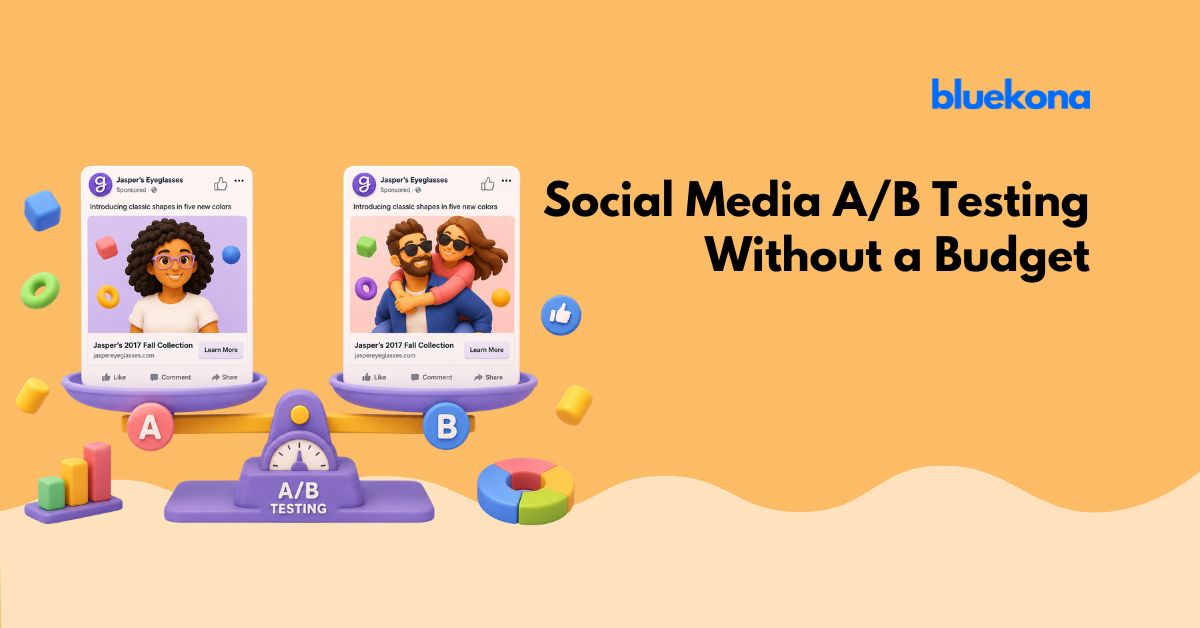
  • Social Media A/B Testing Without a Budget: How to Run Organic Content Experiments That Actually Teach You Something

    Social Media A/B Testing Without a Budget: How to Run Organic Content Experiments That Actually Teach You Something

    Most teams assume A/B testing belongs in the paid ads world. And honestly, that assumption makes sense. Paid gives you a clean split. Two versions, two audience groups, one clear winner. Organic social does not work that way. You cannot divide your audience. You cannot post two versions at the same time and measure them side by side.

    So most content teams skip experiments entirely and go with gut feel instead.

    That is where growth stalls.

    You do not need a paid budget to run meaningful content experiments. You need a system. And right now, most of your competitors are running without one. They post, check the numbers, feel okay or a little disappointed, and move on. No written hypothesis. No experiment log. Nothing changes next time because of what happened last time.

    This guide walks you through a practical framework for running organic social media A/B tests that give you real, repeatable lessons. Not hunches. Actual insights that compound into a content advantage over time.

    Why Most Organic Teams Never Actually Learn

    The irony of social media is that you are already swimming in data. Every platform gives you reach, impressions, saves, shares, watch time, and click-through rate. You are not short on numbers.

    What most teams are short on is a structure for turning those numbers into conclusions.

    When you post a video, check the views, notice it did well, and try to “do more of that” next week without understanding what specifically worked, you are not learning. You are hoping the same unknowable combination of factors lines up again on its own.

    Real learning needs a before-and-after comparison where only one thing changed. Without that, every result is ambiguous. Your Reel got 80% more reach this week. Was it the hook? The format? The audio? The fact that you posted on a Wednesday instead of Monday? The algorithm having a generous day?

    You will never know. And that is the whole problem. Check out our article on the problem with social media metrics to understand why this blind spot costs most teams more than they realise.

    The One Rule That Makes or Breaks Every Experiment

    Change exactly one thing at a time.

    That is the whole rule. Everything else in your testing process builds on this single idea.

    If you change your hook, your format, your posting time, and your caption length all in the same post, and that post performs well, you have a data point but no lesson. You cannot untangle what drove the result. You are right back to guessing.

    The discipline of organic A/B testing is picking one variable, keeping everything else the same, and comparing the results over a consistent time window. It feels slow. It is the only method that actually tells you what is working and why.

    Delphi, Bluekona AI mascot

    Changing your hook, your format, your caption length and your posting time in the same test is not an experiment. That is just chaos with a content calendar.

    What to Test First (and What to Leave for Later)

    Not all variables are worth your time equally. Some have a massive impact on whether your content gets seen at all. Others are marginal adjustments. Here is where to focus first, and what to come back to once you have the big stuff dialled in.

    Start Here

    Hook or Opening Line

    The first sentence of your caption, the first frame of your video, or the headline on a static post. This is the highest-leverage variable across almost every platform. A weak hook kills reach before the algorithm has a chance to push the content anywhere.

    Start Here

    Content Format

    Carousel versus single image versus Reel versus text post. Format sends a major signal to platform algorithms and shapes how your audience consumes and shares content. Test the same topic in different formats to isolate what the format itself is contributing to your results.

    Next

    Call to Action Wording

    The specific words and placement of your CTA drive comments, saves, and shares, which all feed the algorithm. Small wording changes produce surprisingly large differences. Test “Save this for later” against “Which tip was most useful to you?” and you will likely see a real gap.

    Next

    Posting Time and Day

    When your audience is online and in what mindset matters more than most people think. Test the same content type at different times to find your actual peak windows, not the generic “best times to post” guides that have nothing to do with your specific audience.

    Later

    Caption Length

    Short and punchy versus long-form and contextual. Platform and audience both shape which performs better. The only way to know what your specific audience prefers is to test it directly on your own account, not by following generic platform advice.

    Later

    Thumbnail or Cover Image

    On YouTube and TikTok especially, the cover frame or thumbnail determines whether anyone clicks or watches in the first place. If video is your primary format, move this variable higher on your testing list. It is one of the most direct levers for improving click-through rate.

    How to Run the Experiment Step by Step

    Here is the process that separates teams who accumulate real content knowledge from teams who are still guessing after two years of posting.

    • 1
      Write a hypothesis before you post anything. Do not reverse-engineer a story after the results come in. Write it down first. Something like “I believe a question-based hook will generate more comments than a statement hook on our LinkedIn posts about analytics, because it prompts the reader to give a direct response.” This forces clarity and makes your results actually interpretable.
    • 2
      Create two versions of the post and change only one variable. Write Version A and Version B. Keep the topic, format, visual style, posting time, and hashtags identical. The only thing that changes is your test variable. If you are testing hooks, the rest of the caption must stay exactly the same in both versions.
    • 3
      Post them in the same week on different days. Post Version A on Tuesday, then Version B on the following Tuesday. Same time of day, same platform, same week of the month. You cannot post both simultaneously on organic, so this staggered approach is your best approximation of a controlled comparison.
    • 4
      Measure the right metric for the variable you are testing. Match your measurement to your test. Testing a CTA? Measure comments and saves. Testing a hook? Measure early reach and the percentage of people who watched past the first three seconds. Testing format? Look at shares and profile visits. Using one vanity metric for everything will give you misleading conclusions.
    • 5
      Log the result as a win, a loss, or inconclusive. Keep a simple experiment log. Record what you tested, the hypothesis, the result for each version, and your conclusion. A basic spreadsheet works. The log is the real asset here. It is what turns a collection of individual tests into compounding institutional knowledge about your audience.
    • 6
      Run the same test at least three times before drawing conclusions. One test is a data point. Three tests are a pattern. If question-based hooks outperform statement hooks in three out of three tests, you have a finding worth acting on. If results split two to one, keep testing. Do not build strategy on a single result.

    Which Metrics to Track on Each Platform

    One of the most common testing mistakes is measuring the wrong thing. A post can have high reach and zero engagement. Another can have low reach and very high saves. Which one won? It depends entirely on what you were testing for.

    Match your measurement to your variable every single time. Here is a quick breakdown of which metrics signal real performance on each platform, as opposed to the vanity numbers that look good but tell you nothing useful.

    On Instagram, saves and shares carry the most algorithmic weight. Reach from people who do not follow you yet is a signal that the algorithm is actively pushing your content beyond your existing base. Likes are the weakest indicator by far and should be the last thing you optimise for.

    On LinkedIn, comments and reposts are what drive reach. Impressions from outside your network tell you the content is breaking through into new audiences. Reactions matter far less than the volume and quality of comments you generate. See our breakdown of LinkedIn content strategy for more context on what the algorithm rewards.

    On TikTok, watch time percentage and rewatch rate are the metrics that matter most. A high view count with low average watch time means people are clicking away fast. That is a negative signal regardless of how impressive the raw number looks in your dashboard.

    On YouTube, click-through rate on your thumbnail and title combined with average view duration explains most of your algorithmic performance. High CTR with low view duration is a signal your title over-promised what the video actually delivered.

    On Facebook, shares and link clicks matter most for organic reach. Track your organic reach per post as a percentage of your total follower count. If that ratio is shrinking month over month, your content is losing relevance with the algorithm. Our guide on Facebook metrics that actually matter in 2026 goes deeper on this.

    On Threads, replies and quote posts are the strongest signals. Reshares tell you people found the content worth amplifying to their own networks. Like counts on Threads are almost meaningless as a performance indicator and should be ignored when evaluating your tests. And if you want to understand how dwell time quietly shapes your reach, that applies across all of these platforms too.

    Likes are the participation trophy of social media. Nice to receive. They will not tell you a single useful thing about whether your content is actually working.

    Delphi, Bluekona AI mascot

    Building a Quarterly Learning Loop

    Individual tests are useful. A system of tests over time is a growth engine.

    The difference is compounding. Each experiment builds on the last. After a quarter of structured testing, you stop asking “what should we post this week?” and start asking “based on what we already know works, what should we test next?” That shift changes how your whole content operation runs.

    Here is a simple quarterly loop that works for SMBs and agencies of any size.

    In Month 1, run four to six hook experiments on your two most active platforms. By the end of the month you should know with real confidence which hook styles drive the most early engagement for your specific audience, not for someone else’s audience in a different niche.

    In Month 2, run four to six format experiments, applying your winning hook style from Month 1. You are now stacking knowledge. You have already optimised the opening line. Now you are testing what structure and format perform best on top of that foundation. See our piece on why manual audits waste your time for how automation can accelerate this part of the process.

    In Month 3, test CTA wording and posting time. By this point your content is already stronger from two rounds of experiments. The smaller optimisations compound on a better base and produce a bigger result than they would have at the start.

    At the end of the quarter, review your experiment log and write a short summary of what you found. This becomes your actual content strategy for the next quarter. Not a mood board. Not a trend report. An evidence-based plan built entirely on what you know works for your audience.

    Mistakes That Make Your Tests Useless

    Testing too many variables at once. Already mentioned, worth repeating one more time. One variable per test. Every single time. No exceptions.

    Pulling results too early. Organic content needs time to distribute and find its audience. Do not compare a two-day-old post to a seven-day-old post. Set a consistent measurement window of five to seven days and apply it to every experiment you run, every time.

    Treating outliers as strategy. A post that goes semi-viral will skew your data. Note it in your log, celebrate it, and then set it aside when drawing conclusions. Do not rebuild your entire content approach around one anomaly that you may never be able to replicate.

    Missing the external context. A post that underperforms during a major news cycle or platform outage is not failing because of your content. Log what was happening alongside your results. That context becomes important when you review your data later and need to explain why a particular test week looks different from the rest.

    Comparing across different audience sizes. If your account grew significantly between Version A and Version B, you are not running a fair comparison. You are measuring two different audience pools. Flag large growth jumps in your experiment log and treat those results with appropriate caution.

    The Compounding Advantage

    Most of your competitors are not doing this.

    They are posting based on what worked for someone else, in a different niche, with a different audience, six months ago. They are copying trending formats without checking whether those formats actually convert for their specific followers. And when something underperforms, they shrug and move on without a single lesson to show for it.

    When you have six months of structured organic experiments behind you, you have something no competitor can copy. Tested, validated knowledge about what works for your audience, on your platforms, in your category. Because every experiment builds on the last, the knowledge gap between you and teams that are still guessing keeps getting wider every single week.

    The brands that win on organic social over the long term are not always the ones with the biggest teams or the most creative instincts. They are the ones who learn faster. Structured A/B testing on organic content is exactly how you build that learning advantage, without spending a cent on ads. If you want to see how this applies to a specific brand playbook, our breakdown of scaling social media strategy with AI is a good place to go next.

    Delphi, Bluekona AI mascot

    Your competitors are still posting on vibes. You are posting on evidence. That is not a small edge. That is the whole game.

    Bluekona AI gives you cross-platform analytics, automated content audits, and actionable insights across every platform in one place, so your experiment log practically writes itself.

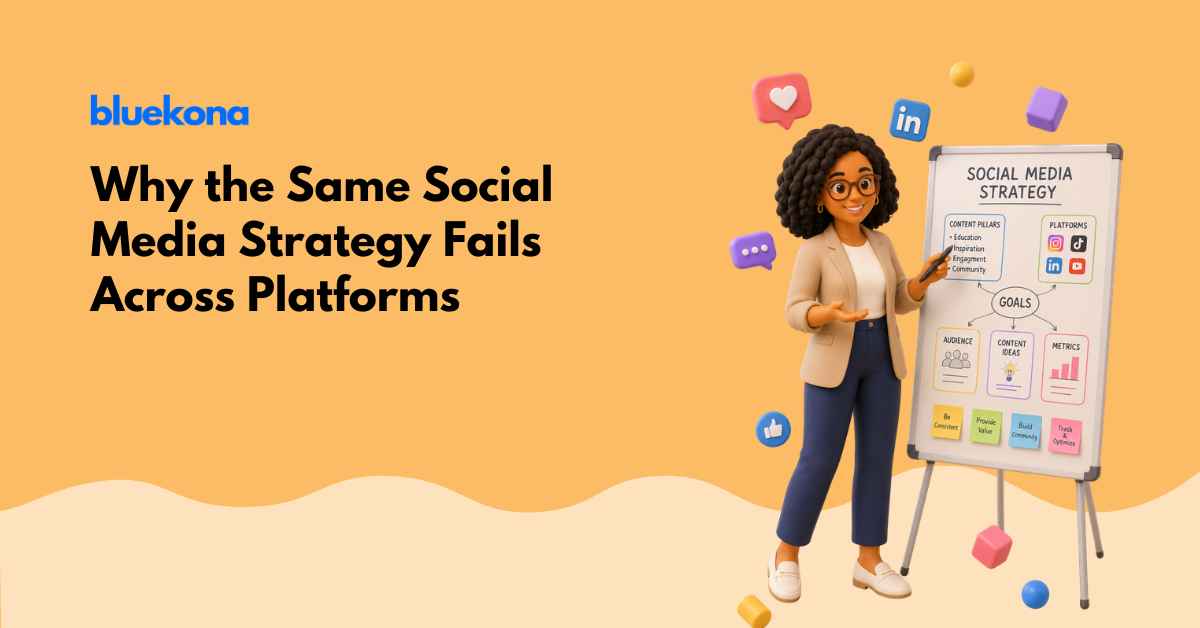
  • Why the Same Social Media Strategy Fails Across Platforms

    Why the Same Social Media Strategy Fails Across Platforms

    Most brands do not actually have a content problem. What they have is a mismatch problem. The same post goes out on LinkedIn, Instagram, TikTok, Facebook and YouTube, all on the same day, all looking the same. Then everyone sits around wondering why one platform brings results and the rest bring silence.

    Here is the simple truth. Different people use different platforms for different reasons. A teenager scrolling TikTok on a Tuesday night is not in the same headspace as a manager researching software on YouTube during lunch. A founder checking LinkedIn before a meeting is not doing the same thing as a parent chatting in a Facebook group about weekend plans.

    This guide walks through how audience, platform, content and business goals fit together, and how Bluekona helps you figure out what is actually working instead of guessing.

    The Biggest Social Media Mistake Brands Still Make

    A lot of companies treat social media like a broadcast tower. One piece of content goes up, then it gets copied and pasted across five platforms with zero changes. Same caption, same image, same tone, everywhere.

    The problem is that social platforms are not the same kind of place. They are not five doors leading into the same room. Each one is its own little world, with its own rules, its own pace and its own kind of audience attention. When you post the exact same thing everywhere, you are speaking the same language to people who are not listening for the same things.

    Think about how differently you behave on different apps. On LinkedIn you might be reading something useful before a meeting. On Instagram you might be looking for something nice to look at while waiting in line. On TikTok you might just want to laugh for thirty seconds. None of these moods match up, so why would one piece of content work for all of them?

    Different Platforms, Different Mindsets

    People do not just use platforms, they use them with a purpose in mind, even if that purpose is something small like killing five minutes. Once you understand what mindset someone is in when they open an app, it becomes much easier to know what kind of content will actually land.

    LinkedIn

    On LinkedIn, people are usually thinking about their work, their career or their industry. They are reading with a slightly more serious hat on. This is the place for thought leadership, industry insights, case studies and the occasional opinion that goes against the usual advice. People here want to learn something or feel sharper after reading.

    Instagram

    Instagram is more about feeling than thinking. People come here for inspiration, for lifestyle, for a sense of who they want to be. Reels, visual storytelling, behind the scenes glimpses and creator collaborations all do well here because they tap into identity and aspiration rather than logic.

    TikTok

    TikTok is built for discovery and entertainment. People are not searching for anything specific, they are just scrolling and letting the app surprise them. Short videos, trends, things that feel real and unpolished, and quick product demos all fit this fast moving environment.

    Facebook

    Facebook still has a strong sense of community and family around it. A lot of activity happens in groups, in local discussions and around small businesses. Customer stories and community conversations do well here because people are looking for connection, not just content.

    YouTube

    YouTube is where people go when they actually want to solve something. They are researching, learning or trying to decide between two options. Tutorials, comparisons, reviews and deep dives work well because the audience has already arrived with a question in mind.

    Understanding Generational Behavior

    On top of platform behavior, there is also the question of who you are talking to in terms of age and life stage. Different generations were raised on different internet habits, and that shapes what feels natural to them.

    Gen Z

    Gen Z grew up with social media as their default search engine. Around 46 percent of them say they prefer social platforms over traditional search when looking things up, and about 77 percent use TikTok to discover new products. Many of them spend more than four hours a day on social apps.

    What they respond to is authenticity, community, fast answers and entertainment. Brands that want their attention need to lean into short form video, work with creators, use content made by real users, and build things that feel interactive rather than one way.

    Millennials

    Millennials are big users of social media too, with around 86 percent active on these platforms and an average of 8.4 accounts per person. About 56 percent say they buy things based on influencer recommendations, and 65 percent trust suggestions that come from friends.

    This group wants practical value. They want to trust the brand, they want convenience, and they want to feel like the people behind the brand know what they are talking about. Educational content, honest testimonials, real case studies and influencer partnerships all work well here.

    Gen X and Boomers

    These audiences value trust, familiarity, simplicity and reliability above almost everything else. They are not chasing trends, they are looking for something steady. Community focused content, regular engagement on Facebook, longer educational videos and genuine customer success stories tend to do well with this group.

    The Apollo.io Playbook

    For sales reps and founders, Apollo focuses on LinkedIn, TikTok and YouTube Shorts, with content built around growth hacks, tutorials and practical workflows people can use right away. For VPs of sales and other executives, the focus shifts to LinkedIn, review sites and more enterprise focused channels, with messaging centered on return on investment, consolidating tools and overall business outcomes.

    The product is the same. What changes is who is being spoken to, where they are being reached, and what kind of message actually matters to them.

    Why Posting Frequency Is Not the Real Problem

    A question that comes up again and again is how often a brand should be posting. Should it be daily, three times a week, once a day per platform?

    The honest answer is that frequency is the wrong starting point. The better question is what should be posted, where it should go, and who it is actually for. Posting seven times a week to an audience that does not care will almost always do worse than posting three times a week to people who are genuinely interested.

    Frequency still matters, but only after relevance, audience fit and content quality are in place. Without those, more posting just means more noise.

    Building an Audience-Platform Matrix

    One simple way to bring all of this together is to build a kind of matrix or map that connects audience to platform to content to goal. It does not need to be complicated, but it does need to be honest.

    Start by asking who your audience actually is. Are they Gen Z, Millennials, Gen X, professionals, everyday consumers, or decision makers inside companies?

    Next, ask where these people actually spend their time. Not where you assume they spend time, but where they really are based on what you can see in your own data.

    Then look at what kind of content they consume in those spaces. Are they watching videos, scrolling carousels, reading thought leadership posts, following tutorials, or hanging out in community groups?

    Finally, be clear about what action you actually want. Is this about awareness, engagement, getting leads, driving sales, or keeping existing customers around longer? Each of these goals might point you toward a different mix of platform and content.

    Why Most Brands Struggle

    Most brands are not failing because they are lazy. They are failing because they are working off assumptions instead of evidence.

    You hear things like, we should be on TikTok because everyone is talking about it, or LinkedIn is hot right now so let us double down there, or let us just post every single day and see what happens. None of these statements actually answer the real questions. Is our audience even there? Are they engaging when we show up? What kind of content is actually working for us right now?

    Without answers to those questions, a strategy is really just a guess dressed up as a plan.

    How Bluekona Helps

    This is exactly where Bluekona comes in, by turning those guesses into something you can actually see and act on.

    On the audience side, Bluekona helps you understand who is engaging with your content, what kind of content resonates with them, and how different audience segments are responding over time.

    On the platform side, it shows you where your engagement is actually strongest, how each platform is performing compared to the others, and how content effectiveness differs from one channel to the next.

    On the content side, it helps identify which content pillars are winning, what your audience seems to genuinely prefer, and what patterns keep showing up in the way people engage.

    Put together, this means that instead of guessing where to post, how often to post, or what to create next, you get a clearer, data backed direction to work from.

    “I am not here to tell you social media is hard. I am here to tell you that guessing is hard. The data was just sitting there the whole time.” – Delphi

    The Future of Social Media Strategy

    The brands that win going forward will be the ones that stop thinking platform first and start thinking audience first. Instead of asking which app to chase next, they will ask who they are actually trying to reach, what those people care about, where they spend their time, and how they like to take in information.

    Once those questions are answered honestly, the platform strategy almost builds itself. The platforms are just the rooms. The real work is understanding the people inside them, and that is the shift that separates brands that get noticed from brands that get scrolled past.

    Frequently Asked Questions

    Does every business need to be on every social media platform?
    No. It makes more sense to focus on the platforms where your target audience is actually active and engaged, rather than trying to be everywhere at once.

    How do I know which platform is best for my audience?
    Look at audience demographics, content preferences and engagement patterns instead of just following whatever platform is trending at the moment.

    Is posting more often always better?
    Not really. Consistent, good quality content aimed at the right audience usually does better than high volume posting aimed at nobody in particular.

    Should B2B and B2C brands use different social media strategies?
    Yes. While some basic principles overlap, audience behavior, content formats and buying journeys tend to look quite different between the two.

    How can Bluekona improve audience targeting?
    Bluekona helps identify audience segments, content performance patterns and platform specific opportunities using real engagement and behavioral data, so decisions are based on what is actually happening rather than assumptions.

  • What Is The New Currency of Social Media?

    What Is The New Currency of Social Media?

    Something has shifted. You have probably felt it, even if you could not name it. A creator with 18,000 followers drops a video and the comment section explodes. A brand with two million followers posts something and it lands with a quiet thud. Crickets.

    People scroll faster than ever. Watch time is shrinking. Audiences consume content in bursts, fragments, and stolen moments. And yet, somehow, they are leaving more comments, saving more posts, sharing more things, and sliding into more DMs than ever before.

    This is not a contradiction. This is the new reality of social media.

    The platforms that are winning right now are not rewarding the people who get seen the most. They are rewarding the people who get responded to the most. The game has changed, and most brands are still playing by the old rules.

    Social media used to reward visibility. Now it rewards participation. And those are very different things.

    Why Follower Count Is Losing Its Meaning

    There was a time when follower count meant everything. It made sense. Feeds were chronological, so if you had a big audience, your posts reached them directly. You owned your audience the way a newspaper owned its subscribers. More followers meant more reach, full stop.

    That world is gone.

    Today, algorithms decide what gets seen. Not subscriber lists. Not follower counts. Algorithms look at engagement signals: how quickly people respond, how deep the conversations go, how often the same people keep coming back. A creator with 20,000 genuinely active followers can outperform one with two million passive ones because their content triggers real behavior.

    Follower count now tells you one thing: how many people once clicked a button. It does not tell you how many people trust the creator, remember their content, buy what they recommend, or care enough to come back. It is a headcount, not a relationship measure.

    20K Active followers can beat 2M passive ones in reach
    3x Engagement weight algorithms give comments over views
    80% Of buying decisions happen after social interaction, not just viewing

    The brands that have figured this out are not chasing follower counts anymore. They are chasing conversations. And there is a big, important difference between the two.

    Comments Are Becoming Their Own Culture

    Spend five minutes in a popular TikTok comment section and you will understand. The comments are not just reactions to the video. They are their own show. People are riffing off each other, building inside jokes, starting debates, doing bits. The original content becomes the stage and the comment section becomes the actual performance.

    This is not a quirk. This is a fundamental shift in how people use social platforms.

    On LinkedIn, a single provocative post can trigger a thread that runs for days. People who never watched the original video jump in because the debate is where the action is. On Instagram, meme replies and callback jokes in the comments get more engagement than the post itself. On YouTube, entire communities form inside the threads of certain channels, with regulars who know each other, reference past conversations, and build a shared culture that lives in the replies.

    Why do people love comments so much? Because they offer something that passive content never can: a way to be seen. When you drop a funny comment and people like it, you get a small but real moment of belonging. You signaled your humor, your worldview, your membership in the culture. That is deeply human. And it is now a core feature of how social media works.

    Comments are not just reactions anymore. They are entertainment layers, mini communities, algorithmic fuel, and increasingly, they are the reason people show up at all.

    Why View Time Is Falling but Engagement Is Rising

    Here is the part that confuses a lot of marketers. If people are scrolling faster and watching less, how is engagement going up? Should not the two move together?

    Not anymore.

    Modern users do not consume content the way they used to. They do not sit down and watch a 10-minute video from start to finish. They see a clip, catch the gist, jump to the comments, watch 40 seconds, get pulled into a thread, share a screenshot to a friend, come back three hours later to check replies. Their attention is fragmented, but their participation is real and it is active.

    Attention is not disappearing.
    It is fragmenting.

    What this means practically is that average view duration is a weaker signal than it used to be. Someone who watches 12 seconds of your video, laughs, and sends it to four people is more valuable than someone who watches the whole thing and scrolls past. The first person participated. The second one consumed.

    Platforms have figured this out. The algorithm is no longer just looking at watch time. It is looking at what happens around the content. Did people react? Did they comment? Did they save it? Did they come back? Did the same people engage twice? These signals carry more weight than raw view counts, and they are reshaping what it means to have good content.

    Social Media Is Becoming Participation Media

    Let us name what is actually happening here. Social media is not really social media anymore in the old sense. It is not a broadcasting platform where creators publish and audiences watch. It is a participation platform where the content is just the opening move in a much bigger conversation.

    Old Social Media
    • Broadcasting content outward
    • Creator-centric model
    • Passive audiences watching
    • Follower count = power
    • Views are the win
    • One-way communication
    New Social Media
    • Conversations and participation
    • Community-centric model
    • Active audiences responding
    • Engagement depth = power
    • Recurring interaction is the win
    • Two-way and multi-way dialogue

    The features that platforms are building tell the whole story. Stitches, duets, reaction videos, collaborative posts, comment-pinning, reply threads, DM links from posts: all of these are participation tools, not broadcasting tools. They are built to pull the audience into the content, not just in front of it.

    The brands winning on social right now treat every post as an invitation. An invitation to respond, to share an opinion, to join a joke, to start something. Not a billboard. An opening line.

    The Rise of Engineered Engagement

    Here is where things get interesting, and a little bit clever. Creators and marketers have started to realize that participation can be designed. You do not have to wait and hope people comment. You can build systems that make it almost inevitable.

    You have probably seen this everywhere by now. “Comment GUIDE below and I’ll DM you the full resource.” “Type TEMPLATE and I’ll send it straight to your inbox.” “Reply PART 2 if you want me to continue this.” These are not accidents. They are engineered participation loops, and they work.

    A comment today is often more valuable than a passive view. It signals intent, emotional response, participation, and algorithmic relevance, all at once.

    Tools like ManyChat have made this systematic. Someone comments a keyword, an automated DM fires, a funnel begins. The comment triggers distribution. The comment triggers lead generation. The comment triggers a conversation that might end in a sale. One action, multiple outcomes.

    This is not manipulation. It is smart design. It meets people where they already are, in the comment section, doing what they already want to do, and it turns that behavior into something useful. For the creator and for the audience.

    The Problem With Modern Engagement Loops

    But here is the honest part. Not everything about engineered engagement is good.

    When every creator is doing “comment PART 2,” the comment section starts to feel like a vending machine. Transactional. Hollow. People comment the keyword because they want the thing, not because they actually care. The conversation looks real on the surface, but there is no genuine exchange happening underneath.

    Fake urgency has become a plague. “Last 24 hours to get this.” “Only 3 spots left.” “You need to see this before it’s gone.” When everyone uses the same tricks, the tricks stop working. And worse, they start to erode trust.

    The brands that are going to win long-term are not the most automated. They are the ones that combine scalable systems with genuine interaction. They use the tools to handle volume, but they show up personally when it matters. They respond to comments like humans, not robots. They build systems that serve real relationships, not systems that simulate them.

    Automation is a multiplier. But you have to start with something worth multiplying.

    What Brands Are Still Measuring Wrong

    Most brand social media reports still look the same. Impressions this month. Follower growth. Reach. Views. Maybe engagement rate as a percentage.

    These numbers feel safe because they are easy to explain. “We reached 400,000 people this month.” Great. But did any of them care? Did any of them come back? Did a single one of them feel like they were part of something?

    The old metrics were built for broadcasting. Count how many people you reached. The new metrics need to be built for participation. Measure how many people responded, returned, and brought their friends.

    Reach without participation has limited value. You can pay for reach. You can buy impressions. What you cannot buy is a community of people who genuinely give a damn about what you do.

    The New Metrics That Actually Matter

    So what should you be measuring instead? Here are the signals that tell you whether your social presence is actually building something.

    💬 Comment depth Conversation quality
    🔁 Repeat commenters Returning voices
    🔖 Save behavior Intentional interest
    💌 DM conversions Relationship signals
    📈 Engagement velocity How fast response grows
    🎯 Sentiment quality What people feel

    Repeat commenters tell you that someone is coming back because they want to be part of what you are building, not just because an algorithm served your post. Save behavior tells you that someone valued your content enough to want it again later. DM conversions tell you that a public interaction turned into a private relationship, which is where trust really lives.

    Engagement velocity tells you whether your content is sparking something that compounds. A post that gets 50 comments in an hour and then builds to 300 over three days is a very different beast from a post that gets 300 comments once and goes silent. The first one has momentum. The second one is just a spike.

    These are participation signals. And they are the most honest picture of whether your social presence is actually working.

    Where Bluekona Fits Into All of This

    This is exactly the problem Bluekona was built to solve. Not just what gets seen, but what actually creates participation and builds community momentum over time.

    Detects meaningful engagement patterns

    Identifies what sparks real discussion, what creates recurring interaction, and what your audience emotionally responds to.

    Tracks participation beyond vanity metrics

    Measures comment behavior, engagement depth, audience return patterns, and participation consistency over time.

    Finds your compounding content

    Shows which themes build communities, which formats sustain interaction, and what creates recall instead of a one-time spike.

    Answers the questions that matter

    Not just “how many views did this get?” but did people care, did they participate, did conversations continue, did the community strengthen?

    Why Viral Reach Is Becoming Less Valuable

    Here is a slightly uncomfortable truth that the industry does not talk about enough. Going viral is not what it used to be. Ten years ago, viral meant something. It meant your content broke through, that millions of people chose to share it, that you had captured something real about a cultural moment.

    Today, viral can mean an algorithm pushed your content to a cold audience who scrolled past it in 2 seconds, boosted by a spike of passive eyeballs that evaporated the next morning and left nothing behind. No new followers. No conversation. No community. No recall.

    Visibility without participation is increasingly hollow. You can have a post that reaches 5 million people and builds less lasting value than one that reaches 50,000 people who feel genuinely connected to what you do.

    The brands that understand this are shifting their goal. Not just: reach as many people as possible. But: reach the right people, and give them a reason to respond, return, and recruit others. That is a compounding strategy. That is how communities actually form.

    What This Means for You Right Now

    If you take one thing from all of this, let it be this: the social media game has moved. The old scorecard is broken. Follower counts, raw views, and passive impressions are not the full story anymore, and optimizing for them alone is increasingly a path to spinning your wheels without going anywhere.

    The new game is participation. It is about creating content that people feel compelled to respond to. It is about building systems that turn responses into relationships. It is about measuring the things that actually compound over time, repeat visitors, deep conversations, saves, DMs, community momentum.

    This does not mean you stop caring about reach. Reach still matters. But reach is the starting point, not the finish line. What you do with that reach, how you turn passive eyeballs into active participants, that is where the real value is built.

    The brands that figure this out now will have an enormous head start. Because right now, most of their competitors are still chasing the old numbers. And while they are busy counting followers, the smart brands are building communities that will still be showing up three years from now.

    Stop measuring only visibility

    Understand what actually drives participation. Build communities, not vanity metrics. Measure what compounds.

  • Community-Led Growth Is Replacing Traditional Social Media Funnels

    Community-Led Growth Is Replacing Traditional Social Media Funnels

    Think about the last ad you stopped scrolling for. Now think about the last time a friend recommended something and you actually bought it. The difference between those two moments is the entire story of why social media marketing is changing.

    For years, brands followed the same playbook. Post content on a schedule. Run campaigns around product launches. Buy reach when organic numbers drop. Track impressions and follower counts at the end of each month. Repeat forever.

    That model is running out of steam. Organic reach keeps falling. Paid acquisition costs keep rising. And the audience that brands worked so hard to build has learned to tune out promotional content faster than anyone expected.

    People now trust communities, creators, and peers far more than they trust brand messaging. That is not a trend. That is a fundamental shift in how humans make decisions online. And most brands have not caught up to it yet.

    Community Is No Longer a Layer. It Is the System.

    When people hear the word “community” in a marketing context, they usually picture Discord servers, comment sections, or a branded hashtag that gets used twice and forgotten. That is not what we are talking about.

    Real community-led growth is a repeatable mechanism. It is the system through which your audience grows itself. Not because you pushed them to, but because they found something worth being part of.

    The difference shows up in specific behaviors. Challenges where people create their own versions of your content. UGC systems where customers become your most effective storytellers. Community prompts that spark conversations. Rituals around product drops. Creator collaborations that feel authentic because they actually are.

    What Modern Community-Led Growth Actually Looks Like

    Here is where it gets practical. Community-led growth shows up in four distinct ways, and the best brands are running all of them at once.

    Content Participation Loops

    Your customers are not just consuming your content. In a participation-first model, they are remixing it, reacting to trends alongside you, creating testimonials, and sharing their own experiences. The audience becomes the distribution channel. This is how a simple challenge format can reach ten times more people than a paid promotion of the same idea.

    Community-Driven Discovery

    Most people discover new brands not through ads but through shared posts, conversations, and social proof from people they already trust. The brands building community are investing in that discovery path, not just the paid one. They are making themselves easy to find through their people, not just their budgets.

    Belonging-Based Retention

    People stay with brands when they feel included, seen, and like they are part of something bigger than a transaction. That emotional connection changes the retention equation entirely. It stops being about discount codes and loyalty points and starts being about identity. When someone feels like they belong, they are not just a repeat customer. They are a quiet ambassador.

    Event-Driven Momentum

    Product drops. Creator activations. Community launches. Coordinated participation moments that people actually look forward to. Some of the biggest brands have figured out that demand is increasingly orchestrated socially. The event is the marketing. The community shows up because they want to be part of the moment, not because they were targeted.

    What Solopreneurs Can Learn from Gymshark’s Go-to-Market Playbook

    Why Most Brands Fail at Community

    Knowing about community-led growth and actually building it are two very different things. Most brands that try to make the shift end up doing the same things they always did, just with a community label on top.

    They chase engagement through posting more often. They confuse high follower counts with actual community health. They run a challenge, get a small spike, declare success, and move on to the next campaign.

    The real failure is in design. Most teams never ask the question that actually matters. What triggers someone in our audience to participate? Not just like something. Not just watch it. But actually do something because of it.

    The Real Problem: Teams Do Not Know What Actually Compounds

    Here is the uncomfortable truth about most social media teams right now. They are tracking the wrong things.

    Likes tell you what people approved of in the moment. Participation patterns tell you what people keep coming back to. Follower growth tells you about the top of a funnel. Recurring contribution tells you about the health of a community. These lead to completely different decisions.

    Where Bluekona Fits Into All of This

    This is the problem Bluekona was built to solve. Most teams are not missing effort. They are missing clarity. They are putting genuine work into their social presence and still not seeing compound growth because they cannot see the patterns that would tell them what is actually working.

    The future of social growth is not audience accumulation. It is participation design.

    The Shift From Campaigns to Systems

    Legacy brands launch campaigns. Modern brands design ecosystems. A campaign has a start date, an end date, and a budget. It creates a spike in attention and then it is over. The next campaign has to start from scratch and do the same work all over again.

    What High-Performing Teams Are Doing Differently

    The teams seeing real community-led growth share a handful of habits that separate them from everyone still running the old playbook.

    They are designing systems before they design content. They start by asking what they want people to do, feel, and share, and then they build the content to support that. The content serves the system, not the other way around.

    They are measuring participation, not just performance. They track how many people came back, what triggered repeat behavior, and which community signals are strengthening over time. They do not celebrate a viral post if it did not bring people deeper into the community.

    They are building identity-driven communities. Gymshark is not just selling gym wear. It is giving people a community of people committed to training. Glossier is not just selling skincare. It is building a space for people who see beauty differently. The product is the ticket to the community, not the other way around.

    How to Build a Community-Led Growth System

    If you are ready to stop running campaigns and start building systems, here is where to begin.

    1. Design participation triggers

    Figure out what makes your audience want to do something, not just watch something. What prompt or challenge will get them to create, share, or respond?

    2. Create repeatable content loops

    Build formats that can run again and again with your audience generating new versions each time. The format stays the same. The community fills it in.

    3. Reward visibility and contribution

    Spotlight the people who participate. Feature their content. The fastest way to get more people to show up is to show that showing up means something.

    4. Build identity around the community

    Give your community a name, values, a shared language. Make it feel like a place, not a marketing channel. Identity drives the most durable participation.

    5. Track compounding engagement signals

    Measure what is building over time. Repeat contributors. Recurring threads. Community-driven amplification. These signals tell you if your system is actually working.

    Stop building campaigns people scroll past.

    Start building systems people participate in. Design growth that compounds. Bluekona shows you exactly where your community is already trying to grow, and how to help it.

  • LinkedIn Is Becoming a Search Engine. Most Brands Still Treat It Like a Feed

    LinkedIn Is Becoming a Search Engine. Most Brands Still Treat It Like a Feed

    There’s a quiet shift happening on LinkedIn that most marketing teams haven’t caught on to yet.

    LinkedIn has been slowly changing what it rewards. It now pushes long-form posts, original thinking, structured content, and real expertise. The platform is nudging people away from quick engagement plays and toward content that actually teaches something.

    This is not a random design decision. LinkedIn is building toward becoming a place where people search for knowledge, not just scroll through updates.

    And that changes everything about how you should be showing up there.

    The problem with chasing likes

    Most companies use LinkedIn like a broadcasting channel. Post the blog recap. Share the team photo. Drop a motivational quote on Monday morning. Watch the likes come in. Move on.

    That approach feels productive, but it builds nothing over time.

    A post that gets 500 likes today will be completely invisible by Thursday. The engagement was real, but it left no trace. Nobody finds it a month later. It does not help someone discover your brand when they search for a topic you cover.

    Searchable content works differently. A well-written article or a post that actually explains something useful can keep pulling in new readers for months. People find it through search. AI tools surface it when someone asks a related question. It keeps working long after you stopped thinking about it.

    That is the difference between content that performs and content that compounds.

    LinkedIn content is now an SEO asset

    Here is something most brands have not fully accepted yet: your LinkedIn posts are being indexed by Google.

    LinkedIn articles especially. When someone searches for a topic, LinkedIn content shows up in results. And as AI-powered search tools get better at pulling in expert opinions and structured knowledge, the brands that have built a consistent body of work on LinkedIn will have a real advantage.

    Think about what people actually search for on LinkedIn. They search for founders by name. They look up companies before a sales call. They search for opinions on a specific topic. They look for people who seem to know a lot about a problem they are trying to solve.

    If your content does not show up in those searches, you are invisible at exactly the moment someone is looking for you.

    What actually works in this new environment

    Not all LinkedIn content is created equal when it comes to discoverability. Here is what tends to perform well over time.

    Original perspective. Repeating what everyone else is saying does nothing for your authority. When you share a genuine point of view, especially one that challenges a common assumption, people remember it.

    Clear structure. Posts that are easy to skim and read on a phone tend to reach more people. Short paragraphs, clear breaks, a strong opening line.

    Language people actually search for. Write the way someone would type a question into a search bar. What would they ask? Answer that.

    Real depth. Insight beats inspiration every time. One well-explained idea will do more for your reputation than ten motivational posts.

    Content that stays useful. A post explaining how to think about a specific business problem will still be relevant a year from now. A post about a trending news story will not.

    What most brands are still doing wrong

    The habits that used to work on LinkedIn are now working against you if you are trying to build long-term discoverability.

    Engagement bait gets likes but no recall. When someone sees your brand name three months later, they will not remember what you said.

    Reposting your blog does not build authority. It just moves existing content to a different channel without adding anything.

    Chasing trends that have nothing to do with your expertise makes you look like you are just filling a content calendar.

    Generic corporate tone makes every post forgettable. People do not connect with a brand voice that sounds like it was written by a committee.

    The bigger shift in how you need to think about content

    The brands that are winning on LinkedIn right now are not posting more. They are posting with a clear point of view, consistently, on a specific set of topics.

    Over time, they become the brand you think of when a certain topic comes up. That kind of recall is worth far more than any single viral post.

    But most companies do not have a system for figuring out which topics are building that recognition, which posts people keep coming back to, or which ideas deserve to be expanded into something bigger. They post, check the engagement numbers, and move on.

    That is where most of the value gets left on the table.

    What this means for your LinkedIn strategy

    Stop thinking about LinkedIn as a place to distribute content. Start thinking about it as a place to build a searchable body of knowledge about your area of expertise.

    That means publishing content with some depth to it. It means writing in a way that answers real questions. It means staying consistent on a few topics long enough that people start to associate your brand with those ideas.

    It also means paying attention to what is actually working, not just what is getting likes. Which posts bring in new followers weeks after they were published? Which topics keep coming up in comments? Which content seems to spark real conversations rather than just passive scrolling?

    The brands that figure that out will have a significant advantage as LinkedIn continues to shift from a social feed into something closer to a professional knowledge engine.

    The ones still chasing likes will keep wondering why their content never seems to build any momentum.

  • Facebook metrics that actually matter in 2026

    Facebook metrics that actually matter in 2026

    Here’s something most marketing teams won’t say out loud: Facebook still works. Not in the same way it did in 2015, and not for every business, but it works. Billions of people still open the app every day. Ads still convert. Pages still drive real traffic. The platform is not dying.

    So why do so many teams feel like they are getting nothing from it?

    The answer is not Facebook. It is the way most teams think about what success looks like on Facebook. There is a quiet assumption baked into a lot of marketing conversations that if a platform feels old or unsexy, the results must be bad. And when results feel bad, the instinct is to blame the channel.

    But here is what the data actually shows: most teams are not failing because Facebook stopped working. They are failing because they are measuring the wrong things and making decisions based on those numbers. Their dashboards are full of activity. What they do not have is clarity.

    1 stats - Facebook metrics that actually matter -

    Platforms do not die. Bad strategy does. And bad strategy almost always starts with bad measurement.

    If you are running Facebook as part of your marketing mix and it feels like you are spinning your wheels, the first question to ask is not “should we still be on Facebook?” The first question is “do we actually know what we are measuring and why?”

    2 delphi - Facebook metrics that actually matter -

    Most teams, if they are honest, do not.

    The Real Problem With Facebook Metrics

    Open up Facebook Ads Manager or Meta Business Suite and you will find dozens of numbers staring back at you. Reach, impressions, frequency, CPM, CPC, CTR, engagement rate, video views, 3-second views, 10-second views, post reactions, shares, comments, link clicks, landing page views, cost per result, relevance score, and on and on.

    Every single one of those numbers is real. Some of them matter a lot. Most of them, for most goals, do not matter at all.

    The problem is not that the data does not exist. The problem is that having a lot of data and understanding what to do with it are two completely different things. Most marketing teams have built reporting habits where they screenshot numbers into a slide deck, present them on a call, and everyone nods. Nobody asks the hard question: based on this, what should we do differently?

    That disconnect, between reporting and actual decision-making, is where most social media budgets quietly leak out.

    Vanity metrics are the biggest culprit. A post that gets 4,000 likes sounds great until you realize those likes came from people who would never buy your product. A campaign with impressive reach numbers looks good in a report until someone asks why revenue did not move. Impressions tell you that an ad was served. They do not tell you that it worked.

    3 delphi - broken pipeline Facebook metrics that actually matter -

    Data is not the problem. Interpretation is. And interpretation requires having a framework, a clear idea of what you are actually trying to achieve and which numbers connect to that goal. Without that framework, you are just collecting numbers.

    Most teams have no framework. They measure everything and understand nothing. And the more metrics they add, the less clear the picture gets.

    The Only Facebook Metrics That Actually Matter

    4 - quadrent - broken pipeline Facebook metrics that actually matter -

    Not every metric deserves your attention. Here are the four categories that actually connect to outcomes, and what to look at inside each one.

    Awareness Metrics: Are You Even Visible?

    Before anything else, people need to see you. That sounds obvious, but a lot of teams skip over awareness metrics because they feel soft, like they are not tied to money. They are wrong.

    Reach tells you how many unique people saw your content. This is different from impressions, which counts total views including the same person seeing the same post multiple times. Reach gives you the real number of individuals your message actually got in front of.

    Impressions tell you how often your content appeared in front of people. A high impression count with low reach means a small group of people is seeing you over and over. That can be a sign your targeting is too narrow, or that you are burning out the same audience.

    Mentions show up when people talk about your brand without being prompted. Organic mentions are a signal that something you did or said actually stuck. They are rare and worth tracking because they indicate real awareness, not just ad delivery.

    Here is the thing about visibility though: being seen is not the same as being remembered. If your content is getting reach but no engagement, no clicks, no follows, you are visible but forgettable. Visibility without recall is wasted effort. Awareness metrics should not be the end of the story. They should be the start.

    Engagement Metrics: Do People Actually Care?

    Engagement is where things get tricky, because not all engagement is equal.

    Likes are the lowest form of engagement. They take one tap and they mean almost nothing. Someone liking a post is not the same as someone caring about your brand. It is a passive gesture. Do not optimize for likes.

    Comments are more meaningful, but the quality matters more than the count. Ten thoughtful comments from your ideal customers are worth more than a hundred one-word replies. When you read your comments, ask yourself: are these from people who look like buyers? Are they asking questions, sharing opinions, engaging with what you actually said? Depth of conversation beats volume of noise every time.

    Shares are the strongest engagement signal on Facebook. When someone shares your post, they are putting their name on it. They are saying “this is good enough that I want my friends and followers to see it.” That is a much higher bar than a like. If your content is being shared consistently, that tells you something important about what is resonating.

    Engagement rate combines all interactions relative to reach or followers. It is a better benchmark than raw numbers because it gives you a rate, not just a count. A post that gets 200 engagements from 2,000 people is performing better than a post that gets 300 engagements from 30,000. Engagement rate normalizes for audience size.

    5- delphi - 3month- Facebook metrics that actually matter -

    The mistake most teams make is chasing total engagement numbers. What you should be chasing is engagement from the right people. High engagement from an audience that does not convert is a feel-good metric that does not move your business.

    Performance and Business Impact Metrics: Does Any of This Drive Revenue?

    This is where most Facebook measurement breaks down, and it is the most important category.

    Link clicks tell you how many people cared enough to leave Facebook and go somewhere you control. This is one of the clearest signals of real interest. If someone clicks a link, they did not just scroll past your content. They took a deliberate action. Track this number carefully and always ask: out of everyone who saw this, what percentage clicked? A low click-through rate on a broadly targeted post might be fine. A low click-through rate on a retargeting campaign aimed at warm leads is a problem.

    Conversion rate is the number that ties everything back to business reality. Of all the people who clicked through, how many did the thing you wanted them to do? Bought something, signed up, booked a call, whatever your goal is. Traffic without conversion is not marketing. It is just burning budget.

    This is the gap that most social media teams fall into. They optimize for clicks and celebrate when traffic numbers go up. But if the conversion rate is low, more traffic just means more people arriving and leaving without doing anything. The issue might be the ad, but it might also be the landing page, the offer, the audience targeting, or the timing. Conversion rate forces you to look at the whole picture.

    Customer Lifetime Value is the number that almost nobody in social media talks about, and it is possibly the most important one. If you acquire a customer through Facebook and they spend significantly more over their lifetime than the average customer from another channel, your Facebook investment is paying off in ways that short-term ROAS numbers will never capture. If Facebook tends to bring in low-value customers who churn quickly, that is also something you need to know.

    Traffic means nothing if it does not convert. And conversion data only tells part of the story if you are not tracking what happens after the first purchase.

    Content Intelligence Metrics: What Should You Do More Of?

    The fourth category is often completely ignored. It should not be. Your past performance on Facebook is one of the best roadmaps you have for your future strategy.

    Video watch time is a signal that tells you whether the thing you made was worth watching. Not whether people hit play, whether they kept watching. Short watch times on a long video tell you the opening was not strong enough. High average watch percentages tell you the content genuinely held attention. Facebook rewards content that keeps people on the platform, which means watch time data is doubly useful: it tells you what your audience wants and it tells you what the algorithm will prioritize.

    Content pillars are the broad themes your content falls into. When you look at your top-performing posts over the past three months, what do they have in common? Are behind-the-scenes posts getting more traction than product posts? Are educational pieces outperforming promotional ones? This kind of analysis tells you what your audience actually wants from you on Facebook, which is often different from what you think they want or what you want to say.

    Competitor benchmarks give you context. Your engagement rate means nothing in isolation. Is it high or low for your industry? Your reach growth might feel slow until you see that your competitors are flat. Context does not change your numbers, but it completely changes how you should interpret them.

    Your future content strategy is hidden inside your past performance data. Most teams never look hard enough to find it.

    8- delphi- Facebook metrics that actually matter -

    The Missing Layer: Where Most Teams Actually Fail

    7- difference - Facebook metrics that actually matter -

    Here is something that almost never gets said in social media conversations: most teams are decent at tracking metrics. They are terrible at turning metrics into decisions.

    Think about this scenario. You have a campaign with strong reach. Lots of impressions. Decent engagement. And then you look at conversions and the number is low. What do you do next?

    Most teams write “reach was good, conversions were low” in their report and move on. That is not insight. That is description.

    What you need is a layer of thinking that connects the numbers to a specific action. High reach with low conversions tells you one of several things: your targeting is too broad and you are reaching people who are not your customer, your creative is grabbing attention but not communicating value, your offer is not compelling enough, or your landing page is breaking the experience. Each of those diagnoses leads to a different fix. But you can only get there if someone is asking the question.

    Here is another scenario. High engagement, lots of comments and shares, great response in the comments section, and then you look at who is engaging and realize it is not your target customer at all. Your posts are resonating with an audience that will never buy from you. What do you do?

    Again, most teams celebrate the engagement and move on. But the right question is: why are we attracting the wrong audience, and how do we adjust targeting or messaging to shift that?

    The gap between metrics and action is where most marketing budgets disappear. Teams have the data. They do not have the habit of asking what the data means and what it should change.

    This is the hardest skill to build in a social media team and the most valuable one. Anyone can pull a report. Very few people can look at a set of numbers and say “here is what this tells us and here is exactly what we should do differently this week.”

    The 3-step framework: metrics to decisions to outcomes

    9- 3 steps- Facebook metrics that actually matter -

    The best social media teams are not the ones with the most data. They are the ones who know exactly what their data is telling them and what to do about it. Here is the simplest version of that habit.

    Where Bluekona Fits In

    Most analytics tools give you more data. That is not always what you need.

    What most teams are missing is not more numbers. It is a system that takes the numbers they already have and turns them into clear, specific actions. Something that tells you: this content is working, do more of it. This campaign is underperforming against your goal, here is why. This audience segment is showing strong conversion signals, prioritize it.

    That is what Bluekona is built to do. It is not another dashboard. It is a layer that sits between your metrics and your decisions, and it does the translation work that most teams either skip or do badly.

    Bluekona identifies which metrics actually matter given your specific goal. If your current objective is acquisition, it weights conversion data differently than if your objective is brand awareness. It connects engagement signals to business outcomes so a spike in shares does not just get celebrated but gets analyzed: who shared it, did those shares drive traffic, did that traffic convert?

    It also surfaces what content to double down on based on actual performance patterns, not just the most recent post or the one that got the most likes. And it flags what is not working before you have spent another month running a campaign that is not going to deliver.

    The core idea is simple: instead of tracking everything and understanding nothing, you track what matters, understand what it means, and know what to do next.

    That is the loop most teams are missing. Metrics, decisions, execution. Not metrics, report, repeat.

    Key Takeaways

    Facebook is not dead. Billions of people use it every day and it still drives real business outcomes for brands that use it well.

    Most measurement frameworks are dead though. They were built for a version of social media where reach and likes were enough to show value, and they have not caught up with what actually matters now.

    The metrics that drive decisions are reach, engagement quality, conversion rate, and content performance patterns. Everything else is noise unless you can draw a direct line from that number to a business outcome.

    Engagement does not equal growth. A post can go viral with entirely the wrong audience. Strong engagement from people who will never buy from you is not a win. It is a misdirection.

    And clarity always beats dashboards. A team that tracks six metrics with real understanding of what each one means will outperform a team drowning in forty metrics they do not know how to use.

    Start Here

    If you are tracking everything but understanding nothing, it is time to step back and rebuild from the metrics that actually connect to your goals.

    Stop measuring more. Start measuring what matters.

    Pick one goal. Find the three metrics that most directly tell you whether you are hitting it. Build your reporting around those three numbers. When you have a clear picture of what is working and what is not, then you can layer in more complexity.

    The best social media teams are not the ones with the most data. They are the ones who know exactly what their data is telling them and what to do about it.

    TL/DR

    Remember these 5 things

    • Facebook is not dead. Billions of people use it every day and it still drives real business outcomes for brands that use it well.
    • Most measurement frameworks are dead. They were built for a version of social media where reach and likes were enough to show value.
    • Metrics only matter if they drive decisions. Reporting without action is just describing what happened.
    • Engagement does not equal growth unless it converts. Strong engagement from people who will never buy is a misdirection, not a win.
    • Clarity beats dashboards. Six metrics you understand deeply will always outperform forty you do not.
  • Social Media Management vs Marketing: Why Most Brands Get It Wrong (And How to Fix It)

    Social Media Management vs Marketing: Why Most Brands Get It Wrong (And How to Fix It)

    Most brands think that showing up on social media every day is enough. Post something in the morning, reply to a few comments, maybe throw in a reel, and call it a day.

    But here is the thing. Posting consistently is not the same as growing consistently.

    There is a big difference between managing your social media and actually marketing through it. Most brands either do not know the difference or treat them as the same thing. And that one mistake is quietly killing their growth.

    Let us break it all down.

    social media management and marketing difference

    The Confusion That Is Costing You Growth

    Here is what most brands believe: if we stay active on social media, the results will follow.

    So they post every day. They stay consistent. They reply to comments. They keep the page looking alive.

    But months go by and nothing much changes. No real bump in sales. No new customers coming in through social. Just a page that looks busy but is not really doing anything.

    The problem is not effort. The problem is strategy disconnect.

    Social media management and social media marketing are two very different things. They have different goals. They need different thinking. But most brands blur the line between them and end up doing neither well.

    Once you understand how they are different and why they need to work together, everything starts to make more sense.

    What Social Media Management Actually Is (And What It Is Really For)

    Social media management is about showing up. Every day, consistently, in a way that feels familiar to your audience.

    It includes things like posting content on a regular schedule, replying to comments and messages, keeping your brand voice consistent across every post, and watching what people are saying about you online.

    Now here is how most people think about management. They think it is just “the posting part.” Like a chore you tick off a list.

    But that is the wrong way to look at it.

    Management is actually building something invisible but very powerful. It is building familiarity. When someone sees your content three days in a row, then again next week, then the week after, something starts to happen in their brain. They start to recognise you. They start to trust you. They think, “these people are around. They seem real. I know them a little.”

    That kind of trust does not happen from one viral post. It happens from showing up, over and over, in a way that feels human and consistent.

    So management is not just posting. It is planting seeds of trust every single day.

    What Social Media Marketing Actually Is (And Why It Feels Harder)

    If management is about building trust, marketing is about turning that trust into action.

    Social media marketing is the growth side of things. It includes running paid ads, partnering with influencers, building funnels that move people from seeing your content to actually buying something, and tracking what is working in terms of real numbers like clicks, conversions, and revenue.

    Marketing feels harder because it is more direct. You are not just trying to stay visible. You are trying to get someone to do something. Click this. Buy this. Sign up for this. That requires more strategy, more testing, and more understanding of your audience.

    But here is the reframe. Marketing is not just promotion. It is not just running ads and hoping people bite. Done right, it is turning attention into revenue in a way that is predictable and repeatable.

    The key word there is attention. You need attention before marketing can work. And that is exactly what management builds.

    The Real Problem: They Do Not Talk to Each Other

    This is the part most brands miss entirely.

    Management and marketing usually live in completely separate worlds inside a company. The person managing content is focused on posting schedules and engagement rates. The person running campaigns is focused on ad spend and conversions. They rarely sit in the same room and compare notes.

    So what happens?

    Management and marketing disconnected

    Your team keeps generating content. Some posts do really well. People love them. The comments are great. Lots of shares. But nobody takes that information and asks, “what made this work? Can we put money behind this and reach ten times more people?”

    On the other side, the sales team runs campaigns. They pick creative based on what they think will work. But they are not looking at what has already proven itself in organic content. So they are guessing, spending money, and sometimes getting lucky.

    There is no feedback loop. Content does not inform campaigns. Campaigns do not shape content.

    The result is that effort keeps going up but impact stays the same. You are doing more and more but the needle is barely moving.

    This is the real problem. Not a lack of content. Not a lack of budget. A lack of connection between the two.

    Why Doing Only One of Them Will Always Fall Short

    A lot of brands pick a lane. Either they go heavy on management or they go heavy on marketing. And both paths hit a wall eventually.

    If you only focus on management, you feel busy and active. Your page looks great. Engagement is decent. But at the end of the month when someone asks what social media actually brought in for the business, the answer is not satisfying. You are visible but you are not growing.

    If you only focus on marketing, you can get attention fast. Ads can put you in front of thousands of people overnight. But if those people land on your page and there is nothing there to trust, they leave. A thin content presence with no real history, no community, no voice makes even the best ad feel hollow. People do not buy from strangers, and a page with no soul feels like a stranger.

    Here is the idea to hold onto.

    Trust without reach does not scale.

    Reach without trust does not convert.

    You need both. And you need them working together, not running in parallel and never crossing paths.

    How High Performing Brands Actually Win

    The brands that are genuinely winning on social media are not posting the most. They are not spending the most on ads either.

    What they are doing is learning the fastest.

    They treat their organic content like a testing ground. Every post is an experiment. Which hook got people to stop scrolling? Which format got the most saves? Which topic made people tag their friends? They are watching all of this closely.

    Then they take what works and they scale it. They put money behind the posts that already proved themselves. They build campaigns around the themes and messages that organic content showed actually resonate.

    It is a simple loop but most brands are not running it.

    loop 4 step management and marketing

    Post something. See what connects. Learn from it. Scale the winners.

    Content leads to insight. Insight leads to campaigns. Campaigns lead to growth. And then that growth tells you what to do next.

    The Missing Layer That Most Teams Overlook

    Here is where things get interesting.

    Most social media teams are tracking metrics. They know their reach numbers. They know how many likes a post got. They watch follower counts go up and down.

    But there is a difference between tracking metrics and actually understanding what is happening.

    Knowing that a post got a lot of likes is not the same as knowing why it got likes. And knowing why something worked is what lets you repeat it and scale it.

    Most teams are collecting data but not creating insight. They are looking at numbers but not seeing patterns. They do not know which type of content consistently builds trust over time. They do not know which topics tend to lead to actual conversions down the line. They are flying a bit blind.

    Metrics without meaning is just noise.

    data insight patterns

    The missing layer is insight. Someone or something that takes all that data from your daily content and your campaigns and finds the patterns that actually matter for your business goals.

    Without that layer, management and marketing stay disconnected. With it, they start working as one system.

    Where Bluekona Fits Into All of This

    This is not about adding another tool to your stack.

    Bluekona sits in that missing space between management and marketing. It connects your daily content activity to your actual growth outcomes.

    With Bluekona, you can see which content patterns are consistently driving engagement and building trust. You can understand what kind of posts tend to lead to conversions, not just likes. You can take that knowledge into your campaigns so you are not guessing, you are doubling down on what already works.

    It is not a scheduling tool. It is not just an analytics dashboard. It is the system that takes what you post every day and turns it into something your whole strategy can learn from.

    If you have ever felt like your content team and your growth team are working in different directions, Bluekona is what brings them back to the same page.

    social media marketing and management stats

    A Simple Framework to Align Both

    You do not need to overhaul everything. Here is a simple way to start connecting management and marketing.

    Start by using your organic content as a testing ground. Try different types of posts. Mix up your hooks. Experiment with formats like carousels, short videos, text posts, and stories. At this stage you are not trying to go viral. You are trying to learn what resonates with your specific audience.

    Then pay attention to the patterns. What content keeps getting saved? What makes people comment something real, not just a fire emoji? What gets shared? What makes people come back to your page? These signals are telling you something important.

    Finally, use those signals to guide your marketing. When you run paid campaigns, lead with the ideas and formats that already proved themselves. When you retarget people who engaged with your content, you are reaching people who already have a little bit of trust built up. That makes conversion so much easier.

    Test with management. Learn from the data. Scale with marketing. That loop is what high performing brands are running all the time.

    The Future of Social Media Strategy

    The brands that will win in the next few years will not win because they posted the most or spent the most.

    They will win because they learned the fastest and built systems that connect everything.

    The social media landscape is noisier than ever. Getting attention is harder. Keeping it is harder. Converting it is harder. But the brands that treat every post as a data point, every campaign as a learning opportunity, and every insight as fuel for what comes next will keep pulling ahead.

    It is not about doing more. It is about doing things that are connected to each other and pointed in the same direction.

    Bringing It All Together

    Social media management keeps you visible. It builds the familiarity and trust that makes people feel comfortable with your brand.

    Social media marketing drives growth. It takes that trust and turns it into real business results.

    But neither one works fully on its own. Management without marketing keeps you stuck in maintenance mode. Marketing without management keeps you reaching people who do not trust you yet.

    The real advantage is in connecting them. Letting what you learn from daily content shape your campaigns. Letting your campaign results influence your content. Building a system where every part of your social media effort is talking to the other parts.

    connecting what you have

    Most brands are not doing this. Most brands are treating content and growth as separate problems. And that gap is exactly where they are losing.

    Stop treating them as two different jobs. Start building the system that connects them.

    Run a Bluekona audit and see what your content is really telling you about what drives your growth.