Every post you drop into the feed void has a 24-hour lifespan—maybe less. Engagement spikes, then dies. By tomorrow? It’s digital graveyard material.
Here’s the shift most brands are missing: by 2025, TikTok, YouTube, and Instagram aren’t “social” anymore—they’re search-first platforms. Gen Z already treats TikTok as their #1 discovery engine, and 36% of consumers now trust brand info from social search more than Google.
That means if your content only lives in feeds, it’s invisible to the fastest-growing search behavior.
Also, only ~20% of content actually gets repurposed across platforms—leaving 80% of discoverability on the table.
This workbook isn’t about squeezing out more posts. It’s about future-proofing them by designing assets that survive algorithm shifts, stay searchable, and keep working long after the hype fades.
Future-Proof Audit
Most audits obsess over vanity metrics—likes, shares, quick spikes. None of that matters if your content can’t survive without the algorithm’s life support.
This audit is about shelf life. If your work dies in 24 hours, you don’t own attention—you’re just renting it.
The Survival Test: Three Brutal Questions
1. Which of your posts still bring traffic 3+ months later? Pull up analytics for content 90+ days old. What’s still driving views or clicks? If the answer is “almost nothing,” you’re designing for decay, not discovery. Evergreen content compounds. Feed-only content vanishes.
2. If TikTok killed the For You Page tomorrow, would your content still rank in search? Search your own profile with keywords your audience would use. Can you find your videos? If not, you’re building on rented land. Search rankings are the only real estate you control.
3. How many of your video titles would someone actually type into a search bar? “POV: This changed everything” won’t survive. “How to fix a leaky faucet in 5 minutes” will. Trend titles get attention today but search titles work forever.
Your Results: Where You Actually Stand
Feed Addict: If<10% survives past 30 days. Dependent on algorithm roulette.
Hybrid Creator: If ~30% has search potential, but no system.
Search Savvy: If 60%+ discoverable months later. You get search but miss feed momentum.
Platform Master: If content thrives in both feed + search. Rare.
Most brands think they’re Hybrid. But the audit shows they’re Feed Addicts.
Wake-up call: If your content dies within weeks, you’re not broken—you’re just outdated. The good news? Every new piece can be engineered for survival.
Think your content can survive the algorithm apocalypse? Let’s test it.
The Search Survival Matrix
Not all platforms are created equal. Some bury your content by breakfast. Others let it resurface months or even years later.
Creators lose because they treat every platform the same. They spend 80% of their energy on feeds that consume content instantly, and almost none on search platforms that compound.
Feed-First Platforms – The 24-Hour Gamble
Threads, X (Twitter), Instagram Stories, Facebook Feed, LinkedIn Feed
Visibility peaks within hours, then collapses.
Discovery is algorithm roulette, not search.
Old posts are practically unfindable.
Think about it: when was the last time you scrolled back 90 days on someone’s Twitter feed? Exactly.
Search-First Platforms – The Compound Interest Play
Discovery happens through search queries + related content.
Old posts keep pulling traffic long after publish.
Your “how to negotiate salary” TikTok from last year can still rank today. That YouTube tutorial? Still feeding leads while you sleep.
Feed-first posts are like the groceries you buy to eat right away. Whereas, search-first are like planting fruit trees, where you put in the effort once and enjoy the harvest for years to come.
Workbook Exercise: Rebalance Your Portfolio 1. Pick a home base. Choose one search-first hub (YouTube, TikTok, or Pinterest) and design everything else as distribution spokes. 2. Audit last 30 days. List your posts. Tag each as Feed-first or Search-first. 3. Calculate your ratio. If >70% of your time is on feed-first, you’re burning effort for short-term hits. 4. Shift your mix. Aim for 30% feed-first (quick engagement) and 70% search-first (long-term discovery).
Evergreen Repurposing Framework
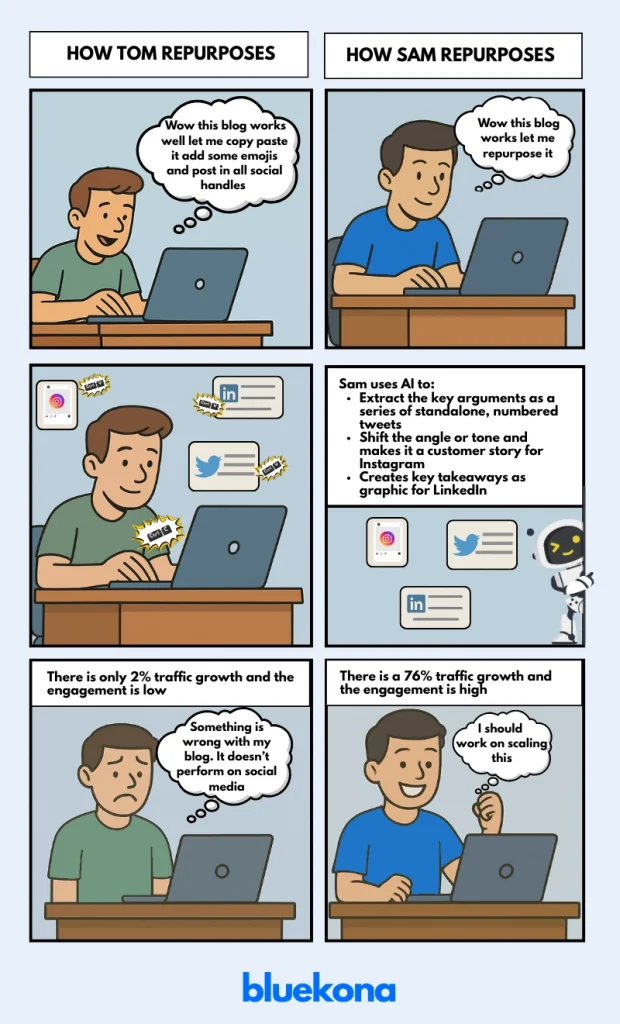
Most brands treat repurposing like leftovers: cut one piece of content into smaller scraps, toss them across platforms, and call it “strategy.” That’s not future-proofing—it’s efficiency theater.
Real repurposing means engineering content to live two lives at once: the immediate burst of feed attention and the long-term compound effect of search discoverability.
Think of every idea as having two timelines:
Feed Bait – short, sharp, designed to spark momentum.
Search Hooks – durable, optimized to keep working months or years later.
When both timelines run together, you get the compound effect: short-term buzz feeding into long-term growth.
The Dual-Timeline Strategy
Feed Bait is the spark. It thrives in feeds where immediacy rules. These posts:
Peak within hours, sometimes minutes.
Live on trends, curiosity, and FOMO.
Are designed to be shared and consumed quickly.
Search Hooks are the fuel. They’re built for search engines—on TikTok, YouTube, Pinterest, and Reddit—where discoverability compounds. These pieces:
Can keep generating traffic for months or years.
Are optimized to answer questions and solve problems.
Get surfaced whenever someone actively looks for the solution you’ve already created.
On their own, each timeline has a weakness. Feed Bait dies fast. Search Hooks take time to gain traction. Together, they solve each other’s problems. Feed Bait drives immediate attention into your Search Hooks, which then capture that interest and sustain it long after feeds move on.
The Framework in Action: Feature Launch
Original idea:“We just launched a new feature.”
Most brands stop here—they make one announcement post and call it content marketing. Future-proof brands split the idea into both timelines.
Feed Bait:
A TikTok clip showing the team celebrating the launch. Hooked with: “POV: Your startup finally ships the feature everyone asked for.” CTA pushes viewers to the full tutorial.
An Instagram Story sequence showing the “before/after” pain point the feature solves. CTA: “See the full walkthrough on YouTube.”
Both create buzz, but within 24 hours they’re gone.
Search Hooks:
A YouTube tutorial: “How to [specific outcome] with [Feature Name] – Complete Tutorial 2025.” Optimized for “how to” search queries.
A Pinterest infographic: “5 Steps to [Desired Outcome].” A format designed to be saved and referenced.
A Reddit snippet: answering “What’s the best way to [solve this problem]?” in a relevant subreddit.
These assets don’t disappear. They’re discoverable for months or years, pulling in fresh traffic every time someone searches.
More Use Cases
Common Mistakes: A Twitter thread listing the top 3 mistakes (Feed Bait) links into a YouTube breakdown of why those mistakes matter and how to fix them (Search Hook).
Unusual Tools: A TikTok showing an unexpected tool hack (Feed Bait) drives to a detailed review and comparison on YouTube or Reddit (Search Hooks).
In each case, the short-term post sparks curiosity, while the long-term post captures intent.
Building the Bridge
The bridge is where most brands fail. They create Feed Bait and Search Hooks but never connect them. Without the bridge, the timelines don’t reinforce each other.
Your feed posts should always point directly to your searchable assets:
“Full tutorial in my bio.”
“I break this down step-by-step in my latest YouTube.”
“Save this infographic—link in comments for the deep dive.”
The bridge turns short-term attention into long-term traffic.
The Compound Effect
Month 1: Feed Bait spikes awareness.
Month 3: Search Hooks begin surfacing in queries.
Month 6: Search traffic surpasses the original feed burst.
Month 12: Search content continues to drive business with zero new effort.
This isn’t about creating more. It’s about creating smarter—where every content idea gets two lives, not one.
Algorithm-Proof Checklist
Algorithms shift daily. What ranks today might vanish tomorrow. But here’s the truth, the platforms don’t reward hacks—they reward content that looks and sounds like what people are already searching for.
Think of this checklist as your final pre-publish filter. Run every piece of content through it before you hit upload. If you can’t check the boxes, your content isn’t algorithm-proof—it’s algorithm-dependent.
1. Is your keyword spoken in the video, not just written in the caption?
Captions are metadata. Spoken words are signals. Platforms like TikTok and YouTube transcribe audio automatically. If your keyword is only buried in text, you’re invisible to search indexing. Say the keyword out loud. Make sure the algorithm—and your audience—hear it.
Example: Instead of captioning “How to fix a leaky faucet,” start your video by literally saying: “Here’s how to fix a leaky faucet in under 5 minutes.”
2. Is your hook framed as a question people actually search?
Hooks drive clicks. But the wrong kind of hook dies fast. Curiosity baits (“You won’t believe this…”) fade in feeds. Search-friendly hooks (“How do you…?” / “What’s the best way to…?”) live forever.
Example: ❌ “POV: When your faucet won’t stop dripping.” ✅ “How do you fix a faucet that won’t stop dripping?”
The second example maps directly to search queries. The first one gets a laugh and disappears.
3. Did you cross-link to longer-form, searchable content?
Feed posts spark attention, but if they end in dead-ends, the momentum dies. Always bridge short-form into your search assets: tutorials, blogs, AMAs, YouTube explainers.
Example: A TikTok trend clip about your new feature should point directly to your YouTube tutorial. The trend creates buzz. The tutorial captures intent. Without the bridge, you’re just tossing sparks into the wind.
Workbook Drill: Audit Your Last 5 Posts 1. Did you say the keyword out loud? 2. Was the hook framed as a searchable question? 3. Did you point viewers to a longer searchable asset? If you answered “no” to 2 or more, your content is built on algorithm roulette, not discoverability.
Stop gambling on algorithms. With bluekona, you can build content systems engineered to last—discoverable today, tomorrow, and years from now.
Here’s a reality check: Google is no longer the starting point for product discovery.
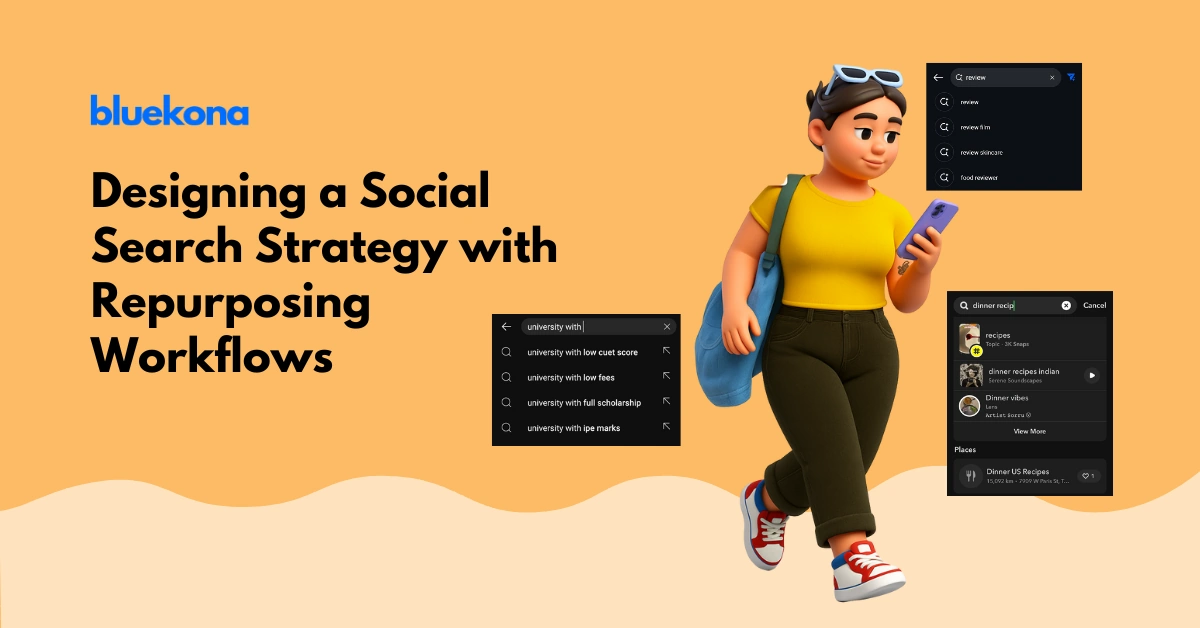
An entire generation has shifted their search behavior to TikTok, YouTube, and Instagram. They’re not typing “best running shoes” into Google—they’re scrolling TikTok reviews, watching YouTube unboxings, and swiping through Instagram carousels. For Gen Z, social platforms are the search engines.
But most brands are still stuck in “post and pray” mode. They publish once, hope for engagement, and move on. The result? Content that vanishes into the feed instead of compounding into visibility.
The brands that win social search know content isn’t disposable—it’s recyclable. They build repurposing workflows that transform a single asset into multiple searchable entry points across every platform like TikTok explainers, YouTube Shorts, Instagram carousels, LinkedIn posts, even Pinterest how-tos.
This isn’t about chasing viral luck. It’s about engineering discovery—turning every blog, video, or podcast into an ecosystem of searchable content that works 24/7.
The question is: will your brand keep treating posts like throwaways, or start building workflows that make you impossible to miss?
Why Social Search > Traditional SEO in 2025
The numbers don’t lie: traditional search is losing the discovery battle.
90% of consumers now rely on social to track trends and discover products. This isn’t passive scrolling—it’s intentional, search-driven behavior that’s replacing the old Google funnel.
TikTok has dethroned Google as Gen Z’s go-to search engine. Instead of reading SEO blog posts, they’re watching 60-second creator reviews, searching hashtags, and scanning comments for unfiltered feedback. TikTok delivers authenticity at scale—something Google can’t replicate.
YouTube isn’t just for entertainment—it’s a 2.5B-user search engine. From “how to fix a leaky faucet” to “best budget smartphone 2025,” users treat it as the visual version of Google. With 3B+ monthly searches, it’s the second-largest search engine in the world.
Instagram is now a full-blown product discovery hub. With 61% of users researching purchases on-platform, discovery flows seamlessly into shopping via Stories, Reels, carousels, and tags.
The shift is clear. SEO gives you answers, but social search gives you experiences. And for modern consumers, experiences win every time.
The Problem with One-and-Done Posting
Here’s the brutal truth: most brands are stuck in a “post once and vanish” cycle. They spend weeks creating a single piece of content, publish it, maybe cross-post once or twice—and then move on. Within 48 hours, that content is buried in the algorithm’s graveyard, never to be seen again. It’s the marketing equivalent of designing a billboard and hiding it in your basement.
Over 80% of brand content is never repurposed. That means teams are treating every post as disposable while sitting on goldmines of insights, tutorials, and stories that could be multiplied into dozens of searchable touchpoints. In an attention economy, that’s not just wasteful—it’s strategically devastating.
Without systematic distribution, even your best content is invisible in social search. TikTok, YouTube, Instagram—they reward consistency and omnipresence. Users don’t just want one perfect video or post; they look for brands that keep showing up with answers.
The math is simple: create 100 posts, you get 100 chances to be discovered. Create 50 and repurpose each into 10 formats across platforms—you now have 500 chances. Guess which brand wins in social search?
The leaders aren’t creating more content. They’re creating smarter workflows that turn every idea into an ecosystem of discovery.
Social Search Optimization Through Repurposing
The secret to winning social search isn’t pumping out endless new content—it’s multiplying the discoverability of what you already have. Every piece of content is a seed that can grow into a searchable forest—if you repurpose it strategically.
Take a single blog post on healthy smoothie recipes. Instead of posting once and moving on, you can break it down into:
TikTok explainers answering “What’s the best smoothie for energy?”
YouTube Shorts showing quick recipe demos
Instagram carousels with ingredient breakdowns
FAQ snippets tackling questions like “Are smoothies good for weight loss?”
Each one becomes its own searchable doorway into your brand.
The key is phrasing content the way people actually search:
“Best smoothie recipes for weight loss”
“How to make a high-protein smoothie”
“Green smoothie vs fruit smoothie benefits”
This isn’t just algorithm-friendly—it mirrors human behavior.
The result? They’re not betting on one viral hit. They’ve built a search ecosystem where every query has a Prime-related entry point. That’s the real power of repurposing.
Platform-by-Platform Breakdown
Each platform has its own search DNA, and winning brands repurpose content to match how users actually discover.
TikTok
TikTok is built for immediate, search-driven answers. Lead with searchable hooks like:
“POV: you need the best skincare routine”
“If you’re wondering how to meal prep…”
Repurpose content into “best of” lists, quick explainers, and trending Q&As. TikTok’s search function prioritizes videos that answer queries directly, so packaging multiple tips into digestible clips multiplies discoverability.
YouTube
Think of YouTube as a dual search engine. Long-form tutorials capture high-intent queries, while Shorts act as snackable discovery tools. Smart brands pin their most searchable Shorts—like “Top 5 budget cameras 2025”—so they serve as permanent entry points that funnel viewers into deeper tutorials.
Instagram
Here, it’s about balance. Carousels = evergreen discovery. Each slide can hit different keywords while the whole post stays searchable long-term.
Reels = immediate attention. They ride trending audio and hashtags to surface in Explore.
LinkedIn
LinkedIn rewards authority-driven repurposing. Turn insights into trend analyses, “lessons learned,” or frameworks broken down in carousel posts. This positions you as the expert people find when they search for professional growth and industry knowledge.
Pinterest & Reddit
These are the evergreen discovery engines. Pinterest thrives on “how-to” content, tutorials, and visual inspiration that users save with purchase intent.
Reddit is the validation hub—repurpose content into comparison posts, authentic reviews, and community-friendly breakdowns that answer niche queries.
The takeaway: Don’t just repurpose content. Reformat it to match each platform’s search psychology—that’s how you create a net that captures discovery everywhere.
The Workflow That Wins
Most brands overcomplicate content creation. The ones dominating social search run systematic workflows that multiply every asset into a network of discovery.
Start with a high-value core asset. A blog, video tutorial, webinar, or case study—the “mother ship” packed with insights and answers people actually search for.
Repurpose into 10+ formats. Not random reposts, but strategic multiplications. From one asset you can create:
TikTok quick tips
Instagram carousel breakdowns
YouTube Shorts
LinkedIn thought leadership posts
Pinterest visual guides
Reddit/FAQ-style explainers Each format mirrors different search behaviors while staying rooted in the same core message.
Distribute with precision. Don’t scatter posts everywhere—map formats to platforms where they win. TikTok for snackable tips, Instagram for visual storytelling, LinkedIn for authority, Pinterest for evergreen how-tos.
Measure and double down. Track what surfaces in search, drives saves, or fuels engagement. Then reinvest in those winning formats and scale harder.
The result is a content multiplication effect: one strategic asset becomes dozens of searchable entry points across every platform. Instead of chasing endless new content, you’re building a system where your ideas keep resurfacing—making your brand not just visible, but unavoidable.
The Automation Advantage
Here’s the reality: everything we’ve outlined—repurposing, platform-specific optimization, systematic distribution, and measurement—takes serious time and coordination. Most teams can’t sustain it manually. That’s exactly why Bluekona exists.
Bluekona automates the repurposing workflow that powers social search dominance. What used to take weeks of manual slicing, formatting, and scheduling now happens in minutes.
The workflow becomes simple:
Create once → optimize everywhere.
Upload a blog, video, or podcast → Bluekona transforms it into TikTok hooks, Instagram carousels, YouTube Shorts, LinkedIn posts, and Pinterest-ready guides.
Every format is search-optimized with phrasing that matches how people actually look for solutions.
The result? Every core asset turns into a comprehensive search funnel, multiplying your chances of discovery across every platform that matters. Instead of hoping one post hits, you’re systematically everywhere your audience is searching.
The social search revolution isn’t coming—it’s here. The only question is whether you’ll try to keep up manually… or win with Bluekona’s automation.
The landscape of TikTok has shifted dramatically and brands that are paying attention are reaping the rewards. What used to be all about viral dances and comedy sketches has quietly transformed into something much more impactful — Gen Z’s favorite search engine for finding products, tutorials, and recommendations.
With a staggering 1.59 billion potential ad impressions and 82% of Gen Z active on the app, TikTok’s algorithm now favors videos that are searchable and driven by intent, rather than just random viral clips.
This means that using keyword-rich captions, on-screen text, and strong watch-time signals are no longer just nice-to-haves—they’re essential tools for driving organic sales.
The results are impressive: creators and brands are raking in seven-figure revenues without spending a dime on ads, simply by mastering TikTok SEO.
Plus, with 54% of users interacting with brand content every day and the average Android user logging 35 hours a month on the app TikTok isn’t merely competing with Google for searches, for Gen Z, it’s taking its place.
This isn’t just a fleeting trend. It’s a significant change in how search, social media, and e-commerce come together. The real question is whether your brand will keep up or risk being left behind.
The TikTok Search Shift
TikTok’s journey kicked off with a delightful mix of algorithmic luck. Users dove into the app, eager for surprises, as the For You Page dished out whatever was hot at the moment—think dances, memes, and hilarious skits. Content thrived or flopped based on engagement metrics like watch time and shares, with little thought given to long-term discoverability.
However, as the platform evolved, so did user habits. Instead of just scrolling for fun, people started looking for answers. Searches like “best skincare routine for acne,” “how to style curly hair,” or “Stanley cup review” began to fill TikTok’s search bar—something we used to reserve for Google.
TikTok’s algorithm was quick to catch on. When users search, it shows they have high intent, which translates to deeper engagement and better conversions. The platform began to favor videos that matched search queries, giving them a boost not just in search results but also on the For You Page.
This created a cycle: content that was easy to search for performed better, prompting more creators to optimize for search, which in turn trained users to see TikTok as a visual search engine.
Why Keywords Now Rule TikTok?
These days, TikTok is indexing nearly every bit of text associated with your video
Captions have become like meta descriptions—rich in keywords that tell TikTok exactly what your content is about.
Comments play a role in discoverability—using strategic keywords in audience Q&As can signal relevance to the algorithm.
Voiceovers and on-screen text are transcribed and indexed, giving you multiple opportunities for keyword optimization.
The bottom line? While entertainment is still key, searchability is what determines if your content gets noticed in the first place.
Creators who seamlessly incorporate targeted keywords into captions, conversations, and dialogue are crafting videos with longer lifespans—content that continues to attract views weeks or even months after it’s been posted.
Going viral isn’t just about luck anymore. It’s all about intent-driven discovery and the brand.
Why Gen Z Skips Google for TikTok?
Why is Gen Z turning away from Google and heading straight for TikTok? Well, understanding this shift in search behavior is just part of the puzzle. The bigger picture is why an entire generation now trusts a social media app more than the biggest search engine on the planet.
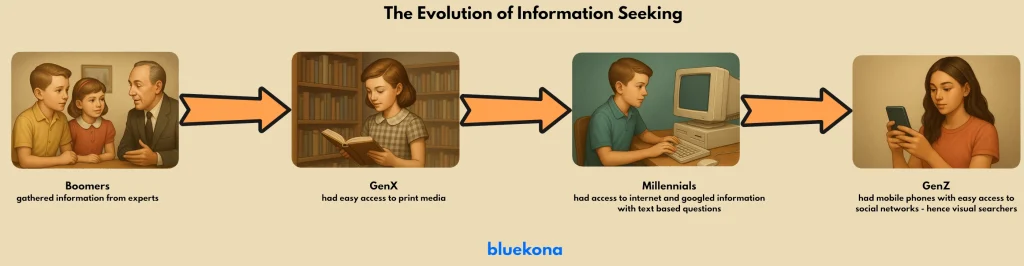
Unlike previous generations, Gen Z didn’t spend their childhood poring over manuals or encyclopedias. They’ve learned to tackle problems visually — think YouTube tutorials, Instagram stories, and now, those quick TikTok clips.
For them, visual learning isn’t just a preference, it’s what they always do. When they need to tie a tie, fix a leaky faucet, or pick out a new moisturizer, they’re not diving into a lengthy blog post — they’re watching someone demonstrate it live.
TikTok has truly mastered this visual-first approach. While Google’s search results often lean heavily on text that requires some patience to sift through, TikTok serves up short, practical videos that feel personal and immediately helpful.
Type “best affordable skincare routine” into Google, and you’ll find yourself wading through blog posts filled with disclaimers and backstories. Do the same on TikTok, and you’ll be greeted with 30-second clips of real people applying products, showcasing results, and sharing their genuine reactions.
That sense of authenticity is crucial. Google’s top results can often come off as overly commercial or optimized for clicks. On the other hand TikTok, feels like advice from a friend. Even sponsored content has to pass the test of real-time demonstration — you can see the product in action, catch those genuine expressions, and make your own judgment.
The real magic lies in what we call edutainment.TikTok’s effortless mix of learning and fun. There’s no clear boundary between “searching for answers” and “watching for enjoyment.” Users absorb information about products, solutions, and trends while they scroll, so by the time they’re ready to make a purchase, they’ve already been influenced — all without feeling like they’re being sold to.
For brands, the takeaway is straightforward, TikTok captures Gen Z’s attention by turning information into entertainment. Success isn’t about interrupting their scrolling with ads, it’s about crafting content so captivating that your product becomes part of the scroll itself.
The SEO Mechanics Inside TikTok
Understanding that TikTok functions as a search engine is one thing, but grasping how it ranks your videos is a whole different ball game.
The algorithm takes into account a blend of keyword signals and engagement metrics to determine which videos pop up in searches and on the For You Page.
1. Captions & Keyword Placement
TikTok scans every word in your caption, aligning it with user searches.
That casual morning skincare video in your feed starts with a hook built around its main keyword “My $8 morning routine for glowing skin.” Along the way, it naturally drops secondary keywords like “AM skincare,” “hydrating toner,” and “daily sunscreen.” The creator prompts interaction with calls-to-action such as “Save this for your next Target run” or “Which SPF do you use?” Finally, they tag 3–5 highly relevant hashtags to help TikTok categorize the content — #MorningSkincare, #GlowingSkin, #AffordableBeauty.
2. Subtitles & On-Screen Text
TikTok automatically generates captions from your audio and can read overlay text, making both searchable.
In the video, if you noticed, the creator syncs it all together — the voiceover says, “Morning skincare routine,” the on-screen text reads, “AM skincare steps,” and the caption might say, “Daily skincare routine for glowing skin.” That video didn’t just show up by chance — it’s the result of clever keyword clustering that boosts ranking across multiple related searches. And when the creator overlays product names, prices, and a “get it here” prompt, it sends an even stronger commercial intent signal to TikTok’s algorithm.
3. Watch-Time & Completion Rate — The Quality Filter
TikTok places a high value on videos that viewers finish watching (or replay).
Here are some key strategies:
Deliver your main message within the first 3 seconds
Show results before the process (after→before)
Create loopable content that viewers want to re-watch for clarity or satisfaction
Finish with a next-step hook (“Full ingredient list on my profile”)
The algorithm also monitors what happens after viewing — profile visits, related searches, and continued session time — and boosts videos that keep users engaged on the platform.
The key takeaway here is that TikTok SEO revolves around stacking signals. This means you should align your captions, spoken words, and on-screen text with intent-driven keywords. The goal is to create such valuable and engaging content that viewers can’t help but stick around, prompting the algorithm to share it even more widely.
Case Study 1: Danielle Athena – TikTok Shop Creator Success
What sets successful brands apart on TikTok from those that struggle isn’t just their budget — it’s all about strategy.
Take beauty creator Danielle Athena, for example. Rather than pouring money into ads, she cleverly utilized TikTok SEO to create a million-dollar sales funnel, racking up an impressive $5.6 million in beauty sales on TikTok Shop this year alone.
What’s her secret sauce? It’s all in her viral content, featuring reviews of popular tools like the Tymo Ring (which snagged 48 million views) and the Wavytalk 5-in-1 (with 25 million views).
But don’t be fooled into thinking it was just luck — it was all about smart search optimization. Athena crafted her videos around high-intent search phrases like “best hair straightener” and “affordable hair styling tools.”
The SEO Strategy Behind the Sales
She used keyword-rich captions that felt like genuine reviews (“This $30 hair straightener outperforms my $200 one — here’s why”).
She grabbed attention with striking visuals — dramatic before-and-after shots within the first 3 seconds to hook viewers. She also layered keyword signals throughout her captions, voiceovers, and on-screen text to maximize discoverability.
Engagement prompts like “Save this for later” or “Which tool should I test next?” encouraged comments and saves, which are strong signals for ranking.
Athena’s approach to integrating TikTok Shop was just as strategic. Instead of pushing hard sales, she presented each review as educational content, seamlessly incorporating purchase options.
Viewers didn’t feel like they were being sold to — they felt informed. The outcome? A significant boost in purchase intent and conversion rates.
Scaling the Playbook
Athena teamed up with Wavytalk to co-create new products, enriching her content pipeline with product launches, behind-the-scenes clips, and tutorials.
This consistency helped her establish a search monopoly for hair tools on TikTok — when users search, her content is what they find.
The Results
Danielle: $5.6 million in creator-driven sales.
Wavytalk: $12.6 million in TikTok Shop revenue in the first half of 2024
Case Study 2: Dee Pizza – From Small-Town Pizzeria to Global Footfall Magnet
https://www.tiktok.com/discover/dee-pizza
If Danielle Athena demonstrates how TikTok SEO can boost digital product sales, Dee Pizza showcases how the same principles can elevate a small-town eatery into a worldwide sensation.
Nestled in Llangollen, Wales, this family-owned pizzeria went viral thanks to a clever concept: the “First Eats Free” campaign. Each day, they captured the moment when their first customer received a complimentary meal — quick, POV-style videos that felt instantly relatable and were perfect for sharing.
The Local SEO StrategyThat Went Global
Dee Pizza didn’t leave things to chance. Their videos were carefully crafted around location-specific keywords like “best pizza in Wales,” “unique dining experiences,” and “food challenges.”
They complemented these with geographic hashtags to attract both local diners and curious tourists. And it paid off. One Saturday’s video exploded with 12.6 million views and 950,000 likes, creating a buzz that had people lining up before the restaurant even opened its doors.
Turning Customers Into Content
What made this campaign truly brilliant was its self-perpetuating cycle: engaging customers create captivating videos, which in turn draw in more customers eager to be part of the fun.
Even those who didn’t win on the freebie wheel left with positive memories and more chances for content creation. Every interaction became a marketing opportunity. Each video entertained followers, ranked well for local search terms, and inspired user-generated content, allowing Dee Pizza’s influence to stretch far beyond its small-town roots.
Scaling Success
This strategy led to impressive growth. With 700,000 followers on TikTok and plans for expansion already underway, Dee Pizza is now franchising its model — a testament to how TikTok SEO can drive not just clicks, but real-world foot traffic and sustainable business growth.
Dee Pizza didn’t win because of polished ads or big budgets. They won because they turned daily operations into SEO-driven storytelling — authentic, repeatable, and optimized for intent. Their playbook shows that on TikTok, the smartest marketing isn’t separate from the business; it is the business.
The Brand Playbook: $1M Funnels Without Ads
What do a beauty influencer and a cozy little pizzeria have in common? On TikTok, quite a lot! Danielle Athena and Dee Pizza show us that the brands making waves on the platform aren’t necessarily those with the deepest pockets — they’re the ones who know how to leverage TikTok SEO to create a sustainable growth engine.
1. Keywords Spark Discovery
Athena tailored her reviews around intent-driven searches like “best hair straightener.” Meanwhile, Dee Pizza focused on “best pizza in Wales.”
Both creators used captions, on-screen text, and hashtags to connect with what people were genuinely looking for.
2. Repeatable Formats Fuel Growth
Athena’s product demos followed a tried-and-true structure: hook → results → tutorial → CTA.
Dee Pizza’s “First Eats Free” campaign was straightforward, easy to replicate, and endlessly captivating.
They didn’t rely on fleeting viral moments — instead, they built a content system designed to deliver results time and again.
3. Authenticity Drives Conversions
These case studies highlight that TikTok users aren’t interested in ads — they crave answers and real experiences. Athena’s reviews felt like friendly advice rather than a sales pitch, while Dee Pizza’s POV clips captured genuine moments instead of scripted commercials. This authenticity fostered trust, which in turn led to conversions.
4. Content Transforms into Commerce
For Athena, her search-optimized videos seamlessly directed viewers to TikTok Shop, racking up over $5.6M in sales.
For Dee Pizza, their short videos sparked real-world demand, filling up their restaurant and paving the way for franchise growth. In both scenarios, entertainment morphed into education, and education turned into sales.
The Takeaway for Brands
You don’t need ads to thrive on TikTok. What you really need is content that’s searchable, authentic, and designed for repeatability. Whether you’re selling beauty products or delicious pizza, the strategy remains the same: stack those keyword signals, make your content easy to find, and let TikTok’s algorithm handle the scaling.
How to Optimize for TikTok Search
When it comes to optimizing for TikTok search, understanding how the platform has evolved is just the beginning—putting your own SEO strategy into action is where the real work lies.
The brands that are thriving on TikTok aren’t just hoping for the best. They’re following a well-thought-out system that revolves around keywords, consistency, and engagement triggers.
1. Embrace TikTok’s Unique Keyword Research
Believe it or not, TikTok itself is a fantastic keyword research tool. Start by typing in some basic terms in the search bar, like “skincare,” “pizza,” or “budget makeup,” and watch as the autocomplete suggestions pop up with high-intent queries such as “skincare routine for acne” or “best pizza in Wales.”
Dig a little deeper with long-tail variations like “skincare routine for teenagers” or “affordable curly hair tools.” These phrases often lead to more specific searches that face less competition.
Keep an eye out for emotional modifiers that TikTok suggests—words like “easy,” “quick,” “affordable,” or “healthy.” These terms give you insight into what users are really looking for.
Here’s a pro tip: Take a close look at the top-ranking videos in your niche. Pay attention to their captions, how they use keywords, and their engagement patterns. This reverse-engineering can reveal what TikTok’s algorithm is favoring.
And don’t forget about seasonality! Terms like “summer skincare,” “holiday outfits,” or “back-to-school makeup” tend to see spikes at certain times of the year. Make sure to align your content calendar with these trends.
2. Post Consistently, Vary the Format
To really shine on TikTok, consistency is key. But don’t confuse consistency with churning out the same video over and over. It’s all about showing up regularly—aim for once a day or three to five times a week, depending on your niche—and mixing things up with different formats and perspectives:
Quick tips that last 15 to 30 seconds
Longer tutorials that run 60 to 90 seconds
Product reviews or demos
Behind-the-scenes looks or POV content
Responses to questions from your comments
One of the smartest ways to scale your content is by batch-creating around specific keyword clusters. For instance, a fitness brand could develop a series focused on “home workouts” that targets phrases like
“home workout no equipment”
“home workout for abs”
“home workout quick results”
This strategy not only establishes your authority on the topic but also keeps your content feeling fresh and engaging.
3. Engineer Engagement That TikTok Rewards
TikTok doesn’t just count views, it looks for signs of real value. Here are the big three:
Comments → Pose specific questions: “Which of these products would you give a shot?”
Shares → Craft content that’s either super relatable or so good that people can’t help but share it.
Saves → Think tutorials, product info, or step-by-step guides that users will want to revisit later.
Don’t hesitate to pin your own strategic comments to give extra keyword context (like, “This $30 straightener outperforms my $200 one — and it’s safe for curly hair too”).
And remember to include CTAs such as: “Save this for your next Target trip.” “Tag a friend who needs to see this.” Early engagement is crucial.
Letting your loyal followers know or promoting your content on other platforms can give the algorithm a boost, but the ultimate aim is to create content that’s so helpful or entertaining that engagement happens naturally and consistently.
The Bottom Line: Achieving success with TikTok SEO isn’t about just wishing for your content to go viral. It’s about treating TikTok like a search engine: identify genuine user queries, consistently create content around those topics, and craft engagement signals that show TikTok your content is worthy of a higher ranking.
Pitfalls to Avoid
Even with a solid TikTok SEO strategy, small mistakes can kill your momentum. These pitfalls don’t just cap your reach — they can actively harm your account’s standing with the algorithm.
1. Overstuffing Keywords
Cramming every variation of a keyword into one caption makes content look spammy and hurts engagement.
Bad: “Best affordable skincare routine for acne-prone sensitive dry oily skin morning night products under $20.” Better: “This $12 cleanser cleared my acne in two weeks — here’s my sensitive-skin morning routine on a budget.”
The second example feels natural, still hits multiple keywords (affordable skincare, acne, sensitive skin, morning routine, budget), and delivers value without keyword overload. TikTok’s algorithm rewards contextual, conversational use — not robotic stuffing.
2. Ignoring Watch-Time Signals
TikTok doesn’t just care what you say — it cares if people stick around to watch it. Many creators lose viewers by delaying the payoff.
Bad: “Today I’m going to show you my skincare routine for dry skin.” (intro drags, users scroll away) Better: “This $8 moisturizer gave me glass skin in one week — here’s how.” (hook delivers instant value)
Watch-time is TikTok’s ultimate ranking filter. Focus on:
Strong hooks in the first 3 seconds.
Quick pacing and no fluff.
Clear visuals and audio.
Loop-ability (before/after reveals, fast demos, or content that’s worth rewatching).
3. Not Updating Content for Seasonal & Trending Searches
TikTok search trends shift constantly. Posting “summer skincare” in November won’t rank. Smart creators build content calendars around predictable cycles:
Winter: “dry skin solutions”
Spring/Summer: “sunscreen recommendations”
August/September: “back-to-school makeup”
They also jump on real-time trends — whether it’s a viral product, trending audio, or cultural moment — but only when it aligns with their niche.
The best creators blend seasonal consistency with trend agility. That means updating proven videos with fresh products, using trending sounds strategically, and being first (but not too early) when new searches spike.
Note: TikTok punishes spammy captions, boring content, and outdated strategies. The creators who win long-term don’t chase hacks — they align naturally with how people search, keep viewers watching, and adapt to the rhythms of TikTok’s ever-changing search landscape.
Ready to rank higher on TikTok? BlueKona shows you which videos drive sales — and how to scale them.
Did you know that a whopping 92% of marketers now consider themselves advanced users of AI?
And it gets better, 80% of them believe these tools are exceeding their ROI expectations, while 94% have seen an increase in revenue. We’ve officially transitioned from asking, “Will this work?” to “What should we keep?”
But here’s where things start to get tricky.
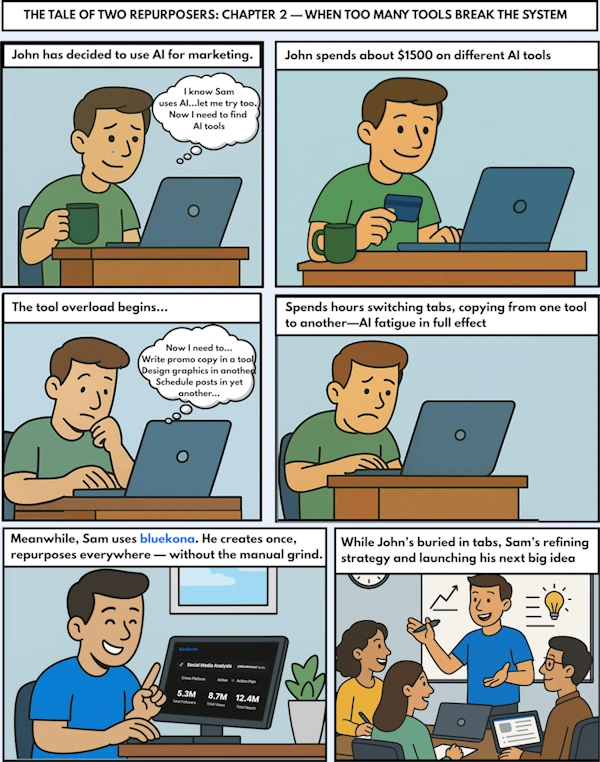
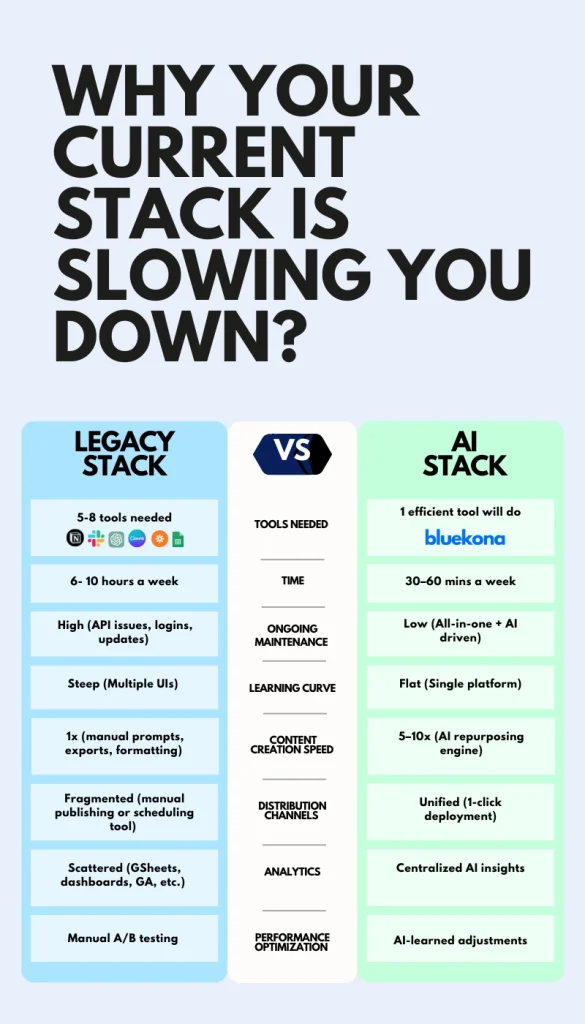
Somewhere between ChatGPT for content creation, Jasper for nailing brand voice, Synthesia for video production, Sprout Social for scheduling, and Albert.ai for ads—the initial promise of efficiency has become buried under a mountain of overlapping solutions.
Interestingly, 82% of teams feel they’re ahead of the AI game. Yet, many now describe themselves as “somewhat advanced,” which suggests that while confidence is high, clarity is lacking. The tools are effective, but the strategies behind them? Not so much.
With over 100 tools for content, email, analytics, and social media, marketers aren’t struggling to adopt AI anymore—they’re overwhelmed by choices. Decision fatigue has taken the place of ROI skepticism as the biggest hurdle to AI-driven growth.
This isn’t just another hype article. It’s a candid examination of what’s excessive, what’s truly valuable, and why streamlining your tools might be the smartest AI strategy your team can adopt—before your entire stack collapses under its own weight.
The AI Landscape Is Overwhelming (Here’s Why)
Remember the days when picking a marketing tool was as simple as choosing between Mailchimp and Constant Contact?
Now, it feels like you’re trying to manage 8 to 12 different AI platforms for everything from content creation to analytics, ads, and scheduling—most of which end up overlapping in ways that just add to the confusion.
AI was meant to make your life easier, but instead, it seems to have complicated things even more.
Let’s take a look at the current situation
Content Creation & Copywriting
ChatGPT (OpenAI): Generates long and short-form content with creative brainstorming, multilingual support, and reasoning tools powered by GPT‑4. Ideal for drafting articles, emails, and chat scripts fast.
Jasper: Tailors copy to your brand voice using templates and workflows — great for scalable content production.
Writesonic: Offers 80+ templates and GPT-4 integration for blog, ad, and SEO content with multilingual support.
Rytr: Affordable tool for short social media posts and emails with built-in plagiarism checks.
Copy.ai: Delivers email and ad copy with predictive performance scoring and team collaboration features.
Anyword: Generates copy with real-time performance predictions while keeping your brand voice consistent.
Scalenut: Supports long-form content with topic clusters and keyword planning to improve SEO relevance.
HyperWrite: Context-aware autocomplete and email reply suggestions, ideal for improving writing speed.
Koala Writer: Automatically drafts SEO-optimized blog posts in multiple languages.
MarketMuse: Uses topic modeling to identify content gaps and build authority.
Frase: Creates SERP-aligned content outlines and briefs using answer scoring and NLP.
Clearscope: Grades term relevance to boost on-page SEO performance.
SurferSEO: Offers keyword clustering and NLP suggestions for SERP-focused content optimization.
Outranking: Automates SERP-gap analysis, outlines, and internal link recommendations.
NeuralText: Combines keyword research with AI-generated drafts and competitor SERP comparisons.
Alli AI: Performs CMS-integrated bulk on-page SEO optimization.
RankIQ: Builds outlines for low-competition niches with high-CTR title suggestions.
Semrush ContentShake AI: Delivers 12× faster brief creation based on trend data and auto-posting integration.
Ahrefs + AI: Suggests SERP-gap questions and keyword ideas aligned with backlink data.
RankMath AI: Offers in-editor title and meta generation using GPT for WordPress users.
WordLift: Adds schema markup and builds knowledge graphs to enhance semantic SEO.
ZipTie: Tracks brand mentions and alerts with AI-generated SERP overview reports.
Video & Audio Production
Synthesia: Creates video avatars and presentations in 140+ languages without filming.
Descript: Provides video editing with AI-generated transcripts, voice overdubs, and filler-word removal.
Runway: Enables real-time object removal and VFX with generative video support.
Google Veo: Converts text into B-roll videos at a lower price point.
OpusClip: Automatically extracts short clips and resizes them for social platforms using hook detection.
ElevenLabs: Generates natural and multilingual AI voices with emotional tonality for dubbing.
Image & Creative Assets
Canva Magic Media: Text-to-image generation and editing using templates and brand kits.
Leonardo.AI: High-speed AI image generation with 3D texture support for creatives.
Scenario: Helps generate game and ad assets trained on specific visual styles.
AdCreative.ai: Builds ad visuals, banners, and videos with scoring and competitive insights.
HubSpot Campaign Assistant: Auto-generates ad copy and visuals with direct sync to Marketing Hub.
Imagine.art: Free HD text-to-art and video generation with real-time upscaling.
Social Media Management & Listening
Sprout Social: Includes AI Assist for captions, posting timing, sentiment analysis, and listening.
Hootsuite + OwlyGPT: Offers caption generation and real-time trend discovery via AI.
Buffer AI Assistant: Simplifies content planning with auto captions and optimal send times.
FeedHive: Recycles top-performing content using AI and conditions content reposting rules.
Agorapulse: Features a content writing assistant and unified inbox with fraud detection filters.
SocialPilot: Enables bulk scheduling and AI tagging for up to 500 posts.
Loomly: Suggests post ideas based on trends, with approval workflows.
Hookle: Serves as a mobile AI assistant offering daily suggestions and smart scheduling.
Zoho Social: Powers governance-ready scheduling with SmartQ AI and analytics.
Sprinklr Social: Delivers enterprise-level AI capabilities, multi-channel support, and brand safety tools.
Advertising & Campaign Optimization
Albert.ai: Self-optimizes across ad channels with budget reallocation and keyword tuning.
Smartly.io: Automates creative, predictive bidding, and cross-channel ad buying at scale.
Moloco Ads: Enables ML-driven programmatic advertising using first-party data.
Enhencer AI Ads: Targets Shopify stores with creative asset and audience modeling for strong ROAS.
Evolv AI: Optimizes web experiences via multivariate testing in real time.
HubSpot AI Ads: Manages creative generation and performance tracking within the CRM.
Email Marketing & Outreach
Seventh Sense: Predicts best time and day to improve email deliverability for each contact.
Encharge: Enables AI journey building with GPT‑powered sequencing and segment prediction.
ActiveCampaign: Offers predictive sending and lead scoring within its CRM.
Send-time optimization and copy tuning are baseline features now
CRO & Testing
Unbounce, Evolv AI, Ortto, HubSpot CRO Toolkit
A/B testing overlaps—insights don’t sync across platforms
Customer Analytics
Optimove, Insider, Delve AI, MyMap.AI, AWS AI Marketplace
All do journey mapping and churn prediction. Data lives in silos
Automation & Forecasting
Zapier Canvas, Salesforce Einstein GPT, IBM Watsonx, Ortto AI
Everyone promises “end-to-end automation”… none delivers it cleanly
Influencer Marketing
CreatorIQ, Heepsy, Sprout Tagger, Lionize, IMAI
Search, vetting, and pricing all duplicated in separate dashboards
Voice & Chat Support
Intercom Fin, Drift AI Chat, Zendesk AI, Amazon Connect
Bots don’t share memory—repetition kills UX and team efficiency
The Uncomfortable Math
Average tools per team: 8–12
Average spend: $200–$2,000/month
Time wasted switching tools: 2–3 hours daily
Functionality actually used: ~30%
What That Looks Like Day to Day
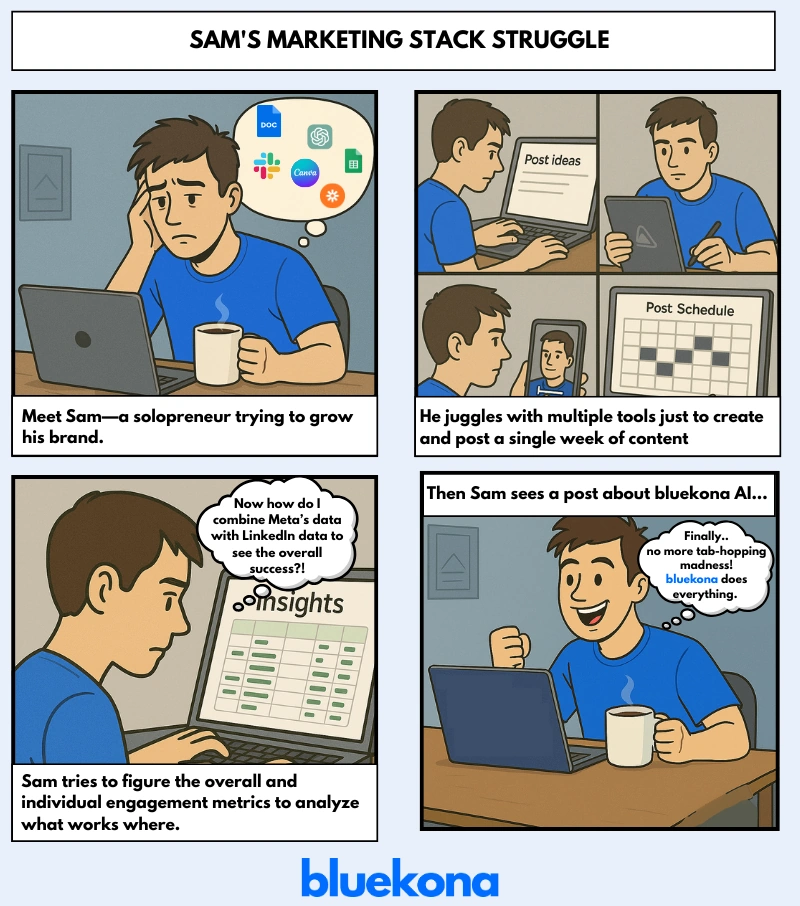
Monday: Juggle between Jasper, Sprout Social, and Canva just to get a single blog post and promo ready.
Tuesday: Realize ChatGPT could handle about 70% of what Jasper does. Start questioning why you’re paying for both.
Wednesday: Spend 45 minutes hunting down your influencer data, only to end up exporting it to a spreadsheet anyway.
Thursday: Manually approve “automated” posts across four different platforms. Here we go again.
Friday: Ask yourself: Are we really using AI—or is it using us? This isn’t about having bad tools.
It’s about unchecked chaos. Every tool claims to be the ultimate solution. So, you end up buying ten. The outcome? More tools, less clarity.
The smartest teams aren’t just scaling AI. They’re streamlining it. The bloat isn’t just a theory—it’s a reality.
The Honest Case for Consolidation
Let’s be honest, consolidation isn’t without its flaws. It’s a strategic trade-off, but if you’re truly focused on speed, clarity, and control, it’s a trade worth making.
You’re not stuck picking between “one platform to rule them all” or juggling eight different specialized tools. Instead, you’re opting for a smarter foundation — a single strategic core that can manage 80% of your marketing operations with just 20% of the overhead.
And, what is it that you gain?
1. Speed That Actually Matters
When content creation, scheduling, and performance analytics are all housed in one place, you can finally stop the endless tool-switching. No more wasting 2–3 hours a day just trying to get the context you need.
2. Clarity in Decision-Making
Unified dashboards aren’t just a nice-to-have. They reveal important patterns. The connection between Tuesday’s blog, Wednesday’s social post, and Friday’s email spike becomes crystal clear when everything is integrated into one system.
3. Lower Cost of Ownership
Many AI stacks can drain your budget: think $200–$8K a month in subscriptions, plus those sneaky hidden costs like integration, troubleshooting, and duplicated features. Consolidation can slash your spending by 40–60%—and you won’t have to sacrifice performance.
4. Reduced Training Overhead
Mastering one platform deeply is far more effective than fumbling with eight tools. New hires get up to speed faster, teams can work more efficiently.
But, you might loose
1. Loss of Depth in Specialized Areas
There’s a reason we have specialist tools. Whether it’s Jasper’s brand voice training, Synthesia’s avatars, or Clearscope’s scoring, these tools outshine generalists when it comes to their specific niches. If you’re really pushing the envelope in a particular field, you might still find yourself needing these resources.
2. Less Flexibility in Unique Situations
Need enterprise-level influencer fraud detection? How about complex multivariate testing or multilingual avatar-led videos? For those tricky last 20%, you’ll definitely want to rely on top-notch tools.
3. Roadmap Reliance
When you decide to consolidate, you’re putting your faith in the idea that your platform will grow alongside you.
If the tool you pick doesn’t focus on what your team needs in the next quarter, you could be left waiting, or forced to add something on temporarily.
The bluekona Approach: 80/20 Done Right
bluekona isn’t about replacing everything you already have. Instead, it acts as a smart consolidation layer, giving your team a single, dependable hub for content, scheduling, analytics and some light automation.
Now, what about that remaining 20%? That’s where you bring in specialists, but only when they can clearly show a return on investment. Think of them as temporary boosts rather than permanent additions.
You don’t need a dozen tools cluttering your workflow. What you really need is one all encompasing tool that cover most bases, plus one or two specialists to step in when it really matters.
Consolidation doesn’t mean you have to settle. It’s all about prioritizing what truly counts.
Because the real question isn’t “Which tool does this best?”. It’s “Which tools actually make a difference?”
What bluekona Covers..And What It Doesn’t?
In a world where every platform claims to be your all-in-one marketing solution, bluekona takes a different approach, it prioritizes focused excellence over unnecessary features.
Instead of trying to replace your CRM, email platform, ad manager, or project tracker, it doesn’t aim to do it all. Its mission is to excel in the 80% of your marketing workflow that truly fuels growth.
Schema markup, link building, SERP performance tracking
Here’s what that looks like
Old Way:
Write in Jasper
Edit in Grammarly
Design in Canva
Schedule in Buffer
Check metrics in Sprout
Combine data from four platforms
Repeat daily with a different mix
bluekona Way:
Connect your channels just once
Create AI-driven content that fits your brand perfectly
Repurpose it everywhere with a single click
Review your performance all in one dashboard
Iterate, improve, and scale—without the hassle of too many tools
Why “Not Everything” Is the Point
1. Efficiency > Complexity
bluekona hones in on the systems that truly matter, content creation, strategy, distribution, and performance. That’s where your time is spent—and where the inefficiencies often hide.
2. Depth > Breadth
You don’t need a toolbox full of 47 tools. What you need is a solid platform designed to deliver results every day, with the flexibility to bring in specialists when the situation calls for it.
The Strategic Play: Core + Optional Power-Ups
Need top-notch video production? Use Synthesia. Launching a major influencer campaign? Add CreatorIQ. Diving deep into SEO? Plug in Clearscope.
But let those tools be situational—not foundational.
bluekona serves as your command center for growth—not just another tech stack. It offers you the simplicity to execute and the power to scale—without getting lost in a sea of tools.
Who This Is For—And Who It’s Not
bluekona isn’t for everyone. It’s designed for marketers who are ready to leave the chaos behind and scale their efforts more intelligently.
This Is For:
Growing Teams Overwhelmed by Tool Chaos You’ve piled on tool after tool, tackling small issues while creating bigger headaches. Now, your team spends more time juggling logins than actually creating content. bluekona offers a single platform to plan, publish, and measure. No need to juggle five different tools to get the job done.
Agencies Wasting Billable Hours on Manual Tasks Client work should be smooth and efficient, but instead, you find yourself hopping between dashboards, copying insights into slides, and manually reformatting posts. bluekona cuts out the middleman, allowing you to work efficiently without having to patch together eight different tools.
Solo Marketers on the Brink of Tech Burnout You’re wearing all the hats, like, writing, designing, scheduling, reporting—and your “tool stack” is starting to cost more than your rent. You need a content engine that’s ready to go right out of the box, not a patchwork system that requires a Zapier expert to operate.
This Isn’t For:
Enterprise Ops with Highly Customized Needs If you’re managing multi-market, compliance-heavy, attribution-focused campaigns, you’ll still need specialized, integrated platforms—and probably a development team to keep everything running smoothly.
Teams Already Committed to Complex Workflows If your setup is already intricately connected with custom APIs and tailored dashboards—and it’s working well—switching to a new system might cause more headaches than it’s worth.
Brands Pushing the Envelope on Creative Innovation If staying ahead means diving into AI-generated 3D content, dynamic video avatars, or interactive experiences, you’ll need cutting-edge creative tools that go beyond what bluekona offers.
The Bottom Line
The AI boom addressed the wrong problem.
It flooded marketers with more tools, more options, and more “solutions”. But it didn’t tackle the real issues, like, fragmentation, decision fatigue, workflow overload, and tool sprawl.
The top-performing teams aren’t cranking up their AI usage, they’re actually dialing it back, but in a smart way. They’re focusing on what truly makes a difference and cutting out the noise.
So, here’s the real question: Are you in control of your tech stack, or is it running the show?
Start your audit. Discover what bluekona can replace. Identify what’s fueling your growth—and what’s just eating away at your budge
The scroll is ruthless. You have ~3 seconds to hook — or die.
Every platform’s algorithm,from YouTube to Instagram to LinkedIn, is designed to reward content that grabs attention instantly. Not eventually. Instantly. Weak openings? They get buried.
In this post, we’ll break down exactly what makes a powerful first three seconds on YouTube Shorts, Instagram Reels, and LinkedIn Carousels. You’ll see real examples, repeatable hook formulas, and data-backed strategies to improve your scroll-stop rate — no matter the platform.
If your job depends on getting people to watch, read, or engage, this is where you start.
Why the First 3 Seconds Matter ?
The first three seconds aren’t just important — they’re make-or-break. In a feed moving faster than a caffeine-fueled scroll session, attention isn’t given. It’s earned instantly.
Viewer Drop-Off Rates Don’t Lie
YouTube Shorts: According to YouTube’s own Creator Insider, a staggering 70% of viewers decide whether to keep watching or swipe away within the first 3 seconds. That’s your entire pitch window.
Instagram Reels: Meta’s internal research shows that the average viewer gives a Reel just 1.7 seconds before deciding if it’s worth their time. That’s less than two blinks — your visual or audio cue needs to hit immediately.
LinkedIn Carousels: LinkedIn’s Ads Benchmark Report reveals that if your first slide lacks contrast or punchy copy, CTRs can drop by over 50%. On a platform where users skim while pretending to read, the first visual has to do the heavy lifting.
Platform Behavior You Can’t Ignore
Users don’t watch — they scan. You’re competing with subconscious thumb reflexes, not just other creators.
Algorithms boost content that causes users to hesitate, rewatch, or interact right away. The quicker you trigger that pause, the better your odds of reach.
Your first frame is algorithmic currency. If it doesn’t hook, it doesn’t rank.
YouTube Shorts: What Grabs & Keeps
When it comes to YouTube Shorts, the first three seconds are less of an opening and more of a grenade. They need to explode fast, loud, and with purpose. Unlike longer-form YouTube content, there’s zero patience for buildup. The best-performing Shorts punch the viewer with motion, tension, or curiosity — immediately.
What Works in the First 3 Seconds
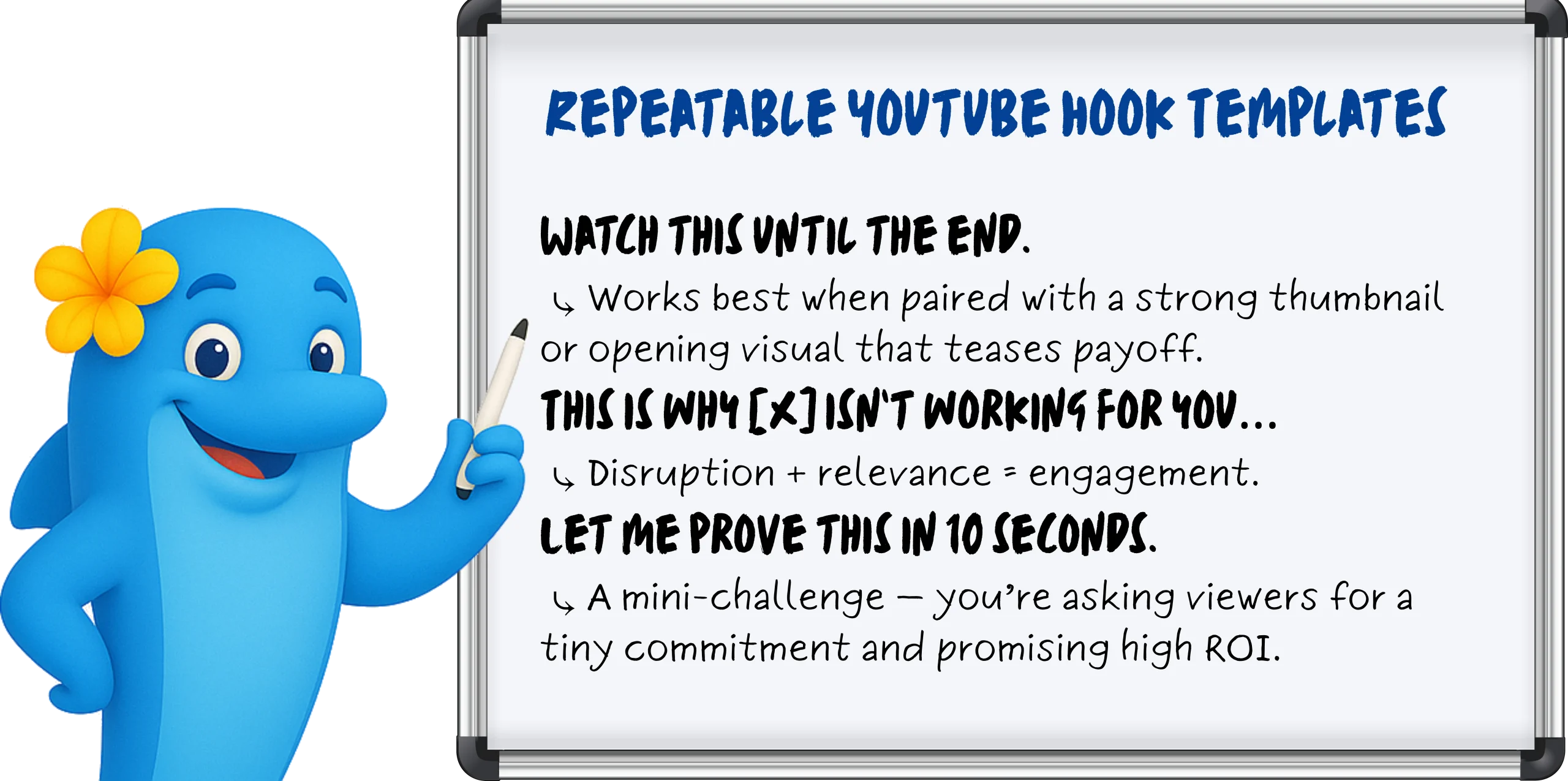
1. Hard Cuts & Pattern Disruption The scroll stops when something breaks the feed’s rhythm. Think jarring transitions, zooms, sudden audio bursts — anything that snaps the brain awake. The goalis to disrupt the default passive scroll.
2. Immediate Voiceovers Top creators open with lines like:
“Here’s what nobody tells you about [topic]…”
“You’ve been doing this wrong — let me show you why.”
The pattern? They open with tension, contradiction, or a bold promise — within the first breath.
3. Motion-Heavy or Unexpected Visuals Whether it’s fast jump cuts, punch-ins on facial expressions, or text that animates with meaning — static = skipped. Viewers are drawn to movement, so even talking heads layer in kinetic typography, visual overlays, or reaction-style inserts to hold attention.
Instagram Reels: Shock, Sound, Overlay
Instagram Reels doesn’t reward slow burns — it rewards sensory ambush. If YouTube Shorts is about pacing and narrative tension, Reels is about vibe and visual punch, often before the viewer even taps.
Scroll-Stop Mechanisms That Work
Your job? Interrupt the scroll within one second — visually or audibly.
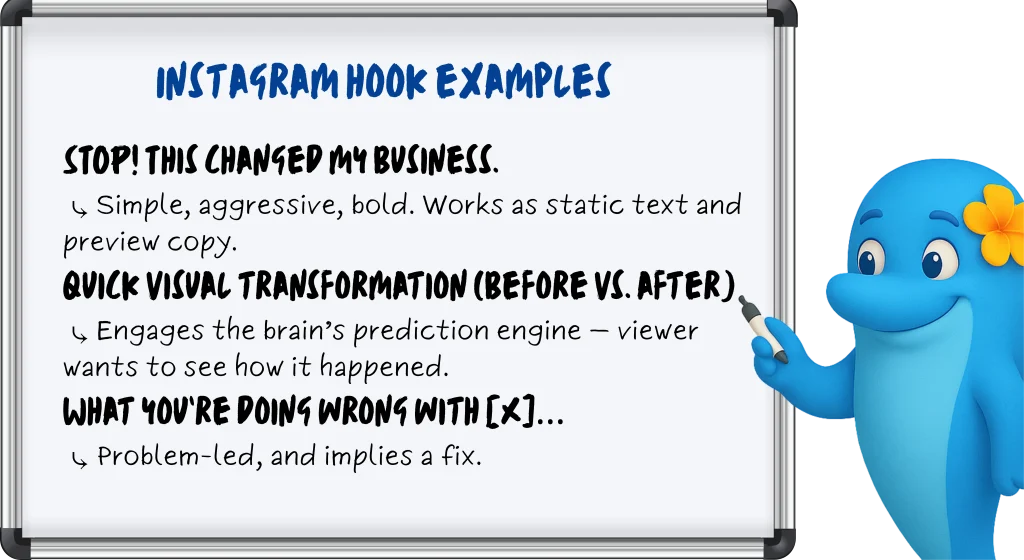
1. Trending Audio Cues (First Second or Bust) Instagram’s algorithm loves audio-native behavior. That means syncing your first second with a recognizable sound — a beat drop, a voiceover hook, or a viral soundbite — to instantly trigger familiarity.
2. Timed Text Overlays (Preview-Optimized) Your first frame matters before the viewer even hits play. The preview frame is your thumbnail. Strategic creators time bold text overlays to appear in the first 0.3 seconds, so the hook is already visible in-feed.
3. High-Contrast or Unexpected Visuals Surreal edits. Face-reacts. Props in weird places. Reels thrives on visual thumb-breakers that contrast with lifestyle content around it. If your face fills the frame and your eyes say “wait for it” — it works.
Reels Editing Tips That Actually Matter
Time your text overlays to appear in the first 0.3 seconds Anything slower risks being cut off in preview mode — aka, your hook dies before it lives.
Always check your preview frame before posting What shows in-feed is what earns the click. A dead frame = dead reach.
Keep the first 1–2 seconds hyper-visual and reactive Even if you’re talking, make the viewer feel like they’re missing something if they scroll.
LinkedIn Carousels: First Slide = Battle Zone
On LinkedIn, the first slide isn’t an intro — it’s a knife fight for attention. Forget clever setups or brand-heavy titles. If your lead slide doesn’t provoke curiosity, urgency, or ego in under a second, you’ve already lost the click.
What Actually Makes People Swipe
1. Stat-Based Hooks That Challenge or Alarm Cold, hard numbers perform well — especially when they suggest most people are doing something wrong.
Example Slide 1: “78% of marketers miss this — are you one of them?”
Why it works: Social proof meets FOMO. Feeds into ego, curiosity, and self-assessment — all at once.
2. Provocative Questions That Poke at Pain Points Challenge the reader’s status quo. Swipe-worthy carousels open with a line that hits where it hurts — budget, performance, perception.
Slide 1: “Are your campaigns bleeding money?”
Slide 1: “Your boss cares about ROI. Show this.”
Why it works: LinkedIn users are job-focused — pain + solution = performance.
3. Visual Hierarchy & Contrast Big fonts. Bold text. Negative space. Colors that don’t blend in with the sea of blue and beige. The first slide should feel like a bold poster — not a polite cover.
Why it works: No fluff, no intro, just friction and value in one frame.
Best Practices That Actually Drive Swipes
Ditch the logo: You’re not Coca-Cola. The first slide is for the reader, not your brand team.
Never waste the slide on a title: If it reads like a headline from a blog post, it’s already being ignored. Make it punch, not label.
Add swipe cues: Use arrows, broken lines, or subtle animation to create movement and momentum — your carousel should feel like a journey.
How BlueKona Can Analyze Which of Your Hooks Actually Work
You’ve posted. You’ve hoped. Maybe even prayed to the algorithm gods. But which hooks actually worked — and which ones got ghosted?
BlueKona takes the guesswork out of performance. It analyzes your posts across platforms — YouTube Shorts, Instagram Reels, LinkedIn Carousels — by impressions vs. engagement, so you can see exactly which hooks stopped the scroll… and which ones got scrolled right past.
You’ll know:
Which posts had high visibility but low engagement (aka, hook fail)
Which ones spiked interaction right at the top (aka, hook magic)
How performance shifts by platform and format
Which opening frames or phrases actually pull people in
No more gut instinct. No more guessing. Just clear, scroll-stopping insight.
Most marketing teams still run content operations like it’s 2015. They are struggling with separate tools, isolated teams, and painfully slow approvals.
You write one blog post, maybe share it on LinkedIn, and then it disappears. Meanwhile, competitors are flooding every platform, daily.
It’s slow. It’s disconnected. And it’s built for a world that no longer exists.
According to the Content Marketing Institute, 70% of marketers say they repurpose content — but fewer than 15% do it systematically. That gap is where growth either compounds, or collapses.
Content today moves at the speed of platforms, not planners. One asset isn’t enough. You need it repurposed into 10 formats, distributed across 5 channels, optimized for multiple audiences — and tracked in real time.
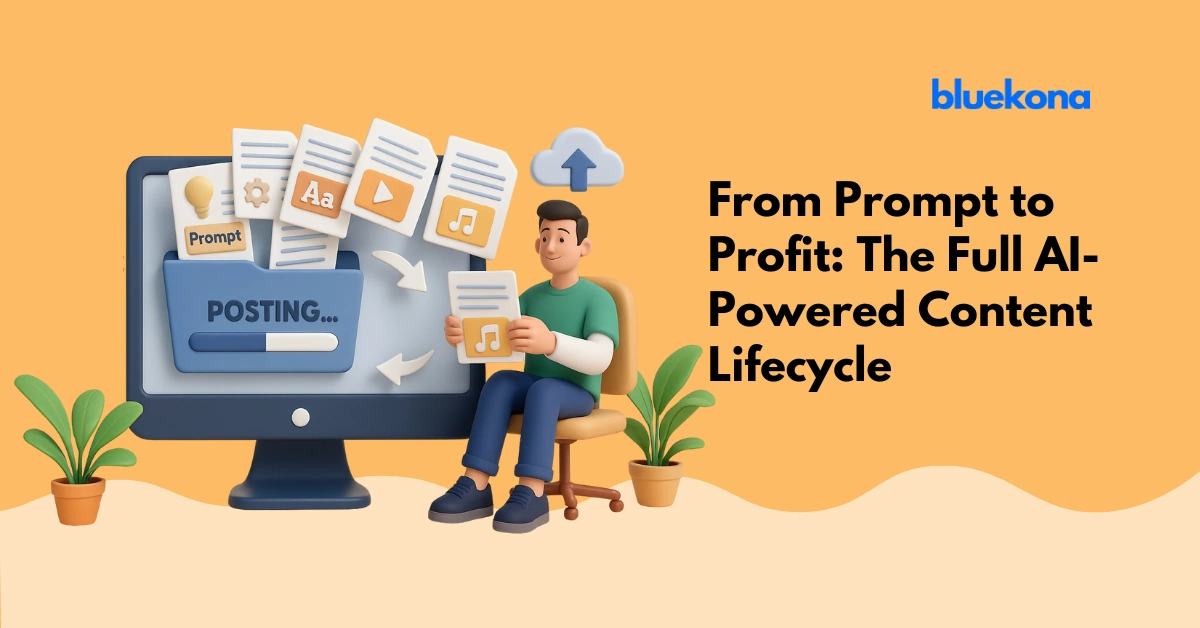
Enter the AI-powered content lifecycle.
We’re not talking about generic AI writing assistants. We’re talking about a full-stack marketing engine that takes you from initial prompt to platform-ready content to performance analytics — without duct-taping together half a dozen tools.
In this guide, I’ll break down each stage of the modern AI-powered content lifecycle — ideation, creation, distribution, repurposing, and performance tracking — and show you exactly how BluekonaAI powers the entire flow from end to end.
If you’re serious about scaling organic growth without bloating your headcount, this is the workflow your team needs.
What is the AI Content Lifecycle?
Traditional content processes are linear and disconnected. You brainstorm, produce, publish, measure and then repeat, often from scratch.
The AI content lifecycle flips that on its head. It treats content creation as a continuous, connected system, where each stage fuels the next, and data constantly feeds back into strategy.
At a high level, the AI content lifecycle has five key stages:
It starts with ideation, where AI taps into real search data, trend signals, and past content performance to surface strategic ideas that actually align with what your audience wants — eliminating the guesswork.
Next comes creation, with AI drafting high-quality, platform-ready assets that serve multiple purposes: long-form blogs, video scripts, social posts, all consistent with your brand’s tone. Instead of jumping between disconnected drafts, you get cohesive content from the first prompt.
After that is distribution, where AI automates publishing across channels in one smooth step. Whether you’re updating your CMS, scheduling emails, or posting to social platforms, the process is centralized and fast, eliminating countless manual copy-paste routines.
Then comes repurposing, the stage where true efficiency compounds. Instead of letting a single blog post gather dust, AI transforms it into multiple new formats: LinkedIn carousels, TikTok scripts, newsletter sequences — each one adapted in tone, length, and structure for its unique audience. No more reinventing the wheel with every piece.
Finally, there’s performance tracking. Forget disconnected dashboards and clunky spreadsheets; AI pulls engagement, conversion, and reach metrics together in real time. That means you know exactly what’s working and can feed those insights right back into your next round of ideation — making the entire system smarter with every cycle.
Together, these five stages form a truly continuous, intelligent loop — one that helps your team publish faster, reach further, and optimize smarter, without bloating headcount or burning out your best people.
This system isn’t just a time-saver. It unlocks compounding growth. Instead of starting from scratch every week, your best-performing content becomes a flywheel — reshaped, reamplified, and continually optimized with no extra friction.
Platforms move fast. So should your team. The AI content lifecycle is how brands stay visible, consistent, and relevant, without bloating headcount or burning out creatives.
Stage 1: Ideation — Smarter Starts with AI
Most content workflows still kick off the same painful way: someone asks, “What should we write this week?” and a random brainstorm happens.
A few half-baked ideas surface, you pick one, and start typing hoping it sticks. That’s not strategy. That’s guesswork.
BluekonaAI turns that guesswork into a systematic, data-powered idea engine. Instead of relying on hunches, it uses trend-aware intelligence from social signals, and even your past best-performing content to surface ideas with proven audience demand.
That means you get to high-opportunity topics before your competitors do with none of the chaos.
Beyond simply suggesting titles, the platform helps you build out your content with your team in the loop.
That means your content creators don’t waste time rewriting objectives, angles, or keyword lists, they get a clear, intelligent first draft that’s almost ready to go, reducing the lag between strategy and execution.
In short, ideation with BluekonaAI means faster, smarter, and more focused planning — setting your entire content lifecycle up for success before a single word is written.
Stage 2: Creation — From Prompt to Platform-Ready
Once you’ve nailed down the right ideas, the next hurdle is actually producing high-quality, on-brand content. And doing it fast enough to stay relevant.
Traditionally, that meant briefing a writer, waiting days for a draft, reviewing it, rewriting it, adapting it for different formats, and hoping it held up across multiple channels.
Multiply that by 10 or 20 assets a month, and you’ve got a bottleneck that can choke any growth plan.
Enter Bluekona’s Content Studio. Need a blog post? You get a fully structured long-form article, with optimized subheads, relevant internal links, and strategic keyword integration already built in.
Want a LinkedIn thought piece from that same topic? It rewrites it in a sharper, persona-driven tone, with a hook, a body, and a CTA specifically designed for feed engagement.
How about a YouTube script? Done. Scene markers, intro/outro lines, on-camera voice and flow — all aligned with your brand guidelines.
This is what sets BluekonaAI apart from cookie-cutter AI tools: it doesn’t just churn out filler. It creates intent-matched content.
Each asset is aware of the format, the distribution channel, and the outcome it’s supposed to achieve.
Even better, BluekonaAI remembers your past content. It can reuse top-performing CTAs, maintain consistent messaging, and avoid repeating ideas that fell flat before.
No more blank docs, no more headline rewrites, no more endless tweaks to fit one post across five channels.
This is full-stack, multi-intent content creation, optimized for both output and outcomes. From a single brief, you can launch a blog post, a video script, a carousel, a Twitter thread, and an email sequence, all aligned and ready to publish.
Stage 3: Distribution — Publish Everywhere, Instantly
You’ve got strategic ideas and platform-ready content — but if it sits in a Google Doc or gets buried in a project folder, it’s worthless.
Distribution is what actually puts your work in front of people, and most teams still struggle here.
Jumping between social schedulers, manually posting, and praying everything goes live at the right time.
BluekonaAI removes that friction by connecting content creation directly to distribution. The moment an asset is approved, it’s ready to schedule— no copy-pasting, no endless uploading, no channel-by-channel checklists.
It’s the “one-click publish” mindset: instead of wasting time coordinating posts across platforms, you can reinvest that effort into refining your strategy. By cutting out the manual steps, you ensure your content goes live—on time, in the right format, and built to perform.
Stage 4: Repurposing — Multiply Every Idea
Most brands treat repurposing as an afterthought, if they do it at all. They’ll copy a paragraph from a blog, squeeze it into a social post, and call it a day. The problem? That approach is random, time-consuming, and rarely consistent in tone or structure.
In today’s multi-platform environment, you can’t afford for a great piece of content to die after a single post. Audiences engage differently on each platform, and you need your best ideas to follow them — adapted to every format, in every channel.
BluekonaAI makes this effortless. Instead of manually rewriting or reformatting, it transforms your primary content asset into a full suite of secondary assets, automatically tuned for context, tone, and platform style.
For example, that in-depth blog post can become:
a LinkedIn carousel with short, scroll-stopping slides
a short-form video script tailored for TikTok or Reels
an engaging Twitter thread built for conversation
a bite-sized email nurture sequence
a podcast snippet summary for Spotify
And it doesn’t just swap words around. BluekonaAI’s repurposing engine is format-aware — understanding the unique style and narrative flow of each channel. It can condense a story for a TikTok script with hooks and cliffhangers, expand it for a podcast transcript, or rewrite it for a more conversational newsletter style.
Even better, it preserves your brand voice and messaging across every asset. That means no more awkward rewrites or hiring yet another freelancer to fix tone inconsistencies. The platform reuses your brand’s proven calls-to-action, style guidelines, and key phrases, keeping everything recognizable and consistent.
This is how you get true scale. Instead of asking your team to “do more with less,” you multiply what’s already working. High-performing content is reamplified, resurfaced, and retargeted to different audiences without starting from scratch.
The result? Your content pipeline goes further, lasts longer, and reaches more people — without the painful delays and coordination hassles that kill momentum.
If the modern attention span is measured in seconds, you need to meet audiences wherever they scroll. BluekonaAI makes that possible, turning one idea into many, across every platform, on-brand and on-time.
Stage 5: Performance Tracking — Close the Loop
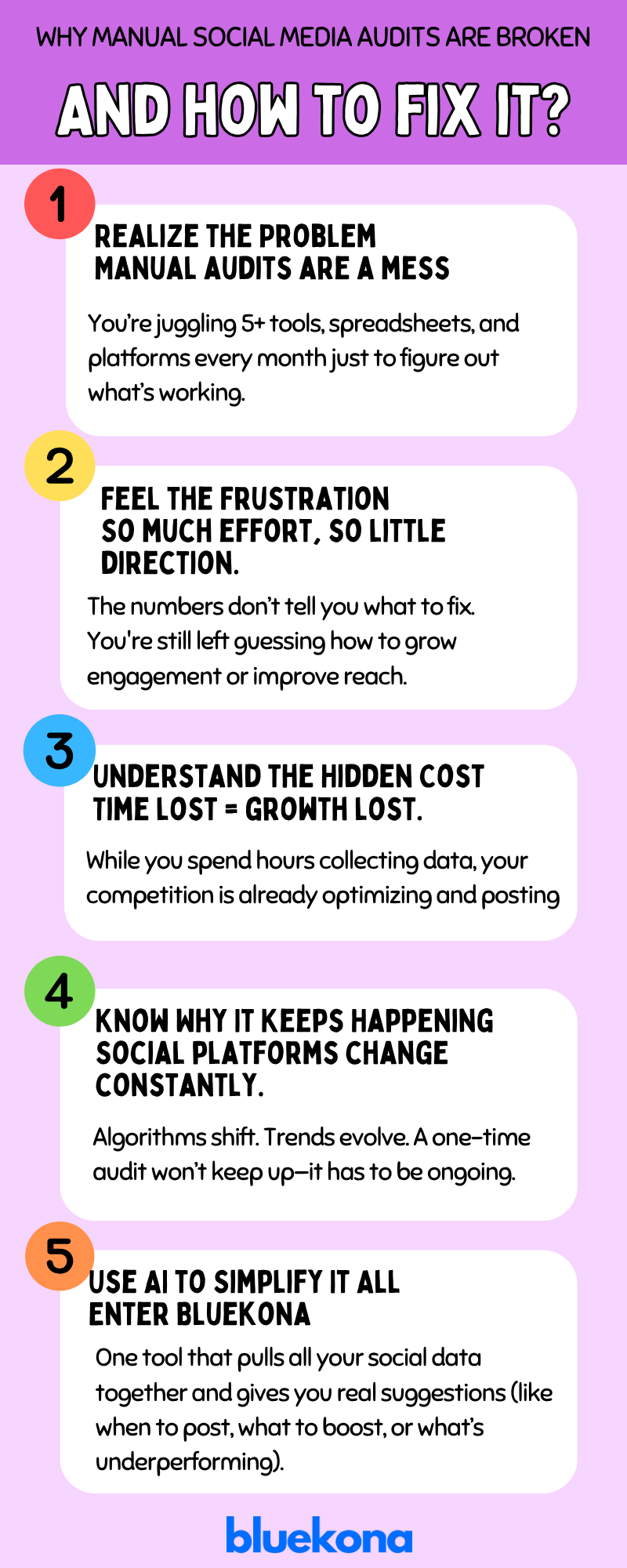
You can’t improve what you don’t measure. Yet most teams still struggle, either relying on lagging useless metrics like traffic or likes, or drowning in a maze of spreadsheets and inconsistent attribution models. It’s messy, slow, and often too late to act.
BluekonaAI changes that by making performance data instantly visible, centralized, and actionable — without hiring a full-time analyst. The moment content goes live, Bluekona begins tracking its impact across every connected channel:
clicks, views, and conversions for blog posts
engagement rates and reach for social posts
open and click-through rates for email campaigns
watch time and retention for video
Even better, Bluekona ties these metrics directly back to the original idea and content format, so you can see exactly what’s moving the needle — and what’s falling flat. No more guessing which assets to scale up or which channels to prioritize.
And it goes beyond reporting. Bluekona builds feedback loops right into the workflow:
Underperforming content? It suggests a retargeting or repackaging strategy.
Top-performing content? It flags it for repurposing and wider syndication.
Channels that underdeliver? It recommends shifting focus, not just throwing more content at the wall.
This isn’t just analytics — it’s true content intelligence, designed to make your marketing lifecycle continuously smarter. You move faster, optimize better, and reinvest effort where it matters most.
With Bluekona, your team doesn’t just ship more content. You ship smarter content, tuned by real-world data.
No spreadsheets. No guesswork. Just clear visibility, faster decisions, and sustainable growth.
Why BluekonaAI Wins: The Power of a Unified Engine
Most content teams stitch together a chaotic patchwork of tools — one for writing, another for scheduling, something else for analytics, plus countless spreadsheets to bridge the gaps. That approach costs time, drains budgets, and often fails to deliver the consistent results growth teams need.
BluekonaAI is different. It replaces the messy “tool stack” with a single, unified engine that covers every phase of the content lifecycle: from strategy and creation to distribution, repurposing, and performance tracking.
No more multiple logins, conflicting data, or tasks falling through the cracks. With one seamless platform, your team can focus on what actually matters: getting valuable content to market, faster and more efficiently.
That means fewer approvals, fewer rewrites, and dramatically lower costs — without sacrificing quality or control. In other words, the same creative horsepower, minus the friction.
If you’re serious about scaling your organic growth, BluekonaAI is the upgrade your workflow has been waiting for.
Wrap Up
Winning with content used to be about who could write better or publish more. Now it’s about who can operate smarter.
The AI-powered content lifecycle isn’t just a productivity hack—it’s how modern marketing teams scale organic growth without bloating headcount or burning out creatives. When ideation, creation, distribution, repurposing, and performance tracking all run through one system, content becomes a growth engine—not a bottleneck.
BluekonaAI gives you that engine.
Whether you’re a lean team trying to punch above your weight or an established brand tired of disconnected tools, Bluekona replaces chaos with clarity—and manual work with momentum.
Content is flooding every single channel right now. Feeds are jam-packed. Search results are more competitive than ever. And your audience? They’re tired of shallow, repetitive posts that sound like they were written by a robot in 30 seconds.
AI has made pumping out content ridiculously easy. But pumping out good content? That’s where most teams fall flat.
Brands either publish a ton of mediocre stuff no one remembers, or they sink weeks into polishing a single article, only to miss opportunities to grow.
But the truth in today’s market is that you can’t afford to pick sides. You need both quality and velocity — because that’s what modern distribution and learning loops demand.
If you want to build authority, rank higher, and stay top of mind, you have to create systems that let you move fast and deliver value.
In this article, I’ll break down exactly how to build a content workflow that scales without sacrificing quality, using smart AI tools and a proven structure.
Ready? Let’s dive in.
Velocity vs. Quality
Before you can fix the problem, you need to name it.
Velocity is all about speed and scale. It’s how fast — and how consistently — you can get content out the door. Think consistency, publishing frequency, and your ability to show up in multiple channels week after week. The faster you move, the more opportunities you have to connect with your audience and test what works.
Quality, on the other hand, is about depth and impact. That means relevance to your audience, originality that stands out, well-researched insights, a polished finish, and a voice that actually resonates. Quality is what makes someone read, remember, and trust your brand.
Here’s the trap: most teams think they have to choose. They either crank out a mountain of low-value posts that nobody cares about, or they obsess over one perfect article for weeks and lose all momentum.
That old trade-off just doesn’t cut it anymore — and in a minute, I’ll show you why.
Why the Old Tradeoff Doesn’t Work Anymore?
When ranking #1 on Google could lock in steady traffic for a year content teams had to pick a lane, either publish fast and risk low-quality output, or spend weeks in every piece and fall behind in distribution.
That tradeoff is now obsolete and infact dangerous.
Today, AI has smashed the barriers to content production. Anyone can spin up a 1,500-word blog post or a week of social posts in minutes. Feeds are overflowing with shallow, mass-produced content. Audiences can sense it instantly. Algorithms can detect it even faster. And platforms are responding.
Google’s Helpful Content updates are actively devaluing AI-written pages that lack originality and real insight.
LinkedIn’s feed algorithm has shifted to prioritize meaningful conversations over cheap engagement hacks.
YouTube and TikTok still reward volume — but only if you hold attention and drive watch time.
In other words, flooding channels with low-effort, high-velocity content is a one-way ticket to irrelevance. It not only fails but signals to algorithms that you’re not worth showing at all.
On the flip side, slow, handcrafted content creation is a luxury most teams can’t afford. If it takes 3 weeks to publish one blog post, you’re not just falling behind you also become invisible in the AI flood. The market moves faster than your editorial calendar.
The only way to scale today is to build a system that delivers both. And that’s exactly what efficient AI workflows like Bluekona Content Studio can do for you.
The 3-Layer Content Stack Framework
To publish fast without sacrificing quality, you need structure and not just more hours.
The 3-Layer Content Stack is a simple but scalable model for content creation that ensures:
Your best ideas don’t die in a Google Doc,
Every asset pulls double or triple duty, and
Your publishing cadence stays consistent without burning out your team (or yourself).
Here’s how it works
Layer 1: Core Content (Depth)
This is your high-value, original thinking—the long-form assets that anchor your expertise.
This can be
A blog post that solves a specific pain point
A podcast episode
A live webinar or founder AMA
You don’t need to publish these daily. But you do need to create them with intent—clear angles, search demand, and a POV that cuts through.
AI’s role here:
Assist with research, structure, and draft generation
Suggest related subtopics to increase coverage depth
Accelerate editing with grammar, clarity, and tone alignment
Layer 2: Repurposed Assets (Reach)
This is where you take that hero content and remix it into format-native posts for each platform.
From one blog of the first layer, you can spin out
A 7-slide LinkedIn carousel
A short-form quote reel (Instagram/Youtube Shorts/TikTok)
An email with the top 3 insights
A Twitter/X thread distilling the main argument
A one-pager for sales enablement
AI’s role here:
Automatically extract key quotes, stats, and CTAs
Rewrite sections to match platform tone (e.g. LinkedIn vs Instagram)
These are your daily snippets that keep you visible and engaged.
From Your content in level two, pick
1-sentence takeaways
Audiograms from podcast clips
Reaction tweets to trends (tied back to your content)
AI’s role here:
Surface snackable moments from longer content
Write first-draft hooks, headlines, and CTAs
Schedule and distribute on a cadence that fits your audience
Why This Framework Works
This model shifts your mindset from “create more” to “extract more value from what you’ve already created.”
It gives your content strategy density. Every core idea generates 5–15 assets, each tailored for different formats and attention spans.
It also feeds the algorithmic loop. In other words, more assets = more data = faster iteration = better results.
And with the right AI engine behind it (hint: BluekonaAI), this becomes an automated system and not your full-time job.
FAQ
What is content velocity in SEO and marketing?
Content velocity is how fast and how consistently you can publish. In SEO, higher velocity helps you target more keywords, stay fresh in Google’s eyes, and build authority. But remember: velocity only works if quality stays high.
Why does content quality matter in the age of AI?
Because AI made it ridiculously easy to crank out generic, soulless content, which audiences and algorithms ignore. Platforms like Google and LinkedIn actively bury low-value spam. Only content that’s insightful, clear, and genuinely helpful gets traction now.
How can AI help improve both speed and quality in content creation?
AI is a brilliant sidekick for research, outlines, drafts, and repurposing — as long as you keep the human brain in charge. Let AI handle the heavy lifting, but don’t outsource your strategic thinking. The best results come from using AI to accelerate, not to autopilot.
How often should I publish content to balance quality and speed?
Forget a magic number. Instead think of its layers. Publish a valuable, in-depth piece weekly or biweekly, then repurpose it into daily or near-daily micro content. Experiment and watch what actually drives reach and engagement.
Can repurposed content still rank in search or perform on social?
Absolutely. If you adapt it properly it can perform. Repurposing is not copying and pasting. It’s transforming a core idea into a format and style that fits the platform and meets audience expectations. Native, audience-first reuse is the key to making it work.
Don’t Pick One, Build the System
The teams winning today aren’t choosing between quality or speed. They’re refusing the question entirely.
Instead of debating tradeoffs, they’re building systems that are repeatable. AI-assisted workflows make high-quality output inevitable and fast.
They publish more. They learn faster. They improve with every iteration.
This isn’t about grinding harder or chasing trends. It’s about structuring your content operation so that every idea has velocity, and every asset has impact.
If your marketing toolkit looks like a game of Tetris—Notion here, ChatGPT there, Zapier hooking things up, Buffer scheduling, Grammarly fixing typos, Hootsuite monitoring feeds—you’re not alone.
Solopreneurs and lean teams have cobbled together “best‑in‑class” apps to get more done, only to discover they’re spending more time switching tabs than actually creating.
Here’s the big truth, stitching together a dozen point solutions isn’t smarter. Infact, it’s slowing you down, bleeding your budget, and masking growth.
Every integration you maintain is another fragile link that can break when one API changes. Every dashboard you check is another distraction from the work that moves the needle.
In this guide, we’ll unpack why the traditional “marketing stack” model fails today’s creators and small teams—and how an AI‑first approach transforms your toolkit into a unified growth engine.
You’ll learn to spot the hidden costs of fragmentation, compare DIY stacks against a centralized AI system, and discover exactly what to look for when choosing an all‑in‑one solution.
Ready to stop duct‑taping tools and start building real momentum? Let’s dive in.
What Is a Marketing Stack?
Your marketing stack is simply the collection of tools and platforms you use to plan, create, publish, and measure your content. Think of it as the toolbox for every campaign, it has content editors, graphic design apps, social schedulers and analytics dashboards.
Why It Breaks Easily?
Tool Fatigue: Juggling half a dozen logins, UIs, and learning curves. You spend more time toggling between apps than crafting the work itself.
Context Switching: Every switch costs mental bandwidth. You lose focus when hopping from your writing app to your scheduler to your analytics.
Duplicate Data: Content calendars in Notion, post metrics in Buffer, engagement numbers in Meta dashboard —no single source of truth.
Fragile Automations: One API update or broken Zap, and your workflows grind to a halt, leaving you scrambling to fix integrations instead of optimizing campaigns.
Meet Sam—a solopreneur running a niche fitness coaching brand. His day starts in ChatGPT to brainstorm post ideas, then he drafts them in Google Docs, polishes the copy with Grammarly, and designs Instagram carousels in Canva. For video content, he edits in InShot and manually resizes clips for each platform.
Scheduling? That’s another chore. He uses Buffer for social posts, tries to connect Zapier to automate reminders, and hops between tabs just to publish a single week of content.
By the end of the week, he’s burned out, unsure what’s working, and too exhausted to dive into the data spread across Meta Insights, Google Sheets, and platform-specific dashboards.
One day, Sam stumbles upon BlueKona AI in a Slack community thread. Curious, he signs up—and everything changes.
Now, he generates platform-ready content in one click, repurposes it for Reels, carousels, and email in seconds, and schedules across platforms with built-in analytics—all in one place. No juggling. No burnout. Just consistent growth with less chaos.
The Hidden Costs of Tool Fragmentation
Multiple apps can become liabilities when they don’t talk to each other
Wasted Hours hopping between UIs and constantly patching broken integrations.
Fragmented Insights because metrics live in silos—no single view of performance.
Mental Overload from juggling too many dashboards and data formats.
Missed Growth when time spent on tool maintenance eats into time for strategy and creation.
These aren’t new frustrations—they’re simply magnified as your stack balloons.
So, let’s see how an AI‑first solution sidesteps these pitfalls entirely.
The Rise of the AI-First Stack
A centralized AI engine doesn’t just execute—it understands:
It auto-generates content across formats
Learns what performs and repurposes it automatically
Distributes to all platforms, perfectly timed and formatted
Surfaces insights—without you lifting a finger
This shift isn’t about adding another layer. It’s about replacing the messy glued-together tools with a clean, self-learning loop.
BlueKona was built with this in mind. One place to ideate, create, distribute, and optimize. Powered by AI that learns and improves with every click. No juggling. No guesswork. Just momentum.
What to Look for in an AI Marketing Stack?
Not all AI tools are created equal. Slapping a chatbot onto a legacy system doesn’t make it “AI-first.”
If you’re evaluating an AI marketing stack, look for these must-haves:
1. Built-in Content Creation, Repurposing, and Distribution
Your stack should help you go from idea to multi-platform execution without switching tabs. Whether it’s turning a blog post into a LinkedIn carousel, a tweet thread, or a short-form video—this should happen in one place.
2. Centralized Analytics
Say goodbye to spreadsheet gymnastics and bouncing between Google Analytics, Instagram Insights, and LinkedIn dashboards. A modern AI stack brings performance data into one unified view—so you actually use it.
3. A Self-Learning Engine
The best stacks don’t just automate—they adapt. Look for AI that learns from your best-performing content and suggests what to double down on (or ditch).
4. Async Collaboration Without Chaos
You shouldn’t need Slack, email threads, and 3 Notion docs to get content approved. An AI-first platform should allow teams (or clients) to review, tweak, and approve inside the workflow—without breaking anything.
If your tools can’t do this, you don’t need another Zap—you need a reset.
Why Marketers Cling to Legacy Stacks?
Old habits die hard—especially when they’re tied to tools you’ve used for years.
1. Fear of Switching
Change feels risky. What if the new system doesn’t work? What if it breaks what’s already “working enough”?
But sticking with a slow, stitched-together setup is a bigger risk—because speed is the new moat.
2. Familiarity Bias
“We’ve always used this.” Sound familiar? Tools become comfort zones.
But just because a process is familiar doesn’t mean it’s effective. Familiar ≠ optimal.
3. The “Specialized Tools” Myth
Many marketers believe they need one tool for design, one for copy, one for scheduling, one for analytics… and so on. That might’ve made sense in 2018. But today, AI can handle all of that under one roof—faster, smarter, and without duct tape.
Clinging to old stacks may feel safe—but it comes at the cost of time, clarity, and compounding growth.
The Future: AI-Native Marketing Systems
The next wave of marketing won’t be about stacking more tools. It’ll be about systems that think, learn, and improve on their own.
We’re entering the era of:
Predictive AI: Know what content will work before you hit publish.
Self-Improving Loops: Your system watches what performs—and evolves.
Real-Time Optimization: Copy, formats, timing—tweaked on the fly, not after the fact.
GPT-6 and beyond: We’re not just talking better writing. We’re talking strategy, decision-making, and creative ideation on autopilot.
The smartest marketers won’t be the ones who do more—they’ll be the ones who build smarter engines.
Wrap Up
The fragmented tool era is on its way out. Stitching together six apps, twenty tabs, and three dashboards isn’t a strategy—it’s a survival tactic.
AI-first systems like BlueKona aren’t just about convenience. They’re about clarity, consistency, and compounding growth.
The future of marketing is lean, intelligent, and lightning fast. And it’s already here.
“Create once, repurpose forever.” It sounds brilliant in theory. But in practice? Most content repurposing is just copy, paste, repost, pray.
Let’s be honest. That’s not strategy. That’s desperation masked as productivity.
The real problem isn’t that you’re repurposing content. It’s that you’re doing it manually, inefficiently, and without any learning loop.
Here’s the kicker: AI can take the same core content and actually make it work across platforms. Let’s break down why your current repurposing workflow is wasting your time, and how AI transforms it into a scalable system.
What Does “Content Repurposing” Actually Mean?
Real content repurposing isn’t a blind copy‑and‑paste marathon. It’s a three‑step process:
Reformat – Change the structure to fit the new channel. Turn a 1,500‑word blog post into a 10‑tweet Twitter thread or a 30‑second reel script.
Reframe – Shift the angle or tone so it resonates with that audience. A B2B LinkedIn carousel might lean on data and case studies but the same core idea on Instagram could lean into storytelling or behind‑the‑scenes visuals.
Redistribute – Publish with the right timing, metadata, and hooks. A YouTube Short needs a punchy title and thumbnail whereas an email snippet needs a compelling subject line and preview text.
But What Most Marketers Are Doing Is
Open your blog post, hit CTRL+C, switch to LinkedIn, hit CTRL+V—maybe swap a word or two—and hit Publish. Rinse and repeat for every channel.
That’s not repurposing. That’s syndication with zero strategy.
Without tracking what performs, you’re flying blind. You churn out variations, cross your fingers, then rinse and repeat. An AI-driven process, by contrast, learns which formats hit and doubles down—turning every post into a smarter, compounding investment.
2. No Channel Context
Treating every social channel the same is like speaking French in Spain. A Twitter thread thrives on rhythm and punchy hooks. An Instagram caption lives on crisp visuals and a killer one-liner. A YouTube description? It’s a search-optimized pitch. Same core idea—different languages.
3. Repetition Kills Engagement
Seeing the identical message on every platform is like hearing the same song on repeat. Audiences tune out. If your followers catch you copy-pasting blog paragraphs into their feeds, they’ll scroll past in seconds.
4. Time Sink with Minimal ROI
Manually slicing and dicing content for each channel eats up six-plus hours a week. That’s not something that can be scaled up.
How AI Fixes Content Repurposing (and Makes It Compound)
1. Learning from What Works
Every click, comment, and share feeds back into the system. AI tracks which formats, styles, and tones hit the mark and refines future outputs accordingly. Over time, your repurposing engine becomes a self-learning flywheel—compounding results with every cycle.
2. Channel-Specific Adaptation
AI doesn’t just chop down your blog paragraph, it recrafts it as a tweet hook, a slide headline, or a meme caption, depending on the platform. No more awkward one-size-fits-all posts.
3. Infinite Angles
Want fresh spins on the same core idea? AI can flip your blog into a punchy listicle, or a visual quote series—in minutes, not hours. It’s not just about pumping out more content it’s also about creating smarter variations that resonate.
4. Built-In Distribution
Modern AI tools handle publishing natively, (i.e) queuing up posts, optimizing send times, and pushing to each channel in one streamlined flow. It’s your automated traffic cop, keeping every piece of content on schedule.
What to Look For in a Good AI Repurposing Tool?
1. Context-Aware Content Transformation
The tool should read your source material and intelligently reshape it for each channe, rather than you fumbling with mismatched pieces.
2. One-Click Distribution Across Platforms
You shouldn’t need separate apps for LinkedIn, Twitter, Instagram, and email. Look for native publishing so you hit “Go” once, and your content lands everywhere on schedule.
3. Performance Feedback Loop
Every post is a data point. Your repurposing engine should feed engagement metrics back into its AI brain, so it learns what works and doubles down on high-ROI formats.
4. Zero Frankenstein Stack
If you’re juggling Chat GPT, Buffer, Zapier, and three other tools just to publish a single thread, you’re wasting time. The right AI repurposing platform bundles creation, scheduling, and analytics under one roof—no duct tape needed.
Spoiler: bluekona was built to do exactly this.
Wrap Up
You don’t need more blog posts. You need to squeeze 10× value from the ones you’ve already written.
Manual repurposing is a dead end. AI is the fast lane.
With BlueKona, your content becomes a growth asset and not a one-off experiment.
Give it a spin for free and watch your best ideas work harder.
If you’re a solopreneur or small-team marketer, you’ve likely spent hours toggling between Facebook Insights, Youtube Analytics, and LinkedIn dashboards—exporting CSVs, wrestling with spreadsheets, and still ending up clueless about “what to do next.”
Manual audits eat up your most precious resource: time. Worse, they leave you staring at numbers rather than guiding real decisions.
Imagine instead having an AI-powered auditor that pulls data from every platform, pinpoints exactly where you’re losing engagement, and delivers clear, prioritized action items in minutes.
In this post, we’ll show you why manual social media audits are killing your growth—and how Bluekona’s AI-driven solution gives you back hours each month plus the confidence to scale your impact.
Manual Social Media Audits Are a Time Sink
Let’s be honest—manual social media audits are exhausting.
You log into Instagram to check post engagement, switch to Facebook Insights for reach and reactions, then jump over to LinkedIn Analytics for follower growth. Maybe you even export all that data into Excel or Google Sheets, try building a few charts, and hope something meaningful pops out. Sound familiar?
Now multiply that by however many platforms you manage—and do it again next month. And the month after that.
Most small teams rely on a patchwork of tools just to cobble together the basics: reach, impressions, clicks, engagement rates. But those numbers alone don’t tell you what’s working or what to do next. They’re just metrics in a vacuum.
There’s No One Tool That Truly Does It All
Sure, there are analytics platforms out there. But most are either hyper-specific to one platform or simply surface-level. They spit out generic dashboards and pretty graphs without translating them into actionable insights.
You’re still left asking:
Should I post more Reels or carousels?
Which posts actually contributed to lead gen?
Is now the time to shift budget to paid?
Plus—The Work Is Never Done
Even if you build out a solid audit, algorithms change constantly. What worked last quarter might flop this month. Instagram may suddenly prioritize Saves over Likes. LinkedIn might start favoring native documents over external links. TikTok trends can shift in a week.
That means your “finished” audit has a shelf life of… maybe a few weeks?
So you’re not just running a manual process. You’re running a never-ending, manual process.
And for small teams juggling everything from content creation to customer support, that’s simply unsustainable.
What Manual Audits Are Really Costing You
It’s not just time you’re losing—it’s momentum, clarity, and competitive edge.
Every Hour Spent Auditing Is an Hour Not Growing
While you’re deep in a spreadsheet, your competitors are pushing out new Reels, testing fresh ad creatives, and riding the latest trend. They’re executing. You’re analyzing.
And it’s not just one hour. A typical manual audit across 3–4 platforms can easily eat up 6–10 hours per month. That’s a full day—gone. If you’re a solopreneur or a lean marketing team, that’s time you don’t have.
All That Work, and Still No Clear Direction
Let’s say you power through the process. You’ve pulled the numbers, built the reports. Now what?
You know your engagement dropped on Instagram… but not why.
Your Facebook reach is up… but which posts moved the needle?
Your LinkedIn follower growth is flat… but what content should you test next?
You have data—but no decisions.
Most analytics tools don’t bridge the gap between metrics and next moves. They tell you what happened. Not what to do.
You’re Always a Step Behind Algorithm Changes
Social media platforms evolve fast. What worked last month might not land this month. By the time you notice a dip in performance and redo your manual audit, the trend has already shifted.
For example:
Instagram deprioritizes static images in favor of carousels.
TikTok favors shorter videos under 15 seconds.
LinkedIn boosts content with native PDFs… again.
If you’re not constantly monitoring for these changes (and let’s face it, who has the time?), you’re reacting instead of staying ahead.
The Emotional Toll? Real.
Manual audits drain energy and motivation. The more complex your audit process becomes, the more likely you are to push it off. And eventually, you stop doing it altogether—which leads to flying blind across channels.
The result? Stagnant growth, inconsistent engagement, and second-guessing every post or campaign.
But it doesn’t have to be that way.
AI-Powered Social Media Auditing with Bluekona
If manual audits are costing you time, clarity, and performance—Bluekona gives you all three back.
Meet Bluekona: Your Always-On Audit Assistant
Bluekona is built for solopreneurs and small teams who don’t have time to dig through dashboards or build weekly reports. Using AI, it automatically ingests data from your connected social channels, analyzes performance, and delivers clear, prioritized recommendations.
No spreadsheets. No guesswork. No delays.
Real-World Example: How HomeCookingShow Turned Data into Growth
HomeCookingShow—an Indian culinary brand with millions of followers across YouTube, Instagram, Pinterest, and more—was facing a classic challenge:
They were publishing content regularly but had little clarity on what formats worked best, when to post, or why engagement fluctuated.
Their social team used to spend hours every month toggling between:
YouTube Studio for video metrics
Instagram Insights for Reels and Stories
Pinterest Analytics to track recipe pin performance
And spreadsheets to stitch it all together
It was exhausting—and still didn’t answer key questions like:
“Are we posting at the right time?” “Should we do more Reels or Carousel recipes?” “Why did our Facebook engagement drop last month?”
Enter Bluekona
With Bluekona, HomeCookingShow connected all their channels in one place. The AI:
Flagged that shorter, vertical Reels under 45 seconds had 2× more completion rate
Notified them that Pinterest was driving traffic to older Diwali recipes—so they re-promoted them
Recommended switching Facebook post times based on when engagement spiked in their regional audience
Result? They saved 10+ hours per month on reporting, and more importantly—started making data-backed content decisions in real time.
If you’re still manually auditing your social media, you’re pouring hours into pulling numbers—only to be left guessing what to do next. And in the fast-paced world of Instagram algorithms and TikTok trends, that lag costs you real growth.
Instead of raw data dumps, you get clear, personalized recommendations—like “Double your carousels on Wednesdays” or “Post Reels at 6 p.m. for maximum reach.”