A 100-year-old thermos brand nearly killed a product that would later redefine its entire business. The Stanley Quencher wasn’t rescued by louder ads or a new engineering breakthrough — it was rescued by a social-driven identity shift. When the brand pivoted its audience, redesigned its aesthetics, seeded creators, and leaned into UGC-fueled hype cycles, a clunky 40-ounce tumbler turned into a cultural staple and a revenue engine.
This isn’t a brand magic story. It’s a roadmap. SMBs and D2C teams can replicate the same levers of audience reframing, aesthetic repositioning, simple creator seeding, limited drops, and smart UGC amplification — without a Fortune 500 budget.
The mechanics are repeatable, the workflow is approachable, and the upside is massive when executed deliberately.
Here’s the playbook behind the Quencher moment — and how smaller brands can steal it, scale it, and ship it starting this quarter.
The Quencher Moment — Quick Case Recap
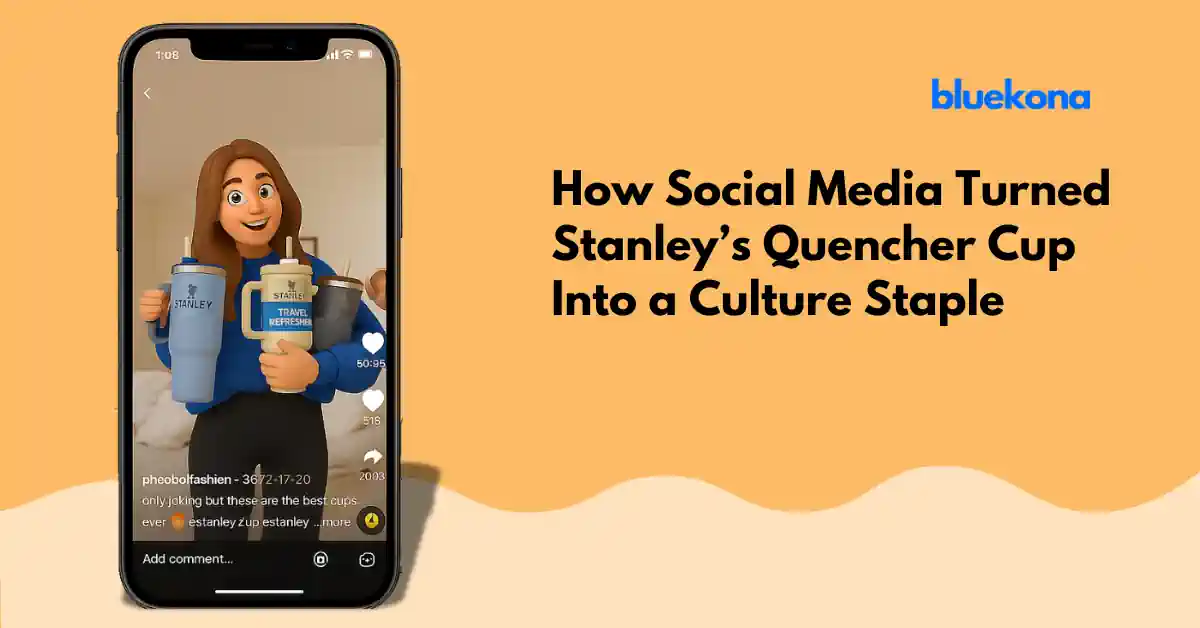
In 2016, Stanley released a 40-ounce tumbler built for outdoorsmen — and it bombed so badly the company nearly discontinued it.
Then a female-led lifestyle blog, The Buy Guide, discovered the Quencher and introduced it to a completely different audience: women who wanted hydration that felt stylish, functional, and part of their daily rituals. Stanley embraced the pivot — new colors, creator seeding, limited-edition drops, and then social took over.
The result: a near-dead SKU became the brand’s hero product, driving Stanley from roughly $70M in annual revenue to a projected $750M.
What Changed: Five Marketing Levers That Flipped the Script
Stanley didn’t overhaul the product, instead they overhauled the context around it. Five deliberate shifts turned the Quencher from an outdoor-worker tumbler into a lifestyle obsession.
1. Audience Redefinition
The original Quencher targeted rugged, outdoorsy men. The people who actually fell in love with it? Women — especially busy moms, wellness-focused consumers, and lifestyle shoppers who wanted a functional and aesthetic hydration staple. Stanley pivoted hard, and the moment they spoke to a new audience, demand ignited.
2. Aesthetic Pivot
The original Quencher came in utilitarian colors — hammertone green, matte black, basic silver. It used to look like a tool. Then it started looking like an accessory. Pastels, soft neutrals, seasonal drops, and collab colorways reframed the Quencher as something you show, not just something you use. Form became as important as function — and the product became Instagrammable.
3. Influencers & Creator-First Distribution
Instead of buying ads, Stanley put cups into the hands of lifestyle creators. Morning routines, hydration recipes, #WaterTok, GRWMs — the Quencher became a supporting character in everyday content. Native placement beat traditional promotion, and TikTok did the heavy lifting.
4. Scarcity & Collabs (Drop Strategy)
Borrowing from sneaker culture, Stanley introduced limited-color drops and collabs (Target, Starbucks, special editions). Scarcity triggered FOMO. Drops sold out in minutes. People camped outside stores. Resale groups formed. A water bottle became a collectible.
5. UGC & Authentic Crisis Responses
Nothing sells like real people doing real things. When a TikTok showing a Quencher surviving a car fire (with ice still in it) went viral, Stanley amplified it — and then replaced the customer’s car. The gesture deepened trust, and the clip became one of the most powerful pieces of UGC the brand could have asked for.
Stanley’s playbook works because it taps the psychological triggers that dominate modern social behavior — and turns them into predictable commerce outcomes.
Social Proof
When hundreds of creators, moms, and wellness influencers show the same product in their routines, it signals “this is the one everyone uses.”
Outcome: Higher discovery → more profile visits → accelerated trust.
Scarcity & FOMO
Limited color drops and collabs create urgency. If you don’t buy now, you may not get another shot.
Each psychological trigger compounds: Discovery → Trial → Repeat Purchases → Cultural Momentum.
A Practical 6-Step Playbook for SMBs & D2C Brands
You don’t need a $100M marketing budget to run the Stanley playbook. You just need a structured test cycle. Here’s the exact workflow small teams can execute in 30–60 days.
Step 1: Re-Define Your Primary Audience (Micro-segments + Hypotheses)
List who else your product could resonate with — not your current customer, but the adjacent one. Write a simple hypothesis:
“[Product] could resonate with [segment] because they care about [value/outcome].”
Test one micro-segment at a time (e.g., “wellness moms,” “home organizers,” “hybrid workers,” “early-morning gym crowd”).
Step 2: Test an Aesthetic Mini-Collection
Small brands don’t need 12 SKUs. Use a three-variant capsule to signal a new identity: softer colors, matte finishes, seasonal hues, or elevated packaging.
Run a small batch. Don’t overcommit inventory — you’re testing signal, not building a full line.
Step 3: Run Creator Seeding
Send product to 5–10 micro-creators (5K–50K followers) who already speak to your target segment.
Add one macro creator (100K+) as a control.
Give them creative freedom: “Use this naturally in your routine.” Prioritize authenticity over polished ad-style posts.
Step 4: Launch a Controlled Drop
Choose one variant for a scarcity test. Announce a drop 3–5 days in advance. Limit units or set a 24–48 hour window.
You’re not trying to sell out instantly — you’re testing urgency, demand, and creator-driven traffic patterns.
Step 5: Seed UGC & Build a Response Playbook
Ask customers to share their experience using a branded hashtag. Repost the best content immediately — amplification is part of the incentive.
Prepare a simple crisis-response plan:
What if something breaks?
What if someone posts a complaint?
What if a piece of UGC goes viral unexpectedly?
Authenticity + fast responses = trust (and more shares).
Double down on what moves. Kill what doesn’t. The system is the strategy.
Small teams don’t win with volume — they win with structured, repeatable workflows. These templates give you plug-and-play systems you can run this week.
Measurement: What to Track (and What ‘Good’ Actually Looks Like)
Here’s the part most brands skip — and the part that determines whether your Stanley-style playbook actually worked. If you’re going to pivot audiences, upgrade your aesthetic, seed creators, and run limited drops, you need a simple measurement system that tells you, “Yes, this is landing,” or “Nope, adjust.”
Think of these four buckets as your dashboard.
1. Discovery Metrics: Are more people finding you… on purpose?
These tell you whether your creators, content, and drops are pulling new eyeballs into your world.
Track:
Impressions
Profile visits
Branded search appearances
(Optional) Follower growth — useful, but not the metric to obsess over
What a win looks like: If your profile visits jump 3× during a drop or creator push, that’s signal. You’re breaking out of your existing bubble and hitting your new audience segment.
If branded search starts climbing (“yourbrand cup,” “yourbrand pastel,” etc.), even better — you’re becoming discoverable on your own terms.
2. Engagement Metrics: Do people actually care?
Discovery without engagement is just window shopping. Engagement shows your new aesthetic and positioning are resonating.
Track:
Saves (strong buying intent)
Shares (distribution booster)
Comments (qualitative signal)
UGC volume under your hashtag
What a win looks like: If your “new look” product content gets a 50%+ increase in saves, that’s people bookmarking the product — usually because they plan to buy.
If your branded hashtag starts populating with new videos each week? Even small numbers matter. That’s momentum.
3. Conversion Metrics: Does the hype translate to sales?
This is where the rubber meets revenue. You don’t need massive jumps — small increases compound fast.
Track:
CTR from social → product page
Add-to-cart rate
Conversion rate
AOV
LTV of customers who bought during your drop
What a win looks like: CTR up 20–40% Add-to-cart up 10–15% Conversion rate up 0.5–1% Drop cohorts buying again within 30–60 days (hello, collectible culture)
Those small percentage lifts? They’re exactly what fuel Stanley-style growth loops.
4. Earned Media Signals: Are you becoming ‘talked about’?
This is when the flywheel kicks in — when your brand stops pushing and starts getting pulled into feeds, posts, and articles.
Track:
Growth in branded hashtags
Press mentions
Creators tagging you without being seeded
Stitch/duet activity on TikTok
What a win looks like: If your branded hashtag grows 200%+ in a 60-day window, you’re doing something right. When people you’ve never spoken to start tagging you or asking for collabs, you’ve crossed from marketing → culture.
A quick “is this working?” baseline
Let’s say you spend $500 on a tiny creator seeding run.
You get:
50,000 impressions
1,500 profile visits
2% conversion (30 orders at $40 AOV = $1,200)
That’s already 2.4× ROIbefore you count repeat purchases or the ripple effect of UGC.
Now stack on:
profile visits tripling
conversion rate rising just 0.5–1%
UGC snowballing
…and the revenue tail outperforms what most small brands get from paid ads.
Common Pitfalls & How to Avoid Them
A Stanley-style playbook can unlock huge upside — but only if you dodge the traps that usually derail small brands. These are the mistakes that show up every single time a D2C team tries to “go viral” without a strategy.
1. Chasing Trends Without a Real Identity
Jumping on every TikTok trend feels productive… until your brand starts looking confused.
The fix: Anchor everything to your brand’s core story, then use trends as seasoning — not the whole meal.
2. Forgetting Your Original Customers
A new audience is great. Abandoning the ones who got you here? Not great.
The fix: Run your pivot in parallel. Keep classic products/colors active while experimenting with new aesthetics and messaging.
3. Betting Everything on One Creator
Creators are NOT silver bullets. One viral video doesn’t build a brand.
The fix: Spread the risk. Test 5–10 micro-creators and treat each as a signal, not a savior.
4. Sharing UGC Without Checking It
Fake testimonials, stolen content, or low-quality UGC can damage trust instantly.
The fix: Always verify the creator, confirm permission, and check the context before you repost anything.
5. Creating FOMO But Forgetting Fulfillment
Nothing kills hype faster than a sold-out product that takes six weeks to ship.
The fix: Match your “scarcity play” to realistic inventory. Drops should feel exciting — not like a logistics crisis.
6. Running Big Experiments With Zero Measurement
If you don’t track what happened, you’re not running a playbook… you’re guessing.
The fix: Use a simple 30–60 day measurement cycle (discovery → engagement → conversion → earned media). Double down on what moves. Ditch what doesn’t.
How to Scale This Without Burning Cash
Everything above works beautifully — until you try to run it consistently. Audience pivots, creator seeding, UGC management, drop cycles, repurposing workflows… they all require systems.
You need a way to see what’s working, repeat what’s working, and stop wasting time on what isn’t. That’s where automation becomes the difference between “fun experiment” and “repeatable growth loop.”
Bluekona steps in as the operational backbone, that has automated cross-platform audits that show which creator posts actually drive discovery, profile visits, and conversions. So you know which partnerships to scale and which to cut.
Stanley didn’t just market better — they reframed the product. Small brands can do the same by testing fast, listening to social signals, and doubling down on what resonates.
You don’t need a heritage brand or a massive budget to spark a Quencher-style moment. You just need the right audience, the right story, and the discipline to keep iterating until it clicks.
Most marketers aren’t running out of ideas — they’re running out of time. Between managing three content calendars, replying to comments, and chasing the latest algorithm shift, “doing social media” starts to feel like a full-time job for five people.
That’s where AI changes the game. Not as a replacement, but as a force multiplier.
With the right systems — and more importantly, the right prompts — AI can help you audit, repurpose, and optimize your content faster than most agencies can write a brief. The difference between average results and real growth?
The strategy behind what you ask it to do.
This guide breaks down proven AI prompt frameworks that help you scale awareness, engagement, and conversions — without adding a single new hire.
Awareness Prompts — How to Get More Eyes on Your Content
If your reach has stalled or impressions are dropping, AI can help you uncover what your audience actually responds to — and show you how to recreate that success across platforms.
These prompts turn your analytics tab into your creative brief. You’ll stop guessing what went viral and start reverse-engineering it with data.
The goal here? Maximize reach and impressions. Stop guessing why that one post blew up and start reverse-engineering success.
1. Social Media Insights Strategist
What it does: Analyzes your top-performing content and generates new post ideas based on what’s actually driving impressions.
Why you need this: Ever feel like you’re just throwing content at the wall to see what sticks? This prompt turns your analytics into a creative brief, so you can stop guessing and start replicating what actually works. Think of it as reverse-engineering your wins — but without the spreadsheet headache.
You are a Social Media Insights Strategist specializing in content performance analytics.
Using the last 90 days of data for [brand] on [platform] (attached as csv), your task is to summarize the post types and content pillars driving the highest reach and views. Then, based on these insights, generate 5 new post angles that mirror those high-performing drivers.
Each new post idea should include the following:
Angle: The strategic perspective or narrative direction of the post
Format: The ideal content type (e.g., Reel, carousel, infographic, story, etc.)
Hook: A short, scroll-stopping opening line or idea
Reason (linked to metric): A rationale connecting the idea to the reach or views metric
Visual Idea: A specific creative or visual concept for execution
Present your analysis and recommendations in a clean table format for easy comparison
Time to implement: 30–45 minutes
AI Power Level: 7/10 — great for pattern recognition and ideation
Manual equivalent: Content strategist + data analyst (4–6 hours)
2. Performance Analyst for Impression Drivers
What it does: Identifies what drives impressions and reverse-engineers hooks that work.
Why you need this: Your analytics are trying to tell you something, but they’re speaking in numbers instead of English. This prompt translates “30K impressions” into “here are 10 hooks that’ll perform just as well” — so you can replicate success without reinventing the wheel every Monday morning.
Prompt
You are a Social Media Performance Analyst.
Using the last 50 posts from [platform] (attached as csv), your task is to identify the top impression drivers — including topic, format, and duration — that contributed most to awareness (reach and impressions/views).
Then, based on these insights, create 10 scroll-stopping hooks (each under 8 words) that mirror the most successful content patterns.
Ensure the hooks align with:
The content style of [content type] posts
The tone of [tone] messaging
The engagement behaviors specific to [platform] users
Present the results in two clear sections:
Top Impression Drivers Summary (table format: “Driver Type | Example | Impact on Reach”)
10 Scroll-Stopping Hooks (numbered list under 8 words each)
Time to implement: 40–60 minutes
AI Power Level: 8/10 — excellent for diagnostic analysis
What it does: Takes your best content and adapts it for TikTok, Reels, LinkedIn, or wherever else you’re trying to show up.
Why you need this: You posted something that killed on Instagram and now you’re wondering if it’ll work on LinkedIn (spoiler: not without tweaking). This prompt handles the translation work so you’re not just copy-pasting the same content everywhere and praying. AI becomes your platform-native translator.
Prompt:
You are a Cross-Platform Content Strategist skilled at adapting high-performing content to native formats.
Using the highest-reaching post from [date range], your task is to repurpose it for multiple social platforms — specifically: Instagram Reels, TikTok, LinkedIn Document, X Thread, and Facebook Post.
Follow these rules:
Maintain the original insight or storytelling essence.
Adapt each piece to fit platform tone, length, and format expectations (e.g., punchy for Reels/TikTok, narrative for LinkedIn, conversational for X).
Include hooks, hashtags, and CTAs aligned with each platform’s best practices.
Present your answer in this format: | Platform | Native Format | Hook/Opening Line | Adapted Copy | Length Guidance | Best Practice Tip |
Conclude with a short paragraph on how this repurposing approach sustains audience engagement while increasing overall cross-platform visibility.
Time to implement: 20–30 minutes per platform
AI Power Level: 7/10 — solid for repurposing, though you’ll want to add your brand voice
Manual equivalent: Platform specialist (2–3 hours per adaptation)
These prompts can turn your analytics into your creative brief. You’ll stop wondering why something went viral and start to systematically recreate the conditions for it to happen again.
Engagement Prompts — How to Turn Scrollers Into Community
Awareness gets you seen. Engagement gets you remembered.
Likes are easy. Conversations are valuable. AI can help you uncover why people interact — and build repeatable frameworks for content that sparks comments, saves, and shares.
These prompts turn passive audiences into active communities — the kind that talks back, not just scrolls past.
AI can diagnose engagement drops and tell you what to fix.
4. Data-Led Creative Strategist
What it does: Diagnoses engagement drops and tells you what to fix.
Why you need this: Your engagement rate is tanking and you’re not sure if it’s the algorithm, your content, or Mercury in retrograde. This prompt plays detective with your data and gives you actual fixes to test — not just vague advice like “post more consistently.” It’s like having a strategist on call, minus the retainer fee.
Prompt:
You are a Data-Led Creative Strategist.
Our engagement rate by reach declined from [x%] to [y%] in [month].
Your mission is to perform a diagnostic analysis of performance trends, considering:
Content mix: Topic balance, storytelling depth, and audience fit.
Format split: Type ratios (Reels, carousels, static posts, etc.).
Cadence: Frequency, timing, and audience fatigue indicators.
Then, create an actionable output containing:
3 Hypotheses: Root cause theories supported by pattern recognition or typical social metrics.
3 Fixes per Hypothesis: Practical recommendations for optimization.
2 Test Posts per Hypothesis: Specific content concepts designed to validate your assumptions.
Tabulate everything in a structured layout: Hypothesis | Underlying Cause | Fix #1 | Fix #2 | Fix #3 | Test Post #1 | Test Post #2 |
Ensure your recommendations reflect best practices for [platform] and focus on rebuilding engagement velocity through creative iteration.
Time to implement: 45–60 minutes
AI Power Level: 8/10 — strong diagnostic reasoning
Manual equivalent: Strategist + community manager (6–8 hours of analysis)
5. Content Architect for Saves & Shares
What it does: Creates saveable, shareable content frameworks that people actually want to keep.
Why you need this: You want to create those posts people bookmark for later, not just like and scroll past. This prompt analyzes what makes content “save-worthy” and builds you templates that are actually useful — the kind of stuff your audience will reference next week, not forget in five minutes.
Prompt:
You are a Data-Led Content Architect for [brand].
Review the top-performing posts by saves and shares from [date range], and analyze what made them successful by identifying:
Topic Patterns: Which themes consistently drove saves/shares.
Structural Traits: Layout, headline flow, and visual rhythm.
Length Patterns: Carousel size, caption brevity, or clip duration.
Visual Approach: Aesthetic consistency or standout visual cues.
Using those insights, design:
3 Saveable Carousel Outlines: Educational or tool-style posts that encourage repeat reference.
3 Shareable Post Frameworks: Emotionally resonant or value-forward content made to spread organically.
Each outline or framework should contain: | Type | Theme/Angle | Content Flow or Slide Plan | Visual/Design Idea | Suggested CTA |
End with a brief summary on how to test these concepts for performance validation (e.g., A/B content split by visual style or caption length).
Time to implement: 60–90 minutes (including design time)
AI Power Level: 8/10 — excellent at structure, though design execution is still on you
What it does: Generates comment-bait questions and conversation starters that actually work.
Why you need this: Getting likes is easy. Getting people to actually talk to you? That’s the hard part. This prompt studies what makes your audience comment and creates questions that spark real conversations — not just “tag a friend” spam that makes everyone roll their eyes.
Prompt:
You are a Community Engagement Strategist.
Analyze the top comment threads from our posts to identify recurring audience themes and emotional triggers that drive conversation.
Based on those insights, generate 20 questions that will have comments from audience — a mix of:
Open-ended prompts (invite storytelling or opinions)
Ensure the tone fits [brand tone or audience type], and write each question to be scroll-stopping yet authentic, sparking curiosity and dialogue.
Time to implement: 30–45 minutes
AI Power Level: 7/10 — great for variety, needs your brand voice layered in
Manual equivalent: Community manager + copywriter (4–5 hours)
These prompts don’t just increase engagement — they help you understand what triggers conversation. It’s like running a mini focus group without leaving your desk.
Conversion Prompts — How to Turn Content Into Clicks
Awareness builds reach. Engagement builds trust.
But conversions? That’s where the ROI actually lives.
This is where most social strategies fall flat — because turning attention into action requires more than great content. It requires precision messaging.
AI can help you sharpen every caption, link, and call-to-action so your content doesn’t just perform — it converts.
Use these prompts to transform engagement into measurable business results.
Generates CTAs that actually convert based on your audience.
7. Conversion Copy Strategist
What it does: Generates CTAs that actually convert based on your audience and offer.
Why you need this: You’re tired of writing “link in bio” like it’s 2017 and hoping for the best. This prompt creates CTAs with actual psychology behind them — from soft nudges to hard sells — so you can test what gets clicks without sounding like a used car salesman.
Prompt:
You are a Conversion Copy Strategist specializing in high-performing social media CTAs.
Using insights from our top conversion posts on [platform], generate 10 CTA variations tailored for [offer/landing page].
For each CTA:
Include a Short Caption Version (under 15 words) and a Long Caption Version (2–3 sentences).
Add UTM guidance showing how to tag campaign source, medium, and content (e.g., ?utm_source=[platform]&utm_medium=social&utm_campaign=[offer_name]).
If applicable, include a compliant disclosure line (e.g., “Affiliate link. I may earn a small commission.”).
Output format: | # | CTA Theme | Short Version | Long Version | UTM Tag Example | Disclosure (if needed) |
Ensure each CTA:
Matches the tone and best practices of [platform].
Reflects proven tactics from past high-converting posts (e.g., urgency, scarcity, social proof).
Encourages immediate action in an authentic, brand-aligned voice.
Time to implement: 20–30 minutes
AI Power Level: 9/10 — highly repeatable and data-friendly
What it does: Writes link copy that drives clicks and helps you track what’s working with UTM parameters.
Why you need this: You need clicks, not just engagement. This prompt writes platform-native link copy that doesn’t sound desperate or salesy, plus it handles the UTM tracking setup so you actually know which post drove that spike in traffic. Finally, attribution you can trust.
Prompt:
You are a Social Conversion Copywriter skilled in crafting human, high-converting link copy.
Your task is to write 10 link copy variations optimized for [platform], promoting [offer or landing page].
Each link copy should:
Front-load the value (why the user should click immediately).
Sound authentic and natural, avoiding overly salesy tones.
Include a UTM-tagged link formatted as ?utm_source=[platform]&utm_medium=social&utm_campaign=[offer_name]&utm_content=[variant_label].
Specify where the link appears — e.g., Bio, First Comment, or Card/End Screen.
Output format: | # | Link Placement | Copy (Human-Tone) | UTM Link Example | Primary Value Hook |
Ensure each variation fits [platform]’s style conventions (e.g., conversational for TikTok, concise for X, professional for LinkedIn).
Time to implement: 30–40 minutes
AI Power Level: 9/10 — excellent at structure and tracking logic
Let’s be real, AI can’t close your sale. But it can absolutely triple your click-through rate if you feed it real insights instead of generic copy templates.
Platform-Specific Prompts
Every social platform rewards different behavior — and your AI prompts should reflect that.
Copy-pasting the same content across channels doesn’t scale your brand. It just multiplies mediocrity.
Use platform-specific AI instructions to go beyond “post more” and start creating strategically.
These prompts help you tailor your message to each algorithm’s language — maximizing visibility, engagement, and conversion potential.
Instagram
Use these prompts to balance creative polish with performance data.
Reels vs. Stories Performance Analysis
Why you need this: You’re splitting time between Reels and Stories but have no idea which one’s actually moving the needle. This prompt analyzes your data and tells you where to invest your energy — complete with ready-to-use post briefs. It’s like having a performance analyst who actually speaks creator.
You are an Instagram Content Performance Strategist.
Using insights from the past 60 days of Reels vs. Stories data, analyze performance patterns to recommend the best-performing format choices for achieving [goal] (e.g., awareness, engagement, conversions).
Then, create 6 post briefs, each including:
Format: Reel or Story (plus sub-format like tutorial, trend, testimonial, etc.)
Hook: Scroll-stopping intro idea
First 2 Lines: What appears on screen or in caption immediately
Suggested Length: Ideal runtime or frame count
Reason (linked to metric): Explain why this format supports the goal, grounded in performance data (e.g., retention rate, completion percentage, interaction rate).
Output in a clean table format: | # | Format | Hook | First 2 Lines | Suggested Length | Reason (Linked to Metric) |
Keep your tone insightful, creative, and platform-native, reflecting Instagram’s evolving engagement trends (e.g., shorter Reels outperforming longer ones, conversational Stories boosting reply rate).
Why you need this: Carousels are engagement gold, but creating 10 slides that people actually swipe through? That’s a Saturday afternoon you’ll never get back. This prompt identifies your best-performing themes and builds complete carousel outlines — slides, visuals, CTAs, the works. You just add the design.
You are an Instagram Content Strategist specializing in performance analytics and engagement optimization.
Using data from the past 90 days of Instagram content, identify the top-performing content pillars (themes driving the most saves and shares).
Then, create 4 carousel post outlines (10 slides each) that build on those high-performing themes.
Each carousel should include:
Slide Titles (1–10): Clear, engaging headline per slide
Imagery Suggestions: Photo, illustration, graphic, or text-based visual ideas
Mid-Carousel CTA (Slide 5–6): A compelling action prompt (e.g., “Save this for later,” “Tag a friend,” “Swipe for the checklist”)
Ensure each outline is designed to maximize saves and shares through value-based storytelling (education, insight, emotional resonance, or listicle-style).
Present the output in a structured table: | Carousel # | Theme (Pillar) | Slide Titles (1–10) | Imagery Ideas | Mid-Carousel CTA | Why It Drives Saves/Shares |
Why you need this: Everyone says “post when your audience is active” but your engagement data looks like a crime scene. This prompt creates an actual test plan with days, times, formats, and success metrics — so you can finally figure out when your people are actually scrolling.
You are an Instagram Performance Analyst.
Using our hourly engagement data from the past 90 days (attached as csv), design a 2-week best-time-to-post test plan for Instagram.
Your plan should include:
Days to Post: Which weekdays/weekends to prioritize.
Times to Post: Optimal hours based on historic engagement peaks.
Formats: Reel, Story, Carousel, or Static Image (with rationale).
Posts per Day: Recommended posting frequency for accurate testing.
Success Criteria: How to measure improvement using Engagement Rate by Reach (ER/R).
Output the test plan in a table format: | Day | Time (Local) | Format | # of Posts | Objective | Success Metric (ER/R Target) |
Then, include a summary section titled “Testing Logic” that explains:
How posting times were chosen (data peaks).
How to compare results week-over-week.
The threshold for declaring a statistically meaningful improvement in ER/R.
Time: 45–60 minutes
AI Power: 7/10
Manual equivalent: Data analyst + strategist (4–5 hours)
TikTok
Hook Generator for Completion Rate
Why you need this: On TikTok, you’ve got 3 seconds before someone swipes away — and you’re running out of ways to say “wait for it.” This prompt analyzes your retention data and creates hooks designed to keep people watching. More completion = more distribution. Simple math.
You are a TikTok Performance Strategist specializing in short-form video optimization.
Analyze the last 20 TikToks to identify:
Hook Patterns: Phrases, visuals, or pacing elements used in the first 3 seconds.
Completion Rate Trends: Average percentage of viewers who finished each video.
Average Watch Time: Key retention benchmarks.
Using those insights, generate 12 new 10-second hook variations specifically designed to increase completion rate by 15%.
Each hook should include:
Hook Line (≤10 seconds)
Format Type: Talking head, POV, text overlay, trend remix, etc.
Emotional Driver: Curiosity, FOMO, humor, controversy, or authority.
Reason (Linked to Metric): Explain how it supports retention or watch time.
Present the output in a table: | # | Hook Line | Format Type | Emotional Driver | Reason (Linked to Metric) |
Keep the tone platform-native, conversational, and optimized for immediate scroll-stopping impact in the first 1–3 seconds.
Time: 40–60 minutes
AI Power: 8/10
Manual equivalent: Performance marketer + video strategist (5–6 hours)
Trend Localization Scripts
Why you need this: You see a trending format and think “this could work for us” — but by the time you figure out how to adapt it, the trend’s already dead. This prompt takes any trend and creates niche-specific scripts that feel authentic, not forced. Jump on trends without losing your brand voice.
You are a TikTok Trend Strategist.
Your task is to localize [trend] for our [niche] by analyzing competitor execution patterns (tone, structure, pacing, visuals).
Using those insights, create 5 original TikTok scripts, each designed to fit the trending format while authentically reflecting our niche.
Each script should include:
Opening Hook (first 2–3 seconds): Must stop the scroll and reference the trend naturally.
3 Beat Points: Key story or content moments that deliver the message.
Niche Insight Callout: Tie the trend directly to our niche’s value, pain point, or humor.
CTA: Platform-native call-to-action (e.g., “Comment if you’ve seen this too,” “Follow for more insider tips”).
Output in a clean table: | Script # | Opening Hook | Beat Point 1 | Beat Point 2 | Beat Point 3 | Niche Insight | CTA |
Keep tone authentic, fast-paced, and visually aligned with the trending TikTok format.
Why you need this: Your TikTok strategy is either “teach everything” or “dance and hope for virality” with no middle ground. This prompt creates scripts for both educational and entertainment content, so you can test what your audience actually wants — saves or shares, credibility or reach.
You are a TikTok Content Strategist.
Your task is to draft six total TikTok scripts — three educational and three entertainment-focused — centered on [topic].
For each script, include:
Format Type: Educational or Entertainment
Script: 3-beat structure (hook, body, payoff)
Expected Engagement Difference: How it will perform (e.g., higher saves for educational, more shares/comments for entertainment)
Ideal Length: Duration in seconds (based on watch time trends)
On-Screen Text Plan: Overlay text for each beat (hook emphasis, value line, CTA text)
Output in this format: | # | Format Type | Hook | Body (Beats 1–3) | Expected Engagement Difference | Ideal Length (sec) | On-Screen Text Plan |
Keep tone platform-native, concise, and authentic, using real-world TikTok pacing and voiceover flow.
Your brand’s authority lives or dies by the quality of insight you share. AI can help you turn raw data or ideas into relatable leadership narratives.
Executive Storytelling from Data
Why you need this: LinkedIn loves a good stat, but nobody wants another “X% of businesses are doing Y” snooze-fest. This prompt turns industry data into executive-level insights that sound smart without being boring. You’ll look like a thought leader, not a press release bot.
You are a LinkedIn Executive Storytelling Expert.
Take [industry stat or report insight] and turn it into 5 C-level point-of-view posts that translate data into leadership insight.
Supporting Claim: Data or trend summary from the original insight.
Leadership Take: What this means for the future — decisions, culture, strategy, or innovation.
Discreet CTA: Soft engagement driver, like “Curious to hear how your team is preparing.”
Output format: | # | Headline Line | Supporting Claim | Leadership Take | CTA (Soft Prompt) |
Conclude with a short section titled “LinkedIn Leadership Content Guidance” — summarizing best practices for formatting (line spacing, emoji usage, post length) and emotional tone (balanced between authoritative and human).
Why you need this: You spent weeks on that whitepaper and now it’s collecting digital dust. This prompt repurposes long-form content into LinkedIn carousels and document posts that people will actually read (and save). Turn your content graveyard into engagement gold.
You are a LinkedIn Content Strategist specializing in turning long-form thought leadership into engaging carousel and document posts.
Using [long-form asset] (e.g., a report, whitepaper, blog, or presentation), create:
2 LinkedIn Carousels
1 LinkedIn Document Post
For each asset, provide:
Hook (Click-to-Open Line): A scroll-stopping, curiosity-driven headline.
Slide-by-Slide Outline: 8–10 slides per carousel/doc post, summarizing each key point.
Data Highlights: Stats, quotes, or visuals that make the content more shareable.
Tone & CTA Recommendation: Voice alignment with brand and platform-appropriate CTA (e.g., “Save this for your next strategy review”).
Output format: | Asset Type | Hook / Opening Line | Slide 1–10 Outline | Data Highlights | CTA Suggestion |
Ensure content is:
Value-forward: Present insights before the ask.
Visually structured: Each slide should have one clear message.
Native to LinkedIn: Professional but conversational, using whitespace and accessible phrasing.
Why you need this: You’re posting on LinkedIn but so are your competitors — and you’re starting to sound the same. This prompt analyzes their voice, finds the gaps, and shows you where to differentiate. Stop blending in and start owning your unique perspective.
You are a LinkedIn Brand Strategist.
Your task is to analyze and compare our brand voice with [3 competitors] across the following dimensions:
Tone & Voice Style (e.g., formal vs. conversational)
Topic Focus (themes, thought leadership areas, trending discussions)
Content Cadence (posting frequency, content mix, and engagement rhythm).
From this analysis, identify 5 content gaps — unique opportunities where our brand can lead and differentiate.
For each gap, provide:
Gap Description: What competitors are missing or underleveraging.
Opportunity Rationale: Why this matters to our audience and aligns with brand positioning.
Sample Post: A short LinkedIn post (headline + 2–3 sentences + discreet CTA).
Output format: | # | Content Gap Description | Opportunity Rationale | Sample LinkedIn Post (Mini-Draft) |
End with a section titled “Strategic Voice Alignment”, summarizing how our tone and cadence can evolve to stand out while maintaining brand authenticity.
Why you need this: Facebook engagement is a ghost town and you’re not sure if anyone’s even seeing your posts anymore. This prompt studies what made people comment before and creates conversation starters that actually get replies. Resurrect your Facebook community from the dead.
You are a Facebook Community Strategist.
Using engagement insights from our top 10 Facebook posts in the last 90 days, identify the content patterns and triggers that drove the highest comments and shares (e.g., tone, topic type, emotional appeal, question framing).
Then, based on these learnings, create 10 new conversation-starter post ideas tailored for [community].
Each post should include:
Opening Line / Hook: Emotionally resonant or curiosity-driven.
Prompt or Question: Designed to spark replies and discussion.
Engagement Intent: Whether it aims to drive comments, shares, or both.
Reason (Linked to Past Performance): Why this approach will work (data-driven rationale).
Output format: | # | Post Hook / Opening Line | Prompt or Question | Engagement Intent | Reason (Linked to Past Top-10 Post Patterns) |
Keep the tone authentic, inclusive, and conversational — encouraging storytelling, opinions, or humor native to Facebook community dynamics.
Time: 30–45 minutes
AI Power: 7/10
Manual equivalent: Community manager + copywriter (3–4 hours)
UGC Showcase System
Why you need this: Your community is creating content about you, but you’re not doing anything with it. This prompt turns user submissions into engaging showcase posts that make your members feel famous — and inspire more people to participate. It’s a content loop that basically runs itself.
You are a UGC Content Repurposing Expert.
Analyze the latest User-Generated Content submitted by members of [community]. Your task: turn 5 of these into Facebook community posts that both highlight members and motivate more to participate.
Each post must include:
Headline: Eye-catching and emotional.
Short Copy: Context about the UGC — story, moment, or quote.
Credit Format: Consistent brand format for acknowledging creators.
CTA: Conversational invitation for others to share, comment, or tag the page.
Present your plan in this format: | # | Headline | Short Copy | Credit Format | CTA (Community Submission Prompt) |
Conclude with a short section titled “Content Loop Strategy”, describing how to build a repeating cycle of UGC → showcase → community participation → new submissions for continuous engagement growth.
Time: 45–60 minutes
AI Power: 7/10
Manual equivalent: Content strategist + community manager (4–5 hours)
A/B Copy Testing Framework
Why you need this: That post format that used to crush? It’s not working anymore, and you don’t know why. This prompt sets up proper A/B tests with real hypotheses and success metrics — so you can figure out what’s broken and fix it, instead of just posting harder.
You are a Facebook Content Strategist tasked with reviving a declining post format (e.g., quotes, polls, carousels, or videos).
Develop 6 A/B copy tests designed to re-engage the audience and identify which tone, structure, or CTA drives higher interaction.
Each test should include:
Hypothesis: What you’re testing (e.g., emotional vs. informative tone, long vs. short copy).
Variant A (Control): Current or baseline copy style.
Variant B (Test): Revised or experimental version.
Why you need this: You want to build authority on X, but your threads either sound like everyone else’s or die after three tweets. This prompt structures viral-worthy threads around real data and contrarian takes — the kind that get quoted, not just liked and forgotten.
You are a Thought Leadership Architect creating viral, data-backed threads to establish expertise on [topic].
Craft 3 thread outlines, each structured around:
A Data Insight or Stat: Foundation for credibility.
A Contrarian Take: Challenges conventional thinking.
A Practical Lesson or Takeaway: Actionable insight for professionals.
Each thread should include:
Opening Tweet (Hook): A bold statement or question using data.
Supporting Data & Benchmarks (2–3 tweets): Use stats to build context.
Contrarian Insight (1–2 tweets): Reframe the narrative.
Takeaway (1–2 tweets): What readers can apply or learn.
End with a short section titled “Thread Optimization Notes”, covering best practices for pacing (line breaks, tweet length, use of visuals, emoji moderation).
Time: 45–75 minutes
AI Power: 8/10
Manual equivalent: Thought leadership writer + data analyst (5–7 hours)
Competitor Commentary System
Why you need this: Your competitors are winning and you want to join the conversation without sounding bitter or copycat-y. This prompt creates smart, additive commentary that piggybacks on their success while positioning you as the thoughtful alternative. Strategic, not salty.
You are an Industry Voice Architect crafting smart, nuanced commentary for X.
Analyze competitor wins (top-performing posts, campaigns, or partnerships) and create 10 tweet ideas that respond with fresh, additive perspective rather than critique.
Each tweet should:
Reference the Trend or Moment: Acknowledge what others are celebrating.
Add Insight: Introduce a data point, future forecast, or missing nuance.
Offer Value: Turn the moment into a learning or strategic takeaway.
Stay Constructive: Maintain a tone of professional admiration and informed curiosity.
Deliver in this format: | Tweet # | Hook / Opening Line | Additive Insight or Contrarian Angle | Key Takeaway (What Readers Learn) | Tone Style |
End with a section titled “Engagement Strategy”, explaining how to use these tweets to spark respectful discussion — e.g., “Curious who’s next to try this?” or “This changes how I think about [X].”
Time: 30–50 minutes
AI Power: 7/10
Manual equivalent: Social media strategist + copywriter (3–5 hours)
Thread Series Calendar
Why you need this: You know threads work, but posting them randomly isn’t building momentum. This prompt maps out a strategic thread series timed to your best engagement windows — so each thread builds on the last and keeps people coming back for more.
You are a X (Twitter) Growth Strategist.
Your task is to plan a 4-part thread series on [topic or theme], strategically aligned with our optimal posting windows (based on engagement data).
For each thread, include:
Working Title: Attention-grabbing and curiosity-led.
Posting Day & Time: Aligned to our best engagement hours.
Key Focus: Core idea or insight per thread.
Expected Metric to Watch: Engagement type that signals success (e.g., likes for relevance, replies for discourse, saves for value, follows for authority).
Output format: | Thread # | Working Title | Posting Day / Time | Key Focus / Summary | Primary Metric to Watch |
End with a section titled “Cadence Strategy” explaining how to space threads (e.g., one every 3 days, 9 a.m. local time) and how each thread should build upon or tease the next to sustain momentum and anticipation.
Time: 40–60 minutes
AI Power: 7/10
Manual equivalent: Content strategist + social media manager (4–5 hours)
YouTube
Title & Thumbnail CTR Optimizer
Why you need this: Your video content is solid, but nobody’s clicking because your titles and thumbnails are doing you dirty. This prompt analyzes what drove clicks in the past and creates title-thumbnail combos designed for maximum CTR — no clickbait required.
You are a Data-Led YouTube Strategist.
Analyze our past CTR and retention data, and create 10 high-performing title ideas and 5 thumbnail text candidates for the next video on .
Each title and thumbnail should:
Reflect proven click triggers (data-backed phrasing like “How to…”, “What Happens When…”, or “The Truth About…”).
Avoid clickbait — instead, promise specific insight or payoff.
Be supported by reasoning tied to audience psychology or historical metrics.
Deliver in two sections:
Title Ideas Table: | # | Proposed Title | CTR Pattern Applied | Rationale (Linked to Past Data) |
Thumbnail Text Table: | # | Text (2–5 Words) | Emotional Angle / Design Suggestion | CTR Reasoning |
Finish with a short section titled “Optimization Guidance”, explaining how to A/B test the top 3 title–thumbnail pairings and which engagement metrics (CTR, average view duration, watch percentage) should determine the winner.
Why you need this: People click your videos, then bounce at the 15-second mark. This prompt writes intros that hook viewers immediately and give them a reason to stay — problem, promise, credibility, all in 30 seconds. Your watch time will thank you.
You are a YouTube Retention Strategist.
Your task is to write an intro script (0–30 seconds) for a video on [topic], structured to maximize audience retention by combining storytelling, clarity, and pacing.
The intro must include:
Problem Setup: Define the core pain point or curiosity gap in the viewer’s mind.
Promise / Payoff: What viewers will gain or learn by watching till the end.
Credibility Cue: Why you’re qualified to speak on it (social proof, results, or experience).
Chapter Tease: A single line previewing the structure (“Here’s how we’ll break it down…”).
Deliver output in this format: | Section | Script (0–30s) | Purpose / Retention Mechanism |
Tone: conversational, confident, and audience-first. Keep pacing brisk, with one idea per sentence.
Time: 20–30 minutes
AI Power: 8/10
Manual equivalent: Video scriptwriter + retention specialist (2–3 hours)
Long-Form to Shorts Repurposing
Why you need this: You spent hours on a long-form video and now you need Shorts to promote it — but creating 6 different clips sounds like torture. This prompt identifies the best moments, writes hooks, and gives you edit directions. One video becomes six pieces of content.
You are a YouTube Shorts Strategist.
Your task is to repurpose a [long-form video] into 6 Shorts, each optimized for strong hooks, punchy edits, and a consistent branded end card line.
Each Short should include:
Hook (0–3s): Captures attention instantly with curiosity, contrast, or emotion.
Key Moment / Core Message (4–40s): The most shareable or insightful moment from the long-form video.
Edit Direction: Notes on pacing, cuts, captions, and music tone.
Branded End Card Line: A short, consistent brand sign-off (e.g., “Follow for smarter growth in 60 seconds.”).
Output format: | Short # | Hook (0–3s) | Key Moment / Message | Edit Direction | End Card Line |
End with a section titled “Performance Layering Strategy” summarizing how to distribute the Shorts (cadence, titles, hashtags) to maximize discoverability and drive back to the original long-form video.
Pro tip: If your team only has bandwidth for one platform, start here. These prompts double as micro playbooks you can adapt as you scale.
From Prompts to Performance: The bluekona Way
Okay, so now you’ve got prompts for days. You could copy-paste these every week, feed your analytics in manually, and keep playing the ChatGPT game.
Or you could let bluekona automate the whole thing.
Because here’s what nobody tells you about AI prompts: they work great… once. But doing them consistently? That’s the real bottleneck. You end up with a Google Doc full of “prompts
Social media moves fast — one week your content is blowing up, the next your engagement tanks and you’re not sure why. You’re posting consistently, testing formats, and watching competitors, but are you actually learning from your data?
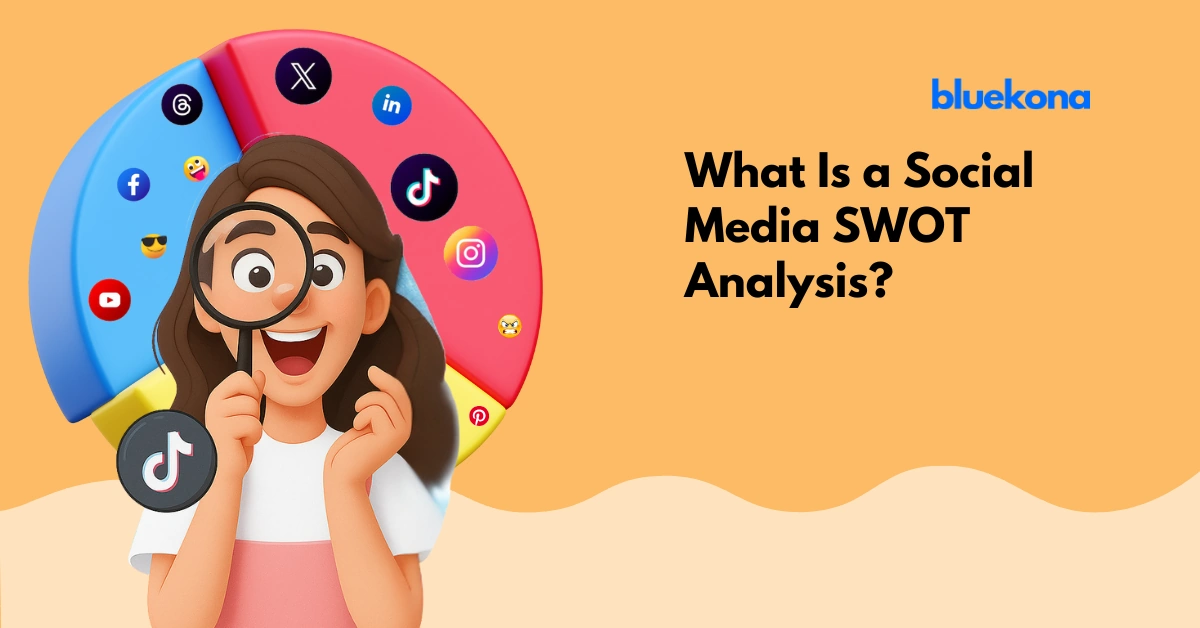
That’s where a social media SWOT analysis comes in.
It’s more than a marketing acronym — it’s a framework for clarity. A structured way to evaluate your Strengths, Weaknesses, Opportunities, and Threats across platforms so you can see what’s working, what’s broken, and what’s next.
In short: creativity grabs attention, but clarity drives growth.
And thanks to AI tools like bluekona, you can automate the entire process — pulling performance data from every platform, visualizing insights instantly, and turning them into strategy without ever touching a spreadsheet.
In this guide, we’ll break down what a social media SWOT analysis is, why it matters, and how to run one step-by-step so your next post isn’t just another guess — it’s a calculated move.
Step-by-Step: How to Conduct a Social Media SWOT Analysis
Before diving into data, decide what success looks like for you. Are you optimizing for engagement, lead generation, brand awareness, or community growth? Your goals determine which metrics actually matter — and they’ll shape every decision that follows.
💡 Tip: Be specific. “Increase engagement” isn’t a goal — “Raise Instagram engagement rate by 20% in Q4” is.
This is where things usually get messy — multiple dashboards, CSVs, and manual sorting.
bluekona shortcut: Instead of juggling data from five different platforms, bluekona pulls it all together automatically and generates actionable insights — no spreadsheets required.
Step 3: Identify Your SWOT
Now organize your findings into the four SWOT categories.
Be brutally honest here — real growth happens when you confront weaknesses and threats head-on.
Step 4: Benchmark Against Competitors
Your SWOT doesn’t exist in a vacuum.
Compare your performance to others in your niche. Look at:
Engagement and posting frequency
Content formats and creative quality
Hashtag and keyword strategies
Audience sentiment and share of voice
This step shows you not just how you’re performing — but where you’re winning or falling behind.
Tip: Run a competitor audit alongside your SWOT to see where you outperform and where you’re losing ground
Step 5: Turn Insights Into Strategy
A SWOT analysis means nothing if it just sits in a deck. Turn your insights into 3–5 focused actions.
Track progress monthly and refresh your SWOT quarterly. Social media shifts fast — your strategy should evolve just as quickly.
Don’t Fall Into the Template Trap
You’ve probably seen those “free SWOT templates” floating around online — neat little grids promising clarity in four boxes.
But the problem is by the time you manually pull data from six platforms, fill it all in, and double-check performance trends… the algorithm has already changed.
Traditional templates are static snapshots in a real-time environment. They look organized, but they quickly become outdated — and worse, they hide insights that could actually move the needle.
If you’re serious about staying competitive, you need a system that updates with your data — not one you have to babysit.
The smarter approach: Skip the spreadsheets. With bluekona, your SWOT analysis updates automatically using live social data — giving you fresh insights as your audience and platforms evolve.
No more manual grids. No more lagging insights. Just actionable clarity, powered by real-time performance.
From SWOT to Strategy: Turning Insight into Action
A SWOT analysis isn’t the finish line — it’s the launchpad. The real value comes when you turn insight into momentum and decisions that actually move the numbers.
1. Focus Where You Win
If your strengths lie in short-form video or community engagement, lean in hard. Reallocate time, budget, or creative energy toward the formats and platforms delivering the highest ROI.
Then test variations to keep what’s working… working even better.
2. Fix the Weak Spots
Every weak link costs you growth. If your posting is inconsistent, build a content calendar or automate scheduling. Low engagement? Audit your CTAs, captions, and creative. Slow response times? Set up auto-replies or dedicate daily engagement blocks.
Small fixes compound into major performance gains.
3. Double Down on High-ROI Platforms
Not every platform deserves equal attention.
Use your SWOT data to identify where your audience converts best — and concentrate resources there. It’s better to dominate two channels than to be mediocre on five.
4. Turn Opportunities Into Experiments
Spotted a rising trend or new feature?
Treat it as a low-risk test, not a full-scale pivot. Repurpose top-performing content into new formats like YouTube Shorts or TikTok collabs and measure early results before scaling.n
5. Mitigate Threats Before They Escalate
Competitors, algorithms, and ad costs will always shift. Use your SWOT to anticipate — not react.
Have contingency plans ready: diversify content formats, grow owned channels, and maintain creative agility.
6. Track, Measure, Evolve
Set benchmarks, monitor progress monthly, and revisit your SWOT quarterly.
Social media moves fast — your strategy should evolve just as quickly.
bluekona connects your SWOT findings to your full content workflow — helping you plan, post, and pivot with precision. Real-time data, continuous insight, zero guesswork.
FAQ
What is a social media SWOT analysis?
It’s a structured method for identifying the strengths, weaknesses, opportunities, and threats in your social media marketing strategy.
Why should marketers perform it regularly?
Because algorithms, audience behavior, and competitor activity change constantly. Regular SWOTs keep your approach sharp and relevant.
How often should I conduct one?
At least quarterly — or monthly if you manage multiple accounts or run ongoing paid campaigns.
How can AI make the SWOT analysis of my social media accounts easier?
AI tools like bluekona automate the data collection, analysis, and visualization steps, freeing you to focus on strategy and content creation.
Ready to Run Your Social Media SWOT Analysis?
You don’t need to be a data analyst to understand your strengths and weaknesses. You just need the right tools to surface the insights that matter.
Your social posts are your storefront. Every TikTok video, Instagram Reel, and Facebook carousel is a first impression—a chance to turn scrollers into sippers. But here’s the uncomfortable truth: if you’re posting seven times a week and can’t name your top-performing post, you don’t need new ideas. You need a better audit.
Most beverage brands are stuck in a posting hamster wheel—churning out content without measuring what actually moves the needle. Meanwhile, 90% of consumers use social media to discover new products
. The opportunity is massive. The gap between effort and outcome? Even bigger.
The food and beverage industry now spends $3.5 billion on social media advertising annually, making it the second most popular digital strategy in the space. Beverage brands post an average of 7.9 times per week, generating 1.17K engagements per post—but the average engagement rate sits at just 0.02%. That’s a lot of noise for very little signal.
A social media audit cuts through that noise. It’s your roadmap to better visibility, consistent engagement, and ROI clarity. And with the right approach, you don’t need an agency or a stack of spreadsheets to make it happen.
What a Social Media Audit Actually Is (and Why It Matters for Beverage Brands)
A social media audit is a structured review of your brand’s online presence. It tracks post performance, audience demographics, content ROI, and platform health—all to help you understand where you’re growing, stagnating, or missing opportunities.
For beverage marketers, this means understanding which flavors, visuals, collaborations, or campaigns actually convert. It’s about connecting every post to your business objectives—whether that’s brand awareness, product launches, or direct sales.
An audit gives you the big picture—not just who’s watching, but why they engage. It turns gut feelings into data-backed decisions and helps you stop wasting time on content that doesn’t perform.
How to Conduct a Social Media Audit (Step-by-Step)
Ready to dig in? Here’s how to run a beverage-specific audit that delivers actionable insights—not just vanity metrics.
Step 1: List All Your Active and Inactive Channels
Start with a complete inventory. Facebook, Instagram, TikTok, YouTube, LinkedIn—even that old Twitter account you forgot about. If it carries your brand name, it matters. Abandoned or inconsistent profiles can confuse customers and dilute your brand presence.
Step 2: Gather Content and Post Performance Data
Pull data on impressions, engagement rate, link clicks, post type, and posting frequency. Look at the last 90 days minimum—ideally six months for seasonal beverage brands. Track which content formats (Reels, carousels, Stories) perform best on each platform.
Step 3: Analyze Audience Demographics
Who’s actually engaging with your content? Dive into age, gender, geography, and device usage. This is especially critical for beverage brands—your kombucha audience on Instagram might skew younger and coastal, while your craft beer followers on Facebook could be older and regional. Match your content strategy to who’s actually showing up.
Step 4: Compare Your Top-Performing Posts
Identify patterns across your best content. Use content tags like recipes, behind-the-scenes, product launches, influencer collaborations, or user-generated content. Which formats consistently drive engagement? Which storytelling angles resonate most? This is where you discover what your audience actually wants—not what you think they want.
Step 5: Review ROI and Conversions
Vanity metrics don’t pay the bills. Which platforms actually generate clicks, inquiries, or orders? Track link clicks, website traffic from social, and conversion paths. If your TikTok has massive reach but zero conversions while your Instagram Stories quietly drive sales, that’s critical intel for budget allocation.
Step 6: Identify Strengths, Weaknesses, Opportunities, and Threats
Map your SWOT visually. What’s overperforming? What’s being ignored? Where are your competitors showing up that you’re not? Look for content gaps, underutilized platforms, and emerging trends in your category. Maybe your behind-the-scenes brewery content crushes on Instagram but you’ve never tried it on TikTok. That’s an opportunity.
Step 7: Turn It Into a Report
Don’t let your audit live in scattered notes. Use a structured template or—better yet—an AI-powered dashboard like bluekona to track results over time. bluekona automates every audit step, turning your weekly social data into a clear, visual report you can act on instantly. No manual exports, no formula errors, no three-hour spreadsheet sessions.
What to Include in a Beverage Brand Audit Report
Your audit report should be comprehensive but scannable. Focus on insights that drive decisions, not data dumps. Include:
Audience Demographics: Who engages most with your content? Break down by age, location, and platform preferences.
Platform Performance Comparison: How does Facebook stack up against Instagram, TikTok, and YouTube? Where should you double down, and where should you pull back?
Content Categories: Analyze performance by content type—recipes, influencer features, promotions, sustainability stories, product launches. What themes consistently outperform?
Influencer and Employee Advocacy ROI: If you’re working with influencers or activating employee advocates, measure their impact. Are micro-influencers driving better engagement than celebrity partnerships? Is your team’s content more authentic than branded posts?
Content Frequency vs. Engagement Correlation: Are you posting too much or too little? Sometimes less is more—especially if quality dips with volume.
Weaknesses and Opportunities Analysis: Be brutally honest about what’s not working. Inconsistent branding? Weak hashtag strategy? Ignoring video when your audience craves it? Name it.
Key Recommendations for the Next Cycle: Turn insights into action items with clear ownership and deadlines.
From Reporting to Action: Turning Audits Into Strategy
An audit is only valuable if it changes what you do next. Here’s how to turn insights into action:
Refine your posting schedule and creative direction based on when and what your audience engages with most. If carousel posts about cocktail recipes perform best on Wednesday evenings, build around that pattern.
Identify which post types or campaigns deserve repurposing. That viral Reel about your new flavor? Turn it into a YouTube Short, an Instagram Story highlight, and a website banner. Maximize every win.
Let AI highlight gaps you might miss manually—like inconsistent branding across platforms, weak hashtag performance, or dormant audience segments you could re-engage.
Create monthly action plans instead of one-off reports. Make auditing a continuous process, not a quarterly chore. bluekona links your audit data directly to your content repurposing and scheduling workflows—so you can fix and scale in one go.
The beverage industry moves fast. Trends shift, platforms evolve, and consumer tastes change. Regular audits keep your strategy nimble and your content relevant.
Audit Less. Learn More.
Manual audits are exhausting. Spreadsheets break. Data gets outdated the moment you export it. And most importantly, you didn’t get into beverage marketing to become a data analyst.
That’s where AI-powered tools like bluekona change the game. Instead of spending hours compiling reports, you get dynamic benchmarking, automated performance tracking, and content optimization recommendations—all in one platform. bluekona turns your beverage brand’s data into a clear action plan, so every post works harder.
Social media marketing isn’t about posting more—it’s about posting smarter. An audit gives you the clarity to stop guessing and start growing.
Ready to see what your data is actually telling you?
78% people prefer learning about products through video but the catch is only 31% will finish a poorly-edited one. The rest? Gone — swiping to your competitor, clicking away, or worse, teaching the algorithm your content isn’t worth surfacing.
Editing is no longer about looking slick. It’s about being seen, shared, and searched.
The SMBs winning on social in 2026 don’t have Hollywood budgets or fancy motion graphics. They have intention. Every cut, caption, and hook is a growth decision — designed to keep viewers engaged, boost discoverability, and repurpose one video into five platform-optimized assets.
The old playbook said: hire an editor, add transitions, slap on a logo, post, and pray. The new playbook says: edit like a growth marketer. Clean captions. Sharp hooks. Purposeful cuts. Choices that drive retention, not ego.
Because reach isn’t about production value anymore — it’s about editing with intention. And that’s what this guide will show you how to do.
What Are Your Editing Intentions? Growth vs. Aesthetics
Before you open your editing app, ask one question: What do I want this video to do?
Not “How do I want it to look?” — but what business outcome am I aiming for?
Most SMBs edit backwards. They obsess over color grading, add transitions because they “look pro,” or stretch intros to showcase their brand. Meanwhile, viewers are leaving, algorithms are burying the video, and the ROI is zero.
Editing with intention flips the script. Every cut serves a goal:
1. Editing for Watch Time
Goal: Keep people watching to the end.
Edits: Ruthlessly cut filler. Add pattern interrupts every 3–5 seconds (text overlays, quick cuts, visual examples). Hold attention, or lose reach.
2. Editing for Shares
Goal: Spark content people want to send.
Edits: Isolate a “shareable moment” in the first 15 seconds. Make it understandable without sound. Keep it short (under 45s works best).
3. Editing for Clicks
Goal: Drive traffic or conversions.
Edits: Front-load the promise. Use text overlays to highlight the value (“This tool saved 6 hours/week”). End with a clean, direct CTA — no fancy outro fluff.
4. Editing for Trust
Goal: Build credibility and authenticity.
Edits: Keep it raw. Show your face. Leave in small imperfections. Add captions for clarity, not polish.
The SMB Reality Check
You don’t have time for 47 transitions. You don’t have budget for motion graphics. And you don’t need them.
A 90-second demo edited for watch time looks completely different than one edited for clicks. Different pacing. Different structure. Different results.
Big brands can afford to edit for aesthetics and hope it converts. You can’t. Every edit has to pull its weight — driving views, engagement, traffic, or trust.
So before you add that swoosh transition, ask: Does this serve my goal, or just look nice? If it’s the latter, cut it.
Choose the Right Platform & Format
A video that crushes on TikTok might flop on LinkedIn. A YouTube Short that goes viral could die as an Instagram Reel.
Why? Because every platform has its own audience expectations and discovery rules. Editing the same way everywhere is like wearing a tuxedo to the beach. Technically fine. Practically wrong.
Here’s how to edit for each platform’s strengths:
TikTok → Hook Fast, Ride Trends
Payoff first: “Here’s the $12K mistake we made” beats “Today we’re talking about budgeting.”
Use trending sounds and effects — the algorithm favors participation.
Cut every 2–3 seconds; add text overlays for sound-off viewers.
Aim for 15–45s unless longer videos prove retention.
SMB win: A local coffee shop hit 400K views with “3 menu hacks your barista won’t tell you” — straight to value, trending sound, 19s long.
YouTube → Play Two Games
Long-form (8+ min): Hook in first 5s, use chapters/timestamps, break monotony with B-roll/graphics, add captions.
Shorts: Vertical 9:16, hook + payoff in <60s, text overlays for context, avoid outbound CTAs (algorithm penalizes exits).
SMB tip: Repurpose long-form into 3–5 Shorts. One tutorial = multiple hooks. One interview = multiple clips.
Instagram → Reels & Carousels
Reels: 30–60s, text hooks, strong CTA in captions.
Carousels: Repurpose video into 7–10 slides. Carousels often outperform Reels in B2B niches for saves/shares.
Combo play: Drop a Reel, then 2 days later post a carousel breaking it down. One video → double reach.
LinkedIn → Professional, But Human
Short explainers (30–90s) that teach value.
Minimal transitions, clean talking head.
Captions are critical (most people scroll at work, sound off).
Native uploads > YouTube links (5x better reach).
SMB win: A fractional CFO posts 60s breakdowns of cash flow mistakes — simple captions, raw delivery, 8–12 leads per video.
How bluekonaAI Makes It Smarter
You can follow best practices and still miss. Maybe your LinkedIn audience prefers TikTok-style cuts. Maybe your Instagram followers binge long-form.
bluekonaAI audits your historical data to show what actually works for you:
Which platform delivers the longest watch times?
Do quick cuts or slower pacing hold attention?
Which formats generate the most saves, shares, or clicks?
Instead of guessing, you edit based on proof. Because the best platform isn’t the one with the biggest user base — it’s the one where your audience actually watches, engages, and converts.
Ideate, Script, Create (with Intention)
Great editing can’t save a weak idea. But a strong idea, paired with intentional scripting and resourceful creation? That’s how SMBs with limited budgets compete with brands spending 10x more.
The key is working smarter before you ever hit record.
1. Ideation: Find What’s Already Working
Don’t ask, “What should I post?” Ask, “What’s already getting attention in my space?”
Trend scan: Check TikTok’s Discover, Instagram’s Explore, and YouTube Shorts. Look for repeatable formats (e.g., “5 things I wish I knew…”), not just trending topics.
Hashtags & sounds: Search the tags your customers follow (#smallbusinesstips, #solopreneur). Note which ones drive engagement, not just views. Early adoption of trending sounds = algorithmic boost.
Competitor check: Study 3–5 accounts one step ahead of you. Sort by “most popular” and analyze hooks, length, and pacing. You’re not copying — you’re learning what resonates with your shared audience.
How to use bluekonaAI: Surfaces your content gaps (topics and formats other creators in your niche use but you don’t) and spotlights your own top performers so you can double down on what’s proven.
2. Script: Structure Beats Spontaneity
“I’ll wing it” usually means rambling, weak hooks, and wasted time. A simple script makes editing faster and outcomes stronger.
Hook (first 3s): Lead with payoff, question, or bold claim.
Promise (next 5s): Tell viewers exactly what they’ll learn.
Body (30–60s): Deliver 3–5 clear points, each paired with a visual or example.
CTA (last 5s): One clear action. No multi-step CTAs.
Caption planning tip: Write captions before you shoot. That way, spoken words and on-screen text reinforce each other and accessibility is baked in, not bolted on.
3. Create: Align With SMB Resources
You don’t need a DSLR or studio. You need clarity, stability, and sound.
Good enough gear: Phone (iPhone 11+ or equivalent), natural light + cheap reflector/LED, $20 lav mic, tripod or stack of books.
Efficiency hacks: Record in short takes, shoot vertical and horizontal if repurposing, film multiple hooks for A/B testing, capture B-roll for reuse across videos.
How to use bluekonaAI: Shows which production styles your audience responds to (e.g., talking-head vs. screen recording, raw clips vs. polished edits) so you stop assuming and start editing based on proof.
The Intention Thread
Notice the through-line: ideation, scripting, and creation all tie back to your editing goal.
Editing for watch time? → Script tight, shoot short takes, keep the pace fast.
Editing for shares? → Script the “aha moment” first, create visuals that pop without sound.
Editing for clicks? → Script a strong CTA, create with branding that directs traffic.
By the time you sit down to edit, 70% of the work is done. You’re not “fixing it in post” — you’re assembling pieces designed to perform.
That’s how SMBs scale content without sacrificing results. Intention from ideation through creation means faster production and edits that actually grow your business.
Editing That Keeps Viewers Watching
Here’s the brutal truth: every unnecessary second is a chance for viewers to leave. Every pause, slow intro, or flashy transition is a dropout risk.
Algorithms don’t care how long you spent color-grading. They care about one thing: did people watch until the end?
Editing for retention isn’t about making videos prettier. It’s about removing every reason to scroll away.
1. Clean Captions: Non-Negotiable
80% of social video is watched without sound. If your video needs audio to make sense, you’ve lost.
Readable: Clean font, high contrast, large enough for mobile.
Accurate: Auto-captions are a start — fix errors, match spoken rhythm.
Strategic: Highlight key phrases, time captions as subtle pattern interrupts.
Protip: captions aren’t just for accessibility. They’re a retention tool.
2. Minimal but Strategic Cuts
Cut dead air, filler, and slow moments.
Change visuals to reset attention (angle shifts, B-roll, screen recordings).
Use the “trim test”: rewatch and try cutting 10% of runtime. If clarity survives, so should the cut.
Rule of Thumb: Every cut should either remove fluff, show something new, or reset attention. Nothing else.
3. Authentic Beats Over-Polished
Keep small imperfections (laughs, stumbles, candid reactions). They build trust.
Overproduced looks like an ad. Raw feels real.
Big brands chase polish. SMBs win by leaning into authenticity.
4. Transitions & Music: Keep Them Invisible
Best transitions: hard cuts > simple dissolves > everything else (swipes, spins, wipes = scroll fuel).
Music: supportive background only. Use trending sounds on TikTok/Instagram, royalty-free on YouTube/LinkedIn. Silence is better than bad music.
5. Purposeful Editing = Retention
Before every edit, ask: Does this keep viewers watching?
Logo intros? Cut them.
Fancy transitions? Cut them.
Montages? Keep only if they teach or build trust.
How to use bluekonaAI?
Most SMBs edit blind — hoping their hooks land and CTAs get watched. bluekona AI removes the guesswork:
Shows where your audience leaves (e.g., “68% dropped at 12s”).
Reveals spikes (e.g., “maximum engagement at 0:22”).
Tracks average watch time vs. length.
This creates a feedback loop: edit → publish → analyze → re-edit smarter. Over time, you learn what keeps your audience watching — not generic best practices, not MrBeast tricks.
The Retention Mindset
Retention isn’t about cutting short videos. It’s about making every second count. The algorithm rewards completion rate and watch time, not brevity.
Remove reasons to leave. Add reasons to stay. Make it effortless to watch. That’s editing for growth — and it’s a game SMBs can win.
Optimize for Discovery (Social SEO Layer)
You can edit the perfect video—tight pacing, strong hook, high retention—and still get zero views if nobody can find it.
This is the layer most SMBs skip: discoverability.
Platforms are now search engines. YouTube always was, TikTok’s search traffic is exploding, and even Instagram and LinkedIn are pushing discovery feeds over follower feeds.
If your video isn’t optimized for search and recommendations, it’s invisible.
Pro move: research by searching your topic and studying which hashtags appear in top-performing videos.
4. Use bluekonaAI: Data-Driven Discoverability
Best practices are guesses. Your audience is the truth.
bluekonaAI tracks:
Which title styles pull more impressions (e.g., “How to…” vs. “Best [tool] for…”).
Whether adding the year boosts clicks.
Which hashtags drive reach, profile visits, or conversions.
What search terms people use to actually find your content.
This creates a feedback loop: Post → Analyze tags/titles in bluekona → Double down on winners → Test one new variable → Repeat.
5. The Compound Effect of Discovery
A video without SEO might get 500 views (your followers).
The same video, optimized with the right title, transcript, and tags, might hit 5,000 — found by people who weren’t even looking for you.
Better yet: discoverability compounds. A search-optimized video keeps pulling views for months, sometimes years. Every extra view feeds more data to the algorithm, extending your reach.
Your editing keeps people watching. Your SEO gets them there. Do both, and every video becomes a growth asset instead of a one-and-done post.
Publishing & Scheduling (Timing Matters)
You’ve ideated, scripted, and edited a strong video. Now comes the decision that can double your reach—or bury your work: when and how often you publish.
Timing isn’t superstition. It’s strategy. Post when your audience is online, and platforms reward you with reach. Post when they’re asleep, and your video dies before it gets traction.
1. Post at Optimal Audience Times
Forget “best time to post” charts. They’re averages across millions of accounts. Your audience is unique.
What really matters:
When they scroll: B2B = work breaks (7–9 AM, 12–1 PM, 5–7 PM). B2C = evenings/weekends. Local = local time zones.
First-hour engagement: Platforms test new content with a small audience. Early engagement = wider push.
Competition levels: Sometimes off-peak hours outperform crowded peak times.
How to find your times:
Check analytics: TikTok (Follower Activity), Instagram (Most Active Times), YouTube (When Viewers Are On), LinkedIn (post analytics).
Test 3–4 time slots over 2–3 weeks, track which deliver the fastest early engagement, then double down.
bluekonaAI Advantage: Instead of guessing, bluekona shows exactly when your posts historically got the most reach, shares, and watch time (e.g., “Tuesday 8 AM posts get 40% more shares than Thursday 6 PM”).
2. Balance Frequency vs. Burnout
Consistency matters more than intensity. Daily posting sounds great—until you quit after 3 weeks.
Frequency benchmarks:
TikTok/Reels → 3–5x per week (daily if sustainable).
YouTube Shorts → 3–4x per week.
YouTube long-form → 1–2x per week.
LinkedIn → 2–3x per week.
The burnout test: If posting makes you cut corners, dread content creation, or neglect your business—you’re overdoing it. Better to post 3x/week for a year than daily for a month and burn out.
3. Repurpose One Video into Many
This is the SMB superpower: scale output without scaling workload.
Re-edit each clip for its platform (style, caption, aspect ratio).
Adjust CTAs per platform behavior.
80% of the content is the same. 20% is platform-specific.
4. Tools & Systems
Free: Meta Business Suite, YouTube Studio, LinkedIn scheduler.
Paid: Later, Buffer, Hootsuite for multi-platform. Repurpose.io to automate clips.
Batching: Record 2–4 videos in one session, edit masters, repurpose clips, schedule 2–3 weeks of content at once.
Optimize Posting Strategy
Generic advice can’t answer:
Should you post 3x or 5x weekly?
Do your 7 AM posts outperform 6 PM?
Are your videos cannibalizing each other if posted too close together?
bluekonaAI analyzes your history to find:
Best-performing time slots.
Frequency sweet spots (where reach grows without quality slipping).
Engagement patterns unique to your audience.
Publishing isn’t just logistics. It’s a growth lever. Post at the right time, at a sustainable frequency, and repurpose ruthlessly — and every video becomes 5x more valuable.
Engagement & Analysis
Publishing isn’t the finish line — it’s the starting gun. The first few hours after you post decide whether your video reaches 500 people or 50,000. And your analytics decide whether the next one performs better, or you just keep guessing.
Reply fast: Respond to every comment in the first hour. Even a “thanks!” counts as engagement.
Pin smart comments: Highlight a question or great insight to spark more discussion.
Ask questions in captions: Specific prompts (“Which tool do you use — CapCut or Descript?”) drive more comments than vague “What do you think?”
Cross-promote: Share your video to Stories or groups immediately to funnel early traffic.
Engage outward: Comment on 5–10 posts in your niche — algorithms notice cross-engagement.
Why it matters: Platforms test your video with a small batch first. If that group engages quickly, the algorithm pushes it further. If not, it dies quietly.
2. Metrics That Actually Matter
Forget vanity metrics like raw views. The growth levers are:
Watch time: #1 algorithm signal. Aim for 50%+ completion on short-form, 40%+ on long-form.
Saves: Proof your video is valuable enough to revisit. Heavily weighted on Instagram.
Shares: Built-in distribution. Each share = exposure to a new network.
CTR (Click-Through Rate): Converts attention into action (profile visits, site clicks, lead forms).
Engagement rate: (Likes + Comments + Shares) ÷ Reach. A composite score of resonance.
Track per platform, but look for trends across them.
bluekonaAI Advantage: Proof of What Works
Most SMBs don’t know if their editing tweaks actually made a difference. bluekonaAI closes that gap by showing:
Before/after impact: “After adding captions, watch time rose 18%.”
A/B tests: “New hook style improved 10-second retention by 22%.”
Drop-off diagnostics: “68% of viewers left at 12s — cut or move that section.”
Trend spotting: “Your most-shared videos all follow this structure…”
Instead of guessing, you edit based on data from your audience — not generic best practices.
The Engagement & Analysis Workflow
After posting: Engage in the first hour → respond, pin, cross-promote.
Monthly (30–45 min): Audit top 10 vs. bottom 5. Double down on what works. Cut what doesn’t.
Quarterly (1–2 hrs): Zoom out. Is watch time improving? Are shares increasing? Are you reaching the right audience? Reset benchmarks.
The Compounding Effect
Treat analytics like a conversation, not a report card. Each video teaches you: what to trim, what to amplify, what to repeat.
Do this consistently, and the growth compounds:
Month 1: You learn shorter hooks retain better.
Month 2: Retention improves → reach expands.
Month 3: Certain hooks double shares.
Month 6: You’ve built a data-backed editing playbook unique to your SMB.
Bottom line: Engage to signal value. Analyze to prove what works. Use bluekonaAI to close the loop. That’s how your videos stop being one-off posts and start compounding into real growth.
Tools That Make It Easier (SMB-Friendly)
You don’t need Premiere Pro. You don’t need Final Cut. You don’t need a $2,000 software license or 40-hour tutorials.
What SMBs need are fast, affordable tools that handle the editing that matters most: clean captions, tight cuts, and content formatted for the right platform.
Here’s the tool stack that works for real businesses:
CapCut: The Free Workhorse
Best for: TikTok, Instagram Reels, YouTube Shorts
Price: Free (Pro $9.99/mo)
Why SMBs use it: Mobile + desktop editing, auto-captions, trending effects, and multi-track editing without the learning curve.
Growth features:
Auto-captions (95%+ accurate → edit, don’t type)
Silence removal (cuts dead air automatically)
Speed controls (1.2x trim = tighter pacing)
Templates (hooks/transitions for beginners)
When to use: Your default short-form editor. When to skip: You need advanced color grading or multi-camera syncing.
Descript: Edit Video Like a Document
Best for: YouTube, LinkedIn, podcasts, tutorials, talking-head content
Price: Free (limited), Creator $12/mo, Pro $24/mo
Why SMBs use it: Edit by deleting words from a transcript. AI removes filler words, cleans audio, and even generates overdubs.
Growth features:
Filler word removal (kill “ums” with one click)
Studio Sound (AI cleans echo/noise)
Auto-captions + transcript export
Repurpose 10-min videos into multiple clips
When to use: Long-form editing, webinars, tutorials, interviews. When to skip: Fast-turnaround viral shorts (CapCut is faster).
Canva: The Swiss Army Knife
Best for: Thumbnails, branded overlays, carousels, simple video edits
Price: Free, Pro $12.99/mo
Why SMBs use it: Drag-and-drop templates + stock footage. If you can make a PowerPoint, you can edit video here.
Growth features:
Resize for multiple platforms instantly
Brand kit for consistent fonts/colors/logos
Templates for hooks, intros, captions
When to use: Quick explainers, carousels, branding polish. When to skip: Precision editing or pacing adjustments.
InShot: Mobile-First Editing
Best for: On-the-go content, phone-shot clips
Price: Free (watermark), Pro $3.99/mo or $14.99/year
Why SMBs use it: Edit and post directly from your phone, no transfer needed.
Growth features:
Speed control + simple text overlays
Aspect ratio switching (vertical, square, horizontal)
Voice-over recording directly in app
When to use: You’re shooting/editing on your phone between client meetings. When to skip: You need captions or more advanced features (CapCut wins).
The Tool Stack by SMB Scenario
Solo founder on TikTok/IG Reels → Phone + CapCut → Schedule via Meta → Analyze in bluekonaAI.
Marketing manager on LinkedIn → Shoot on webcam → Edit in Descript → Brand polish in Canva → Analyze in bluekonaAI.
Small team on YouTube → Shoot DSLR/phone → Edit long-form in Descript → Shorts in CapCut → Thumbnails in Canva → Analyze in bluekonaAI.
Service business creating on-the-go content → Shoot + edit in InShot → Repurpose in CapCut → Analyze in bluekonaAI.
Editing tools make videos. bluekonaAI makes them perform.
CapCut shows you how to add captions.
Descript shows you how to remove filler words.
Canva shows you how to brand your video.
InShot shows you how to trim and post fast.
But none of them tell you which edits actually worked.
That’s where bluekonaAI sits on top of your workflow:
“Videos with captions had 22% higher watch time.”
“Retention spikes when you show screen demos—use more.”
“Your 45-second clips get shared 3x more than 90-second ones.”
Instead of editing blind, you edit with proof.
The Anti-Tool-Hopping Rule
Most SMBs waste weeks switching tools thinking it’ll fix their views. It won’t. The bottleneck isn’t the tool—it’s whether your edits serve retention, shares, clicks, or trust.
Pick 1–2 tools. Learn them deeply. Use bluekonaAI to measure whether your edits are actually moving the needle.
Bottom line: Tools make editing easier. bluekonaAI makes it smarter.
Edit Like a Growth Marketer, Not a Filmmaker
Video editing used to be about looking polished. In 2026, it’s about performing.
The SMBs winning on social aren’t using Hollywood gear or cinematic transitions. They’re making business-driven editing choices: every cut, caption, and hook designed to keep people watching, sharing, and searching.
You don’t need fancy effects. You need smart, intentional edits backed by data:
Edit for goals (watch time, shares, clicks, trust)
Match platform + format
Script and shoot with intention
Cut ruthlessly to remove dead air
Optimize for search and discoverability
Post at the right times, repurpose across channels
Engage early, analyze often
Learn from every video
Because growth compounds: your 10th video should outperform your 1st — not because of gear, but because you learned what keeps your audience watching.
But you can’t improve what you don’t measure. That’s where bluekonaAI comes in.
It shows you:
Where viewers drop off
Which edits boost retention
What formats drive shares
Which titles, tags, and times improve discoverability
Whether your editing changes actually worked
The result? Videos that don’t just get views — they build trust, drive clicks, and fuel your business. One video becomes five assets. Each asset compounds growth.
Ready to stop guessing and start growing? bluekonaAI shows you what edits actually move the needle — so every video works harder for your business.
Most brands try to buy attention. Gymshark built a $1.45B empire by earning it.
Founded in 2012 in a garage by teenager Ben Francis, Gymshark didn’t win by outspending Nike or Adidas. They won by out-creating them—turning influencers into athletes, community into currency, and content into the engine of compounding growth. Paid ads? They used them, sure—but only as fuel for what was already catching fire.
While competitors were burning through ad budgets, Gymshark was building content people actually searched for, shared, and showed up for. That’s the difference between hype and a flywheel.
In this breakdown, we’ll dissect how Gymshark went from garage startup to global powerhouse in just over a decade—and, more importantly, how you can steal their playbook and start applying it today.
Garage to Global — The Fast Growth Timeline
In 2012, Ben Francis wasn’t a founder with investors or a roadmap—he was a teenager stitching gym clothes in his parents’ garage. Fast forward to 2025: Gymshark is valued at $1.45 billion.
The real turning point? The 2013 BodyPower Expo. While legacy brands rolled out sterile booths and glossy displays, Gymshark rolled in with creators like Lex Griffin, Steve Cook, and Nikki Blackketter—athletes who were already embedded in the fitness culture. They weren’t paid mouthpieces; they were real people with real followings who wore Gymshark because it felt authentic.
The effect was explosive. Not a 48-hour viral blip, but the kind of organic buzz that turns heads, builds waitlists, and cements a brand inside a community.
And Gymshark didn’t let it fade. They turned that moment into a system: fast-cycle product launches built on community feedback, limited drops that created genuine scarcity, and a marketing engine that always started with the people living the lifestyle—not a boardroom strategy deck.
The solopreneur steal: Your breakthrough won’t come from a clever ad hack. It’ll come from embedding yourself in the community you serve—and letting them pull your brand forward.
The Content Flywheel — How Gymshark Built a Machine That Compounds
Most brands are still debating whether to chase TikTok trends or double down on Instagram. Gymshark skipped the debate and built something more powerful: a content ecosystem that feeds itself. Every piece of content fueled the next, creating a flywheel of compounding growth.
Creator-Led Marketing (Before It Was Cool)
Those early partnerships with Lex Griffin, Steve Cook, and Nikki Blackketter weren’t just influencer shoutouts. Gymshark called them “athletes,” but really, they were ambassadors living the lifestyle and bringing their audiences with them. By 2023, the network had grown to 125+ creators, driving more than 30% of Gymshark’s social-driven revenue.
The solopreneur steal: Don’t rent billboards disguised as influencers. Build long-term partnerships with creators whose audiences trust them. Authenticity scales better than follower counts.
Content Systems That Compound
Here’s where Gymshark played chess while everyone else played algorithm roulette. Instead of random posting, they built repeatable systems across every major channel:
Instagram (7.7M+ followers): Athlete-driven content, customer transformations, and workouts worth saving—not just polished product shots.
TikTok (4.3M+ followers): They didn’t just hop on trends, they created them. The “66 Days: Change Your Life” challenge alone drove 200M+ views.
YouTube (long-form depth): Series like Gymshark Lifts gave the brand authority and loyalty beyond 15-second clips.
Blog (Gymshark Central): Ranking for 356K keywords and pulling in 1.5M organic visits monthly (Ahrefs, 2025). An SEO gold mine powering the entire funnel.
The brilliance? Every piece of content did double (or triple) duty. A single YouTube video became Instagram clips, TikTok challenges, and blog material. One photoshoot stocked months of social posts. Creator collabs amplified across all platforms.
That’s the flywheel. Not random hype, but a system where content compounds instead of fades.
Paid Ads Were an Amplifier, Not Foundation
Here’s where most marketers misread the Gymshark story. They assume it was all organic magic—that a billion-dollar brand grew without ever touching paid ads. Wrong. Gymshark did use ads—they just didn’t rely on them as the foundation.
While competitors were burning cash on generic product pushes, Gymshark used paid media as an amplifier. The playbook was simple: test content organically, then scale only what proved it could stand on its own.
Take their “66 Days: Change Your Life” challenge. It racked up 200M+ views organically before Gymshark spent a dime. Only then did they push paid media behind it—pouring gasoline on a fire that was already roaring.
And when they did spend, it wasn’t on sterile “buy now” ads. It was creator-led videos, user-generated transformations, and challenges people were already sharing. Paid ads extended reach; authenticity did the heavy lifting.
The solopreneur steal: Don’t use ads to test whether your content is good. Use them to scale what’s already proven to resonate. If your content can’t get traction without paid spend, no budget in the world will save it. But nail the organic first, and ads become the multiplier every scrappy brand dreams of.
The Moat: Community as Growth Engine
Here’s what separated Gymshark from every other brand trying to copy their success: they didn’t just build an audience—they built a community.
Offline Experiences That Created Online Legends
While “digital-first” brands obsessed over dashboards, Gymshark was doubling down on the real world. The Gymshark Lifting Club wasn’t just a gym—it was a pilgrimage site. Pop-ups weren’t sales activations—they were gatherings of the tribe. And when they took over Venice Beach, the 70M+ impressions weren’t the point—the cultural signal was.
The solopreneur steal: Even if you run a digital business, find ways to meet your community offline. A coffee chat, a local meetup, or an annual event can forge loyalty no algorithm can touch.
Owned Channels: Where Belonging Happens
Gymshark also built moats on platforms they controlled. Their app, blog, and Discord-style communities weren’t just content distribution—they were connection engines. Members shared transformations, tracked workouts, swapped advice, and held each other accountable.
That’s the difference between customers and evangelists. Customers buy your products. Evangelists defend your brand, recruit new members, and stick with you when competitors come knocking.
The solopreneur steal: Stop chasing “followers.” Start facilitating connections. Your job isn’t just to push content—it’s to create spaces where your people can find each other. Products can be copied. Communities can’t.
What Solopreneurs and Marketers Can Learn
Gymshark didn’t stumble into a $1.45B valuation. They built a system—and you can too, even without a billion-dollar budget. Here’s the playbook worth stealing:
Invest in Content Systems That Compound Forget chasing the next viral TikTok. Gymshark’s blog pulls 1.5M monthly organic visits and their YouTube series keep attracting new fans because they built assets that pay dividends long after publishing. Your move: Start building your own media engine—SEO, blogs, YouTube. Boring? Maybe. Effective? Absolutely.
Build Creator Relationships, Not Transactions Gymshark didn’t rent influencers. They partnered with people who lived the lifestyle. By 2023, those authentic voices drove 30%+ of social-driven revenue. Your move: Don’t buy followers. Find aligned creators—even small ones—who actually believe in what you’re building.
Treat Paid Media Like Gasoline, Not the Engine Most solopreneurs burn money trying to force mediocre content to work. Gymshark only spent when they knew content resonated—turning sparks into bonfires. Your move: Prove it works organically first. Then, use paid to amplify—not compensate.
Close the Feedback Loop Gymshark didn’t guess what content or creators worked. They measured, refined, and doubled down. Your move: Use tools like BlueKonaAI to track performance across channels, spot what drives real engagement, and kill what doesn’t. Guessing is for amateurs—feedback loops are your competitive edge.
The bottom line: Gymshark’s secret wasn’t ads, luck, or hype. It was systems—content, community, creators—that compound. The only question is whether you’re ready to stop winging it and start building your own flywheel.
If I had a dollar every time someone lobbed that cookie-cutter advice at struggling creators, I’d have enough to buy Twitter back from Elon. The problem isn’t that it’s wrong—it’s just about as useful as telling someone to “be yourself” on a first date. Like, thanks, but what does that actually mean?
Here’s the reality check: virality isn’t lightning in a bottle or divine favor from the algorithm gods. Viral content follows predictable patterns, triggers specific psychological responses, and yes—it can be reverse-engineered.
So let’s stop throwing spaghetti at the wall and start cooking with actual intention. This isn’t a motivational pep talk. It’s psychology + data, served with a side of sass and zero fluff. Because if you’re going to spend time creating content, you deserve to understand the science behind why people smash that share button.
Myth-Busting: Virality Isn’t Random
Viral content isn’t lightning in a bottle—or Mercury retrograde blessing one lucky creator who posted at 3:47 PM on a Tuesday. That kind of magical thinking keeps you refreshing your analytics, praying for a miracle, instead of actually engineering one.
The truth? Every creator who consistently goes viral—whether it’s MrBeast, Gary Vee, or that random TikToker you’d never heard of until last week—isn’t lucky. They’re hitting specific psychological triggers that make our lizard brains scream: MUST. SHARE. NOW.
Look closely at almost any viral post and you’ll spot the same ingredients:
Emotion: anger, joy, shock, nostalgia.
Story arc: setup + twist that hooks attention.
Timing: landing when the topic’s hot.
Cultural wink: a pop culture reference that makes people feel in on the joke.
Not coincidence—pattern recognition. So what are the levers you can pull to tilt the odds? Let’s break them down.
Lever 1: The Plot Twist Hook
Oh, you thought you were getting a straightforward business tip? Plot twist: we’re starting with why your brain just perked up at the words “plot twist.”
Here’s the psychology: our brains are dopamine junkies. When you set up an expectation and then flip it with a surprise reveal, you trigger that did NOT see that coming rush. It’s the same reason you binge Netflix or keep scrolling TikTok—you’re chasing twists.
Example? That viral LinkedIn post: “I thought I was hiring a graphic designer for $500. Turns out, I accidentally hired my biggest competitor’s CEO.” Setup (normal transaction) → twist (competitor’s CEO) → reveal (awkward but valuable conversation) = instant shares.
How to apply: use the Setup → Expectation → Surprise → Reveal formula.
Pitfall: don’t spoil the twist in your headline or make it so cryptic your audience feels tricked. The best twists feel surprising and make sense in hindsight.
Lever 2: The Emotion Bomb
Want to know the difference between content that gets a polite “like” and content that explodes in group chats?
One word: feelings. Not the warm fuzzy kind either—we’re talking emotions that make people practically vibrate with the need to hit share.
The psychology: when we feel something intensely, logic goes out the window. High-arousal emotions bypass the “should I share this?” filter and push us straight into action mode. It’s evolutionary—back in the tribe days, if something sparked outrage, joy, or fear, you had to tell others to survive.
Example: That corporate tweet everyone dunked on (anger), the surprise pregnancy announcement video (joy), the plot twist TikTok (shock), or that “only 2000s kids will remember” thread (nostalgia). Each hit one of the Big Four and spread like wildfire.
How to apply: Audit your best-performing content for the Big Four—anger, joy, shock, nostalgia—and craft around them.
Pitfall: Don’t fake it. Manufactured outrage = instant credibility loss. If you’re not genuinely feeling it, your audience won’t either.
Lever 3: The Hot Take Hack
Here’s the thing about trending topics: everyone’s talking about them, which usually means everyone’s saying the same thing. It’s like showing up to a party where 47 people are wearing the same outfit—except instead of changing, you throw on accessories that make you unforgettable.
Psychology explains it: our brains are wired to pay attention to novelty within familiar contexts. A trending topic primes us to notice it—but what stops the scroll is when someone adds a perspective we hadn’t considered. That’s the “wait, what?… oh damn, they’re right” effect.
Example: When ChatGPT blew up, most takes were either panic (“AI kills jobs”) or hype (“AI boosts productivity”). The viral takes were nuanced: “AI won’t replace writers—it’ll expose the bad ones.” or “As a therapist, here’s why ChatGPT could actually deepen human connection.”
How to apply: Spot a trend (set up Google Alerts for topics in your niche). Ask, “What’s everyone missing?” Then layer your expertise or contrarian lens. Formula: Popular Topic + Your Unique Angle + Actionable Insight = Viral fuel.
Pitfall: parroting headlines or slapping “Thoughts?” at the end. That’s not a hot take—it’s laziness.
Lever 4: The Pop Culture Cheat Code
Pop culture references are the social media equivalent of knowing the secret handshake. Done right? Pure magic. Done wrong? It’s your dad dabbing at graduation—painful for everyone.
The psychology: shared cultural references create instant in-group bonding. When someone gets your reference, their brain lights up with recognition and belonging. It’s like an inside joke and social proof rolled into one. Plus, references act as shortcuts—you can communicate complex ideas in a single meme.
How to apply: Only reference what you genuinely consume and what your audience will actually get. If you have to Google it, skip it. Reference to enhance your point, not overshadow it.
Pitfall: forcing memes that don’t fit your brand. Nothing screams “How do you do, fellow kids?” louder.
Ready to Stop Posting Blind?
Virality isn’t luck—it’s strategy. You’ve got the toolkit now: plot twists that hijack attention, emotions that demand sharing, hot takes that cut through noise, and pop culture winks that make people feel in on the joke.
But here’s the catch—those levers work differently for every audience. What sends your followers into a frenzy might flop somewhere else. That’s why bluekona exists: We analyze your actual content history to show you which levers, formats, and timing patterns already resonate.
Stop guessing. Stop hoping. Stop throwing spaghetti at the algorithm and crossing your fingers.
Because “just post more” is advice for people with unlimited time and zero strategy.
Social listening sounds simple. Track mentions of your brand, competitors, or industry, set up a few alerts, and respond when customers speak up.
Useful? Sure. But here’s the catch: most SMBs treat it like a smoke alarm. It beeps when something’s burning, you scramble to put out the fire, then move on. The problem? Smoke alarms don’t build empires.
And while 48% of consumers now interact with brands more often on social than they did six months ago, most small businesses are still stuck in reactive mode — playing digital whack-a-mole. They reply fast but don’t shape narratives. They monitor mentions but don’t set trends.
The brutal truth: if all you do is listen and reply, you’ll stay invisible. Competitors who use those same signals to fuel fresh content, sharpen positioning, and spot trends early will leave you behind — no matter how small their teams or budgets.
Social listening is step one. What you do next decides whether your brand leads or just follows.
The Upside of Social Listening (When Done Right)
When wielded strategically, social listening isn’t just a safety net — it’s one of the most cost-effective growth tools an SMB can use. Here’s how it works when done right
1. Customer insights that drive action
Skip the overpriced surveys. Customers are already telling you what they love, hate, and wish existed — right in their comments.
A small coffee roaster noticed Instagram chatter about using their beans for cold brew. They doubled down, launched a cold brew blend, and turned it into a bestseller.
2. Spotting trends before competitors
Big brands wait for reports, small teams can see trends bubbling up in real conversations. Restaurants tracking food hashtags saw the plant-based wave long before McDonald’s, and had vegan menu items ready while the giants were still testing. Listening gives SMBs agility that money can’t buy.
3. Direct fuel for product and content
Your audience writes your roadmap for you. A skincare startup seeing constant questions about sensitive skin products in competitor comment sections can respond with a gentle formula and a content series around skin sensitivity — doubling their revenue in a year.
4. Protecting reputation before crises flare
Social listening is an early warning system. A single bad review can snowball, but listening lets you catch sparks before they turn into fires.
The smartest SMBs go further, they track sentiment shifts to prevent issues before they explode.
5. A competitive edge against giants
Enterprise brands are slow. SMBs can move fast. When a major brand stumbles, small competitors who are listening can pivot messaging instantly and capture attention.
Same intelligence, but with speed on your side — that’s your David vs. Goliath advantage.
Done right, these benefits don’t add up — they compound. Customer insights shape products, trends feed your content, reputation monitoring protects your brand, and agility keeps you ahead. Social listening becomes a flywheel that powers every part of your business.
The Pitfalls SMBs Fall Into
Here’s the painful truth, most SMBs know social listening matters. They invest time, sometimes money, but end up stuck in patterns that drain resources without driving growth.
1. Listening ≠ Leading
Most SMBs confuse speed with strategy. They pride themselves on replying in minutes, but quick responses don’t build memorable brands — they make you forgettable. If you’re just echoing customers and competitors, you’re not shaping the conversation, you’re trapped in it.
2. Time and Resource Drain
For small teams, social listening can quickly become a black hole. The marketing manager already juggling five jobs now spends hours scrolling mentions and parsing hashtags.
What was supposed to be a growth lever turns into daily busywork, often abandoned because it feels like “extra,” not essential.
3. Expensive Tools, Wasted Data
Many SMBs overspend on enterprise tools that spit out overwhelming dashboards. You end up with hundreds of dollars in fees, thousands of alerts, and zero actionable decisions. Data piles up, but no one has the bandwidth to execute. Insights die in the dashboard.
4. The Reactive Trap
The biggest pitfall is always playing defense. Competitor launches? You scramble to copy. Customers complain? You apologize quietly. New trends? You follow late. Instead of leading, you become a prisoner of other people’s narratives.
The Reactive Trap: Why Most SMBs Stay Stuck in Level 2?
Think of social listening maturity as a ladder. Most SMBs never climb past the second rung.
Level 1: Passive Monitoring You’ve set up a few alerts, maybe check mentions occasionally. Opportunities slip by. Better than nothing, but barely.
Level 2: Reactive Responders This is where most SMBs get stuck. You monitor consistently, respond quickly, and feel productive because you’re “doing social listening.” Metrics look good — response times, engagement rates, mention counts. But here’s the trap: you’re measuring activity, not impact. You reply fast, but you don’t set the agenda.
Level 3: Proactive Leaders This is where growth happens. You don’t just ask “How can we respond?” — you ask “How can we lead?” You use customer questions to fuel content, spot competitor weaknesses and position against them, and jump on conversations before they peak. You stop reacting and start shaping.
Most SMBs stall at Level 2 because it feels safe and measurable. Breaking through requires a mindset shift: from monitoring what’s happening to shaping what happens next.
How to Break Out of the Trap (Actionable Framework)
Breaking free from reactive social listening isn’t about ditching monitoring — it’s about turning what you hear into moves that make competitors chase you. Here’s how:
1. Balance listening with bold creative moves
Don’t just match your competitors’ tone or echo customer comments. Use insights to spark conversations they’re too timid to start. A small agency did this by publishing “Why We Can’t Guarantee Your Marketing Results (And Why You Should Run From Anyone Who Does).” It went against the grain, drew debate, and positioned them as refreshingly honest in a sea of overpromising.
2. Turn insights into repurposable content ecosystems
Every customer question or trend is content fuel. Don’t waste it on a single reply. Repurpose it across formats:
A TikTok demo for quick answers
A LinkedIn thought post reframing the pain point
A YouTube tutorial for deeper dives
A blog post that becomes the evergreen resource One SaaS startup did this with a recurring “How do I export my data?” question — turning it into a video, blog, and LinkedIn series that boosted visibility and trust while competitors stayed silent.
3. Turn complaints into positioning advantages
Complaints about your industry = opportunities to own the narrative. A boutique fitness studio leaned into frustrations about overcrowded gyms with their “Anti-Gym Movement” campaign, reframing the problem and presenting themselves as the solution. Look for patterns:
“Too confusing” → Brand yourself as simple.
“Too expensive” → Show transparent pricing.
“Terrible support” → Highlight your human touch.
4. Track what actually matters
Likes and mentions are vanity. The real metric is, are you shifting conversations?
Ask:
Are people associating you with topics you want to own?
Are competitors responding to your content?
Are influencers picking up your language? One B2B brand tracked how often their CEO’s LinkedIn posts sparked debates competitors had to weigh in on — proof they were setting the agenda, not following it.
5. Follow the 80/20 rule
Spend 20% of your time monitoring and responding. Spend 80% creating the content, narratives, and positioning that make others respond to you.
The brands that win aren’t just listening — they’re leading louder.
The Audit → Act → Adapt Cycle
Most social listening tools stop at “here’s what people are saying.” But in reality you need to go further — turning insights into action and impact:
Audit: See which conversations you should join, uncover gaps competitors are ignoring, and spot trends you could lead.
Act: Transform insights into multi-platform content that positions you proactively, not reactively. That pricing transparency insight? Turn it into a TikTok series, LinkedIn thought leadership post, YouTube explainer, and email campaign — all working together to own the conversation.
Adapt: Measure whether your actions shifted perception, increased discovery, or moved the competitive landscape. Use these results to refine your next cycle.
Bluekona ensures insights never die in dashboards. Every trend, gap, or opportunity gets a clear action plan and measurable impact. For SMBs, this isn’t just monitoring — it’s turning social intelligence into competitive advantage.
Lead the conversation. Don’t just follow it.
The Choice Every SMB Faces
Social listening isn’t going away. 90% of consumers rely on social platforms to track trends, and 36% trust brand information on social more than Google or AI chatbots. Monitoring these conversations is now table stakes.
But here’s the difference between blending in and standing out: listening is essential, but only proactive brands win.
You can respond to every mention, match your competitors’ tone, and feel busy—but you’ll just blend into the background noise. Or you can turn those same conversations into fuel for leadership:
Transform customer questions into content strategies.
Turn competitor weaknesses into positioning opportunities.
Spot emerging trends and claim them before anyone else does.
Stop asking, “How should we respond?” Start asking, “How can we lead?”
With the right system, every conversation becomes fuel for leadership. The brands that thrive won’t just listen best—they’ll lead loudest. Bluekona doesn’t just show you what’s happening. We show you what to do next—and make sure it gets done.
Most tools tell you what’s happening. Bluekona shows you what to do next — and makes sure it gets done. Join early access.
Every post you drop into the feed void has a 24-hour lifespan—maybe less. Engagement spikes, then dies. By tomorrow? It’s digital graveyard material.
Here’s the shift most brands are missing: by 2025, TikTok, YouTube, and Instagram aren’t “social” anymore—they’re search-first platforms. Gen Z already treats TikTok as their #1 discovery engine, and 36% of consumers now trust brand info from social search more than Google.
That means if your content only lives in feeds, it’s invisible to the fastest-growing search behavior.
Also, only ~20% of content actually gets repurposed across platforms—leaving 80% of discoverability on the table.
This workbook isn’t about squeezing out more posts. It’s about future-proofing them by designing assets that survive algorithm shifts, stay searchable, and keep working long after the hype fades.
Future-Proof Audit
Most audits obsess over vanity metrics—likes, shares, quick spikes. None of that matters if your content can’t survive without the algorithm’s life support.
This audit is about shelf life. If your work dies in 24 hours, you don’t own attention—you’re just renting it.
The Survival Test: Three Brutal Questions
1. Which of your posts still bring traffic 3+ months later? Pull up analytics for content 90+ days old. What’s still driving views or clicks? If the answer is “almost nothing,” you’re designing for decay, not discovery. Evergreen content compounds. Feed-only content vanishes.
2. If TikTok killed the For You Page tomorrow, would your content still rank in search? Search your own profile with keywords your audience would use. Can you find your videos? If not, you’re building on rented land. Search rankings are the only real estate you control.
3. How many of your video titles would someone actually type into a search bar? “POV: This changed everything” won’t survive. “How to fix a leaky faucet in 5 minutes” will. Trend titles get attention today but search titles work forever.
Your Results: Where You Actually Stand
Feed Addict: If<10% survives past 30 days. Dependent on algorithm roulette.
Hybrid Creator: If ~30% has search potential, but no system.
Search Savvy: If 60%+ discoverable months later. You get search but miss feed momentum.
Platform Master: If content thrives in both feed + search. Rare.
Most brands think they’re Hybrid. But the audit shows they’re Feed Addicts.
Wake-up call: If your content dies within weeks, you’re not broken—you’re just outdated. The good news? Every new piece can be engineered for survival.
Think your content can survive the algorithm apocalypse? Let’s test it.
The Search Survival Matrix
Not all platforms are created equal. Some bury your content by breakfast. Others let it resurface months or even years later.
Creators lose because they treat every platform the same. They spend 80% of their energy on feeds that consume content instantly, and almost none on search platforms that compound.
Feed-First Platforms – The 24-Hour Gamble
Threads, X (Twitter), Instagram Stories, Facebook Feed, LinkedIn Feed
Visibility peaks within hours, then collapses.
Discovery is algorithm roulette, not search.
Old posts are practically unfindable.
Think about it: when was the last time you scrolled back 90 days on someone’s Twitter feed? Exactly.
Search-First Platforms – The Compound Interest Play
Discovery happens through search queries + related content.
Old posts keep pulling traffic long after publish.
Your “how to negotiate salary” TikTok from last year can still rank today. That YouTube tutorial? Still feeding leads while you sleep.
Feed-first posts are like the groceries you buy to eat right away. Whereas, search-first are like planting fruit trees, where you put in the effort once and enjoy the harvest for years to come.
Workbook Exercise: Rebalance Your Portfolio 1. Pick a home base. Choose one search-first hub (YouTube, TikTok, or Pinterest) and design everything else as distribution spokes. 2. Audit last 30 days. List your posts. Tag each as Feed-first or Search-first. 3. Calculate your ratio. If >70% of your time is on feed-first, you’re burning effort for short-term hits. 4. Shift your mix. Aim for 30% feed-first (quick engagement) and 70% search-first (long-term discovery).
Evergreen Repurposing Framework
Most brands treat repurposing like leftovers: cut one piece of content into smaller scraps, toss them across platforms, and call it “strategy.” That’s not future-proofing—it’s efficiency theater.
Real repurposing means engineering content to live two lives at once: the immediate burst of feed attention and the long-term compound effect of search discoverability.
Think of every idea as having two timelines:
Feed Bait – short, sharp, designed to spark momentum.
Search Hooks – durable, optimized to keep working months or years later.
When both timelines run together, you get the compound effect: short-term buzz feeding into long-term growth.
The Dual-Timeline Strategy
Feed Bait is the spark. It thrives in feeds where immediacy rules. These posts:
Peak within hours, sometimes minutes.
Live on trends, curiosity, and FOMO.
Are designed to be shared and consumed quickly.
Search Hooks are the fuel. They’re built for search engines—on TikTok, YouTube, Pinterest, and Reddit—where discoverability compounds. These pieces:
Can keep generating traffic for months or years.
Are optimized to answer questions and solve problems.
Get surfaced whenever someone actively looks for the solution you’ve already created.
On their own, each timeline has a weakness. Feed Bait dies fast. Search Hooks take time to gain traction. Together, they solve each other’s problems. Feed Bait drives immediate attention into your Search Hooks, which then capture that interest and sustain it long after feeds move on.
The Framework in Action: Feature Launch
Original idea:“We just launched a new feature.”
Most brands stop here—they make one announcement post and call it content marketing. Future-proof brands split the idea into both timelines.
Feed Bait:
A TikTok clip showing the team celebrating the launch. Hooked with: “POV: Your startup finally ships the feature everyone asked for.” CTA pushes viewers to the full tutorial.
An Instagram Story sequence showing the “before/after” pain point the feature solves. CTA: “See the full walkthrough on YouTube.”
Both create buzz, but within 24 hours they’re gone.
Search Hooks:
A YouTube tutorial: “How to [specific outcome] with [Feature Name] – Complete Tutorial 2025.” Optimized for “how to” search queries.
A Pinterest infographic: “5 Steps to [Desired Outcome].” A format designed to be saved and referenced.
A Reddit snippet: answering “What’s the best way to [solve this problem]?” in a relevant subreddit.
These assets don’t disappear. They’re discoverable for months or years, pulling in fresh traffic every time someone searches.
More Use Cases
Common Mistakes: A Twitter thread listing the top 3 mistakes (Feed Bait) links into a YouTube breakdown of why those mistakes matter and how to fix them (Search Hook).
Unusual Tools: A TikTok showing an unexpected tool hack (Feed Bait) drives to a detailed review and comparison on YouTube or Reddit (Search Hooks).
In each case, the short-term post sparks curiosity, while the long-term post captures intent.
Building the Bridge
The bridge is where most brands fail. They create Feed Bait and Search Hooks but never connect them. Without the bridge, the timelines don’t reinforce each other.
Your feed posts should always point directly to your searchable assets:
“Full tutorial in my bio.”
“I break this down step-by-step in my latest YouTube.”
“Save this infographic—link in comments for the deep dive.”
The bridge turns short-term attention into long-term traffic.
The Compound Effect
Month 1: Feed Bait spikes awareness.
Month 3: Search Hooks begin surfacing in queries.
Month 6: Search traffic surpasses the original feed burst.
Month 12: Search content continues to drive business with zero new effort.
This isn’t about creating more. It’s about creating smarter—where every content idea gets two lives, not one.
Algorithm-Proof Checklist
Algorithms shift daily. What ranks today might vanish tomorrow. But here’s the truth, the platforms don’t reward hacks—they reward content that looks and sounds like what people are already searching for.
Think of this checklist as your final pre-publish filter. Run every piece of content through it before you hit upload. If you can’t check the boxes, your content isn’t algorithm-proof—it’s algorithm-dependent.
1. Is your keyword spoken in the video, not just written in the caption?
Captions are metadata. Spoken words are signals. Platforms like TikTok and YouTube transcribe audio automatically. If your keyword is only buried in text, you’re invisible to search indexing. Say the keyword out loud. Make sure the algorithm—and your audience—hear it.
Example: Instead of captioning “How to fix a leaky faucet,” start your video by literally saying: “Here’s how to fix a leaky faucet in under 5 minutes.”
2. Is your hook framed as a question people actually search?
Hooks drive clicks. But the wrong kind of hook dies fast. Curiosity baits (“You won’t believe this…”) fade in feeds. Search-friendly hooks (“How do you…?” / “What’s the best way to…?”) live forever.
Example: ❌ “POV: When your faucet won’t stop dripping.” ✅ “How do you fix a faucet that won’t stop dripping?”
The second example maps directly to search queries. The first one gets a laugh and disappears.
3. Did you cross-link to longer-form, searchable content?
Feed posts spark attention, but if they end in dead-ends, the momentum dies. Always bridge short-form into your search assets: tutorials, blogs, AMAs, YouTube explainers.
Example: A TikTok trend clip about your new feature should point directly to your YouTube tutorial. The trend creates buzz. The tutorial captures intent. Without the bridge, you’re just tossing sparks into the wind.
Workbook Drill: Audit Your Last 5 Posts 1. Did you say the keyword out loud? 2. Was the hook framed as a searchable question? 3. Did you point viewers to a longer searchable asset? If you answered “no” to 2 or more, your content is built on algorithm roulette, not discoverability.
Stop gambling on algorithms. With bluekona, you can build content systems engineered to last—discoverable today, tomorrow, and years from now.
Here’s a reality check: Google is no longer the starting point for product discovery.
An entire generation has shifted their search behavior to TikTok, YouTube, and Instagram. They’re not typing “best running shoes” into Google—they’re scrolling TikTok reviews, watching YouTube unboxings, and swiping through Instagram carousels. For Gen Z, social platforms are the search engines.
But most brands are still stuck in “post and pray” mode. They publish once, hope for engagement, and move on. The result? Content that vanishes into the feed instead of compounding into visibility.
The brands that win social search know content isn’t disposable—it’s recyclable. They build repurposing workflows that transform a single asset into multiple searchable entry points across every platform like TikTok explainers, YouTube Shorts, Instagram carousels, LinkedIn posts, even Pinterest how-tos.
This isn’t about chasing viral luck. It’s about engineering discovery—turning every blog, video, or podcast into an ecosystem of searchable content that works 24/7.
The question is: will your brand keep treating posts like throwaways, or start building workflows that make you impossible to miss?
Why Social Search > Traditional SEO in 2025
The numbers don’t lie: traditional search is losing the discovery battle.
90% of consumers now rely on social to track trends and discover products. This isn’t passive scrolling—it’s intentional, search-driven behavior that’s replacing the old Google funnel.
TikTok has dethroned Google as Gen Z’s go-to search engine. Instead of reading SEO blog posts, they’re watching 60-second creator reviews, searching hashtags, and scanning comments for unfiltered feedback. TikTok delivers authenticity at scale—something Google can’t replicate.
YouTube isn’t just for entertainment—it’s a 2.5B-user search engine. From “how to fix a leaky faucet” to “best budget smartphone 2025,” users treat it as the visual version of Google. With 3B+ monthly searches, it’s the second-largest search engine in the world.
Instagram is now a full-blown product discovery hub. With 61% of users researching purchases on-platform, discovery flows seamlessly into shopping via Stories, Reels, carousels, and tags.
The shift is clear. SEO gives you answers, but social search gives you experiences. And for modern consumers, experiences win every time.
The Problem with One-and-Done Posting
Here’s the brutal truth: most brands are stuck in a “post once and vanish” cycle. They spend weeks creating a single piece of content, publish it, maybe cross-post once or twice—and then move on. Within 48 hours, that content is buried in the algorithm’s graveyard, never to be seen again. It’s the marketing equivalent of designing a billboard and hiding it in your basement.
Over 80% of brand content is never repurposed. That means teams are treating every post as disposable while sitting on goldmines of insights, tutorials, and stories that could be multiplied into dozens of searchable touchpoints. In an attention economy, that’s not just wasteful—it’s strategically devastating.
Without systematic distribution, even your best content is invisible in social search. TikTok, YouTube, Instagram—they reward consistency and omnipresence. Users don’t just want one perfect video or post; they look for brands that keep showing up with answers.
The math is simple: create 100 posts, you get 100 chances to be discovered. Create 50 and repurpose each into 10 formats across platforms—you now have 500 chances. Guess which brand wins in social search?
The leaders aren’t creating more content. They’re creating smarter workflows that turn every idea into an ecosystem of discovery.
Social Search Optimization Through Repurposing
The secret to winning social search isn’t pumping out endless new content—it’s multiplying the discoverability of what you already have. Every piece of content is a seed that can grow into a searchable forest—if you repurpose it strategically.
Take a single blog post on healthy smoothie recipes. Instead of posting once and moving on, you can break it down into:
TikTok explainers answering “What’s the best smoothie for energy?”
YouTube Shorts showing quick recipe demos
Instagram carousels with ingredient breakdowns
FAQ snippets tackling questions like “Are smoothies good for weight loss?”
Each one becomes its own searchable doorway into your brand.
The key is phrasing content the way people actually search:
“Best smoothie recipes for weight loss”
“How to make a high-protein smoothie”
“Green smoothie vs fruit smoothie benefits”
This isn’t just algorithm-friendly—it mirrors human behavior.
The result? They’re not betting on one viral hit. They’ve built a search ecosystem where every query has a Prime-related entry point. That’s the real power of repurposing.
Platform-by-Platform Breakdown
Each platform has its own search DNA, and winning brands repurpose content to match how users actually discover.
TikTok
TikTok is built for immediate, search-driven answers. Lead with searchable hooks like:
“POV: you need the best skincare routine”
“If you’re wondering how to meal prep…”
Repurpose content into “best of” lists, quick explainers, and trending Q&As. TikTok’s search function prioritizes videos that answer queries directly, so packaging multiple tips into digestible clips multiplies discoverability.
YouTube
Think of YouTube as a dual search engine. Long-form tutorials capture high-intent queries, while Shorts act as snackable discovery tools. Smart brands pin their most searchable Shorts—like “Top 5 budget cameras 2025”—so they serve as permanent entry points that funnel viewers into deeper tutorials.
Instagram
Here, it’s about balance. Carousels = evergreen discovery. Each slide can hit different keywords while the whole post stays searchable long-term.
Reels = immediate attention. They ride trending audio and hashtags to surface in Explore.
LinkedIn
LinkedIn rewards authority-driven repurposing. Turn insights into trend analyses, “lessons learned,” or frameworks broken down in carousel posts. This positions you as the expert people find when they search for professional growth and industry knowledge.
Pinterest & Reddit
These are the evergreen discovery engines. Pinterest thrives on “how-to” content, tutorials, and visual inspiration that users save with purchase intent.
Reddit is the validation hub—repurpose content into comparison posts, authentic reviews, and community-friendly breakdowns that answer niche queries.
The takeaway: Don’t just repurpose content. Reformat it to match each platform’s search psychology—that’s how you create a net that captures discovery everywhere.
The Workflow That Wins
Most brands overcomplicate content creation. The ones dominating social search run systematic workflows that multiply every asset into a network of discovery.
Start with a high-value core asset. A blog, video tutorial, webinar, or case study—the “mother ship” packed with insights and answers people actually search for.
Repurpose into 10+ formats. Not random reposts, but strategic multiplications. From one asset you can create:
TikTok quick tips
Instagram carousel breakdowns
YouTube Shorts
LinkedIn thought leadership posts
Pinterest visual guides
Reddit/FAQ-style explainers Each format mirrors different search behaviors while staying rooted in the same core message.
Distribute with precision. Don’t scatter posts everywhere—map formats to platforms where they win. TikTok for snackable tips, Instagram for visual storytelling, LinkedIn for authority, Pinterest for evergreen how-tos.
Measure and double down. Track what surfaces in search, drives saves, or fuels engagement. Then reinvest in those winning formats and scale harder.
The result is a content multiplication effect: one strategic asset becomes dozens of searchable entry points across every platform. Instead of chasing endless new content, you’re building a system where your ideas keep resurfacing—making your brand not just visible, but unavoidable.
The Automation Advantage
Here’s the reality: everything we’ve outlined—repurposing, platform-specific optimization, systematic distribution, and measurement—takes serious time and coordination. Most teams can’t sustain it manually. That’s exactly why Bluekona exists.
Bluekona automates the repurposing workflow that powers social search dominance. What used to take weeks of manual slicing, formatting, and scheduling now happens in minutes.
The workflow becomes simple:
Create once → optimize everywhere.
Upload a blog, video, or podcast → Bluekona transforms it into TikTok hooks, Instagram carousels, YouTube Shorts, LinkedIn posts, and Pinterest-ready guides.
Every format is search-optimized with phrasing that matches how people actually look for solutions.
The result? Every core asset turns into a comprehensive search funnel, multiplying your chances of discovery across every platform that matters. Instead of hoping one post hits, you’re systematically everywhere your audience is searching.
The social search revolution isn’t coming—it’s here. The only question is whether you’ll try to keep up manually… or win with Bluekona’s automation.