Author: Anjana Devi

  • How to Use the Atomic Content Strategy to Create 30 Posts from One Asset?

    How to Use the Atomic Content Strategy to Create 30 Posts from One Asset?

    Here’s the brutal truth about content marketing, posting more doesn’t mean creating more.

    While your team is busy trying to fill up seven content calendars, brands like Duolingo and HubSpot are taking a smarter approach. Instead of churning out 30 separate pieces, they focus on crafting one strong idea and breaking it down into over 30 effective, platform-specific posts.

    This isn’t just lazy recycling or half-hearted repurposing. We’re talking about Atomic Content — a strategic, no-nonsense method that treats every blog post, video, or webinar like precious material: rich, high-value content that can be split into numerous impactful microcontent pieces.

    Take a 10-minute video, for instance. That can easily transform into 30 posts across Instagram, LinkedIn, TikTok, Threads, and YouTube Shorts. Or consider a single blog post; it can generate quote cards, carousels, threads, audiograms, FAQs, and snippets for newsletters. Same insights, but with a much wider reach and zero creative fatigue.

    Trying to do this manually? That’s tough. But with BlueKona AI? It’s as easy as a single click.

    Let’s dive into how the Atomic Content Strategy works and see how BlueKona automates everything from breaking down your content to publishing it, so you can post more without feeling overwhelmed.

    What Is Atomic Content?

    Atomic Content is breaking down a single core idea, like a blog post, podcast, webinar, or video, into smaller pieces that fit different platforms.

    This approach helps you reach more people without doing extra work.

    Think of it this way, instead of making 30 different posts from 30 brainstorming sessions, you create one valuable asset and deconstruct it into 30+ smaller pieces. Each one optimized for where it will be published — Instagram, LinkedIn, TikTok, Threads, Pinterest, and more.

    The Media Company Mindset Shift

    Here’s where many content teams go wrong. They act like bloggers who can distribute. They post once, move on, and repeat.

    Smart brands operate like media companies. When CNN covers a story, it doesn’t stop with just one piece. They turn it into a morning segment, a social clip, a newsletter, a panel discussion, and a podcast episode.

    Same story. Multiple formats. Maximum reach.

    Your content deserves that kind of attention. That blog post you spent 10 hours crafting? It’s not “done.” It’s a valuable source waiting to be tapped.

    Why Atomic Content Works?

    The psychology is straightforward. Repetition = Reach Frequency = Familiarity.

    Most people need to see your message 7 to 12 times before they take action. If you only post once, you’re relying on perfect timing. But if you post thoughtfully, you increase your chances.

    With Atomic Content, you can reach your audience across various platforms and formats.

    Miss them with Monday’s LinkedIn carousel? No problem—Wednesday’s Instagram quote card can pick up the slack. And Friday’s Twitter thread might just be the nudge that drives the click.

    Same message. Different formats. Various moments of receptivity.
    That’s not spam. That’s strategic frequency.

    The Manual Pain (Why Most Don’t Do It)?

    If Atomic Content is so effective, why isn’t everyone jumping on board?

    Well, the manual execution can be a real headache. Repurposing content sounds like a great idea, until you find yourself deep in the process.

    1. The Time Trap

    Let’s take a closer look at what it actually takes to break down a single piece of content by hand

    • Creating the original asset (like a blog, video, or webinar): 3–8 hours
    • Researching platform specifics (format rules, trends): 4.5 hours Adapting the content (copy, hooks, angles): 7.5 hours
    • Creating visuals (graphics, overlays): 2.5 hours
    • Writing captions (tailored for each platform): 2.5 hours
    • Scheduling and optimizing: 2 hours
    • Total: 22+ hours for just one content asset.

    Most teams can barely get their main content out the door, let alone spend another full day breaking it down into smaller pieces.

    2. The Format Nightmare

    Every platform has its own quirks. Instagram demands 1080×1080 squares, 9:16 Reels, and those attention-grabbing hooks in the first 3 seconds. Don’t forget about stories.

    LinkedIn likes carousels, but they have to be professional yet engaging. Text posts? They need to be insightful and shareable.

    TikTok requires vertical, fast-paced edits with captions and trending audio.

    Twitter/X versus Threads? Same message, but the tone and structure need to be completely different.

    YouTube Shorts calls for native edits, catchy captions, and a vertical format.

    Your designer is juggling 47 different aspect ratios. Your editor is buried under clips they’ll never revisit. Your copywriter is rephrasing the same idea a dozen times.

    3. The Creative Burnout Cycle

    Here’s how manual repurposing typically unfolds

    Week 1: “Let’s transform this blog into 20 pieces of content!”

    Week 2: The designer spends 6 hours on quote cards, while the editor is working late.

    Week 3: The copywriter is exhausted, and the editor is falling behind on everything else.

    Week 4: “Forget it, let’s just post the blog and move on.”

    The team gets stuck in a cycle of production purgatory, resizing, reformatting, and rewriting when they should be focusing on what they do.

    The Blueprint. How to Go From 1 to 30?

    Enough theory, here’s how Atomic Content works in practice. One core idea. Thirty native posts. A month of content from a single asset.

    Let’s walk through it using a real example, say your core post is, “The 5 Psychology Triggers That Double Email Open Rates.” This is a 12-minute YouTube video full of useful insights, examples, and results.

    Original Content Asset

    • Format: 12-minute YouTube video (or a long blog post, webinar, or podcast)
    • Time investment: about 8 hours for research, scripting, filming, and editing
    • Initial reach: One post, one platform, one chance

    The Atomic Breakdown. 30 Pieces

    3 Quote Cards (Instagram/LinkedIn)

    • “Fear of missing out drives 34% more opens than curiosity.”
    • “Questions in subject lines increase opens by 23%.”
    • “Numbers outperform words: ‘5 tips’ beats ‘several tips’ every time.”

    3 Video Snippets (Reels/Shorts/TikTok)

    • 60-second breakdown of the curiosity gap
    • 30-second subject line makeover
    • 45-second rapid-fire on all 5 triggers

    1 Carousel (LinkedIn/Instagram)

    • 8-slide format, one trigger per slide with examples

    3 Pinterest Pins

    • Infographic, step-by-step
    • Checklist

    2 FAQ Snippets (SEO-rich blog sidebars or schema)

    • “What psychology triggers increase email open rates?”
    • “How do you write subject lines that get clicked?”

    2 LinkedIn Text Posts

    • “I analyzed 10,000 subject lines. Here’s what actually works…”
    • “Your open rates are low. Here’s why (and how to fix them)…”

    1 Twitter/X Thread (republished on Threads)

    • 8-tweet breakdown of each trigger

    1 Newsletter Blurb

    • 150-word teaser with a CTA for the full video

    1 Reddit or Quora Answer

    • Direct reply to “What makes people open marketing emails?”

    3 Audiograms

    • 30 to 60 seconds of soundbites with waveform visuals for LinkedIn/X

    Reposts + Remixes ( 1 Republish)

    • 1 Republished Version – Fresh angle: “Why Your Subject Lines Are Killing Your Sales.”

    5 Scheduled Reposts (spread out across platforms)

    • Week 2: Instagram quote repost
    • Week 3: LinkedIn carousel replay
    • Month 2: TikTok snippet with trending audio
    • Month 3: Threads thread repost
    • Month 6: Full video repost with a “Did you miss this?” hook

    3 Platform Variants

    • Different thumbnails, headlines, or CTAs

    The Math That Changes Everything

    Old model: 1 video = 1 post

    Atomic model: 1 video = 30 posts across 7 platforms over 6 months

    Same core idea. 30 times the visibility. Zero burnout.

    Output, Visibility, and Performance

    When you implement Atomic Content systematically, it doesn’t just increase output. It changes your whole content operation. This is how leading brands boost their presence without increasing their team size.

    Higher Frequency Without Burnout

    Before Atomic Content: –

    • 3 to 4 posts per week across all platforms
    • Team scrambling for fresh ideas
    • 50-plus hour weeks to maintain consistency
    • Constant panic about having nothing to post

    After Atomic Content: –

    • 15 to 20 posts per week with the same team
    • 6 months of content planned from 5 to 6 core ideas
    • Creators focus on strategy instead of formatting
    • Content calendar stays full without the rush

    A two-person agency team increased their output from 12 to over 60 posts per month. They did this by creating 5 deep assets each month and breaking them down into smaller pieces.

    Content isn’t just about frequency. It’s also about being consistently present. You show up everywhere your audience is.

    Virality equals the right idea, the right platform, and the right timing. With traditional content, you get one chance. With Atomic Content, you get over 30 chances for the same core insight to succeed.

    Authority grows faster through repeated angles and conversion rates increase due to familiar content.

    Moreover, creation becomes easier as you dive deeper rather than wider

    Bottom line: Atomic Content turns your best ideas into engines for growth, not one-off posts lost to the algorithm.

    Ready to Multiply Your Content?

    Run your Atomic Content Audit. Drop in your last blog post and instantly see how many platform-native pieces it could become.

    BlueKona turns one idea into a month of content, automatically.
    No extra hours. No burnout. Just scale.
  • How to Measure ROI of Content Repurposing?

    How to Measure ROI of Content Repurposing?

    Most brands repurpose content. But almost none can prove if it’s worth it.

    Sure, you can track likes, clicks, or views. But when one podcast becomes a LinkedIn post, a YouTube short, an email snippet, and a blog quote — which one actually delivered value?

    Without a clear view of repurposed content ROI, brands overcommit to content that flops and underuse what performs.

    This is where AI changes everything.

    Bluekona’s Social Media Audit connects the dots across channels, formats, and timelines, revealing how each repurposed asset contributes to real business outcomes. Engagement. Traffic. Leads. ROI.

    Let’s break down why measuring repurposing ROI is so hard — and how Bluekona makes it automatic.

    The Real ROI Problem in Repurposing

    Repurposing content sounds efficient in theory — but in practice, it’s often where marketing data goes to die.

    • Manual tracking is painfully slow and riddled with errors. Spreadsheets break. UTM tags get skipped. Team members forget what went where.
    • Platforms don’t talk to each other. YouTube tracks views. LinkedIn counts impressions. Instagram cares about reach. There’s no unified picture of performance.
    • Performance gets fragmented. One idea spawns multiple assets. But how do you compare the original YouTube video to its Instagram Reel or LinkedIn quote card? You can’t — not without painful stitching.

    The result? Teams double down on content that looks good in isolation but delivers little ROI.

    Meanwhile, high-performing repurposed assets go unnoticed or get used once and forgotten.

    The biggest problem isn’t creating more content — it’s not knowing which content is actually worth creating again.

    What ROI of Repurposing Should Include

    Most content teams track surface-level metrics — likes, views, maybe CTR. But repurposing ROI goes deeper. To make smart decisions about what to keep creating (and what to stop), you need to measure impact holistically.

    Measuring ROI isn’t just about likes. It’s about efficiency and impact — across every repurposed asset.

    If you're only measuring likes, you're not tracking ROI - you're tracking applause

    1. Platform-by-Platform Engagement

    How did each version of your content perform — not just in aggregate, but per channel?

    A LinkedIn snippet may drive comments, while the same clip on Instagram gets ignored. You need to know what works where, not just that something worked.

    2. Time Saved vs. Reach Gained

    Repurposing is supposed to be efficient — but is it?

    ROI should weigh how much time and effort was saved versus how much additional reach or engagement was actually earned. Did the five social edits justify the edit hours?

    3. Attribution to Leads, Traffic, or Growth

    Which repurposed pieces are pulling their weight in real business terms?

    ROI means tracking back to outcomes — clicks, form fills, subscribers, pipeline. Not every post will convert, but patterns reveal which formats move people forward.

    4. Frequency of Reuse vs. Effectiveness

    How many times did an asset get reused — and how did performance hold up? Some formats degrade after the first post.

    Others get stronger with iteration. ROI measurement should help you identify when to repurpose again, reformat, or retire.

    With this level of visibility, you’re not just tracking content but you’re also optimizing your entire repurposing strategy for efficiency and impact.

    What It Takes to Measure ROI of Repurposed Content

    To get real visibility into repurposed content performance, teams need more than scattered analytics. The process should be automated, connected, and insight-driven. Here’s what an effective solution looks like

    Bluekona gives you full visibility into how your repurposed content performs.

    Each feature is designed to solve a specific pain point and help you make smarter, faster decisions about what to reuse, reformat, or retire.

    1. Cross-Platform Content Mapping

    Manually connecting performance across channels is messy and time-consuming.

    Bluekona automatically links every version of a content piece, whether it’s original posts, repurposed formats, or cross-posts, so you can measure their performance together or separately, all in one place.

    2. AI-Powered Content Grouping

    The AI clusters similar content types, like quote cards or short-form reels, and then ties them to actual results.

    It maps each group to key metrics like engagement, lead generation, and click-through rates.

    3. Timeline-Based ROI Views

    Tracking repurposed content over time is nearly impossible without a system.

    Bluekona gives you a timeline view that shows how a single idea performs across platforms and over weeks or months. This makes you see momentum, fatigue, or missed opportunities.

    4. Cross-Platform Attribution and Scoring

    Performance isn’t just about views. To measure impact, content should be evaluated on what it actually drives — clicks, form fills, new followers.

    Ideally, each asset should carry an engagement score that factors in all of its appearances, even across different platforms.

    5. Smart Recommendations Engine

    Deciding what to repurpose again shouldn’t be a guessing game.

    Bluekona analyzes performance patterns and gives clear guidance on whether to republish, reformat, or retire each asset based on data.

    This lets your team focus time and budget on what’s proven to work.

    See Bluekona in Action

    A well-executed repurposing strategy isn’t just about content output. It’s about visibility into what’s working, where, and why.

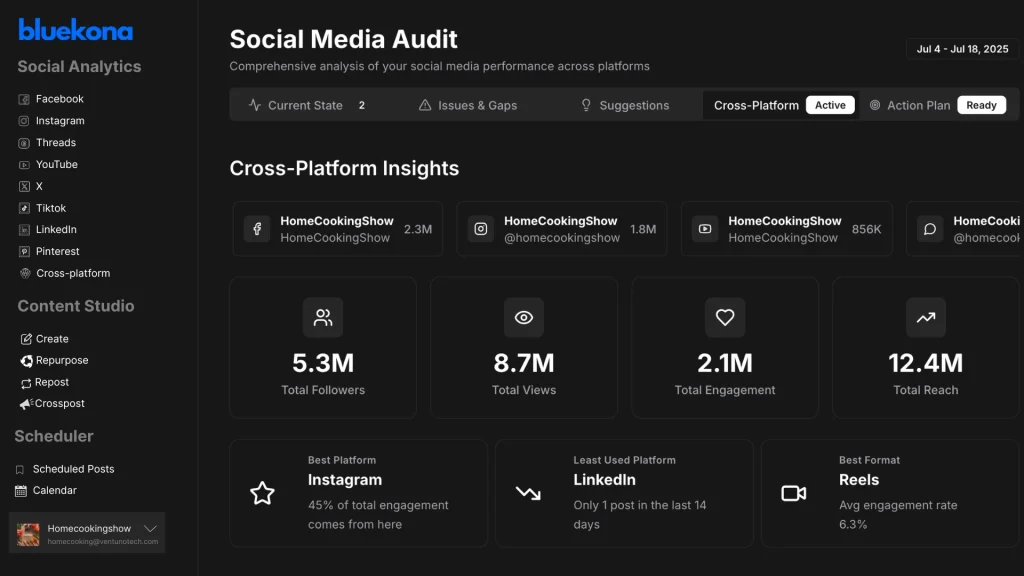
    Dashboards like this one provide a centralized view of cross-platform performance so you can stop guessing and start optimizing.

    bluekona - dashboard of client homecooking

    Here is what to look for in the dashboard

    1. Unified Performance Across Platforms

    The dashboard pulls in metrics from each social channel — including views, engagement, and reach.

    This allows you to compare performance side by side. No more toggling between apps or exporting CSVs.

    2. Total Impact at a Glance

    Core metrics like Total Followers, Views, Engagement, and Reach are displayed across all platforms. This makes it easy to measure the full return on marketing efforts, even when it’s scattered into different channels.

    3. Format-Specific Wins

    In this example, Reels are identified as the best-performing format with a 6.3% average engagement rate.

    Knowing which format consistently drives ROI helps you decide where to focus future repurposing efforts.

    4. Platform Gaps and Opportunities

    While Instagram drives nearly half of the total engagement, LinkedIn has seen almost no recent activity.

    This type of insight helps justify reallocating team time — or testing underused platforms with proven content.

    Insight in action: Repost high-performing Instagram content to LinkedIn to fill engagement gaps.

    This kind of visual breakdown gives your team the clarity to stop guessing, start tracking, and make every repurposed asset count.

    What to Do With This Data

    It’s not enough to know how your content performed — you need to act on it. ROI insights like these turn your repurposing efforts into a high-efficiency growth strategy.

    Cut the Waste

    If certain formats consistently underperform, stop investing time in them.

    Low-engagement Stories, static posts with no clicks, or platforms with zero traction — this is where effort gets lost. Let the data make those calls for you.

    Double Down on What Works

    Use ROI insights to identify high-performing formats and platforms, then scale them.

    If Instagram Reels drive the most engagement, views, or leads, make that your core repurposing focus. Invest more in what’s proven to deliver results.

    Prove the Value of Your Content Team

    Go beyond vanity metrics. Use hard data to measure impact of your team’s work — how much reach, engagement, and lead potential each repurposed asset is generating.

    You’re not just making content — you’re building a system that multiplies returns.

    This is the kind of insight that turns content strategy from a creative function into a measurable, defendable business asset.

    Ready to See What’s Actually Working?

    Book a free social media ROI audit and get a clear view of how your repurposed content is performing across every platform.

    Stop guessing. Start measuring what matters.

    Let BlueKona show you how every piece of content pays off — or doesn’t.

  • What Viral Social Posts Teach Us About the First 3 Seconds

    What Viral Social Posts Teach Us About the First 3 Seconds

    The scroll is ruthless. You have ~3 seconds to hook — or die.

    Every platform’s algorithm,from YouTube to Instagram to LinkedIn, is designed to reward content that grabs attention instantly. Not eventually. Instantly. Weak openings? They get buried.

    In this post, we’ll break down exactly what makes a powerful first three seconds on YouTube Shorts, Instagram Reels, and LinkedIn Carousels. You’ll see real examples, repeatable hook formulas, and data-backed strategies to improve your scroll-stop rate — no matter the platform.

    If your job depends on getting people to watch, read, or engage, this is where you start.

    Why the First 3 Seconds Matter ?

    The first three seconds aren’t just important — they’re make-or-break. In a feed moving faster than a caffeine-fueled scroll session, attention isn’t given. It’s earned instantly.

    Viewer Drop-Off Rates Don’t Lie

    • YouTube Shorts: According to YouTube’s own Creator Insider, a staggering 70% of viewers decide whether to keep watching or swipe away within the first 3 seconds. That’s your entire pitch window.
    • Instagram Reels: Meta’s internal research shows that the average viewer gives a Reel just 1.7 seconds before deciding if it’s worth their time. That’s less than two blinks — your visual or audio cue needs to hit immediately.
    • LinkedIn Carousels: LinkedIn’s Ads Benchmark Report reveals that if your first slide lacks contrast or punchy copy, CTRs can drop by over 50%. On a platform where users skim while pretending to read, the first visual has to do the heavy lifting.

    Platform Behavior You Can’t Ignore

    • Users don’t watch — they scan. You’re competing with subconscious thumb reflexes, not just other creators.
    • Algorithms boost content that causes users to hesitate, rewatch, or interact right away. The quicker you trigger that pause, the better your odds of reach.
    • Your first frame is algorithmic currency. If it doesn’t hook, it doesn’t rank.

    YouTube Shorts: What Grabs & Keeps

    When it comes to YouTube Shorts, the first three seconds are less of an opening and more of a grenade. They need to explode fast, loud, and with purpose. Unlike longer-form YouTube content, there’s zero patience for buildup. The best-performing Shorts punch the viewer with motion, tension, or curiosity — immediately.

    What Works in the First 3 Seconds

    1. Hard Cuts & Pattern Disruption
    The scroll stops when something breaks the feed’s rhythm. Think jarring transitions, zooms, sudden audio bursts — anything that snaps the brain awake. The goalis to disrupt the default passive scroll.

    2. Immediate Voiceovers
    Top creators open with lines like:

    • “Here’s what nobody tells you about [topic]…”
    • “You’ve been doing this wrong — let me show you why.”

    The pattern? They open with tension, contradiction, or a bold promise — within the first breath.

    3. Motion-Heavy or Unexpected Visuals
    Whether it’s fast jump cuts, punch-ins on facial expressions, or text that animates with meaning — static = skipped. Viewers are drawn to movement, so even talking heads layer in kinetic typography, visual overlays, or reaction-style inserts to hold attention.

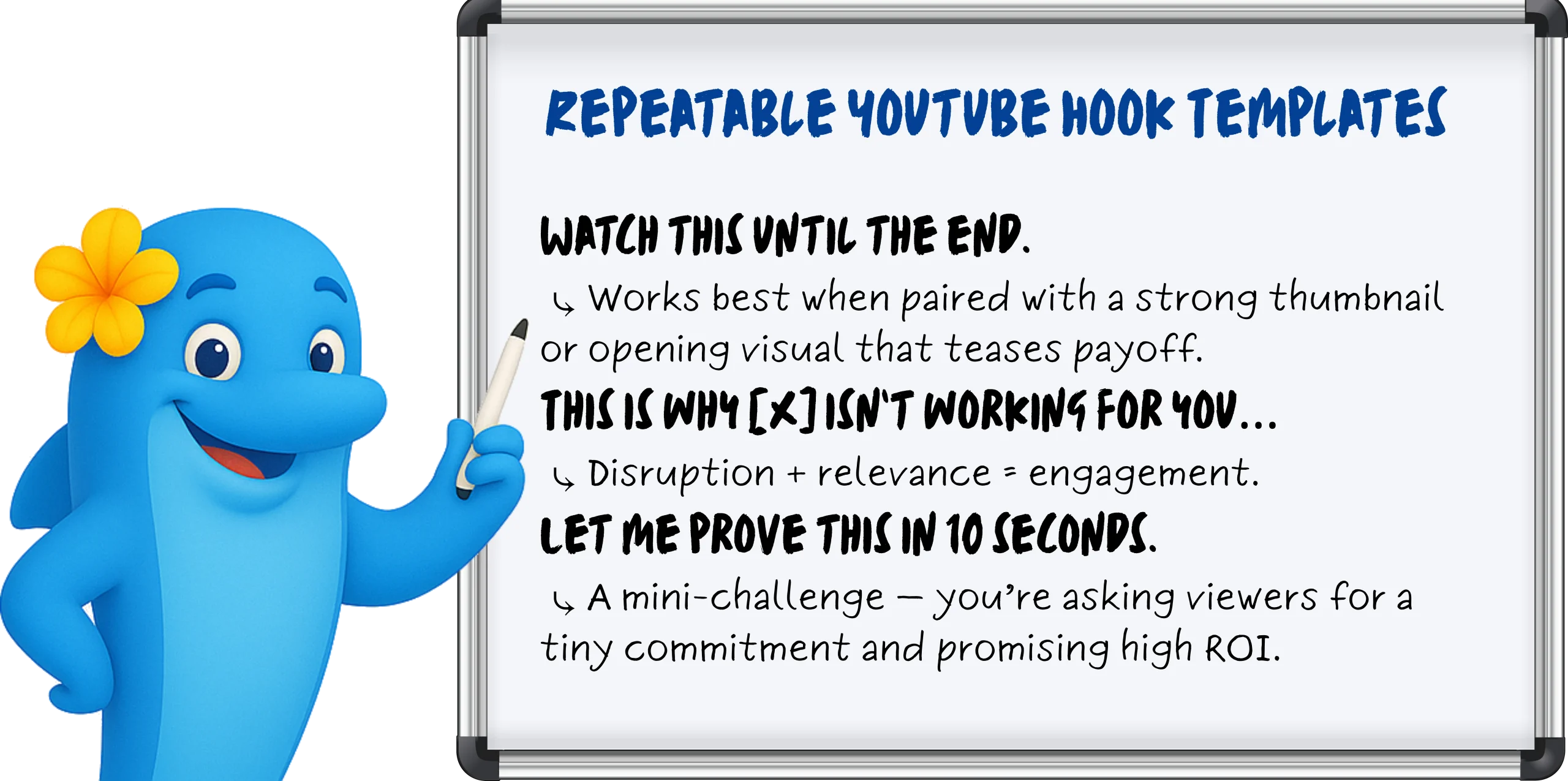
    Repeatrable Youtube hook templates

    Instagram Reels: Shock, Sound, Overlay

    Instagram Reels doesn’t reward slow burns — it rewards sensory ambush. If YouTube Shorts is about pacing and narrative tension, Reels is about vibe and visual punch, often before the viewer even taps.

    Scroll-Stop Mechanisms That Work

    Your job? Interrupt the scroll within one second — visually or audibly.

    1. Trending Audio Cues (First Second or Bust)
    Instagram’s algorithm loves audio-native behavior. That means syncing your first second with a recognizable sound — a beat drop, a voiceover hook, or a viral soundbite — to instantly trigger familiarity.

    2. Timed Text Overlays (Preview-Optimized)
    Your first frame matters before the viewer even hits play. The preview frame is your thumbnail. Strategic creators time bold text overlays to appear in the first 0.3 seconds, so the hook is already visible in-feed.

    3. High-Contrast or Unexpected Visuals
    Surreal edits. Face-reacts. Props in weird places. Reels thrives on visual thumb-breakers that contrast with lifestyle content around it. If your face fills the frame and your eyes say “wait for it” — it works.

    Reels Editing Tips That Actually Matter

    • Time your text overlays to appear in the first 0.3 seconds
      Anything slower risks being cut off in preview mode — aka, your hook dies before it lives.
    • Always check your preview frame before posting
      What shows in-feed is what earns the click. A dead frame = dead reach.
    • Keep the first 1–2 seconds hyper-visual and reactive
      Even if you’re talking, make the viewer feel like they’re missing something if they scroll.
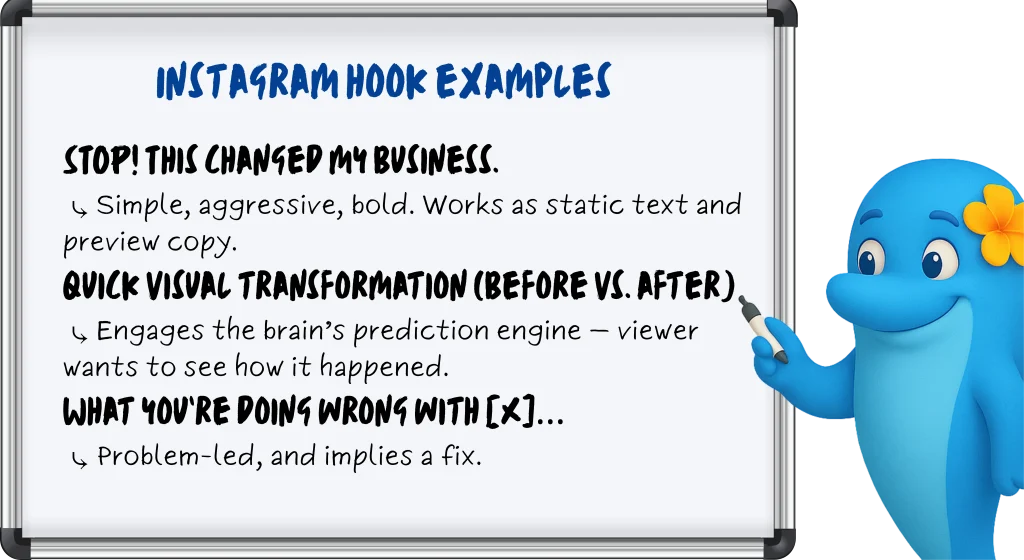
    Instagram hooks

    LinkedIn Carousels: First Slide = Battle Zone

    On LinkedIn, the first slide isn’t an intro — it’s a knife fight for attention. Forget clever setups or brand-heavy titles. If your lead slide doesn’t provoke curiosity, urgency, or ego in under a second, you’ve already lost the click.

    What Actually Makes People Swipe

    1. Stat-Based Hooks That Challenge or Alarm
    Cold, hard numbers perform well — especially when they suggest most people are doing something wrong.

    Example Slide 1: “78% of marketers miss this — are you one of them?”

    Why it works: Social proof meets FOMO. Feeds into ego, curiosity, and self-assessment — all at once.

    2. Provocative Questions That Poke at Pain Points
    Challenge the reader’s status quo. Swipe-worthy carousels open with a line that hits where it hurts — budget, performance, perception.

    Slide 1: “Are your campaigns bleeding money?”

    Slide 1: “Your boss cares about ROI. Show this.”

    Why it works: LinkedIn users are job-focused — pain + solution = performance.

    3. Visual Hierarchy & Contrast
    Big fonts. Bold text. Negative space. Colors that don’t blend in with the sea of blue and beige. The first slide should feel like a bold poster — not a polite cover.

    Slide 1: “Most social strategies suck. Here’s why yours might too.”

    Why it works: No fluff, no intro, just friction and value in one frame.

    Best Practices That Actually Drive Swipes

    • Ditch the logo: You’re not Coca-Cola. The first slide is for the reader, not your brand team.
    • Never waste the slide on a title: If it reads like a headline from a blog post, it’s already being ignored. Make it punch, not label.
    • Add swipe cues: Use arrows, broken lines, or subtle animation to create movement and momentum — your carousel should feel like a journey.

    How BlueKona Can Analyze Which of Your Hooks Actually Work

    You’ve posted. You’ve hoped. Maybe even prayed to the algorithm gods. But which hooks actually worked — and which ones got ghosted?

    BlueKona takes the guesswork out of performance. It analyzes your posts across platforms — YouTube Shorts, Instagram Reels, LinkedIn Carousels — by impressions vs. engagement, so you can see exactly which hooks stopped the scroll… and which ones got scrolled right past.

    You’ll know:

    • Which posts had high visibility but low engagement (aka, hook fail)
    • Which ones spiked interaction right at the top (aka, hook magic)
    • How performance shifts by platform and format
    • Which opening frames or phrases actually pull people in

    No more gut instinct. No more guessing. Just clear, scroll-stopping insight.

  • The Secret Content Gaps in Your Facebook Page And How to Fix Them

    The Secret Content Gaps in Your Facebook Page And How to Fix Them

    You’re posting consistently. Your follower count is growing—slowly. Some posts even get a decent number of likes. But somehow, your Facebook page still feels dead. No comments. No shares. No real engagement that turns into leads or sales.

    If that sounds familiar, you’re not alone. Most solopreneurs and solo marketers are misled by surface metrics. They obsess over post frequency and follower counts while ignoring the real issue: content gaps.

    These are the blind spots in your content strategy—the missing formats, ignored audience behaviors, and timing misfires that quietly sabotage your reach. They don’t show up in your vanity metrics, but Facebook’s algorithm notices. So does your audience.

    This post is about exposing those invisible flaws and showing you exactly how to fix them fast.

    What Are Content Gaps ?

    Content gaps are the hidden cracks in your Facebook strategy. they’re the silent killers of your Facebook performance. These are the missing pieces between what your audience wants, what the algorithm rewards, and what you’re actually posting.

    And the worst part? They’re easy to miss.

    You might think your Facebook strategy is solid. But if you’re not seeing engagement, clicks, or growth, you’re likely falling into one (or more) of these five common content gap traps

    1. Ignoring High-Performing Formats

    Facebook loves native video. But if you’re relying on link shares or static images, you’re handing visibility over to your competitors. Algorithm-friendly formats aren’t optional—they’re essential.

    2. Posting at the Wrong Times

    Consistency is great, but not if it’s inconvenient for your audience. You keep posting at 9 AM because it fits your schedule. Meanwhile, your audience is most active at 7 PM. Even great content flops when no one’s around to see it.

    3. Off-Topic or Irrelevant Content

    Your followers engage with tutorials and how-tos, but your last five posts were memes and motivational quotes. That disconnect kills relevance and consistency, both of which Facebook rewards.

    4. No Clear CTA (Call-to-Action)

    You’re sharing useful info, but never asking your audience to do anything. Every post should guide your audience. No CTA means no clicks, no comments, and no shares. Whether it’s “Tag a friend,” “Comment below,” or “Click to learn more,” your content needs direction or it takes your audience to dead-ends.

    5. Engagement Black Holes

    Low likes and zero comments? That’s a signal Facebook takes seriously. If your posts consistently underperform, the platform will start showing them to fewer people. That’s a downward spiral you don’t want.

    Delphi - dont blame the algorithm

    If you’re seeing low reach or weak engagement, don’t just blame the algorithm. Run a content gap audit. Identify what’s missing, adjust your strategy, and watch your performance climb.

    How AI Audits Reveal These Gaps

    Surface-level metrics like likes and reach are not enough.They make your content look good on the surface, but they rarely tell the full story. If you’re relying on those numbers to guide your strategy, you’re flying blind.

    That’s where BlueKona’s AI audit flips the script.

    Instead of just measuring what happened, it dives into why it happened—and more importantly, what to fix. BlueKona uses artificial intelligence to detect the blind spots your team (and even your analytics tools) are missing.

    It’s not just data—it’s diagnosis.

    Here’s how BlueKona uncovers what’s really holding your content back

    1. Engagement by Post Type

    Are your native videos secretly outperforming everything else? Are carousel posts killing it while quote images tank? BlueKona dissects engagement by content type, so you know which formats to scale—and which ones to retire.

    2. Behavioral Drop-Off Analysis

    Are people commenting and then vanishing? Are they clicking but not sharing? Are they clicking but not converting? BlueKona identifies where interest dies, so you can fix the friction.

    3. Topics That Get Shared vs. Scrolled Past

    Not all engagement is equal. A like is easy. A share or save means your content hit home. BlueKona highlights which topics get shared, saved, or spread. And also which ones your audience scrolls past without a second thought.

    4. Spotting Repeatable Wins

    You may have nailed a format or topic once and never repeated it. BlueKona identifies the high-performing content patterns you didn’t notice—so you can rinse, repeat, and scale what works.

    Delphi - find content gaps

    This isn’t just analytics. It’s diagnosis. BlueKona gives you specific, data-backed insight into why your content is flatlining and what to do next.

    Why You Don’t See These Gaps Yourself?

    Let’s clear something up — this isn’t about laziness or lack of effort.

    You’re posting consistently. You’re diving into Facebook Insights. You’re adjusting your content strategy on the fly.

    But in reality, you’re still flying blind.

    And it’s not your fault. Here’s why even smart marketers fail to see the gaps in their content strategy

    1. You’re Too Emotionally Attached to Your Content

    When you’re the one writing the captions, choosing the images, and crafting the message, you see the intention. But your audience only sees the output—and if it doesn’t hit the mark, the intent doesn’t matter. You’re inside the bottle, trying to read the label.

    2. You’re Chasing Likes Instead of Reading Patterns

    A single post gets 50 likes and it feels like a win. But without comparing post types, engagement trends, or time-based performance clusters, that success is just noise—not signal. One good post doesn’t mean your strategy is working.

    3. Facebook Insights Are Data-Rich, But Insight-Poor

    Sure, Facebook tells you what happened—but not why. You get raw numbers, not strategic clarity. No context. No benchmarks. No roadmap for what to improve or double down on.

    4. You Don’t Have Time to Become a Data Scientist

    Tracking post formats, timing, engagement depth, and thematic trends across dozens of posts? That’s a full-time job which no solo marketer can keep up.

    That’s why content gaps stay invisible. But only until AI pulls them out into the open.

    BlueKona doesn’t overwhelm you with data. It gives you answers. Actionable insights. Strategic next steps. The kind of clarity that transforms content from hit-or-miss to high-performance.

    How to Fix Content Gaps on Facebook?

    You don’t need more tools. You need a system. Fixing content gaps isn’t about guessing or “posting better”—it’s about auditing, spotting patterns, and scaling what works.

    Here’s how to do that, solo

    Step 1: Run an AI-Powered Content Audit

    Before you can fix the problem, you need to see it.

    BlueKona’s AI scans your Facebook content across post formats, topics, timing, and interaction types.

    It pinpoints the exact elements driving engagement and highlights the ones dragging you down.

    You’ll know what to keep, cut, and create—backed by hard data.

    Step 2: Identify Winning Patterns

    Sort your posts by post type, topic, and time. Analyze what consistently performs.

    • Which formats get the most interaction?
    • Which topics spark shares or saves?
    • What times drive the highest visibility?

    BlueKona sorts this for you automatically, without any spreadsheet and wasted hours.

    Step 3: Build a Content Matrix That Scales

    This is where strategy meets system.

    Create a Content Matrix by combining your top-performing:

    • Topics (e.g., tutorials, story-based posts, industry tips)
    • Formats (videos, carousels, polls, live streams)
    • Timings (evenings, weekends, lunch hours)

    This becomes your plug-and-play calendar.

    Stop guessing. And start executing a plan designed to win.

    Step 4: Repurpose What Already Works

    Stop reinventing the wheel. Start repurposing your best content.

    • Turn a high-performing video into a quote graphic or reel
    • Break long posts into shorter carousels or Q&A formats
    • Update and repost evergreen winners on a new schedule

    BlueKona tracks how often you’ve reused content. So you can maximize results without becoming repetitive.

    Step 5: Fill the Gaps with Smart Content

    Need new content ideas?

    BlueKona gives AI-powered prompts based on your missing content types, ignored topics, or dead time zones. It’s not just “what to post”—it’s “what’s missing and will likely work.”

    Delphi Audits

    Fixing content gaps isn’t about working harder—it’s about working with precision.

    BlueKona gives you the blueprint, the tools, and the patterns so you can post with confidence, not guesswork.

    More Posts ≠ More Growth

    Most solopreneurs try to fix a slow Facebook page by posting more. But more content on top of a broken strategy just buries the problem deeper.

    If you’re serious about growing your reach, engagement, and leads—stop guessing. Start auditing.

    Content gaps are the silent killers of growth. They don’t show up in likes or reach. But they explain why your posts get ignored, your audience drifts, and your funnel stays dry.

    The smart move isn’t more content. It’s better content, driven by patterns you didn’t know to look for. BlueKona shows you those patterns—and tells you exactly what to do next.

    If you’re doing this alone, you need that edge.

  • How to Know What Content to Repurpose And What to Retire

    How to Know What Content to Repurpose And What to Retire

    You’ve probably published hundreds of blog posts, landing pages, social content, and resource guides over the years. But be honest — how many of those assets are still driving meaningful results today?

    If you’re like most marketing teams, the answer is “very few”.

    Research shows that more than 60% of published content generates little to no organic traffic after just six months. That means the bulk of your hard work is quietly rotting away — outdated, ignored, and invisible in search.

    Yet within that giant content graveyard, there are often hidden pages with proven audience interest, or past traffic that just needs a boost.

    The real challenge is knowing what deserves a second chance, and what should be put out of its misery for good.

    In this post, I’ll break down a simple, repeatable content repurposing strategy that helps you

    1. Pinpoint high-potential content worth reviving
    2. Spot obsolete pieces you can safely retire
    3. Streamline the entire process with AI-powered content audit tools that take the guesswork out of prioritization

    You’ll get a clear, tactical framework and see exactly how to apply it using an automated content lifecycle management approach.

    Let’s transform your bloated content library into a lean, ROI-generating machine.

    Why Some Content Deserves a Second Life?

    Not every piece of underperforming content should be tossed in the trash. In fact, some of your best growth opportunities may come from evergreen topics that have simply decayed over time.

    Think of it like a house with solid foundations but peeling paint. The core idea is still valuable — it just needs a refresh.

    Here’s why giving existing content a second life is such a smart move:

    Evergreen + decaying content = low-hanging fruit

    If you already covered an evergreen topic that once performed well, updating it is far easier (and faster) than creating something from scratch. You’ve got a head start with backlinks, a history of ranking keywords, and some brand familiarity.

    Updating can outperform net-new creation

    Many marketers think publishing more content is always the answer. But updated content often sees ranking improvements much faster than brand-new posts, thanks to Google’s preference for freshness. In fact, a well-optimized update can reclaim traffic and authority in weeks — while new content can take months to ramp up.

    Repurposing helps you reach new audiences

    You can breathe fresh life into proven ideas by reshaping them for different channels:

    • Turn a top blog post into a short-form video
    • Slice it into a LinkedIn carousel
    • Summarize it for a Twitter thread
    • Adapt it for a webinar or newsletter

    That way, you’re maximizing every ounce of value from content you already know resonates — without reinventing the wheel.

    Instead of burning resources on constantly reinventing the next “big post,” you’ll get far more leverage by systematically repurposing what’s already working.

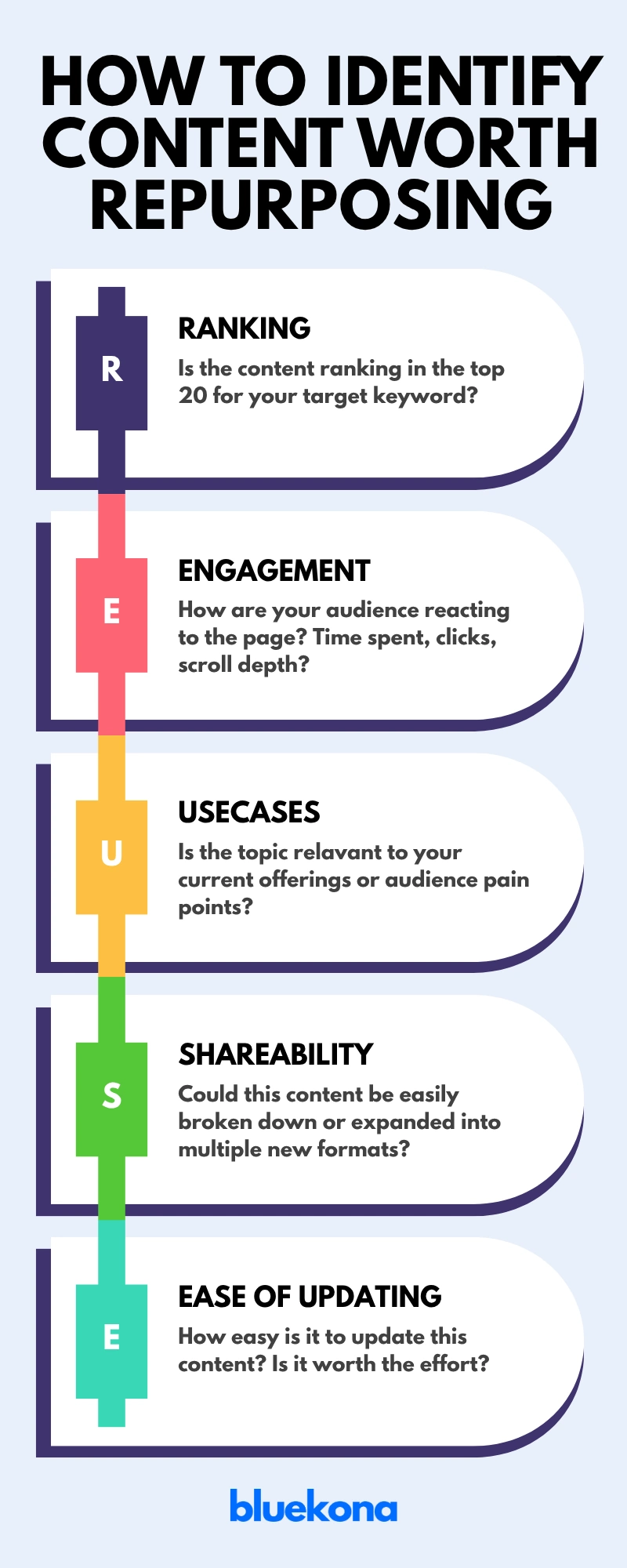
    How to Identify Content Worth Repurposing

    conten worth repurposing - REUSE score

    So, how do you separate the content with real second-life potential from the pieces that should stay buried?

    You don’t want to repurpose just any outdated post. You want to focus on assets with enough existing value that a strategic refresh can turn them into winners again.

    To make this process dead simple, use the REUSE Score — a five-part framework that helps you instantly evaluate whether a piece of content is worth repurposing.

    R — Rankings

    • Is the content ranking in the top 20 for any target keyword?
    • Even if it’s on page 2 of Google, that’s a sign it has ranking potential worth reviving.

    E — Engagement

    • Does it have decent time on page, comments, or social shares?
    • Good engagement signals mean your audience already found it valuable once — a perfect candidate to repackage or update.

    U — Use Cases

    • Is the topic still relevant to your business today?
    • Does it align with your current offerings or audience pain points?
    • If yes, repurposing makes sense. If no, consider retiring it.

    S — Shareability

    • Could this content be easily broken down or expanded into multiple new formats?
      • Social posts
      • Short-form videos
      • Infographics
      • Podcasts
    • If yes, you’ll get more ROI from repurposing.

    E — Ease of Updating

    • Can you modernize it quickly with fresh data, visuals, or a minor rewrite?
    • Or does it need a complete overhaul?
    • Easy wins should go straight to the top of your repurposing list.

    By applying the REUSE Score, you’ll never again waste time guessing which pieces deserve a second life. You’ll have a simple, repeatable way to prioritize high-ROI repurposing opportunities.

    How to Spot Content That Needs to Be Retired

    Not every piece of old content deserves a second chance. Some posts are simply beyond rescue — and keeping them live might actually hurt your site’s performance by wasting crawl budget, confusing search engines, or cannibalizing your rankings.

    Here’s how to know when to retire content, confidently and guilt-free.

    Outdated Stats or Irrelevant Topics

    • If the post covers data from five years ago, or trends that no longer exist, it’s a poor fit for today’s audience.
    • If the topic is no longer relevant to your current brand or offering, let it go.

    Zero Traffic for 12+ Months

    • Check Google Search Console and Google Analytics:
      • Has the post delivered no meaningful organic or referral traffic for a year or more?
      • If so, it’s usually dead weight.

    Competing (Cannibalizing) Pages

    • Sometimes multiple pages target the same keyword and end up fighting each other in Google.
    • Look in Search Console:
      • Do impressions and clicks seem split across similar pages?
      • If yes, consider consolidating into one stronger post, and retire the duplicate.

    Off-Brand or Legacy Campaigns

    • Older content tied to discontinued products, seasonal campaigns, or outdated messaging can damage your brand if left online.
    • Ask yourself: Would I feel proud to show this to a prospect today?
      • If the answer is no, archive or redirect it.

    Quick Metrics to Check Before Hitting Delete

    In Google Search Console

    • CTR steadily dropping over 6–12 months
    • Impressions flatlined or trending to zero
    • Position stuck outside the top 30

    In Ahrefs or SEMrush

    • Zero backlinks or lost all referring domains
    • No keyword rankings in the top 50
    • Traffic estimates = zero

    When you see these patterns, don’t waste time trying to save that content. Retire it, redirect if necessary, and refocus your energy on assets with true repurposing potential.

    Manual Audit? Painful. Here’s the AI Shortcut.

    Let’s be honest, auditing hundreds of posts manually can be a nightmare. You’d have to pore over spreadsheets, cross-check traffic stats, analyze keyword cannibalization, check backlinks, and then figure out repurposing formats — one by one.

    No wonder so many content teams procrastinate, or worse, keep guessing about what to update.

    That’s exactly why we built Bluekona AI — to automate the entire repurposing audit process and help you reclaim more ROI from your content library in minutes, not weeks.

    Here’s how it works

    Auto-Detects High-Potential, Decaying Posts

    Bluekona continuously scans your content inventory and spots pages showing organic traffic decay but with strong past performance signals — the perfect repurposing targets.

    Pulls Performance Data from Every Platform

    Instead of you jumping between Google Analytics, Search Console, Ahrefs, or social metrics, Bluekona ingests them all automatically. You get a unified dashboard showing exactly which posts are underperforming, and why.

    Suggests the Best Repurposing Format

    Should you turn that stale blog post into a LinkedIn carousel? A short-form video? A tweet thread? Bluekona analyzes engagement patterns to recommend the right format to breathe new life into your existing content.

    Flags Irrelevant or Obsolete Posts to Archive

    No more guessing which posts to kill off. Bluekona flags content with zero relevance, outdated messaging, or keyword cannibalization, so you can retire it confidently and keep your content library lean and high-performing.

    Stop Guessing. Start Repurposing With Purpose.

    Your content library is a goldmine — but only if you know how to separate the hidden gems from the dead weight.

    Most brands waste hundreds of dollars creating new content while ignoring existing assets that could be updated and repurposed to drive 2–3x more results, with a fraction of the effort.

    By applying a systematic, data-backed framework like the REUSE Score — and leveraging AI to automate the heavy lifting — you’ll never have to second-guess what to revive, what to retire, or how to prioritize.

    It’s time to transform your content operations from a guessing game into a precision growth engine.

    Let Bluekona AI audit your content library and show you the high-ROI opportunities in minutes — so you can repurpose with purpose, and win back your valuable time.

  • From Prompt to Profit: The Full AI-Powered Content Lifecycle

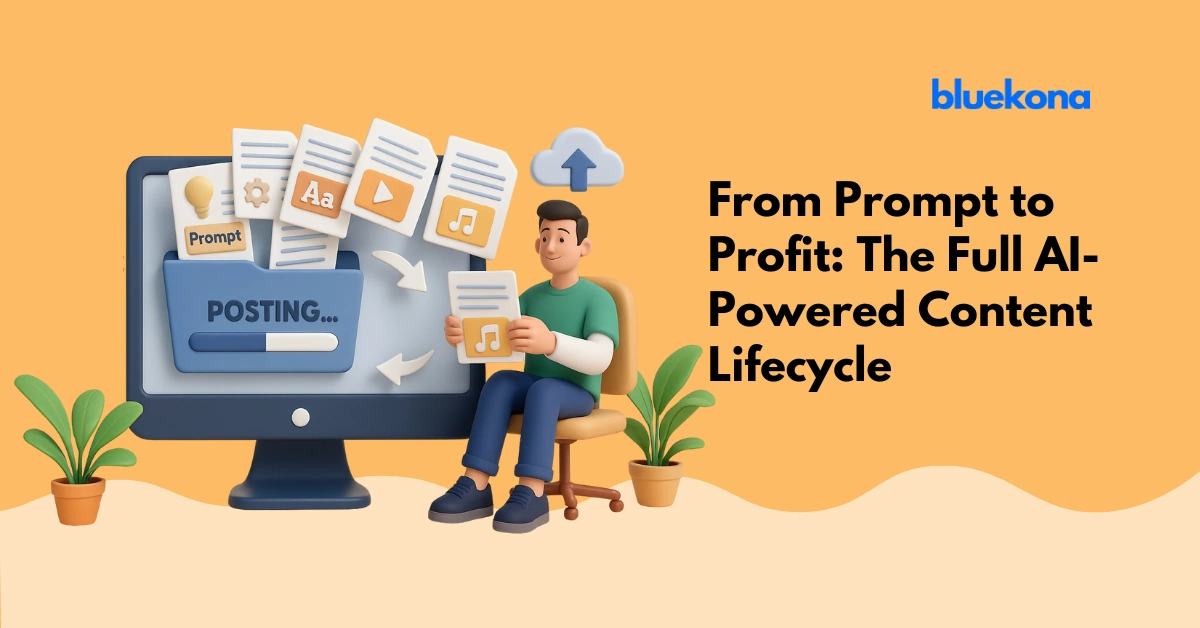
    From Prompt to Profit: The Full AI-Powered Content Lifecycle

    Most marketing teams still run content operations like it’s 2015. They are struggling with separate tools, isolated teams, and painfully slow approvals.

    You write one blog post, maybe share it on LinkedIn, and then it disappears. Meanwhile, competitors are flooding every platform, daily.

    It’s slow. It’s disconnected. And it’s built for a world that no longer exists.

    According to the Content Marketing Institute, 70% of marketers say they repurpose content — but fewer than 15% do it systematically. That gap is where growth either compounds, or collapses.

    Delphi quote - working for workflow

    Content today moves at the speed of platforms, not planners. One asset isn’t enough. You need it repurposed into 10 formats, distributed across 5 channels, optimized for multiple audiences — and tracked in real time.

    Enter the AI-powered content lifecycle.

    We’re not talking about generic AI writing assistants. We’re talking about a full-stack marketing engine that takes you from initial prompt to platform-ready content to performance analytics — without duct-taping together half a dozen tools.

    In this guide, I’ll break down each stage of the modern AI-powered content lifecycle — ideation, creation, distribution, repurposing, and performance tracking — and show you exactly how BluekonaAI powers the entire flow from end to end.

    If you’re serious about scaling organic growth without bloating your headcount, this is the workflow your team needs.

    What is the AI Content Lifecycle?

    Traditional content processes are linear and disconnected. You brainstorm, produce, publish, measure and then repeat, often from scratch.

    Delphi quote

    The AI content lifecycle flips that on its head. It treats content creation as a continuous, connected system, where each stage fuels the next, and data constantly feeds back into strategy.

    At a high level, the AI content lifecycle has five key stages:

    1. It starts with ideation, where AI taps into real search data, trend signals, and past content performance to surface strategic ideas that actually align with what your audience wants — eliminating the guesswork.
    2. Next comes creation, with AI drafting high-quality, platform-ready assets that serve multiple purposes: long-form blogs, video scripts, social posts, all consistent with your brand’s tone. Instead of jumping between disconnected drafts, you get cohesive content from the first prompt.
    3. After that is distribution, where AI automates publishing across channels in one smooth step. Whether you’re updating your CMS, scheduling emails, or posting to social platforms, the process is centralized and fast, eliminating countless manual copy-paste routines.
    4. Then comes repurposing, the stage where true efficiency compounds. Instead of letting a single blog post gather dust, AI transforms it into multiple new formats: LinkedIn carousels, TikTok scripts, newsletter sequences — each one adapted in tone, length, and structure for its unique audience. No more reinventing the wheel with every piece.
    5. Finally, there’s performance tracking. Forget disconnected dashboards and clunky spreadsheets; AI pulls engagement, conversion, and reach metrics together in real time. That means you know exactly what’s working and can feed those insights right back into your next round of ideation — making the entire system smarter with every cycle.

    Together, these five stages form a truly continuous, intelligent loop — one that helps your team publish faster, reach further, and optimize smarter, without bloating headcount or burning out your best people.

    This system isn’t just a time-saver. It unlocks compounding growth. Instead of starting from scratch every week, your best-performing content becomes a flywheel — reshaped, reamplified, and continually optimized with no extra friction.

    Platforms move fast. So should your team. The AI content lifecycle is how brands stay visible, consistent, and relevant, without bloating headcount or burning out creatives.

    Stage 1: Ideation — Smarter Starts with AI

    Most content workflows still kick off the same painful way: someone asks, “What should we write this week?” and a random brainstorm happens.

    Delphi - Stop throwing spaghetti at the wall. Start serving what your audience is actually hungry for.

    A few half-baked ideas surface, you pick one, and start typing hoping it sticks. That’s not strategy. That’s guesswork.

    BluekonaAI turns that guesswork into a systematic, data-powered idea engine. Instead of relying on hunches, it uses trend-aware intelligence from social signals, and even your past best-performing content to surface ideas with proven audience demand.

    That means you get to high-opportunity topics before your competitors do with none of the chaos.

    Beyond simply suggesting titles, the platform helps you build out your content with your team in the loop.

    That means your content creators don’t waste time rewriting objectives, angles, or keyword lists, they get a clear, intelligent first draft that’s almost ready to go, reducing the lag between strategy and execution.

    In short, ideation with BluekonaAI means faster, smarter, and more focused planning — setting your entire content lifecycle up for success before a single word is written.

    Stage 2: Creation — From Prompt to Platform-Ready

    Once you’ve nailed down the right ideas, the next hurdle is actually producing high-quality, on-brand content. And doing it fast enough to stay relevant.

    Traditionally, that meant briefing a writer, waiting days for a draft, reviewing it, rewriting it, adapting it for different formats, and hoping it held up across multiple channels.

    Multiply that by 10 or 20 assets a month, and you’ve got a bottleneck that can choke any growth plan.

    Delphi - Why 10 drafts - boss 1 prompt

    Enter Bluekona’s Content Studio. Need a blog post? You get a fully structured long-form article, with optimized subheads, relevant internal links, and strategic keyword integration already built in.

    Want a LinkedIn thought piece from that same topic? It rewrites it in a sharper, persona-driven tone, with a hook, a body, and a CTA specifically designed for feed engagement.

    How about a YouTube script? Done. Scene markers, intro/outro lines, on-camera voice and flow — all aligned with your brand guidelines.

    This is what sets BluekonaAI apart from cookie-cutter AI tools: it doesn’t just churn out filler. It creates intent-matched content.

    Each asset is aware of the format, the distribution channel, and the outcome it’s supposed to achieve.

    Even better, BluekonaAI remembers your past content. It can reuse top-performing CTAs, maintain consistent messaging, and avoid repeating ideas that fell flat before.

    No more blank docs, no more headline rewrites, no more endless tweaks to fit one post across five channels.

    This is full-stack, multi-intent content creation, optimized for both output and outcomes. From a single brief, you can launch a blog post, a video script, a carousel, a Twitter thread, and an email sequence, all aligned and ready to publish.

    That’s how you scale quality, velocity, and consistency without adding headcount.

    Stage 3: Distribution — Publish Everywhere, Instantly

    You’ve got strategic ideas and platform-ready content — but if it sits in a Google Doc or gets buried in a project folder, it’s worthless.

    Distribution is what actually puts your work in front of people, and most teams still struggle here.

    Jumping between social schedulers, manually posting, and praying everything goes live at the right time.

    BluekonaAI removes that friction by connecting content creation directly to distribution. The moment an asset is approved, it’s ready to schedule— no copy-pasting, no endless uploading, no channel-by-channel checklists.

    It’s the “one-click publish” mindset: instead of wasting time coordinating posts across platforms, you can reinvest that effort into refining your strategy. By cutting out the manual steps, you ensure your content goes live—on time, in the right format, and built to perform.

    Stage 4: Repurposing — Multiply Every Idea

    Most brands treat repurposing as an afterthought, if they do it at all. They’ll copy a paragraph from a blog, squeeze it into a social post, and call it a day. The problem? That approach is random, time-consuming, and rarely consistent in tone or structure.

    In today’s multi-platform environment, you can’t afford for a great piece of content to die after a single post. Audiences engage differently on each platform, and you need your best ideas to follow them — adapted to every format, in every channel.

    BluekonaAI makes this effortless. Instead of manually rewriting or reformatting, it transforms your primary content asset into a full suite of secondary assets, automatically tuned for context, tone, and platform style.

    Delphi quote - Data should not play hide and seek

    For example, that in-depth blog post can become:

    • a LinkedIn carousel with short, scroll-stopping slides
    • a short-form video script tailored for TikTok or Reels
    • an engaging Twitter thread built for conversation
    • a bite-sized email nurture sequence
    • a podcast snippet summary for Spotify

    And it doesn’t just swap words around. BluekonaAI’s repurposing engine is format-aware — understanding the unique style and narrative flow of each channel. It can condense a story for a TikTok script with hooks and cliffhangers, expand it for a podcast transcript, or rewrite it for a more conversational newsletter style.

    Even better, it preserves your brand voice and messaging across every asset. That means no more awkward rewrites or hiring yet another freelancer to fix tone inconsistencies. The platform reuses your brand’s proven calls-to-action, style guidelines, and key phrases, keeping everything recognizable and consistent.

    This is how you get true scale. Instead of asking your team to “do more with less,” you multiply what’s already working. High-performing content is reamplified, resurfaced, and retargeted to different audiences without starting from scratch.

    The result? Your content pipeline goes further, lasts longer, and reaches more people — without the painful delays and coordination hassles that kill momentum.

    If the modern attention span is measured in seconds, you need to meet audiences wherever they scroll. BluekonaAI makes that possible, turning one idea into many, across every platform, on-brand and on-time.

    Stage 5: Performance Tracking — Close the Loop

    You can’t improve what you don’t measure. Yet most teams still struggle, either relying on lagging useless metrics like traffic or likes, or drowning in a maze of spreadsheets and inconsistent attribution models. It’s messy, slow, and often too late to act.

    Delphi Quote - chasing data

    BluekonaAI changes that by making performance data instantly visible, centralized, and actionable — without hiring a full-time analyst. The moment content goes live, Bluekona begins tracking its impact across every connected channel:

    • clicks, views, and conversions for blog posts
    • engagement rates and reach for social posts
    • open and click-through rates for email campaigns
    • watch time and retention for video

    Even better, Bluekona ties these metrics directly back to the original idea and content format, so you can see exactly what’s moving the needle — and what’s falling flat. No more guessing which assets to scale up or which channels to prioritize.

    And it goes beyond reporting. Bluekona builds feedback loops right into the workflow:

    Underperforming content? It suggests a retargeting or repackaging strategy.

    Top-performing content? It flags it for repurposing and wider syndication.

    Channels that underdeliver? It recommends shifting focus, not just throwing more content at the wall.

    This isn’t just analytics — it’s true content intelligence, designed to make your marketing lifecycle continuously smarter. You move faster, optimize better, and reinvest effort where it matters most.

    With Bluekona, your team doesn’t just ship more content. You ship smarter content, tuned by real-world data.

    No spreadsheets. No guesswork. Just clear visibility, faster decisions, and sustainable growth.

    Why BluekonaAI Wins: The Power of a Unified Engine

    Most content teams stitch together a chaotic patchwork of tools — one for writing, another for scheduling, something else for analytics, plus countless spreadsheets to bridge the gaps. That approach costs time, drains budgets, and often fails to deliver the consistent results growth teams need.

    BluekonaAI is different. It replaces the messy “tool stack” with a single, unified engine that covers every phase of the content lifecycle: from strategy and creation to distribution, repurposing, and performance tracking.

    Delphi - Fire tools

    No more multiple logins, conflicting data, or tasks falling through the cracks. With one seamless platform, your team can focus on what actually matters: getting valuable content to market, faster and more efficiently.

    That means fewer approvals, fewer rewrites, and dramatically lower costs — without sacrificing quality or control. In other words, the same creative horsepower, minus the friction.

    If you’re serious about scaling your organic growth, BluekonaAI is the upgrade your workflow has been waiting for.

    Wrap Up

    Winning with content used to be about who could write better or publish more. Now it’s about who can operate smarter.

    The AI-powered content lifecycle isn’t just a productivity hack—it’s how modern marketing teams scale organic growth without bloating headcount or burning out creatives. When ideation, creation, distribution, repurposing, and performance tracking all run through one system, content becomes a growth engine—not a bottleneck.

    BluekonaAI gives you that engine.

    Whether you’re a lean team trying to punch above your weight or an established brand tired of disconnected tools, Bluekona replaces chaos with clarity—and manual work with momentum.

  • How Duolingo Dominates Social Media Through Intelligent Content Reuse

    How Duolingo Dominates Social Media Through Intelligent Content Reuse

    If you’ve scrolled TikTok or Instagram lately, chances are you’ve met Duo, the green owl.

    Duolingo is everywhere. Reels, tweets, memes, YouTube Shorts — all spun from the same simple ideas, but adapted so cleverly they feel brand new every time.

    It’s tempting to chalk this up to luck. Viral mascots. Funny scripts. But that’s missing the point.

    Duolingo built a repeatable content system that reuses and repurposes content at scale, without losing authenticity. It’s a machine, not magic.

    Today, I’ll break down exactly how this system works, why it’s so effective, and how you can clone it for your own brand — even if you’re working solo and can’t afford a social media team.

    Step Inside Duolingo’s Content Machine

    Let’s pull back the curtain.

    One consistent mascot. One consistent brand tone. Yet they show up on ten different platforms with near-daily content.

    How?

    They’ve mastered low-fi content on purpose. This means quick videos, memes, screenshots, and trends with minimal production — but maximum relatability.

    They don’t reinvent the wheel daily. They repackage ideas instead of creating from scratch.

    That’s the real Duolingo social media strategy — reuse in a way that doesn’t feel reused.

    One Idea to Ten Outputs

    Here’s how their machine works in practice:

    • TikTok? Meme it with the owl dancing.
    • Twitter? Shrink it to a one-liner.
    • Instagram? Break it into a carousel with swipeable slides.
    • YouTube Shorts? Add a voiceover to the same footage.
    • Blog? Expand the concept with examples, then embed all the above.

    Most people come up with an idea and post it once. Duolingo runs it across 5–10 outputs, milking every drop of engagement.

    Duolingo repurposing

    Why This Works

    Let’s break down why Duolingo’s approach absolutely crushes it.

    Familiarity = Trust

    When you see Duo’s chaotic, funny personality appear again and again — even in slightly remixed jokes — you start to trust it. Humans crave patterns. Psychologically, repetition makes a brand feel reliable and memorable.

    Think of it like a catchphrase on a sitcom. If Joey from Friends had said “How you doin’?” only once, no one would remember it. Because he repeated it, it became iconic. Duolingo does the same with its social voice.

    Duolingo Familiarity

    Platform Algorithms Love Volume

    If you post once, even a brilliant piece of content can get buried. Algorithms on TikTok, Instagram, YouTube, and Twitter reward volume + consistency, not just originality.

    Duolingo doesn’t create new ideas daily. They redistribute the same ideas in new formats, which triggers multiple algorithm boosts throughout the week.

    That means one concept can get surfaced to multiple audiences — on different days, on different platforms — rather than burning out in a single post.

    Duolingo Volume

    Speed > Perfection

    In a feed-driven world, perfection is a trap.

    If you spend weeks polishing, you’ll miss the trend window entirely. Duolingo ships content fast, then refines only if it sticks. That lets them ride cultural moments before they fade, with raw, authentic, relatable production.

    Think of their iPhone-shot videos filmed in a corner of the office. That “lo-fi” look is the point — it blends perfectly with the native feed, and avoids the overproduced, stale brand vibe people ignore.

    Duolingo Speed over Perfection

    Team Efficiency

    Here’s the secret to Duolingo’s insane output: they aren’t making more ideas, they’re multiplying them.

    If you build a system to slice, dice, and remix one idea into 5–10 platform-optimized posts, your team avoids burnout while publishing way more.

    That means:

    • Fewer approvals
    • Faster turnaround
    • More consistent brand voice

    And consistency builds familiarity, which brings us full circle to trust — the ultimate brand advantage.

    Duolingo Efficiency

    Bottom line? Duolingo’s reuse machine works because

    • Audiences trust repetition
    • Algorithms reward frequency
    • Lo-fi speed beats polish
    • Your team (or you solo) can stay consistent without burning out

    It’s not luck. It’s a system — and it’s 100% stealable.

    Why Manual Repurposing Fails?

    Let’s get brutally honest, most people try to repurpose manually, and then quit. Here’s why that approach fails — almost every single time.

    Too Many Tools, Too Many Steps

    You’re writing scripts in Google Docs, then jumping over to Canva for graphics, then chopping video in Premiere, then adding captions by hand in yet another tool. It’s a productivity nightmare. Every switch costs you time, attention, and money — and slows your entire workflow to a crawl.

    Rewrites Feel Like Starting Over

    Ask any creator: taking a 1,000-word blog post and rewriting it for Twitter can feel like starting from scratch. Your brain freezes because it has to shift style, tone, and structure. It’s exhausting, and most people procrastinate rather than power through.

    Scaling Dies at the Second Platform

    Sure, you might repurpose manually for Instagram and TikTok. But what happens when you add Twitter? Or YouTube Shorts? Your system crumbles. Manually adapting every post to multiple platforms is simply too heavy to sustain at scale. Burnout is guaranteed.

    Creative Fatigue Sets In

    The final nail in the coffin: you feel like you’re repeating yourself over and over, even though your audience hasn’t even seen most of it yet. That disconnect kills your motivation. Creators burn out because they’re mentally exhausted trying to repackage the same message, worrying it’s stale, when in reality their followers still need to hear it.

    The right system, powered by AI or a structured repurposing framework, takes away all this friction. That’s how you achieve Duolingo-level consistency — without burning through your sanity or your budget.

    Clone the System: Do It Like Duolingo — Without a Team

    Alright, let’s get tactical. You know Duolingo’s secret, reuse with ruthless efficiency.

    Now let’s build your own version — even if you don’t have a team, a video editor, or a mascot suit.

    Here’s how to do it, step by step.

    1. Start with a Core Asset

    Pick one piece of content. That’s it. It could be a blog post, a podcast episode, a YouTube video, or even an old newsletter you wrote months ago. You do not need to start from scratch — in fact, your old content is a goldmine just waiting to be reused.

    2. Drop It into Bluekona AI

    Take that asset and paste it straight into Bluekona. Then, pick the formats you want like a tweet thread, linkedIn post, instagram carousel, tiktok script, email subject lines

    No more blank page syndrome. No more struggling to rewrite the same idea 10 different ways.

    3. Instantly Get Platform-Optimized Outputs

    Bluekona doesn’t just regurgitate plain text — it actually reshapes your message to fit each platform’s native style, tone, length, and best-practice CTAs. That means less tinkering for you, and more shipping content that actually fits where it’s going.

    4. Polish & Post

    Now you’re working with drafts that are already 80% finished, instead of facing a cold, empty doc. Your only job is to add any final personal touches and hit publish.

    duolingo Advice

    Wrap-Up

    Let’s make this crystal clear. Duolingo isn’t magical. They aren’t riding on lucky viral moments. They’re methodical, consistent, and ruthlessly efficient at squeezing every ounce of value out of their ideas.

    You don’t need a green owl costume to pull this off. You just need a system — a repeatable machine that helps you reuse, repackage, and remix what you’ve already created.

    And remember, reusing isn’t cheating. It’s the smartest move you can make. You’ve already put in the hard work once. Why let it fade after a single post?

    Your best ideas deserve more life, more reach, and more engagement — without burning you out.

    Don’t create more. Repurpose better.

    Start with Bluekona AI.

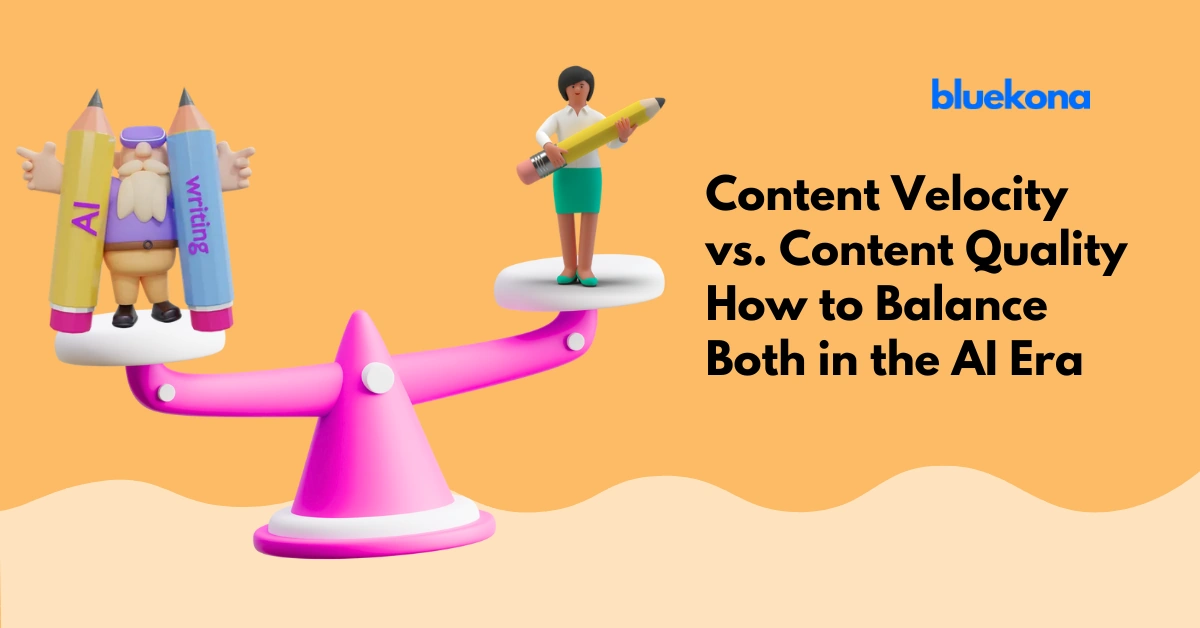
  • Content Velocity vs. Content Quality: How to Balance Both in the AI Era

    Content Velocity vs. Content Quality: How to Balance Both in the AI Era

    Content is flooding every single channel right now. Feeds are jam-packed. Search results are more competitive than ever. And your audience? They’re tired of shallow, repetitive posts that sound like they were written by a robot in 30 seconds.

    AI has made pumping out content ridiculously easy. But pumping out good content? That’s where most teams fall flat.

    Brands either publish a ton of mediocre stuff no one remembers, or they sink weeks into polishing a single article, only to miss opportunities to grow.

    But the truth in today’s market is that you can’t afford to pick sides. You need both quality and velocity — because that’s what modern distribution and learning loops demand.

    Delphi - Worthy Content

    If you want to build authority, rank higher, and stay top of mind, you have to create systems that let you move fast and deliver value.

    In this article, I’ll break down exactly how to build a content workflow that scales without sacrificing quality, using smart AI tools and a proven structure.

    Ready? Let’s dive in.

    Velocity vs. Quality

    Before you can fix the problem, you need to name it.

    Velocity is all about speed and scale. It’s how fast — and how consistently — you can get content out the door. Think consistency, publishing frequency, and your ability to show up in multiple channels week after week. The faster you move, the more opportunities you have to connect with your audience and test what works.
    Quality, on the other hand, is about depth and impact. That means relevance to your audience, originality that stands out, well-researched insights, a polished finish, and a voice that actually resonates. Quality is what makes someone read, remember, and trust your brand.

    Here’s the trap: most teams think they have to choose. They either crank out a mountain of low-value posts that nobody cares about, or they obsess over one perfect article for weeks and lose all momentum.

    That old trade-off just doesn’t cut it anymore — and in a minute, I’ll show you why.

    Delphi Speed vs Quality

    Why the Old Tradeoff Doesn’t Work Anymore?

    When ranking #1 on Google could lock in steady traffic for a year content teams had to pick a lane, either publish fast and risk low-quality output, or spend weeks in every piece and fall behind in distribution.

    That tradeoff is now obsolete and infact dangerous.

    Delphi quotes on AI - Human in the loop

    Today, AI has smashed the barriers to content production. Anyone can spin up a 1,500-word blog post or a week of social posts in minutes. Feeds are overflowing with shallow, mass-produced content. Audiences can sense it instantly. Algorithms can detect it even faster. And platforms are responding.

    • Google’s Helpful Content updates are actively devaluing AI-written pages that lack originality and real insight.
    • LinkedIn’s feed algorithm has shifted to prioritize meaningful conversations over cheap engagement hacks.
    • YouTube and TikTok still reward volume — but only if you hold attention and drive watch time.

    In other words, flooding channels with low-effort, high-velocity content is a one-way ticket to irrelevance. It not only fails but signals to algorithms that you’re not worth showing at all.

    On the flip side, slow, handcrafted content creation is a luxury most teams can’t afford. If it takes 3 weeks to publish one blog post, you’re not just falling behind you also become invisible in the AI flood. The market moves faster than your editorial calendar.

    The only way to scale today is to build a system that delivers both. And that’s exactly what efficient AI workflows like Bluekona Content Studio can do for you.

    The 3-Layer Content Stack Framework

    To publish fast without sacrificing quality, you need structure and not just more hours.

    The 3-Layer Content Stack is a simple but scalable model for content creation that ensures:

    1. Your best ideas don’t die in a Google Doc,
    2. Every asset pulls double or triple duty, and
    3. Your publishing cadence stays consistent without burning out your team (or yourself).

    Here’s how it works

    Layer 1: Core Content (Depth)

    This is your high-value, original thinking—the long-form assets that anchor your expertise.

    This can be

    • A blog post that solves a specific pain point
    • A podcast episode
    • A live webinar or founder AMA

    You don’t need to publish these daily. But you do need to create them with intent—clear angles, search demand, and a POV that cuts through.

    AI’s role here:

    • Assist with research, structure, and draft generation
    • Suggest related subtopics to increase coverage depth
    • Accelerate editing with grammar, clarity, and tone alignment

    Layer 2: Repurposed Assets (Reach)

    This is where you take that hero content and remix it into format-native posts for each platform.

    From one blog of the first layer, you can spin out

    • A 7-slide LinkedIn carousel
    • A short-form quote reel (Instagram/Youtube Shorts/TikTok)
    • An email with the top 3 insights
    • A Twitter/X thread distilling the main argument
    • A one-pager for sales enablement

    AI’s role here:

    • Automatically extract key quotes, stats, and CTAs
    • Rewrite sections to match platform tone (e.g. LinkedIn vs Instagram)
    • Create multiple angles (e.g. “hot take,” “how-to,” “summary”) for A/B testing

    Layer 3: Micro Content (Momentum)

    These are your daily snippets that keep you visible and engaged.

    From Your content in level two, pick

    • 1-sentence takeaways
    • Audiograms from podcast clips
    • Reaction tweets to trends (tied back to your content)

    AI’s role here:

    • Surface snackable moments from longer content
    • Write first-draft hooks, headlines, and CTAs
    • Schedule and distribute on a cadence that fits your audience

    Why This Framework Works

    This model shifts your mindset from “create more” to “extract more value from what you’ve already created.”

    It gives your content strategy density. Every core idea generates 5–15 assets, each tailored for different formats and attention spans.

    It also feeds the algorithmic loop. In other words, more assets = more data = faster iteration = better results.

    And with the right AI engine behind it (hint: BluekonaAI), this becomes an automated system and not your full-time job.

    FAQ

    What is content velocity in SEO and marketing?

    Content velocity is how fast and how consistently you can publish. In SEO, higher velocity helps you target more keywords, stay fresh in Google’s eyes, and build authority. But remember: velocity only works if quality stays high.

    Why does content quality matter in the age of AI?

    Because AI made it ridiculously easy to crank out generic, soulless content, which audiences and algorithms ignore. Platforms like Google and LinkedIn actively bury low-value spam. Only content that’s insightful, clear, and genuinely helpful gets traction now.

    How can AI help improve both speed and quality in content creation?

    AI is a brilliant sidekick for research, outlines, drafts, and repurposing — as long as you keep the human brain in charge. Let AI handle the heavy lifting, but don’t outsource your strategic thinking. The best results come from using AI to accelerate, not to autopilot.

    How often should I publish content to balance quality and speed?

    Forget a magic number. Instead think of its layers. Publish a valuable, in-depth piece weekly or biweekly, then repurpose it into daily or near-daily micro content. Experiment and watch what actually drives reach and engagement.

    Can repurposed content still rank in search or perform on social?

    Absolutely. If you adapt it properly it can perform. Repurposing is not copying and pasting. It’s transforming a core idea into a format and style that fits the platform and meets audience expectations. Native, audience-first reuse is the key to making it work.

    Don’t Pick One, Build the System

    The teams winning today aren’t choosing between quality or speed. They’re refusing the question entirely.

    Instead of debating tradeoffs, they’re building systems that are repeatable. AI-assisted workflows make high-quality output inevitable and fast.

    They publish more. They learn faster. They improve with every iteration.

    This isn’t about grinding harder or chasing trends. It’s about structuring your content operation so that every idea has velocity, and every asset has impact.

  • The AI Marketing Stack: Why Glueing Together Tools is Costing You Growth

    The AI Marketing Stack: Why Glueing Together Tools is Costing You Growth

    If your marketing toolkit looks like a game of Tetris—Notion here, ChatGPT there, Zapier hooking things up, Buffer scheduling, Grammarly fixing typos, Hootsuite monitoring feeds—you’re not alone.

    Solopreneurs and lean teams have cobbled together “best‑in‑class” apps to get more done, only to discover they’re spending more time switching tabs than actually creating.

    Here’s the big truth, stitching together a dozen point solutions isn’t smarter. Infact, it’s slowing you down, bleeding your budget, and masking growth.

    Every integration you maintain is another fragile link that can break when one API changes. Every dashboard you check is another distraction from the work that moves the needle.

    In this guide, we’ll unpack why the traditional “marketing stack” model fails today’s creators and small teams—and how an AI‑first approach transforms your toolkit into a unified growth engine.

    You’ll learn to spot the hidden costs of fragmentation, compare DIY stacks against a centralized AI system, and discover exactly what to look for when choosing an all‑in‑one solution.

    Ready to stop duct‑taping tools and start building real momentum? Let’s dive in.

    What Is a Marketing Stack?

    Your marketing stack is simply the collection of tools and platforms you use to plan, create, publish, and measure your content. Think of it as the toolbox for every campaign, it has content editors, graphic design apps, social schedulers and analytics dashboards.

    Why It Breaks Easily?

    • Tool Fatigue: Juggling half a dozen logins, UIs, and learning curves. You spend more time toggling between apps than crafting the work itself.
    • Context Switching: Every switch costs mental bandwidth. You lose focus when hopping from your writing app to your scheduler to your analytics.
    • Duplicate Data: Content calendars in Notion, post metrics in Buffer, engagement numbers in Meta dashboard —no single source of truth.
    • Fragile Automations: One API update or broken Zap, and your workflows grind to a halt, leaving you scrambling to fix integrations instead of optimizing campaigns.

    Real-World Example: Sam’s Marketing Stack Struggle

    Sam's Marketing Stack Struggle

    Meet Sam—a solopreneur running a niche fitness coaching brand. His day starts in ChatGPT to brainstorm post ideas, then he drafts them in Google Docs, polishes the copy with Grammarly, and designs Instagram carousels in Canva. For video content, he edits in InShot and manually resizes clips for each platform.

    Scheduling? That’s another chore. He uses Buffer for social posts, tries to connect Zapier to automate reminders, and hops between tabs just to publish a single week of content.

    By the end of the week, he’s burned out, unsure what’s working, and too exhausted to dive into the data spread across Meta Insights, Google Sheets, and platform-specific dashboards.

    One day, Sam stumbles upon BlueKona AI in a Slack community thread. Curious, he signs up—and everything changes.

    Now, he generates platform-ready content in one click, repurposes it for Reels, carousels, and email in seconds, and schedules across platforms with built-in analytics—all in one place. No juggling. No burnout. Just consistent growth with less chaos.

    The Hidden Costs of Tool Fragmentation

    Multiple apps can become liabilities when they don’t talk to each other

    • Wasted Hours hopping between UIs and constantly patching broken integrations.
    • Fragmented Insights because metrics live in silos—no single view of performance.
    • Mental Overload from juggling too many dashboards and data formats.
    • Missed Growth when time spent on tool maintenance eats into time for strategy and creation.

    These aren’t new frustrations—they’re simply magnified as your stack balloons.

    So, let’s see how an AI‑first solution sidesteps these pitfalls entirely.

    The Rise of the AI-First Stack

    A centralized AI engine doesn’t just execute—it understands:

    • It auto-generates content across formats
    • Learns what performs and repurposes it automatically
    • Distributes to all platforms, perfectly timed and formatted
    • Surfaces insights—without you lifting a finger

    This shift isn’t about adding another layer. It’s about replacing the messy glued-together tools with a clean, self-learning loop.

    BlueKona was built with this in mind. One place to ideate, create, distribute, and optimize. Powered by AI that learns and improves with every click. No juggling. No guesswork. Just momentum.

    What to Look for in an AI Marketing Stack?

    Not all AI tools are created equal. Slapping a chatbot onto a legacy system doesn’t make it “AI-first.”

    If you’re evaluating an AI marketing stack, look for these must-haves:

    1. Built-in Content Creation, Repurposing, and Distribution

    Your stack should help you go from idea to multi-platform execution without switching tabs. Whether it’s turning a blog post into a LinkedIn carousel, a tweet thread, or a short-form video—this should happen in one place.

    2. Centralized Analytics

    Say goodbye to spreadsheet gymnastics and bouncing between Google Analytics, Instagram Insights, and LinkedIn dashboards. A modern AI stack brings performance data into one unified view—so you actually use it.

    3. A Self-Learning Engine

    The best stacks don’t just automate—they adapt. Look for AI that learns from your best-performing content and suggests what to double down on (or ditch).

    4. Async Collaboration Without Chaos

    You shouldn’t need Slack, email threads, and 3 Notion docs to get content approved. An AI-first platform should allow teams (or clients) to review, tweak, and approve inside the workflow—without breaking anything.

    If your tools can’t do this, you don’t need another Zap—you need a reset.

    Why Marketers Cling to Legacy Stacks?

    Old habits die hard—especially when they’re tied to tools you’ve used for years.

    1. Fear of Switching

    Change feels risky. What if the new system doesn’t work? What if it breaks what’s already “working enough”?

    But sticking with a slow, stitched-together setup is a bigger risk—because speed is the new moat.

    2. Familiarity Bias

    “We’ve always used this.” Sound familiar? Tools become comfort zones.

    But just because a process is familiar doesn’t mean it’s effective. Familiar ≠ optimal.

    3. The “Specialized Tools” Myth

    Many marketers believe they need one tool for design, one for copy, one for scheduling, one for analytics… and so on. That might’ve made sense in 2018. But today, AI can handle all of that under one roof—faster, smarter, and without duct tape.

    Clinging to old stacks may feel safe—but it comes at the cost of time, clarity, and compounding growth.

    The Future: AI-Native Marketing Systems

    The next wave of marketing won’t be about stacking more tools. It’ll be about systems that think, learn, and improve on their own.

    We’re entering the era of:

    • Predictive AI: Know what content will work before you hit publish.
    • Self-Improving Loops: Your system watches what performs—and evolves.
    • Real-Time Optimization: Copy, formats, timing—tweaked on the fly, not after the fact.
    • GPT-6 and beyond: We’re not just talking better writing. We’re talking strategy, decision-making, and creative ideation on autopilot.

    The smartest marketers won’t be the ones who do more—they’ll be the ones who build smarter engines.

    Wrap Up

    The fragmented tool era is on its way out. Stitching together six apps, twenty tabs, and three dashboards isn’t a strategy—it’s a survival tactic.

    AI-first systems like BlueKona aren’t just about convenience. They’re about clarity, consistency, and compounding growth.

    The future of marketing is lean, intelligent, and lightning fast.
    And it’s already here.

  • How to Track Content Performance Across Platforms (Without a Spreadsheet or Analyst)

    How to Track Content Performance Across Platforms (Without a Spreadsheet or Analyst)

    You’re showing up everywhere: LinkedIn, Instagram, TikTok, YouTube.

    But the second someone asks, “Hey, what’s actually working?” you freeze.

    Panic.

    Twenty browser tabs.

    A spaghetti bowl of spreadsheets.

    Sounds familiar?

    Tracking your content shouldn’t feel like a part-time data analyst gig. But for most content marketers, founders, or agency teams, that’s exactly what it is — unless you rethink the system.

    Let’s break down why cross-platform analytics feels so broken right now — and how to fix it with tools built for the modern content stack.

    Why Traditional Content Tracking Fails (Miserably)

    Let’s be brutally honest.

    Traditional content tracking is broken.

    Because every platform plays by its own rules — and its own metrics.

    • LinkedIn wants you to look at impressions, clicks, and reactions.
    • Instagram dashboard shows you reach, saves, and story taps.
    • TikTok pushes watch time, shares, and comments.
    • YouTube emphasizes on average view duration, CTR, and subscriber growth.

    It’s a Tower of Babel for marketers.

    Different formats. Different goals. Different numbers.

    So what happens? You end up trying to stitch all this chaos together by hand

    • Exporting reports from five different platforms
    • Copy-pasting the data into a spreadsheet
    • Normalizing metrics that may not even measure the same behavior
    • Manually building pivot tables or charts
    • Emailing updates to your boss or client days later

    By the time you finish all that?

    • The data is old.
    • The conversation has moved on.
    • The insights are ignored.

    Data delayed is data denied.

    And it’s not just about the time you waste.

    It’s about what you’re not measuring.

    Most teams stop at vanity metrics — likes, comments, views — because they’re easy to screenshot and easy to explain.

    But the truth is

    • Likes don’t pay your team’s salaries
    • Views don’t pay your ad budget
    • Comments don’t guarantee business growth

    The real metrics such as traffic generated, leads collected, deals closed, content reused — get buried in the spreadsheet shuffle.

    And that’s when teams fall back on gut feelings:

    • “That post felt good, let’s do more like it.”
    • “My boss liked the design, so let me reuse it.”
    • “This one got a lot of hearts on Instagram, so it must be a winner.”

    But, feelings are not a strategy.

    If you’re running a lean team or juggling multiple clients, you can’t afford to base decisions on your gut. You need performance-led reuse of what actually drives results, not what simply looks good.

    But with traditional tracking, you never get there.

    That’s why spreadsheets and platform-native dashboards fail you — they’re designed for reporting, not for making smarter, faster decisions.

    What You Should Be Tracking

    core roi metrics

    OK, let’s be real. You don’t want to live in spreadsheets. You want to know

    “Is my content working?”

    But what does working even mean?

    Let’s ditch the fluff metrics and look at what actually matters. Here’s a simple, memorable framework you can steal right now — I call it the CORE Metrics of Content ROI

    C: Clicks (or Engagement)

    First, you need to know if your content moves people.

    • Did they click your CTA?
    • Did they comment, share, save, or react?
    • Did they swipe through all the slides?

    If no one is interacting, the rest of the funnel doesn’t matter. Think of clicks and engagement as your first proof of life.

    O: Overall Reach

    Next, look at how many people even saw your content in the first place.

    • Impressions
    • Views
    • Reach

    This tells you if your distribution is working. Because no matter how amazing your video is, if only 14 people see it, you can’t scale its impact.

    Pro tip: Combine reach with engagement to find your engagement rate — a stronger indicator of how well your creative resonates.

    R: Retention (or View Duration)

    Retention is the forgotten hero of content analytics.

    Yes, it’s awesome if people see your video. But do they finish it?
    Or do they bounce after two seconds?

    Retention shows you

    • whether your hook works
    • whether your story structure keeps attention
    • whether people are getting real value

    For video, measure average watch time or % viewed.

    For blogs, measure time on page or scroll depth.

    Retention is the difference between a scroller and a future customer.

    E: Effect (Repurposed Content That Drives Traffic/Leads)

    Finally, measure the effect.

    This is where many teams fail — they post once, look at the likes, and move on.Smart content teams reuse high-performing assets across other platforms or formats.

    But realistically, you’re too busy jumping between channels, copying data, and fighting spreadsheets.

    That’s why a modern tracking tool should do this heavy lifting for you.

    So you can stop guessing — and start scaling.

    The Dream Setup

    Okay. Let’s imagine for a second that you weren’t stuck in spreadsheet hell.

    Instead, you had a dream setup built perfectly for a modern content team.

    Here’s what that would look like.

    A Unified Dashboard

    First off, picture one single dashboard pulling in:

    • LinkedIn stats
    • Instagram engagement
    • TikTok watch time
    • YouTube retention
    • Blog traffic
    • Even email campaign clicks

    No more bouncing between tabs, exporting CSVs, or wasting hours merging data.

    A unified view means you instantly spot patterns across all your channels.

    Because let’s be honest — your audience doesn’t live on just one platform. Neither should your reporting.

    Real-Time Updates from All Platforms

    The second piece of the dream: fresh, live data.

    Real-time updates mean you’re not making decisions on week-old metrics.

    • You see what’s working today
    • You see what tanked yesterday
    • You can adjust campaigns before wasting more budget

    Real-time signals let you pivot fast.

    If a LinkedIn carousel is going viral, you want to double-down immediately. If your YouTube Shorts are tanking, you can pause and rethink before investing more.

    In a content world that moves at the speed of memes, stale data is worthless.

    Visual Indicators: What to Double Down On, What to Stop

    You shouldn’t have to become a data scientist to spot patterns.

    A dream dashboard would give you visual cues — at a glance

    • Green = winning content worth boosting
    • Yellow = test more, not sure yet
    • Red = content that’s burning money or attention

    Think of it like traffic lights for your content.

    Instead of digging through 45 rows of numbers, you’d have a clear, visual answer

    This is what to keep. This is what to kill.

    Actionable Insights, Not Just Raw Data

    Finally — the best setup doesn’t just dump data on your lap.

    It tells you what to do with it.

    • Repurpose this high-retention video into a blog post
    • Cut spending on this Instagram ad — no conversions
    • Double your budget on these TikTok themes — high ROI

    You want decisions, not data paralysis.

    Because here’s the truth:

    Data is only powerful if it changes your behavior.

    The dream setup takes away all the busywork of aggregating, cleaning, and guessing — and gives you the confidence to act today.

    Of course, most teams can’t build this from scratch. You’d need:

    • data engineers
    • data scientists
    • a reporting platform
    • constant maintenance
    • budget your CFO will never approve

    And that’s exactly why Bluekona AI steps in — to give you this dream system without the nightmare build-out.

    Enter Bluekona AI: Tracking Without the Spreadsheet

    Here’s where tools like Bluekona AI flip the old process on its head.

    Instead of manual tracking, you get

    • Data pulled automatically from every platform you post to
    • Content auto-tagged by theme, asset type, or campaign
    • Metrics tracked for reuse — see what’s repurposed, what drives ROI, what fizzles
    • Smart recommendations on what to remix or repost

    In other words, Bluekona AI takes your messy content data soup and turns it into a clear, actionable strategy.

    It’s like having a strategist + analyst living inside your content engine — powered by AI.

    How Bluekona AI Works (A Quick Walkthrough)

    Here’s how it might look in practice:

    1. Connect Your Platforms

    Plug in your LinkedIn, TikTok, YouTube, Instagram, and beyond.

    2. See Everything in One Place

    Bluekona pulls your metrics and maps them to a consistent framework (the CORE Metrics)

    3. Get AI Recommendations

    Instead of combing through a spreadsheet, you’ll get instant suggestions:

    • what to remix
    • what to repost
    • what to retire

    Your time goes into strategy, not spreadsheet busywork.

    Track Less, Learn More, Scale Faster

    Let’s face it. If you can’t measure, you can’t scale.
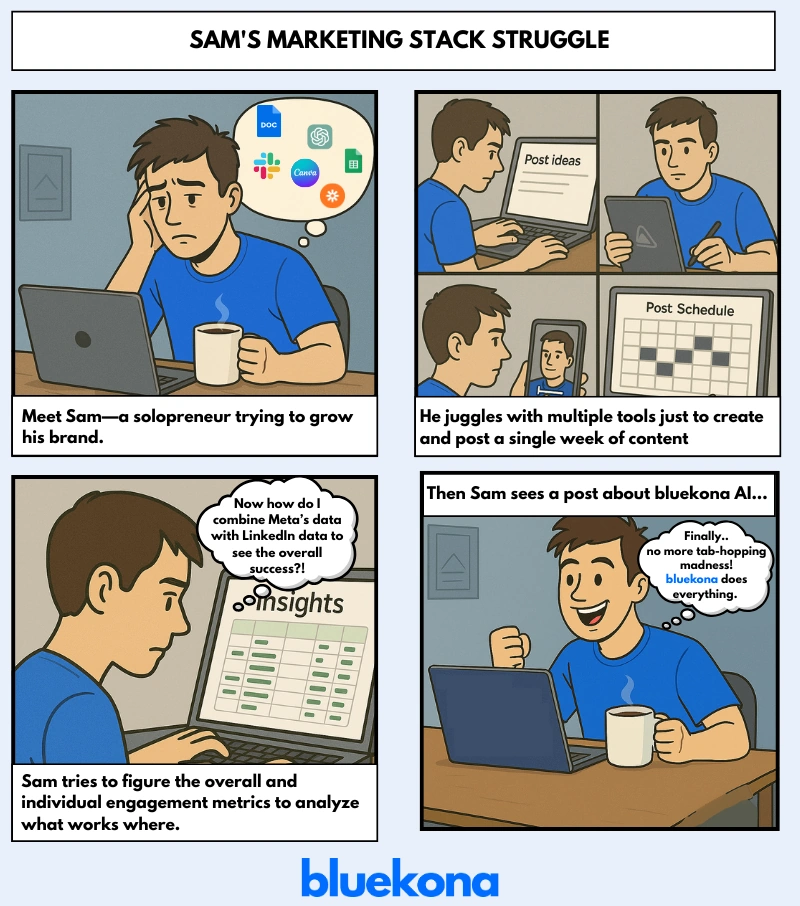
    It’s not enough to know what feels good on social media. You need to know — with clarity and confidence — what’s actually driving business results.

    But you shouldn’t have to turn yourself (or your team) into a data scientist just to answer these questions.

    Bluekona AI takes the grunt work off your plate, automatically handling. From pulling the data to tagging and organizing your content, from analyzing performance across every channel to recommending your next best move.

    With Bluekona, you track less, but you learn more — because insights are delivered to you, ready for action.

    Let Bluekona do the tracking. You make the calls.